Loading page, please wait…
Periodic Labour Force Survey (PLFS) Report - UPSC Economy
What is Periodic Labour Force Survey (PLFS) Report in UPSC Economy?
Periodic Labour Force Survey (PLFS) Report is a key topic under Economy for UPSC Civil Services Examination. Key points include: PLFS is conducted by NSO (MOSPI) to measure employment/unemployment in India.. It replaced older NSSO quinquennial surveys, offering more frequent data.. Two main objectives: quarterly urban estimates (CWS) and annual rural/urban estimates (Usual Status & CWS).. Understanding this topic is essential for both UPSC Prelims and Mains preparation.
Why is Periodic Labour Force Survey (PLFS) Report important for UPSC exam?
Periodic Labour Force Survey (PLFS) Report is a Medium-level topic in UPSC Economy. It is tested in both Prelims (factual MCQs) and Mains (analytical answer writing). Previous year UPSC questions have frequently covered aspects of Periodic Labour Force Survey (PLFS) Report, making it essential for comprehensive IAS preparation.
How to prepare Periodic Labour Force Survey (PLFS) Report for UPSC?
To prepare Periodic Labour Force Survey (PLFS) Report for UPSC: (1) Study the comprehensive notes covering all key concepts on Vaidra. (2) Practice previous year questions on this topic. (3) Connect it with current affairs using daily updates. (4) Revise using key takeaways and mind maps available for Economy. (5) Write practice answers linking Periodic Labour Force Survey (PLFS) Report to related GS Paper topics.
Key takeaways of Periodic Labour Force Survey (PLFS) Report for UPSC
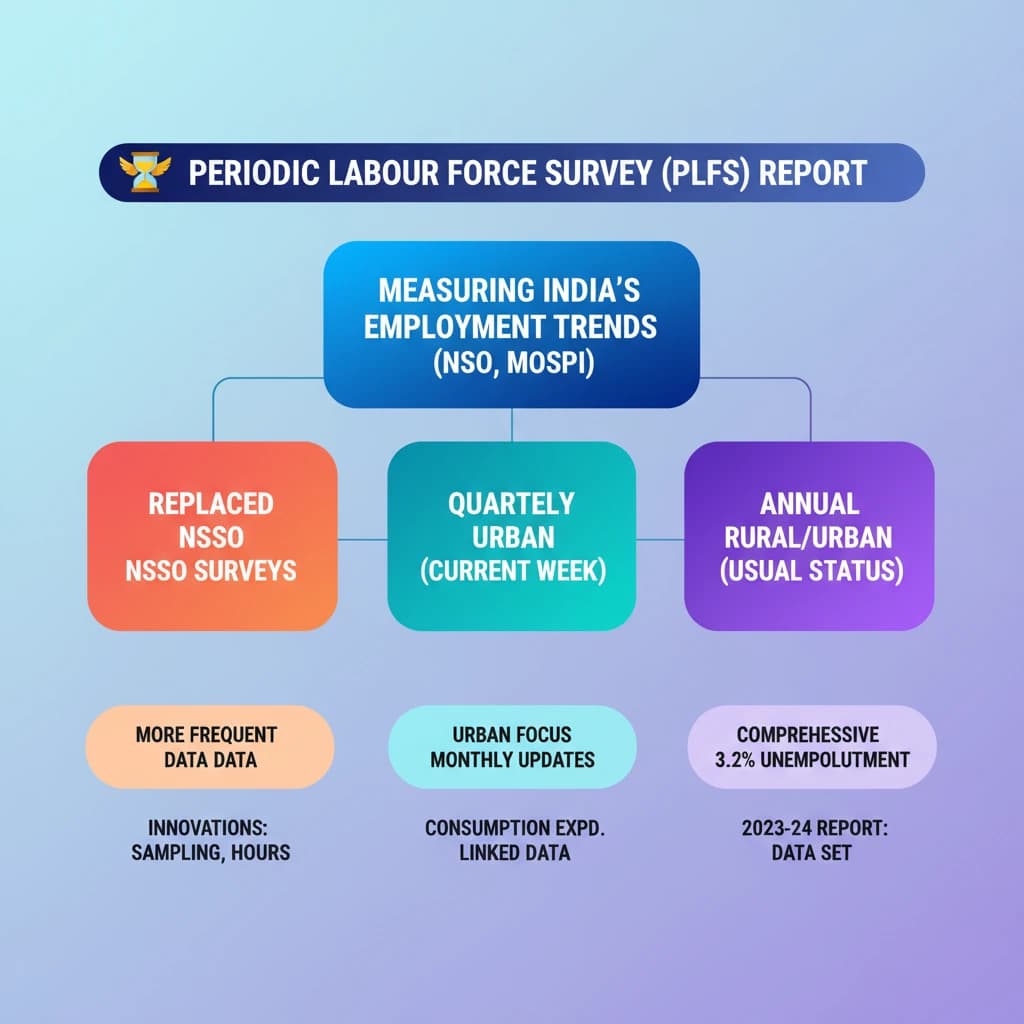
- PLFS is conducted by NSO (MOSPI) to measure employment/unemployment in India.
- It replaced older NSSO quinquennial surveys, offering more frequent data.
- Two main objectives: quarterly urban estimates (CWS) and annual rural/urban estimates (Usual Status & CWS).
- Innovations include changes in sampling design and collection of 'hours worked' data.
- The 2023-24 report showed unemployment stagnating at 3.2%, raising concerns about formal job creation.
- PLFS data is crucial for policy formulation and assessing economic performance.
Periodic Labour Force Survey (PLFS) Report
Medium⏱️ 8 min read
economy
📖 Introduction
Introduction to the PLFS Report
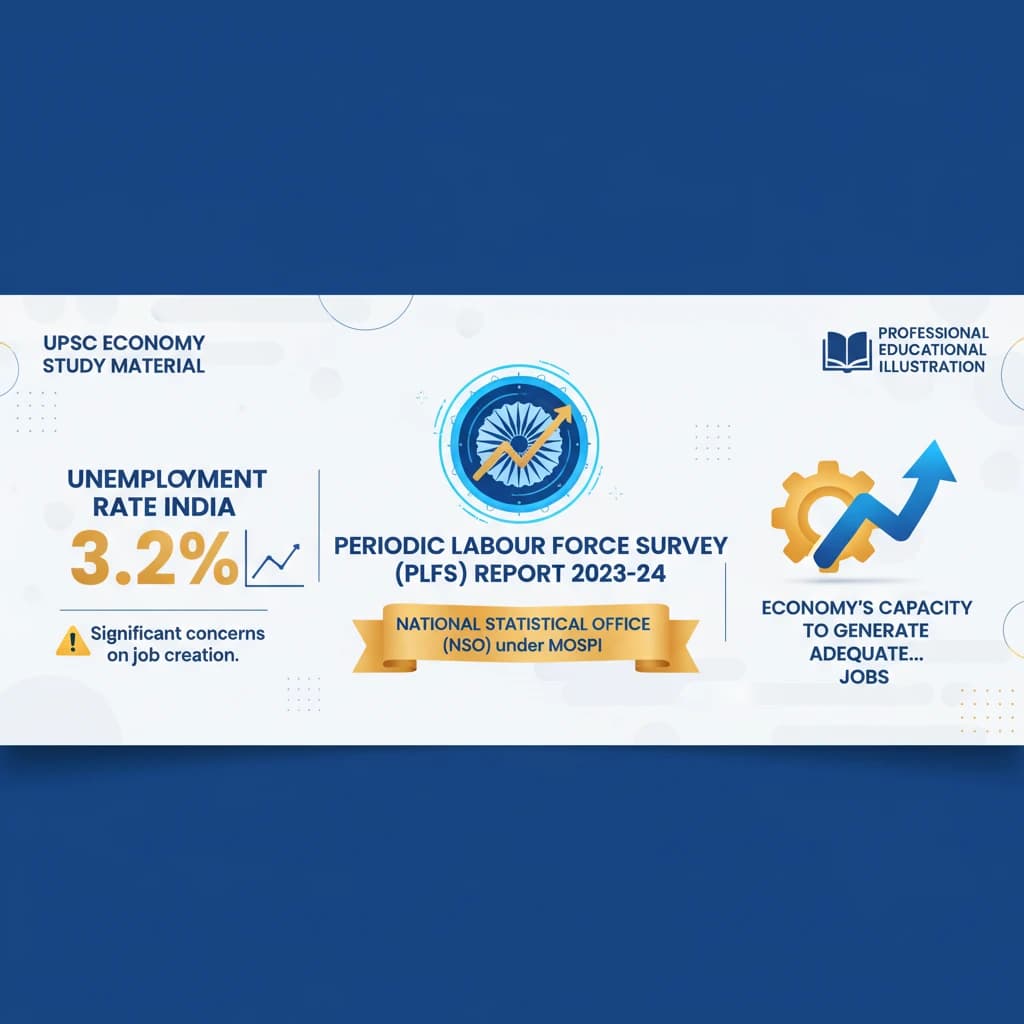
The National Statistical Office (NSO), under the Ministry of Statistics and Programme Implementation (MOSPI), recently released its annual Periodic Labour Force Survey (PLFS) report 2023-24.
This report indicated that the unemployment rate in India has stagnated at 3.2%. This finding raises significant concerns regarding the economy's capacity to generate an adequate number of formal jobs.
What is the Periodic Labour Force Survey (PLFS)?
The PLFS is a crucial survey conducted by the NSO to comprehensively measure the employment and unemployment situation across India.
Conducted by: National Statistical Office (NSO)
Under: Ministry of Statistics and Programme Implementation (MOSPI)
Purpose: To measure employment and unemployment in India.
It was specifically developed to overcome the limitations observed in earlier labour force surveys that were conducted by the erstwhile National Sample Survey Office (NSSO).
Primary Objectives of PLFS
The PLFS was designed with two distinct and major objectives to effectively measure employment and unemployment dynamics:
- First Objective: To measure the dynamics of labour force participation and employment status at short, frequent intervals (specifically, every three months) for urban areas. This is achieved using the Current Weekly Status (CWS) approach.
- Second Objective: To provide comprehensive labour force estimates for both rural and urban areas. This objective utilizes both the Usual Status and Current Weekly Status (CWS) parameters.
Innovations in PLFS Design and Data Collection
The introduction of the PLFS brought about several significant innovations compared to previous surveys.
The PLFS introduced notable changes in its sampling design and the overall structure of its schedule of inquiry. These were improvements over the quinquennial surveys previously conducted by the NSSO.
Furthermore, the PLFS expanded the scope of data collection. It began to include additional critical data points, such as the number of hours worked by individuals, which was not collected in the earlier quinquennial rounds carried out by the NSSO.
Understanding the objectives and methodological innovations of PLFS is crucial for UPSC Mains GS Paper III (Indian Economy). Questions often test the understanding of key economic indicators and their evolution.
💡 Key Takeaways
- •PLFS is conducted by NSO (MOSPI) to measure employment/unemployment in India.
- •It replaced older NSSO quinquennial surveys, offering more frequent data.
- •Two main objectives: quarterly urban estimates (CWS) and annual rural/urban estimates (Usual Status & CWS).
- •Innovations include changes in sampling design and collection of 'hours worked' data.
- •The 2023-24 report showed unemployment stagnating at 3.2%, raising concerns about formal job creation.
- •PLFS data is crucial for policy formulation and assessing economic performance.
🧠 Memory Techniques

95% Verified Content
📚 Reference Sources
•Press Information Bureau (PIB) releases on PLFS
•Economic Survey of India (various editions)