Loading page, please wait…
Section 3 and 4 of Patents Act, 1970 - UPSC Economy
What is Section 3 and 4 of Patents Act, 1970 in UPSC Economy?
Section 3 and 4 of Patents Act, 1970 is a key topic under Economy for UPSC Civil Services Examination. Key points include: Sections 3 and 4 of the Patents Act, 1970, define specific categories of non-patentable subject matter in India.. Section 3 excludes mere discoveries, abstract theories, inventions contrary to natural laws or public order/morality, and certain medical/agricultural methods.. Section 4 specifically prohibits patents for inventions related to atomic energy, safeguarding national strategic interests.. Understanding this topic is essential for both UPSC Prelims and Mains preparation.
Why is Section 3 and 4 of Patents Act, 1970 important for UPSC exam?
Section 3 and 4 of Patents Act, 1970 is a Medium-level topic in UPSC Economy. It is tested in both Prelims (factual MCQs) and Mains (analytical answer writing). Previous year UPSC questions have frequently covered aspects of Section 3 and 4 of Patents Act, 1970, making it essential for comprehensive IAS preparation.
How to prepare Section 3 and 4 of Patents Act, 1970 for UPSC?
To prepare Section 3 and 4 of Patents Act, 1970 for UPSC: (1) Study the comprehensive notes covering all key concepts on Vaidra. (2) Practice previous year questions on this topic. (3) Connect it with current affairs using daily updates. (4) Revise using key takeaways and mind maps available for Economy. (5) Write practice answers linking Section 3 and 4 of Patents Act, 1970 to related GS Paper topics.
Key takeaways of Section 3 and 4 of Patents Act, 1970 for UPSC
- Sections 3 and 4 of the Patents Act, 1970, define specific categories of non-patentable subject matter in India.
- Section 3 excludes mere discoveries, abstract theories, inventions contrary to natural laws or public order/morality, and certain medical/agricultural methods.
- Section 4 specifically prohibits patents for inventions related to atomic energy, safeguarding national strategic interests.
- Recent Patents (Amendment) Rules, 2024, have streamlined processes like reducing RFE timelines and introducing a Certificate of Inventorship.
- These sections balance promoting genuine innovation with ensuring public interest, access to essential goods, and national security.
Section 3 and 4 of Patents Act, 1970
Medium⏱️ 8 min read
economy
📖 Introduction
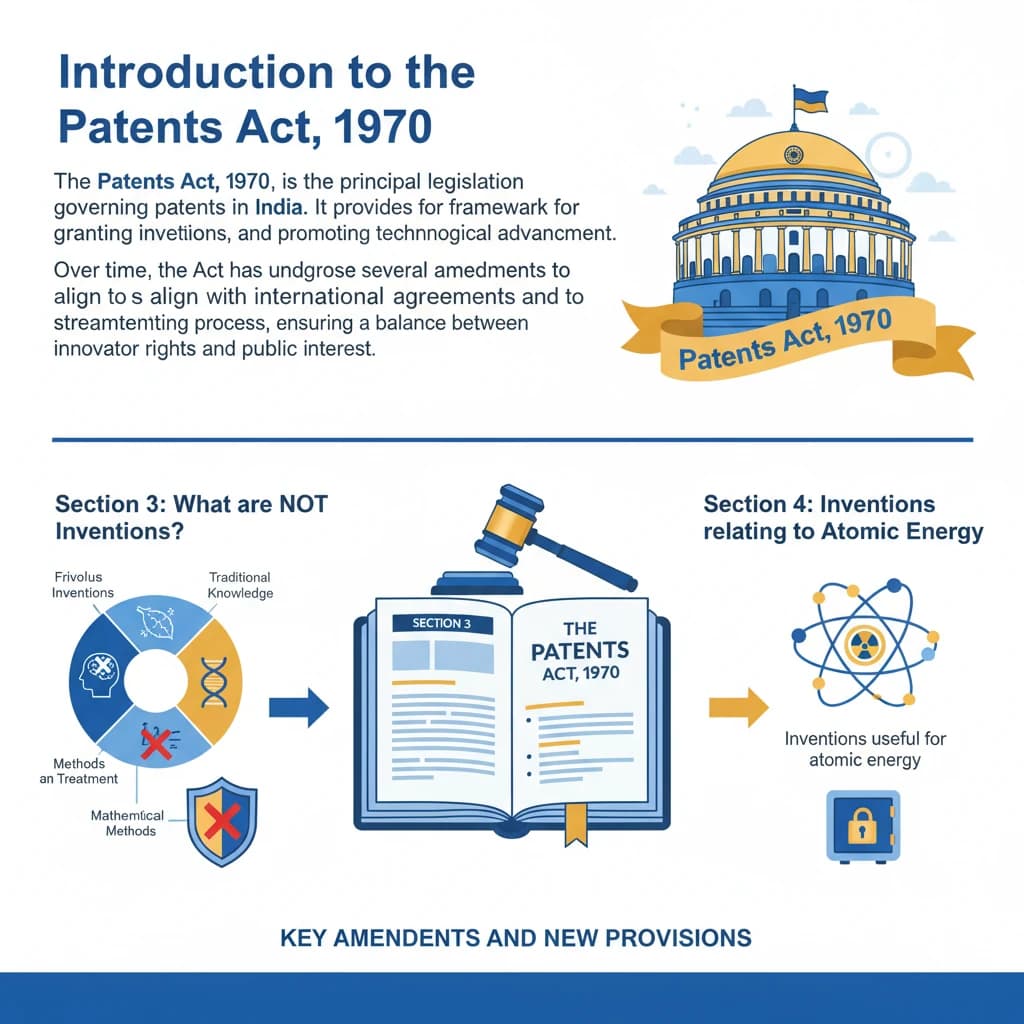
Introduction to the Patents Act, 1970
The Patents Act, 1970, is the principal legislation governing patents in India. It provides a framework for granting patents, protecting inventions, and promoting technological advancement.
Over time, the Act has undergone several amendments to align with international agreements and to streamline the patenting process, ensuring a balance between innovator rights and public interest.
Key Amendments and New Provisions
Significant amendments have been made to the Patents Act, 1970. Notably, provisions related to Exclusive Marketing Rights (EMRs) have been repealed, reflecting India's evolving intellectual property regime.
The Act now includes a crucial provision enabling the grant of a compulsory license. This mechanism allows third parties to produce a patented product or process without the consent of the patent owner under specific circumstances, often related to public health or national emergency.
Furthermore, the procedures for both pre-grant and post-grant opposition have been formally introduced and refined, allowing interested parties to challenge patent applications or granted patents.
Compulsory Licensing: A key provision allowing governments to authorize third parties to produce patented products without the patent holder's consent, typically for public health crises or other national emergencies.
Patents (Amendment) Rules, 2024: Key Changes
The recent Patents (Amendment) Rules, 2024, have brought about several procedural changes aimed at enhancing efficiency and transparency in the patent system.
- Reduced Timeline for Request for Examination (RFE): The period for filing an RFE has been shortened from 48 months to 31 months from the priority date. This aims to expedite the examination process.
- Introduction of ‘Certificate of Inventorship’: This new provision formally acknowledges the contributions of inventors by identifying them for their patenting inventions, promoting recognition and morale.
- Frequency of Filing Statements: The requirement for filing statements has been reduced from once every financial year to once every three financial years, easing the compliance burden on patent holders.
- Amendments in Pre-grant and Post-grant Opposition Procedures: The time frames for the submission of recommendations by an Opposition Board and the response time for applicants have been adjusted to make the opposition process more efficient.
Section 3: What are NOT Inventions?
Section 3 of the Patents Act, 1970, explicitly lists categories of subject matter that are not considered inventions for the purpose of patent grant in India. These exclusions are crucial for preventing the patenting of trivial, abstract, or non-inventive concepts.
Under Section 3, the following are generally not patentable:
- Frivolous claims: Inventions that are obviously contrary to well-established natural laws.
- Inventions against natural laws: For example, a perpetual motion machine.
- Inventions contrary to public order or morality: Any invention whose primary or intended use could be contrary to public order or morality or which causes serious prejudice to human, animal, or plant life or health or to the environment.
- Discovery of scientific principles or abstract theories: Mere discoveries of scientific principles or the formulation of abstract theories are not patentable.
- Discovery of natural living or non-living substances: The mere discovery of a naturally occurring substance is not an invention.
- New forms of known substances: Unless they show enhanced efficacy.
- Methods of agriculture or horticulture.
- Any process for the medicinal, surgical, curative, prophylactic, diagnostic, therapeutic or other treatment of human beings or any process for a similar treatment of animals to render them free of disease or to increase their economic value or that of their products.
Section 4: Non-Patentability of Atomic Energy Inventions
Section 4 of the Patents Act, 1970, deals with specific exclusions related to atomic energy. This section underscores the strategic importance and national security implications associated with atomic research and development.
According to Section 4, no patent shall be granted in respect of an invention relating to atomic energy falling within sub-section (1) of section 20 of the Atomic Energy Act, 1962. This ensures that inventions critical to India's nuclear program remain under state control and are not subject to private patent monopolies.
Understanding Sections 3 and 4 is vital for UPSC aspirants. These sections define the boundaries of patentability, reflecting India's policy priorities regarding innovation, public health, and national security. They are frequently tested in questions related to Intellectual Property Rights (IPR) and Science & Technology.
💡 Key Takeaways
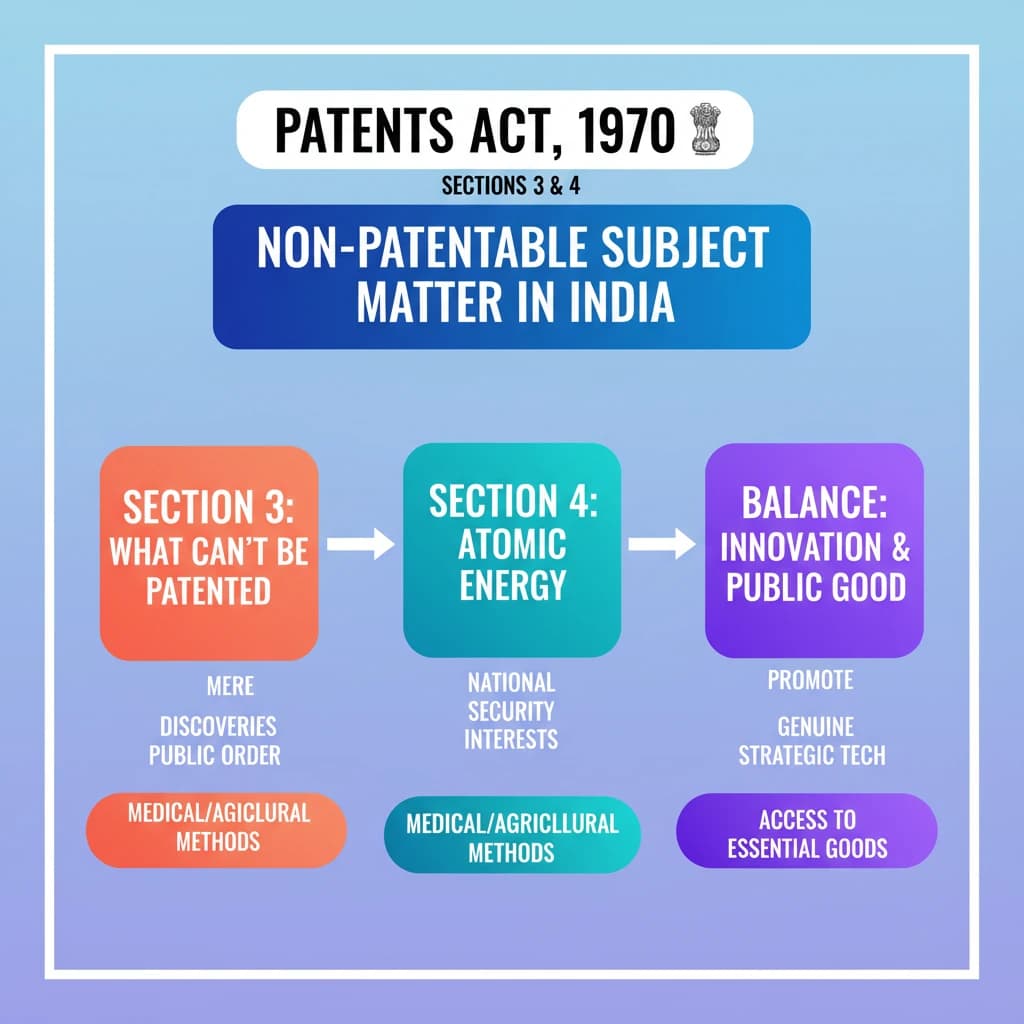
- •Sections 3 and 4 of the Patents Act, 1970, define specific categories of non-patentable subject matter in India.
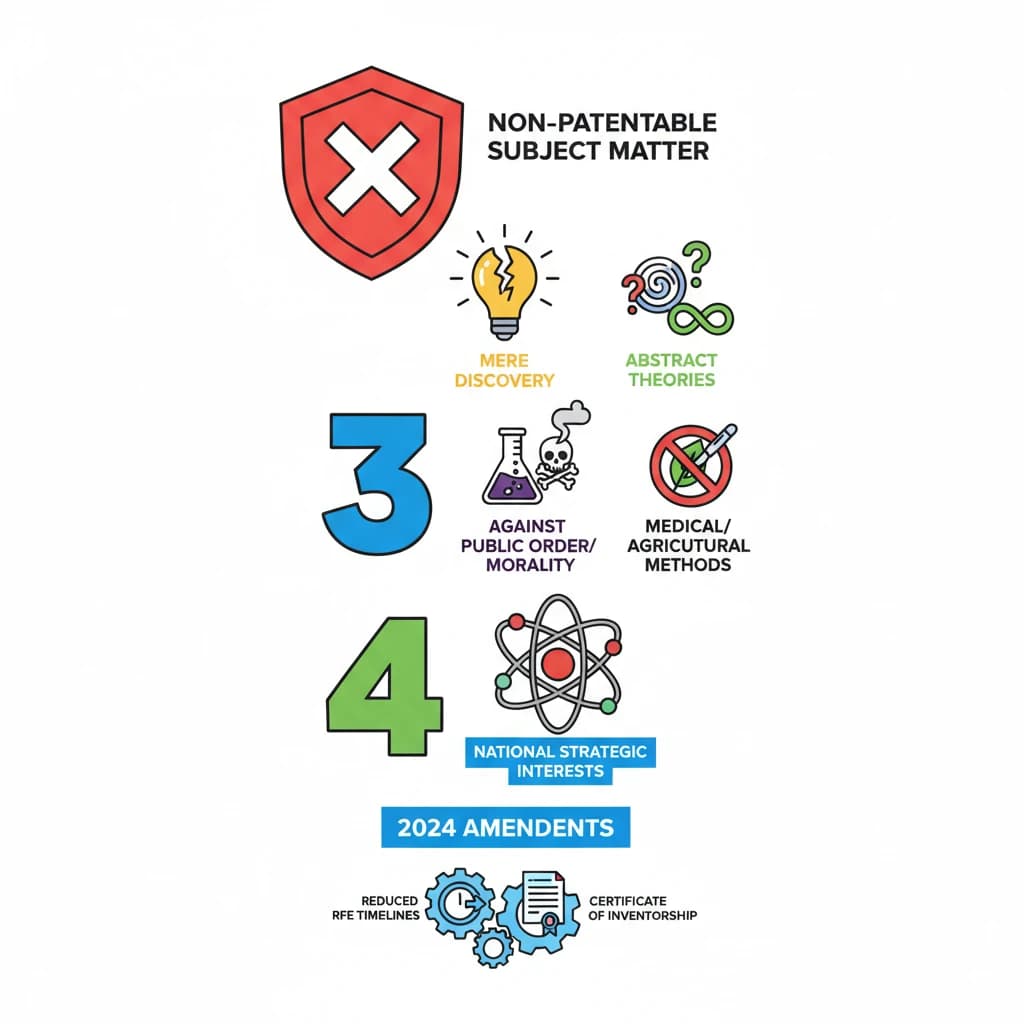
- •Section 3 excludes mere discoveries, abstract theories, inventions contrary to natural laws or public order/morality, and certain medical/agricultural methods.
- •Section 4 specifically prohibits patents for inventions related to atomic energy, safeguarding national strategic interests.
- •Recent Patents (Amendment) Rules, 2024, have streamlined processes like reducing RFE timelines and introducing a Certificate of Inventorship.
- •These sections balance promoting genuine innovation with ensuring public interest, access to essential goods, and national security.
🧠 Memory Techniques
95% Verified Content
📚 Reference Sources
•Patents (Amendment) Rules, 2024
•Department for Promotion of Industry and Internal Trade (DPIIT), Ministry of Commerce & Industry, Government of India