Loading page, please wait…
Ship Emissions Evaluation: NOx, SOx, & Greenhouse Gas Reporting - UPSC Economy
What is Ship Emissions Evaluation: NOx, SOx, & Greenhouse Gas Reporting in UPSC Economy?
Ship Emissions Evaluation: NOx, SOx, & Greenhouse Gas Reporting is a key topic under Economy for UPSC Civil Services Examination. Key points include: Ship emission evaluation criteria assess Nitrogen Oxides (NOx), Sulphur Oxides (SOx), and Greenhouse Gases (GHG).. NOx and SOx contribute to conventional air pollution and acid rain; GHG to global climate change.. The International Maritime Organization (IMO) is the primary global body setting these standards, including MARPOL, EEXI, and CII.. Understanding this topic is essential for both UPSC Prelims and Mains preparation.
Why is Ship Emissions Evaluation: NOx, SOx, & Greenhouse Gas Reporting important for UPSC exam?
Ship Emissions Evaluation: NOx, SOx, & Greenhouse Gas Reporting is a Medium-level topic in UPSC Economy. It is tested in both Prelims (factual MCQs) and Mains (analytical answer writing). Previous year UPSC questions have frequently covered aspects of Ship Emissions Evaluation: NOx, SOx, & Greenhouse Gas Reporting, making it essential for comprehensive IAS preparation.
How to prepare Ship Emissions Evaluation: NOx, SOx, & Greenhouse Gas Reporting for UPSC?
To prepare Ship Emissions Evaluation: NOx, SOx, & Greenhouse Gas Reporting for UPSC: (1) Study the comprehensive notes covering all key concepts on Vaidra. (2) Practice previous year questions on this topic. (3) Connect it with current affairs using daily updates. (4) Revise using key takeaways and mind maps available for Economy. (5) Write practice answers linking Ship Emissions Evaluation: NOx, SOx, & Greenhouse Gas Reporting to related GS Paper topics.
Key takeaways of Ship Emissions Evaluation: NOx, SOx, & Greenhouse Gas Reporting for UPSC
- Ship emission evaluation criteria assess Nitrogen Oxides (NOx), Sulphur Oxides (SOx), and Greenhouse Gases (GHG).
- NOx and SOx contribute to conventional air pollution and acid rain; GHG to global climate change.
- The International Maritime Organization (IMO) is the primary global body setting these standards, including MARPOL, EEXI, and CII.
- These criteria drive technological innovation towards cleaner fuels and energy-efficient shipping, impacting global trade.
- India's compliance and proactive green shipping initiatives are crucial for its maritime sector and international climate commitments.
Ship Emissions Evaluation: NOx, SOx, & Greenhouse Gas Reporting
Medium⏱️ 8 min read
economy
📖 Introduction
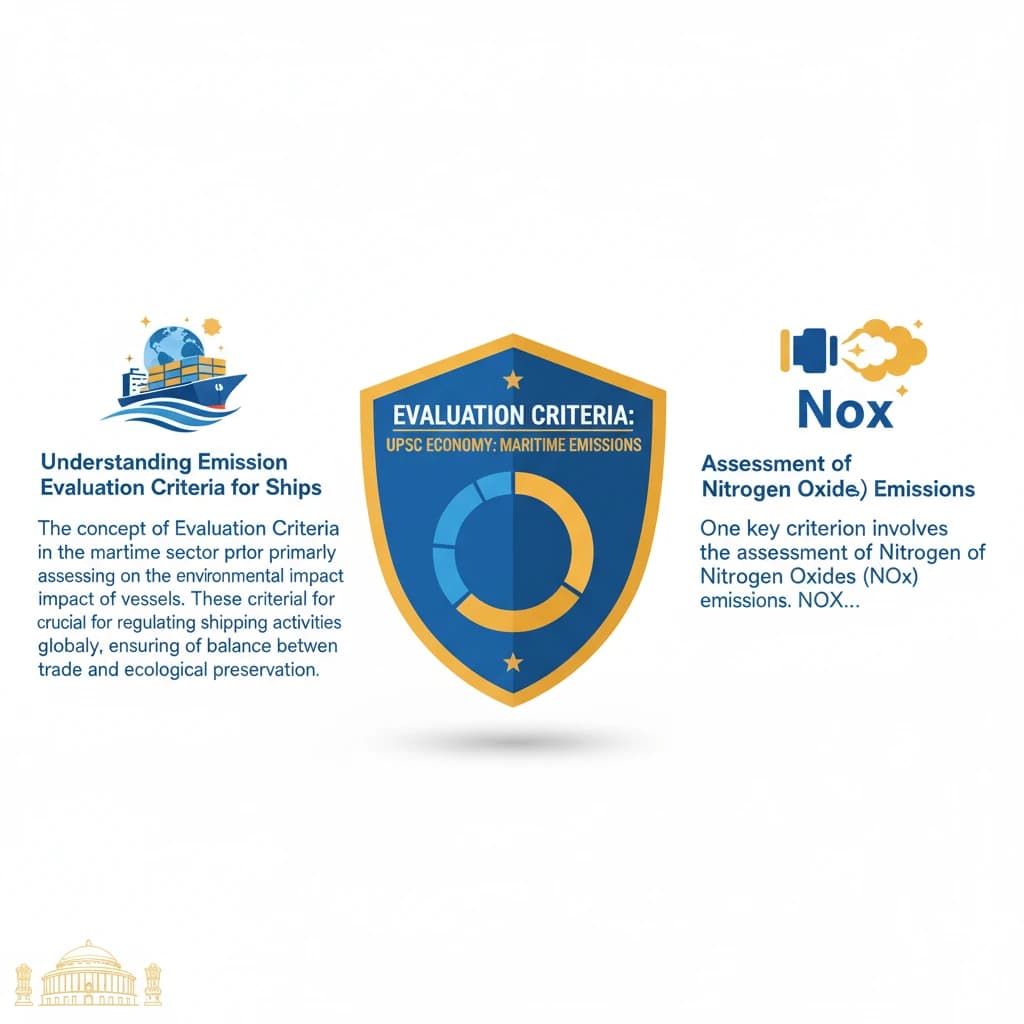
Understanding Emission Evaluation Criteria for Ships
The concept of Evaluation Criteria in the maritime sector primarily focuses on assessing the environmental impact of vessels. These criteria are crucial for regulating shipping activities globally, ensuring a balance between trade and ecological preservation.
Assessment of Nitrogen Oxides (NOx) Emissions
One key criterion involves the assessment of Nitrogen Oxides (NOx) emissions. NOx are a group of highly reactive gases that contribute significantly to air pollution, smog formation, and acid rain, posing risks to both human health and ecosystems.
NOx Emissions: These pollutants are primarily produced during the high-temperature combustion of fuel in marine engines. Various forms of nitrogen oxides are formed under these conditions.
Assessment of Sulphur Oxides (SOx) Emissions
Similarly, the evaluation criteria also encompass the emissions of Sulphur Oxides (SOx). SOx are harmful air pollutants known to cause respiratory problems in humans and contribute to acid rain, damaging forests and aquatic life.
SOx Emissions: These are a direct result of burning fuels that contain sulphur, such as heavy fuel oil, which is commonly used in ships. International regulations, like IMO 2020, have drastically tightened limits on fuel sulphur content.
Greenhouse Gas (GHG) Emissions Reporting Scheme
Beyond traditional air pollutants, the evaluation criteria now explicitly include a reporting scheme for Greenhouse Gas (GHG) emissions from vessels. This inclusion reflects the growing global concern over climate change and the shipping industry's contribution to it.
GHG Reporting: This scheme aims to monitor and eventually reduce the emissions of gases like carbon dioxide (CO2), methane (CH4), and nitrous oxide (N2O), which are primary contributors to global warming.
UPSC often asks about international conventions and India's commitments related to environmental protection. Understanding the International Maritime Organization (IMO)'s role and specific emission types is vital for GS Paper III (Environment).
💡 Key Takeaways
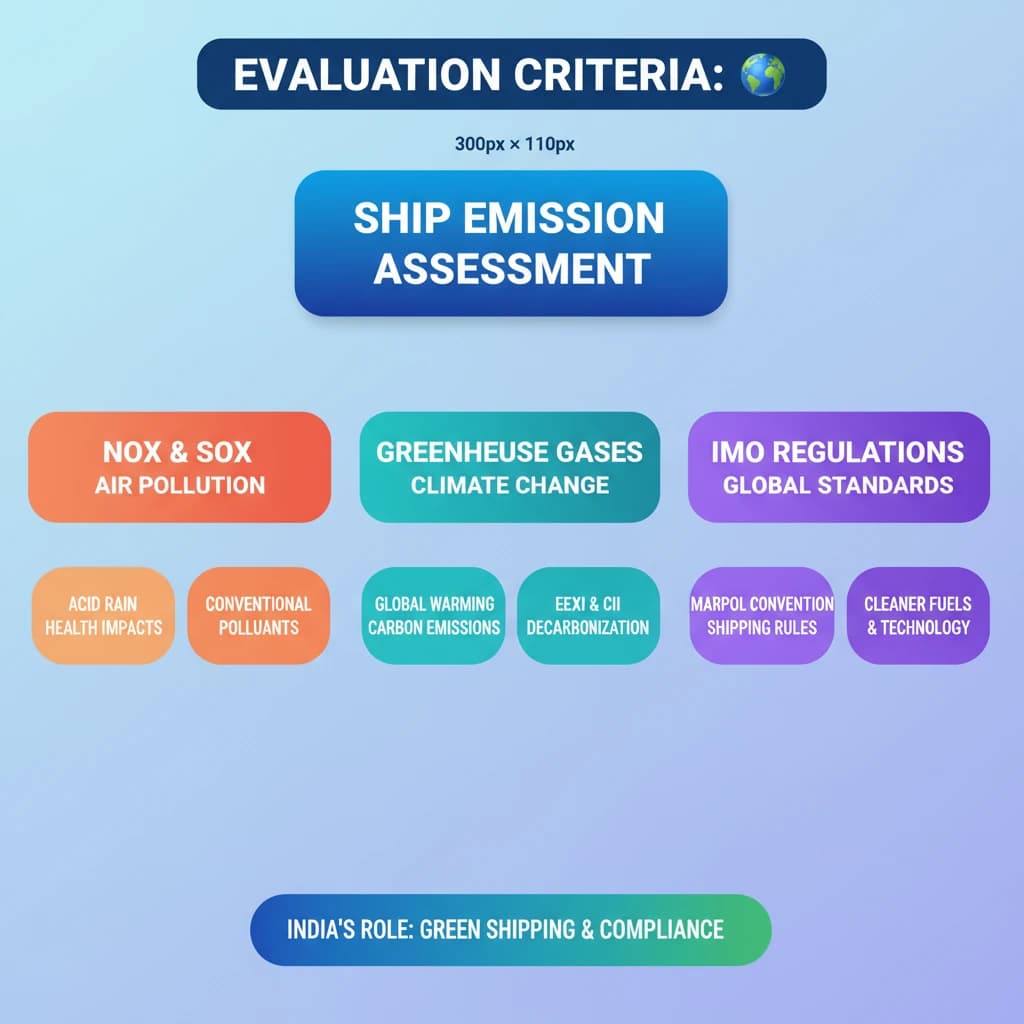
- •Ship emission evaluation criteria assess Nitrogen Oxides (NOx), Sulphur Oxides (SOx), and Greenhouse Gases (GHG).
- •NOx and SOx contribute to conventional air pollution and acid rain; GHG to global climate change.
- •The International Maritime Organization (IMO) is the primary global body setting these standards, including MARPOL, EEXI, and CII.
- •These criteria drive technological innovation towards cleaner fuels and energy-efficient shipping, impacting global trade.
- •India's compliance and proactive green shipping initiatives are crucial for its maritime sector and international climate commitments.
🧠 Memory Techniques
95% Verified Content
📚 Reference Sources
•Ministry of Ports, Shipping and Waterways, Government of India (shipmin.gov.in)
•European Union (EU) environmental regulations and directives (eur-lex.europa.eu)
•United Nations Environment Programme (UNEP) publications