Loading page, please wait…
Steps to Reform Regulatory Bodies - UPSC Economy
What is Steps to Reform Regulatory Bodies in UPSC Economy?
Steps to Reform Regulatory Bodies is a key topic under Economy for UPSC Civil Services Examination. Key points include: Regulatory bodies like PFRDA, PNGRB, CERC, and SEBI are vital for orderly market functioning and protecting public interest in specific sectors.. The 2nd ARC (12th and 13th Reports) provided key recommendations for regulatory reforms, focusing on transparency, accountability, and uniformity in appointments.. SEBI, established in 1992, is the primary regulator for India's securities market, ensuring investor protection and market development.. Understanding this topic is essential for both UPSC Prelims and Mains preparation.
Why is Steps to Reform Regulatory Bodies important for UPSC exam?
Steps to Reform Regulatory Bodies is a Medium-level topic in UPSC Economy. It is tested in both Prelims (factual MCQs) and Mains (analytical answer writing). Previous year UPSC questions have frequently covered aspects of Steps to Reform Regulatory Bodies, making it essential for comprehensive IAS preparation.
How to prepare Steps to Reform Regulatory Bodies for UPSC?
To prepare Steps to Reform Regulatory Bodies for UPSC: (1) Study the comprehensive notes covering all key concepts on Vaidra. (2) Practice previous year questions on this topic. (3) Connect it with current affairs using daily updates. (4) Revise using key takeaways and mind maps available for Economy. (5) Write practice answers linking Steps to Reform Regulatory Bodies to related GS Paper topics.
Key takeaways of Steps to Reform Regulatory Bodies for UPSC
- Regulatory bodies like PFRDA, PNGRB, CERC, and SEBI are vital for orderly market functioning and protecting public interest in specific sectors.
- The 2nd ARC (12th and 13th Reports) provided key recommendations for regulatory reforms, focusing on transparency, accountability, and uniformity in appointments.
- SEBI, established in 1992, is the primary regulator for India's securities market, ensuring investor protection and market development.
- India's insurance sector is rapidly growing, ranking 10th globally, with increasing insurance density and penetration, attracting significant FDI.
- Reforms aim to simplify procedures, strengthen oversight, and promote self-regulation, balancing autonomy with accountability for effective governance.
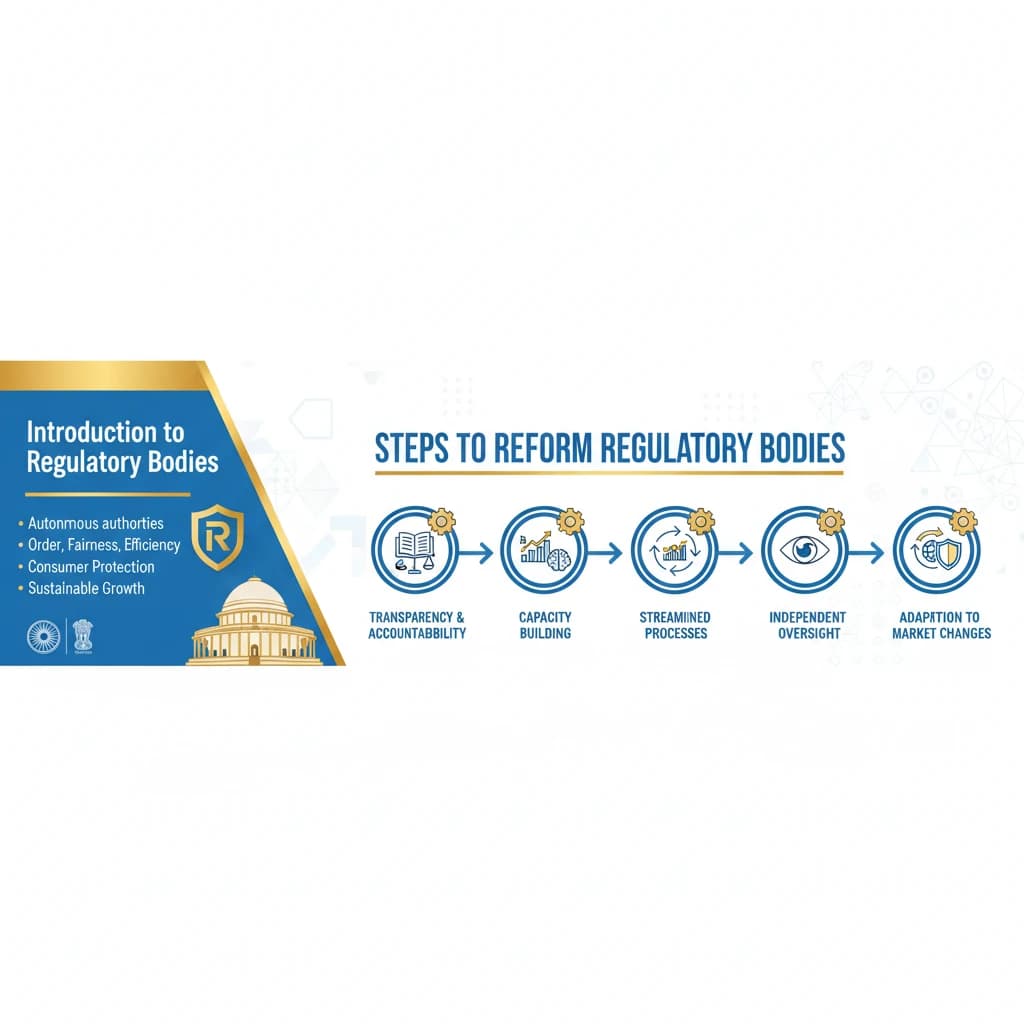
Steps to Reform Regulatory Bodies
Medium⏱️ 15 min read
economy
📖 Introduction
Introduction to Regulatory Bodies
Regulatory bodies are autonomous or semi-autonomous public authorities responsible for exercising autonomous authority over some area of human activity in a regulatory or supervisory capacity. They are crucial for maintaining order, fairness, and efficiency in various sectors of an economy.
These institutions ensure that markets operate smoothly, protect consumer interests, and promote sustainable growth. Their independence is vital for effective governance and preventing undue influence.
Key Regulatory Bodies in India
India has a diverse landscape of regulatory bodies, each with a specific mandate. Understanding their roles is fundamental for UPSC aspirants.
Pension Fund Regulatory and Development Authority (PFRDA)
The Pension Fund Regulatory and Development Authority (PFRDA) is a statutory body established to promote, develop, and regulate the pension sector in India. It plays a pivotal role in ensuring the security of retirement savings.
- Oversight: The PFRDA primarily oversees the National Pension System (NPS).
- Mandate: It is responsible for the overall development and regulation of the pension industry in India.
Petroleum and Natural Gas Regulatory Board (PNGRB)
The Petroleum and Natural Gas Regulatory Board (PNGRB) was established to regulate the refining, processing, storage, transportation, distribution, marketing, and sale of petroleum, petroleum products, and natural gas.
- Establishment: Set up under the PNGRB Act, 2006.
- Key Function: Sets technical and safety standards for petroleum, petroleum products, natural gas, and related infrastructure projects across the country.
Central Electricity Regulatory Commission (CERC)
The Central Electricity Regulatory Commission (CERC) is a key regulator in India's power sector. It ensures fair competition and efficient operation within the electricity market.
- Regulation: Regulates tariffs for Central Government-owned electricity generating companies.
- Oversight: Oversees their inter-State transmission of electricity, ensuring smooth power flow across states.
Recommendations for Regulatory Reforms: 2nd Administrative Reforms Commission (ARC)
The 2nd Administrative Reforms Commission (ARC) provided comprehensive recommendations to improve the functioning and effectiveness of regulatory bodies in India. These reports are crucial for understanding governance reforms.
12th Report of the 2nd ARC Suggestions
The 12th Report of the 2nd ARC focused on making regulatory procedures more transparent and citizen-centric. Its suggestions aimed at reducing corruption and enhancing public trust.
- Simplify Procedures: Advocate for simplifying, streamlining, and making regulatory procedures transparent.
- Citizen-Friendly: Emphasize making procedures citizen-friendly and less discretionary to reduce corruption.
- Strengthen Supervision: Recommend strengthening internal supervision and independent assessments of regulatory agencies.
- Promote Self-Regulation: Suggest promoting self-regulation in sectors like taxation and public health to ease enforcement burdens.
13th Report of the 2nd ARC Recommendations
The 13th Report of the 2nd ARC focused on structural and oversight improvements for regulatory bodies. These recommendations are critical for ensuring consistency and accountability.
- Management Statement: Ministries should create a ‘Management Statement’ outlining regulators’ objectives and roles.
- Uniformity in Appointments: Ensure uniformity in the appointment, tenure, and removal of regulatory authorities for consistency and independence.
- Parliamentary Oversight: Strengthen parliamentary oversight of regulators through Standing Committees for enhanced accountability.
Securities and Exchange Board of India (SEBI)
The Securities and Exchange Board of India (SEBI) is the primary regulator for the securities market in India. It plays a vital role in protecting investor interests and fostering market development.
About SEBI
- Nature: SEBI is a Statutory Body (a Non-Constitutional body).
- Establishment: Established under the SEBI Act, 1992.
- Initial Constitution: It was initially constituted as a non-statutory body on April 12, 1988, through a Government of India resolution.
- Predecessor: Prior to SEBI, the Controller of Capital Issues, governed under the Capital Issues (Control) Act, 1947, was the regulatory authority for capital markets.
- Main Functions: To protect the interests of investors in securities and to promote and regulate the securities market in India.
SEBI's Structure
The organizational structure of SEBI is designed to ensure effective governance and decision-making in the complex securities market.
- Board Composition: SEBI’s board includes a Chairman, and other whole-time, and part-time members.
- Appeals Mechanism: The Securities Appellate Tribunal (SAT) handles appeals against SEBI’s decisions.
- SAT Powers: SAT possesses powers similar to those of a civil court, ensuring judicial review of regulatory orders.
Key Responsibilities of SEBI
SEBI carries out a broad range of responsibilities to maintain a fair and efficient securities market. These functions are critical for market integrity and investor confidence.
- Facilitating Finance: Enables issuers to raise finance efficiently from the market.
- Investor Protection: Ensures safety and accurate information for investors, safeguarding their interests.
- Market Promotion: Promotes a competitive market for intermediaries, fostering innovation and efficiency.
The Insurance Sector in India
India's insurance sector is a dynamic and growing industry, playing a crucial role in financial security and economic development. Recent discussions among industry leaders highlight its challenges and future trajectory.
Current State of the Insurance Sector
The Indian insurance market is experiencing significant growth and holds a prominent position globally. Its potential for expansion is recognized by international bodies and domestic regulators.
- Global Market Position: India ranks as the 10th largest insurance market worldwide.
- Emerging Markets: Holds the 2nd largest position among emerging markets, with an estimated market share of 1.9%.
- Growth Potential: As per the Insurance Regulatory and Development Authority of India (IRDAI), India is projected to be the fastest-growing insurance market within a decade.
- Future Outlook: Expected to outgrow major economies like Germany, Canada, Italy, and South Korea.
- Market Size Projection: The insurance market in India is expected to reach USD 222 billion by 2026.
Insurance Density and Penetration
Insurance density and penetration are key metrics used to assess the development and reach of the insurance sector within an economy. These indicators reflect the extent of insurance coverage among the population.
- Insurance Density: Measures the average insurance premium per person.
- Increased from USD 11.1 in 2001 to USD 92 in 2022.
- Breakdown in 2022: Life insurance density of USD 70 and non-life insurance density of USD 22.
- Insurance Penetration: Defined as premiums as a percentage of GDP.
- Steadily risen from 2.7% in 2000 to 4% in 2022.
Foreign Direct Investment (FDI) in Insurance
The influx of Foreign Direct Investment (FDI) into the insurance sector signifies growing international confidence and contributes to capital infusion and market development.
Between 2014-23, the insurance sector has received nearly Rs. 54,000 crore (USD 6.5 billion) in FDI.
UPSC Insight: Understanding the roles of various regulatory bodies like PFRDA, PNGRB, CERC, and SEBI is crucial for GS Paper III (Economy). Pay attention to their founding acts, mandates, and recent reforms. The 2nd ARC recommendations are frequently asked in GS Paper II (Governance) and can be used to enrich answers on administrative reforms.
For the insurance sector, focus on key metrics like density and penetration, and the reasons behind India's growth potential. This data can be used to substantiate arguments in both mains and prelims.
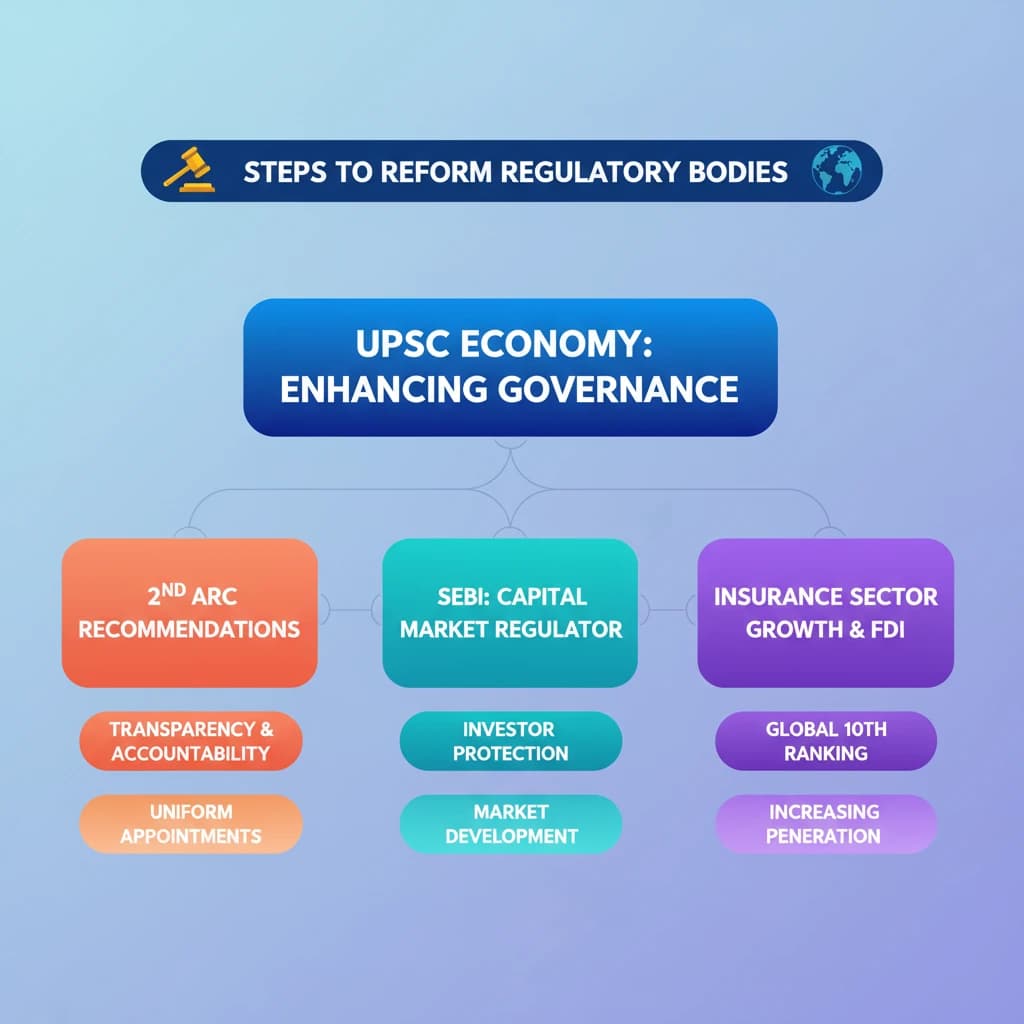
💡 Key Takeaways
- •Regulatory bodies like PFRDA, PNGRB, CERC, and SEBI are vital for orderly market functioning and protecting public interest in specific sectors.
- •The 2nd ARC (12th and 13th Reports) provided key recommendations for regulatory reforms, focusing on transparency, accountability, and uniformity in appointments.
- •SEBI, established in 1992, is the primary regulator for India's securities market, ensuring investor protection and market development.
- •India's insurance sector is rapidly growing, ranking 10th globally, with increasing insurance density and penetration, attracting significant FDI.
- •Reforms aim to simplify procedures, strengthen oversight, and promote self-regulation, balancing autonomy with accountability for effective governance.
🧠 Memory Techniques

95% Verified Content
📚 Reference Sources
•SEBI Act, 1992
•PNGRB Act, 2006
•Reports of the 2nd Administrative Reforms Commission (12th & 13th Reports)
•IRDAI Annual Reports/Statistics