Loading page, please wait…
Survey and Budget - UPSC Economy
What is Survey and Budget in UPSC Economy?
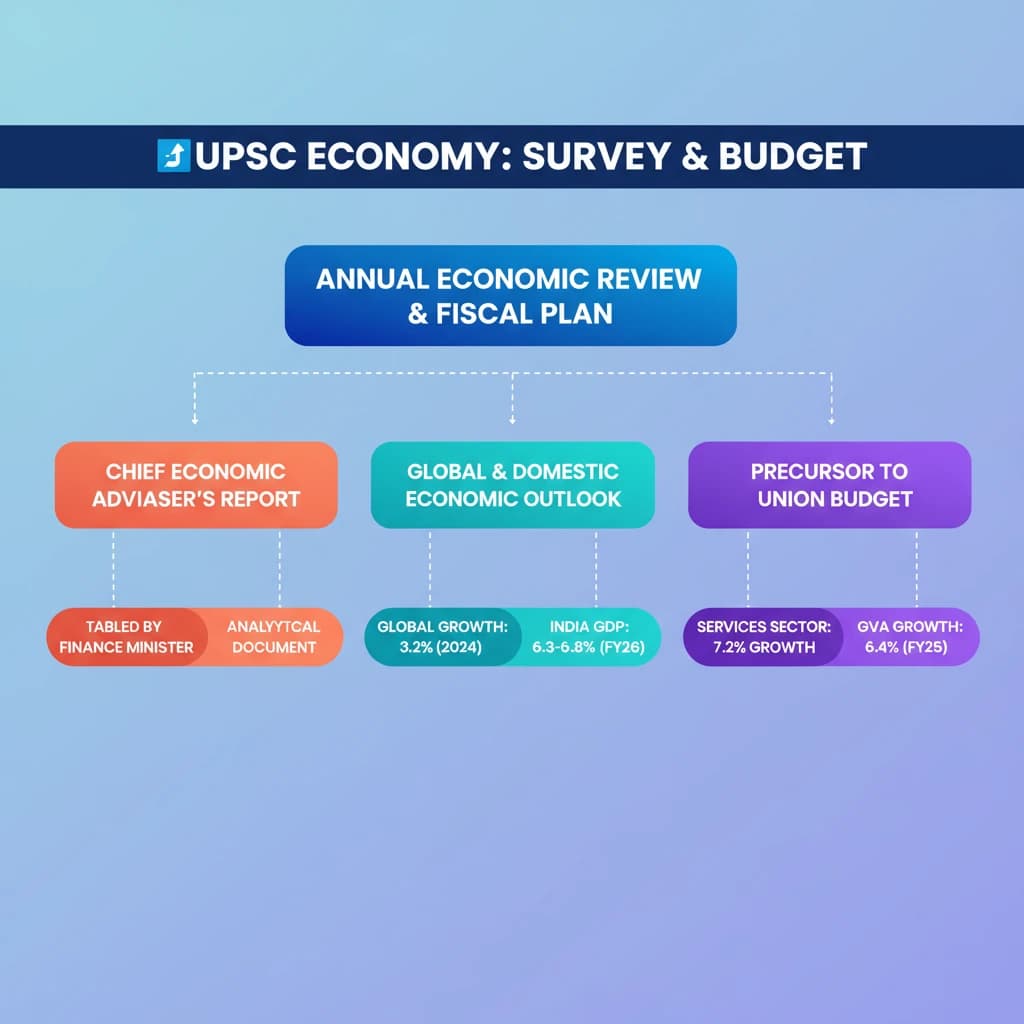
Survey and Budget is a key topic under Economy for UPSC Civil Services Examination. Key points include: Economic Survey is an annual review of India's economy, presented before the Union Budget.. It's prepared by the Chief Economic Adviser and tabled by the Finance Minister.. Global growth projected at 3.2% (2024), with geopolitical risks impacting trade.. Understanding this topic is essential for both UPSC Prelims and Mains preparation.
Why is Survey and Budget important for UPSC exam?
Survey and Budget is a Medium-level topic in UPSC Economy. It is tested in both Prelims (factual MCQs) and Mains (analytical answer writing). Previous year UPSC questions have frequently covered aspects of Survey and Budget, making it essential for comprehensive IAS preparation.
How to prepare Survey and Budget for UPSC?
To prepare Survey and Budget for UPSC: (1) Study the comprehensive notes covering all key concepts on Vaidra. (2) Practice previous year questions on this topic. (3) Connect it with current affairs using daily updates. (4) Revise using key takeaways and mind maps available for Economy. (5) Write practice answers linking Survey and Budget to related GS Paper topics.
Key takeaways of Survey and Budget for UPSC
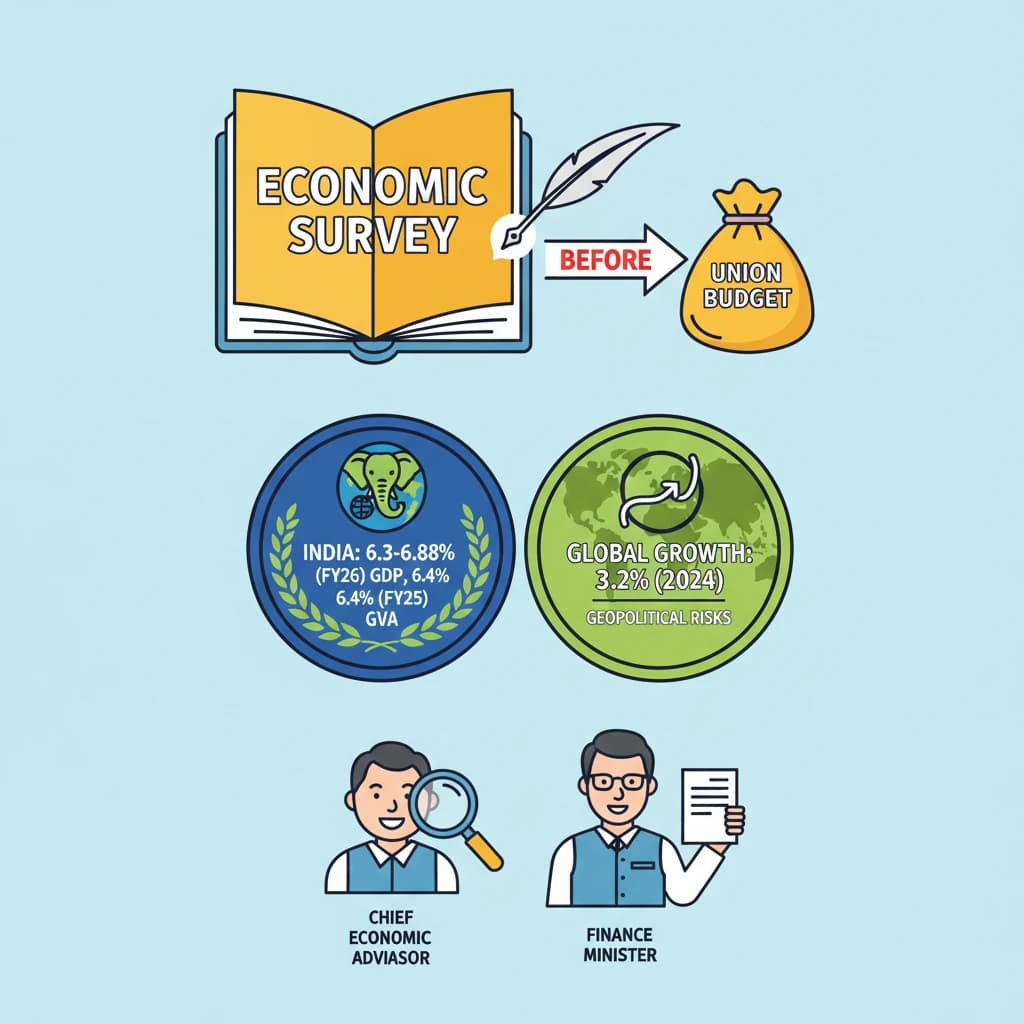
- Economic Survey is an annual review of India's economy, presented before the Union Budget.
- It's prepared by the Chief Economic Adviser and tabled by the Finance Minister.
- Global growth projected at 3.2% (2024), with geopolitical risks impacting trade.
- India's GDP projected 6.3-6.8% for FY26; GVA at 6.4% for FY25.
- Services is the fastest-growing sector (7.2%), while manufacturing faces global demand issues.
- Banking sector health improved: GNPA at 2.6% (12-year low), Net NPA at 0.6%.
- RBI maintained repo rate at 6.5% but reduced CRR to 4%, boosting liquidity.
- India remains top recipient of remittances, helping contain CAD at 1.2% of GDP.
Survey and Budget
Medium⏱️ 10 min read
economy
📖 Introduction
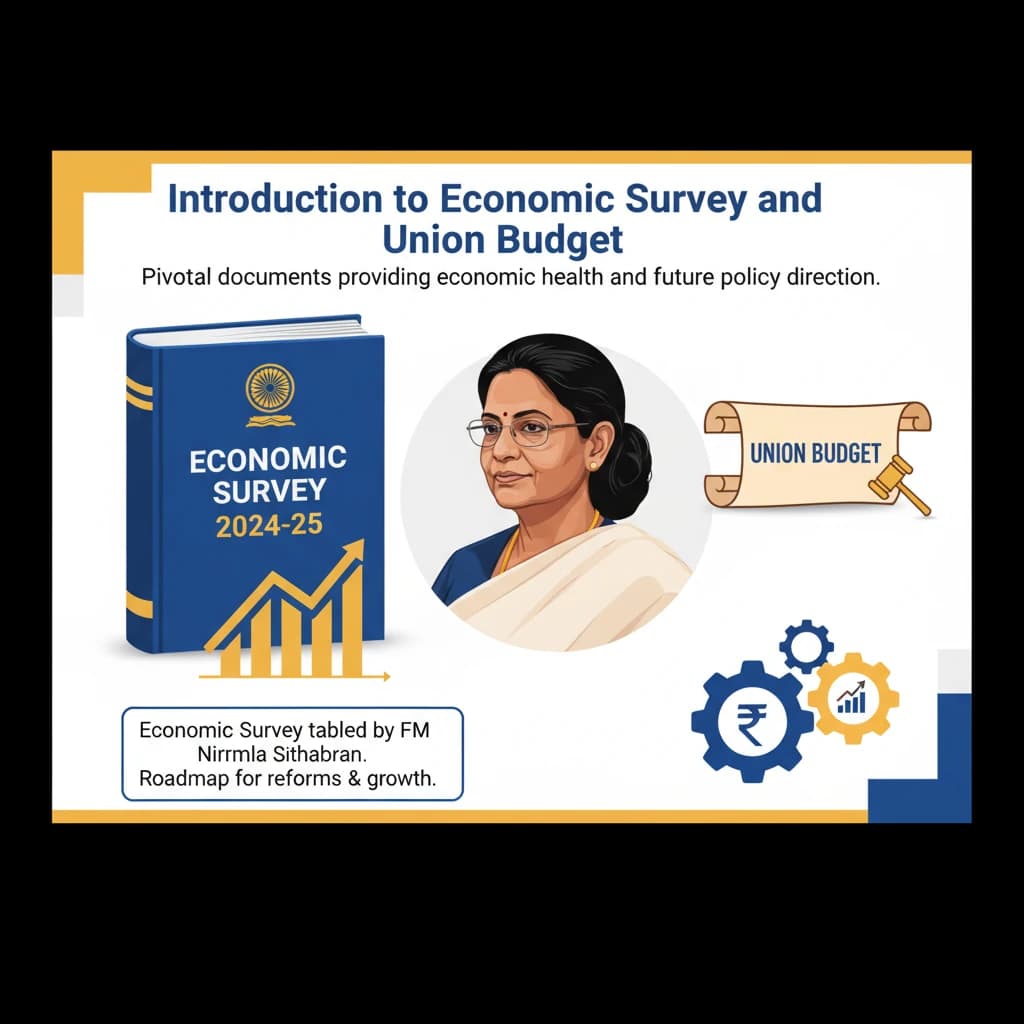
Introduction to Economic Survey and Union Budget
The Economic Survey and Union Budget are two pivotal documents presented by the Government of India. They provide a comprehensive overview of the nation's economic health and future policy direction.
The Finance Minister Nirmala Sitharaman tabled the Economic Survey 2024-25 in Parliament. This document serves as a crucial roadmap, outlining reforms and growth strategies that set the foundation for the upcoming Union Budget 2025.
Understanding the Economic Survey
The Economic Survey is an annual report that the government presents before the Union Budget. Its primary purpose is to assess India’s economic condition over the past financial year.
Preparation: The Survey is prepared by the Economic Division of the Ministry of Finance. It operates under the direct supervision of the Chief Economic Adviser.
Presentation: It is tabled in both houses of Parliament by the Union Finance Minister.
This comprehensive document evaluates economic performance, highlights sectoral developments, identifies key challenges, and provides an economic outlook for the forthcoming year.
Historical Context: The Economic Survey was first presented in 1950-51 as an integral part of the budget document. It gained its independence in 1964, becoming a separate document tabled a day before the Union Budget.
Key Highlights of the Economic Survey 2024-25
Global Economic Outlook
The International Monetary Fund (IMF) projected a 3.2% global growth in 2024, with an anticipated rise to 3.3% in 2025. This forecast indicates a mixed global economic environment.
Manufacturing sectors experienced a slowdown, primarily due to persistent supply chain disruptions. In contrast, the services sector demonstrated robust performance globally.
While global inflation showed signs of easing, services inflation remained persistent. This led to a divergence in monetary policies adopted by various central banks worldwide.
Geopolitical Uncertainties and Their Impact
Ongoing geopolitical conflicts, such as the Russia-Ukraine war and the Israel-Hamas conflict, have significantly impacted global trade, energy security, and inflation dynamics.
Disruptions in the Suez Canal forced many ships to reroute via the Cape of Good Hope. This diversion resulted in increased freight costs and extended delivery times for goods globally.
India’s Economic Performance
India’s Gross Domestic Product (GDP) is projected to grow between 6.3-6.8% in FY26 (2025-26). This robust projection underscores the country's economic resilience.
The real Gross Value Added (GVA) is estimated to achieve a growth rate of 6.4% in FY25 (2024-25), reflecting healthy underlying economic activity.
Sector-Wise Performance in India
- Agriculture: This sector recorded a 3.8% growth in FY25. This growth was primarily fueled by record Kharif production and strong rural demand.
- Industry & Manufacturing: The sector witnessed a 6.2% growth in FY25. However, manufacturing experienced a slowdown attributed to weak global demand.
- Services: Emerging as the fastest-growing sector, services achieved 7.2% growth in FY25. This growth was significantly led by Information Technology (IT), finance, and hospitality segments.
External Sector Developments
Overall exports, encompassing both merchandise and services, registered a 5% Year-on-Year (YoY) growth during the first nine months of FY25. The services sector alone contributed significantly with an 11.6% growth during the same period.
Merchandise exports grew by 1.6%, while imports saw a higher rise of 5.2%. This disparity led to a widening of the trade deficit.
Remittances: India maintained its position as the top global recipient of remittances. This inflow played a crucial role in helping to contain the Current Account Deficit (CAD) at a manageable 1.2% of GDP.
Monetary and Financial Sector Developments
The Gross Non-Performing Assets (GNPA) of Scheduled Commercial Banks (SCBs) witnessed a significant decline. They dropped to a 12-year low of 2.6% in 2024, with Net NPAs further reducing to 0.6%.
The Return on Assets (ROA) for SCBs improved to 1.4%, and the Return on Equity (ROE) enhanced to 13.1% by September 2024, indicating improved profitability and efficiency.
RBI's Role in Financial Inclusion: The Reserve Bank of India (RBI) reported an increase in the Financial Inclusion Index from 53.9 (2021) to 64.2 (2024). This improvement was strongly supported by the operations of Regional Rural Banks (RRBs).
The RBI maintained the repo rate at 6.5%, reflecting its stance on monetary policy. Concurrently, it reduced the Cash Reserve Ratio (CRR) to 4%, injecting a substantial ₹1.16 lakh crore into the financial system to boost liquidity.
The money multiplier rose to 5.7, further indicating increased liquidity in the economy. Capital markets mobilized ₹11.1 lakh crore in primary markets between April and December 2024, marking a 5% increase.
UPSC Insight: Understanding the trends in GDP, GVA, NPAs, CAD, and sectoral growth rates from the Economic Survey is crucial for both Prelims (factual questions) and Mains (analytical answers) in GS Paper 3 (Economy). Pay attention to the year-on-year changes and the reasons behind them.
💡 Key Takeaways
- •Economic Survey is an annual review of India's economy, presented before the Union Budget.
- •It's prepared by the Chief Economic Adviser and tabled by the Finance Minister.
- •Global growth projected at 3.2% (2024), with geopolitical risks impacting trade.
- •India's GDP projected 6.3-6.8% for FY26; GVA at 6.4% for FY25.
- •Services is the fastest-growing sector (7.2%), while manufacturing faces global demand issues.
- •Banking sector health improved: GNPA at 2.6% (12-year low), Net NPA at 0.6%.
- •RBI maintained repo rate at 6.5% but reduced CRR to 4%, boosting liquidity.
- •India remains top recipient of remittances, helping contain CAD at 1.2% of GDP.
🧠 Memory Techniques
98% Verified Content
📚 Reference Sources
•Economic Survey 2024-25 (implied official source for data)