Loading page, please wait…
What are Financial Trends and Budgetary Estimates (2023-24 & 2024-25)? - UPSC Economy
What is What are Financial Trends and Budgetary Estimates (2023-24 & 2024-25)? in UPSC Economy?
What are Financial Trends and Budgetary Estimates (2023-24 & 2024-25)? is a key topic under Economy for UPSC Civil Services Examination. Key points include: Revenue receipts projected to rise to ₹31.3 lakh crore (2024-25 BE).. Effective capital expenditure revised to ₹16.3 lakh crore (RE).. Revenue expenditure increased to ₹37.0 lakh crore (RE).. Understanding this topic is essential for both UPSC Prelims and Mains preparation.
Why is What are Financial Trends and Budgetary Estimates (2023-24 & 2024-25)? important for UPSC exam?
What are Financial Trends and Budgetary Estimates (2023-24 & 2024-25)? is a Medium-level topic in UPSC Economy. It is tested in both Prelims (factual MCQs) and Mains (analytical answer writing). Previous year UPSC questions have frequently covered aspects of What are Financial Trends and Budgetary Estimates (2023-24 & 2024-25)?, making it essential for comprehensive IAS preparation.
How to prepare What are Financial Trends and Budgetary Estimates (2023-24 & 2024-25)? for UPSC?
To prepare What are Financial Trends and Budgetary Estimates (2023-24 & 2024-25)? for UPSC: (1) Study the comprehensive notes covering all key concepts on Vaidra. (2) Practice previous year questions on this topic. (3) Connect it with current affairs using daily updates. (4) Revise using key takeaways and mind maps available for Economy. (5) Write practice answers linking What are Financial Trends and Budgetary Estimates (2023-24 & 2024-25)? to related GS Paper topics.
Key takeaways of What are Financial Trends and Budgetary Estimates (2023-24 & 2024-25)? for UPSC
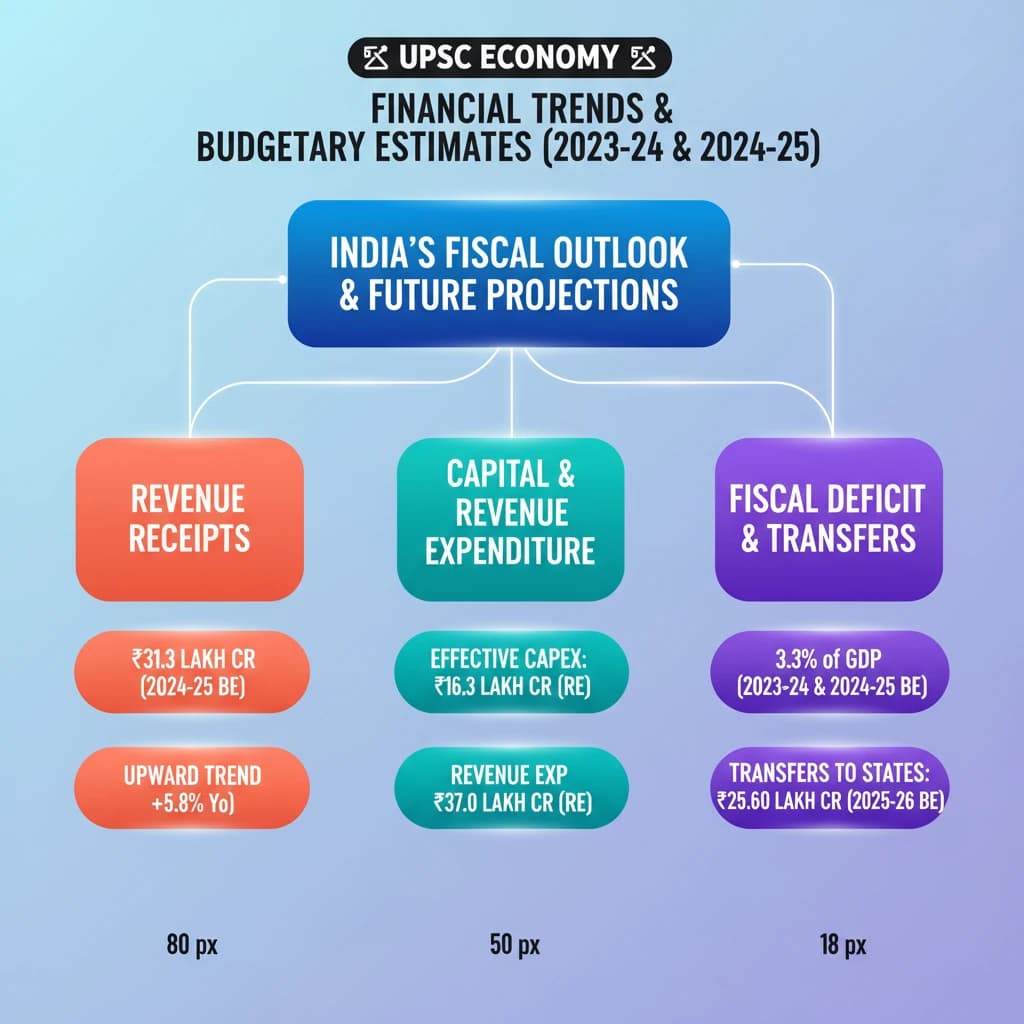
- Revenue receipts projected to rise to ₹31.3 lakh crore (2024-25 BE).
- Effective capital expenditure revised to ₹16.3 lakh crore (RE).
- Revenue expenditure increased to ₹37.0 lakh crore (RE).
- Fiscal deficit maintained at 3.3% of GDP for both 2023-24 and 2024-25 (BE).
- Transfers to States & UTs show a consistent increase, reaching ₹25.60 lakh crore (2025-26 BE).
- Net tax revenue for Centre at ₹28.4 lakh crore (2024-25 RE), with ₹0.8 lakh crore from non-debt capital receipts.
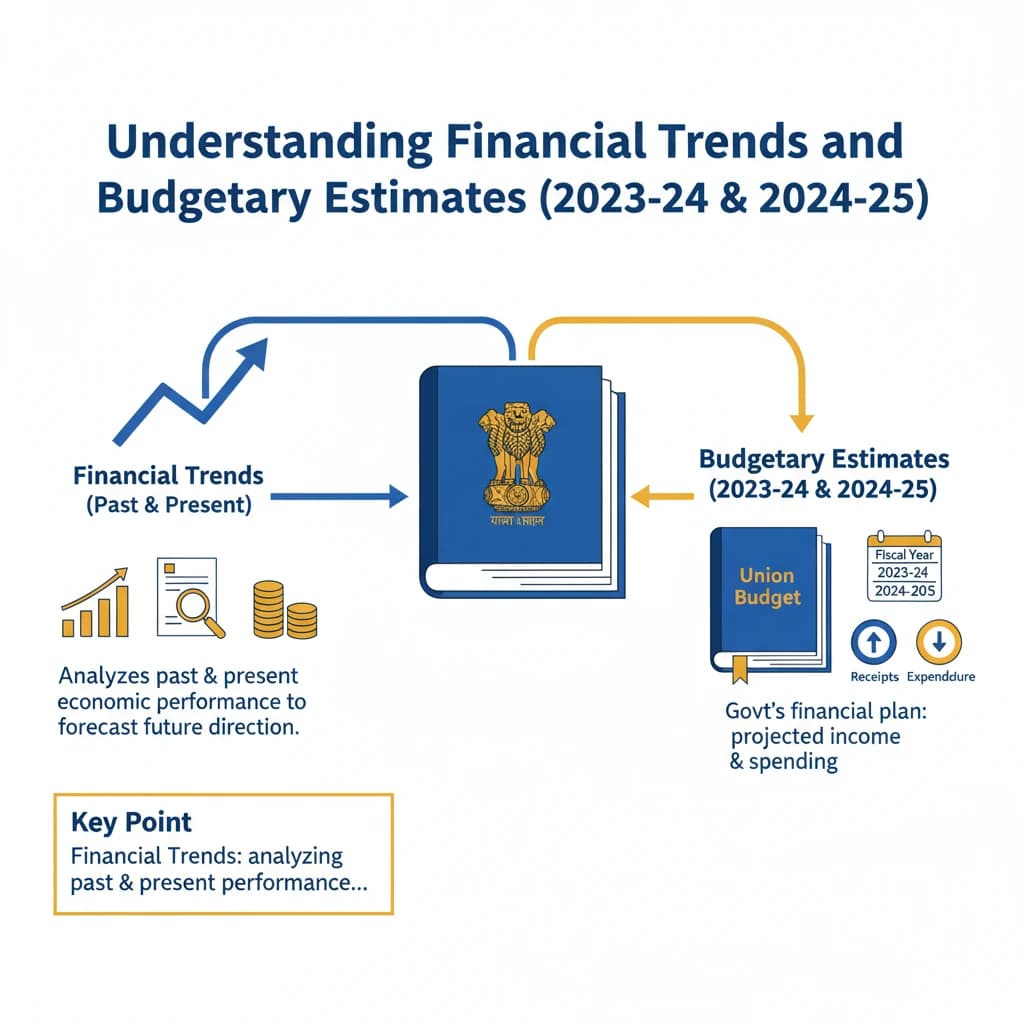
What are Financial Trends and Budgetary Estimates (2023-24 & 2024-25)?
Medium⏱️ 7 min read
economy
📖 Introduction
Understanding Financial Trends and Budgetary Estimates (2023-24 & 2024-25)
The Union Budget is a crucial document that outlines the government's financial plans for the upcoming fiscal year. It includes projections for receipts and expenditure, reflecting the nation's economic health and policy direction.
Understanding Financial Trends involves analyzing the past and present performance of key economic indicators. Budgetary Estimates (BE) are initial projections for the next fiscal year, while Revised Estimates (RE) are updated figures based on actual performance during the current year.
Key Financial Trends: Receipts and Expenditure Dynamics
The government's financial health is primarily assessed through its receipts (money coming in) and expenditure (money going out). These figures are critical for understanding fiscal policy and economic management.
Revenue Receipts:
- 2023-24: ₹27.3 lakh crore
- 2024-25 (BE): ₹31.3 lakh crore (projected increase)
Effective Capital Expenditure:
- Initial: ₹17.1 lakh crore
- Revised (RE): Fell to ₹16.3 lakh crore
Revenue expenditure, which covers the day-to-day running of the government, saw an increase. This category includes salaries, interest payments, and subsidies.
Revenue Expenditure:
- Initial: ₹34.9 lakh crore
- Revised (RE): Increased to ₹37.0 lakh crore
Capital expenditure, which is vital for creating long-term assets like infrastructure, also saw significant changes between estimates.
Capital Expenditure:
- Initial (BE): ₹12.5 lakh crore
- Projected (BE): Rose to ₹15.0 lakh crore
- Later Revised: ₹13.2 lakh crore
Deficit Trends as a Percentage of GDP
Deficits indicate the gap between government expenditure and receipts. Expressed as a percentage of Gross Domestic Product (GDP), they provide a measure of fiscal health relative to the economy's size.
Fiscal Deficit:
- 2023-24: 3.3% of GDP
- 2024-25 (BE): Remains unchanged at 3.3% of GDP
The revenue deficit highlights the shortfall in revenue receipts compared to revenue expenditure, indicating the government's reliance on borrowing for its day-to-day operations.
Revenue Deficit:
- 2023-24: 0.3% of GDP
- 2024-25 (RE): Increased slightly to 0.8% of GDP
The effective revenue deficit is the revenue deficit minus grants for the creation of capital assets. It provides a more accurate picture of the deficit in the government's current account.
Effective Revenue Deficit:
- 2023-24: 0.3% of GDP
- 2024-25 (RE): Stood at 0.8% of GDP
Total Transfers to States and Union Territories
Transfers to States and Union Territories (UTs) are a critical aspect of cooperative federalism, ensuring financial support and resource distribution across the country.
Total Transfers to States & UTs:
- 2023-24: ₹20.65 lakh crore
- 2024-25 (RE): Revised to ₹22.76 lakh crore
- 2025-26 (BE): Projected to increase further to ₹25.60 lakh crore
UPSC often asks about the trend and implications of fiscal transfers. Note the consistent increase, which supports state-level development initiatives.
Central Government's Net Receipts Breakdown
Understanding the components of the central government's receipts is essential for analyzing its revenue-generating capacity and fiscal strategy.
The net tax revenue is the portion of taxes collected by the Centre after devolution to states. This forms the largest part of the government's income.
Net Tax Revenue (Central Government):
- 2024-25 (RE): ₹28.4 lakh crore
Non-tax revenue includes income from sources other than taxes, such as dividends from public sector undertakings, interest receipts, and services provided by the government.
Non-Tax Revenue:
- 2024-25 (RE): ₹5.8 lakh crore
Non-debt capital receipts are crucial for the government as they do not add to the national debt. These primarily include proceeds from disinvestment and recoveries of loans.
Non-Debt Capital Receipts:
- 2024-25 (RE): ₹0.8 lakh crore (including disinvestment proceeds and loan recoveries)
💡 Key Takeaways
- •Revenue receipts projected to rise to ₹31.3 lakh crore (2024-25 BE).
- •Effective capital expenditure revised to ₹16.3 lakh crore (RE).
- •Revenue expenditure increased to ₹37.0 lakh crore (RE).
- •Fiscal deficit maintained at 3.3% of GDP for both 2023-24 and 2024-25 (BE).
- •Transfers to States & UTs show a consistent increase, reaching ₹25.60 lakh crore (2025-26 BE).
- •Net tax revenue for Centre at ₹28.4 lakh crore (2024-25 RE), with ₹0.8 lakh crore from non-debt capital receipts.
🧠 Memory Techniques
95% Verified Content