Loading page, please wait…
What are Government’s Initiatives Related to Employment? - UPSC Economy
What is What are Government’s Initiatives Related to Employment? in UPSC Economy?
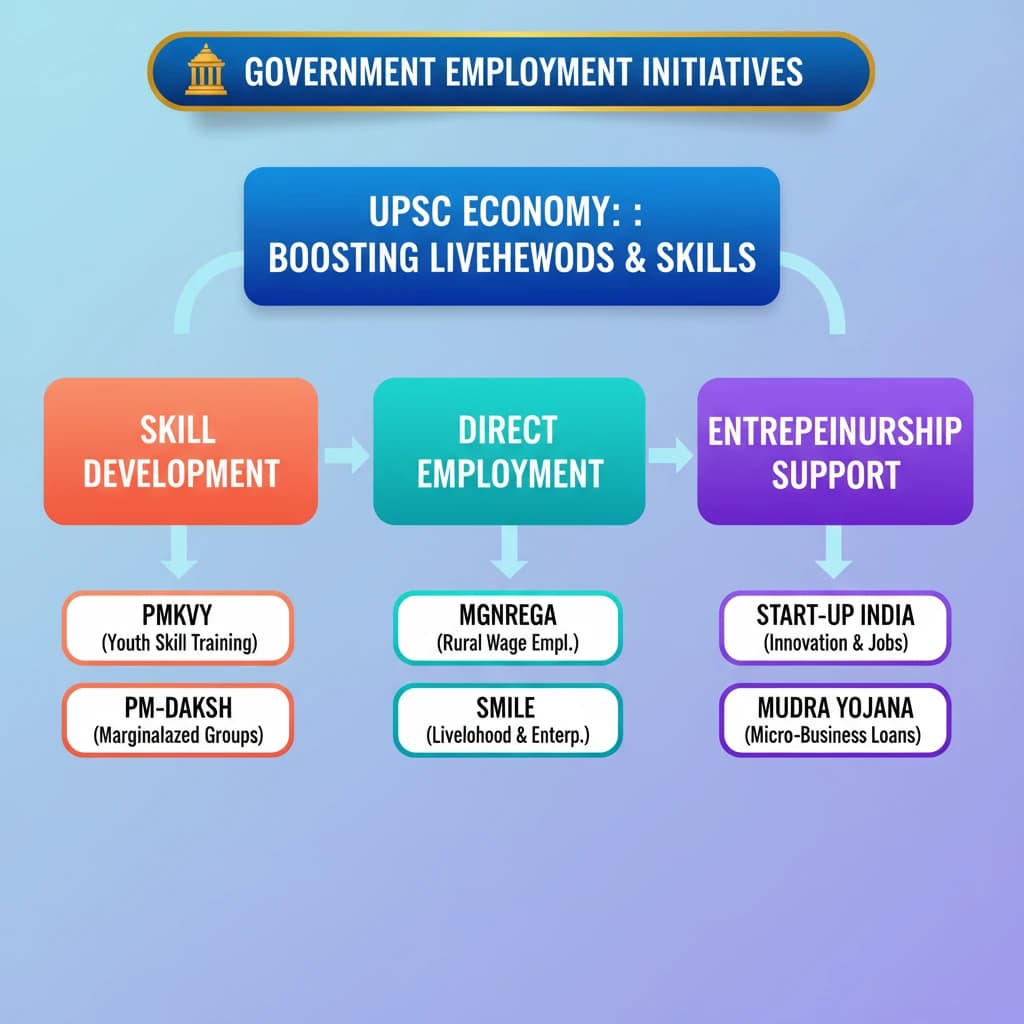
What are Government’s Initiatives Related to Employment? is a key topic under Economy for UPSC Civil Services Examination. Key points include: Government employment initiatives cover skill development, direct employment, and entrepreneurship.. SMILE and PM-DAKSH target marginalized groups for livelihood and skill enhancement.. MGNREGA guarantees rural wage employment, providing a crucial social safety net.. Understanding this topic is essential for both UPSC Prelims and Mains preparation.
Why is What are Government’s Initiatives Related to Employment? important for UPSC exam?
What are Government’s Initiatives Related to Employment? is a Medium-level topic in UPSC Economy. It is tested in both Prelims (factual MCQs) and Mains (analytical answer writing). Previous year UPSC questions have frequently covered aspects of What are Government’s Initiatives Related to Employment?, making it essential for comprehensive IAS preparation.
How to prepare What are Government’s Initiatives Related to Employment? for UPSC?
To prepare What are Government’s Initiatives Related to Employment? for UPSC: (1) Study the comprehensive notes covering all key concepts on Vaidra. (2) Practice previous year questions on this topic. (3) Connect it with current affairs using daily updates. (4) Revise using key takeaways and mind maps available for Economy. (5) Write practice answers linking What are Government’s Initiatives Related to Employment? to related GS Paper topics.
Key takeaways of What are Government’s Initiatives Related to Employment? for UPSC
- Government employment initiatives cover skill development, direct employment, and entrepreneurship.
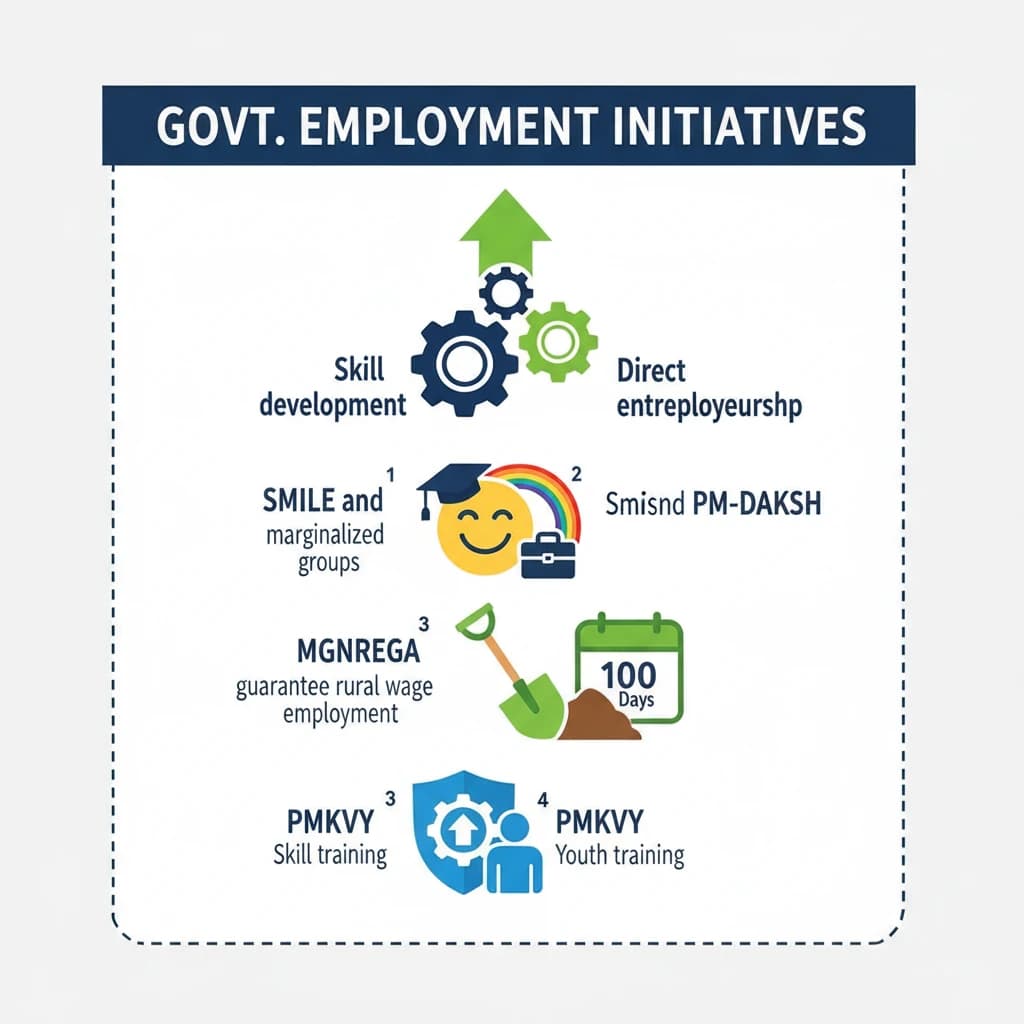
- SMILE and PM-DAKSH target marginalized groups for livelihood and skill enhancement.
- MGNREGA guarantees rural wage employment, providing a crucial social safety net.
- PMKVY focuses on industry-relevant skill training for youth employability.
- Start-up India fosters innovation and job creation through entrepreneurial support.
- Rojgar Melas serve as direct platforms connecting job seekers with employers.
What are Government’s Initiatives Related to Employment?
Medium⏱️ 7 min read
economy
📖 Introduction
Understanding Government Initiatives for Employment
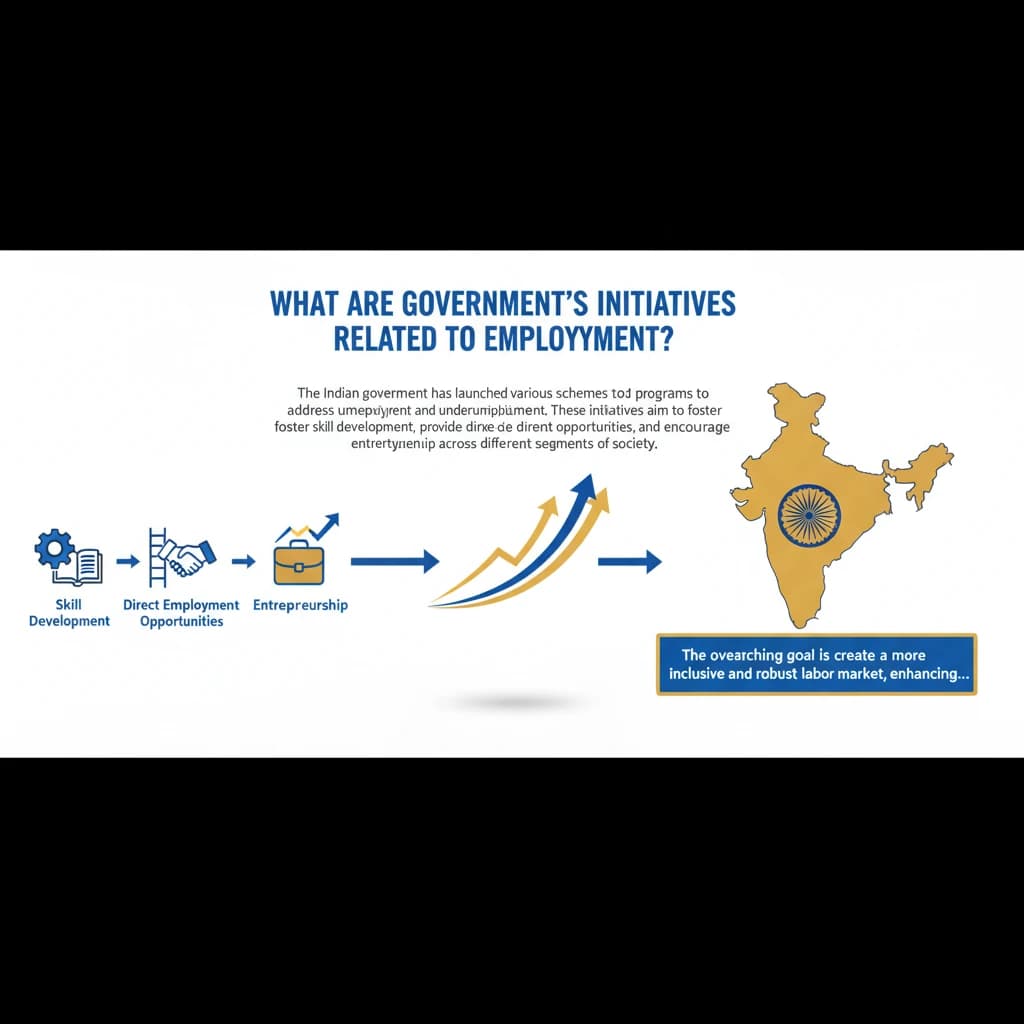
The Indian government has launched various schemes and programs to address unemployment and underemployment. These initiatives aim to foster skill development, provide direct employment opportunities, and encourage entrepreneurship across different segments of society.
The overarching goal is to create a more inclusive and robust labor market, enhancing the employability of the workforce and supporting vulnerable populations.
Support for Marginalised Individuals for Livelihood and Enterprise (SMILE)
The SMILE scheme is a comprehensive initiative designed to provide welfare measures for transgender persons and persons engaged in begging. It focuses on their rehabilitation, medical care, counseling, and skill development.
SMILE stands for Support for Marginalised Individuals for Livelihood and Enterprise. It integrates several sub-schemes to offer holistic support, including shelter homes and skill training for sustainable livelihoods.
PM-DAKSH (Pradhan Mantri Dakshata Aur Kaushalta Sampann Hitgrahi)
The PM-DAKSH Yojana is a skill development scheme implemented by the Ministry of Social Justice and Empowerment. It targets specific marginalized groups to enhance their employability through various training programs.
PM-DAKSH aims to provide skill development training to SC, OBC, EBC, DNT, Safai Karamcharis, including waste pickers and their dependents. Training types include up-skilling/re-skilling, short-term courses, and entrepreneurship development programs.
Mahatma Gandhi National Rural Employment Guarantee Act (MGNREGA)
MGNREGA is a flagship social security scheme that guarantees 100 days of wage employment in a financial year to adult members of every rural household willing to do unskilled manual work.
This act is crucial for poverty alleviation and rural development, providing a legal right to work and ensuring livelihood security in rural areas. It also focuses on creating durable assets.
UPSC Insight: MGNREGA is a vital topic for GS Paper II (Social Justice) and GS Paper III (Indian Economy). Questions often relate to its impact on rural poverty, women empowerment, and challenges in implementation.
Pradhan Mantri Kaushal Vikas Yojana (PMKVY)
PMKVY is the flagship scheme of the Ministry of Skill Development & Entrepreneurship (MSDE). Its objective is to enable a large number of Indian youth to take up industry-relevant skill training that will help them in securing a better livelihood.
Under PMKVY, individuals receive training in various sectors, leading to improved employability. The scheme also provides monetary rewards to candidates upon successful completion and certification.
Start-up India Scheme
The Start-up India initiative, launched in 2016, aims to build a strong ecosystem for nurturing innovation and start-ups in the country. It focuses on empowering start-ups to grow through innovation and design.
This scheme provides various benefits, including tax exemptions, easier compliance, funding support, and intellectual property rights facilitation, to encourage new businesses and job creation.
Rojgar Mela
A Rojgar Mela, or employment fair, is an initiative where the government facilitates direct interaction between job seekers and employers. These events are organized periodically to provide employment opportunities, particularly for the youth.
The government organizes these fairs at various levels to bridge the gap between demand and supply in the labor market, often focusing on specific sectors or regions to maximize impact.
💡 Key Takeaways
- •Government employment initiatives cover skill development, direct employment, and entrepreneurship.
- •SMILE and PM-DAKSH target marginalized groups for livelihood and skill enhancement.
- •MGNREGA guarantees rural wage employment, providing a crucial social safety net.
- •PMKVY focuses on industry-relevant skill training for youth employability.
- •Start-up India fosters innovation and job creation through entrepreneurial support.
- •Rojgar Melas serve as direct platforms connecting job seekers with employers.
🧠 Memory Techniques
95% Verified Content
📚 Reference Sources
•Ministry of Rural Development (MGNREGA website)
•Ministry of Skill Development & Entrepreneurship (PMKVY website)
•Department for Promotion of Industry and Internal Trade (Start-up India website)
•Ministry of Social Justice and Empowerment (SMILE, PM-DAKSH details)