Loading page, please wait…
What are the 4 Engines of Development in the Union Budget 2026-26? - UPSC Economy
What is What are the 4 Engines of Development in the Union Budget 2026-26? in UPSC Economy?
What are the 4 Engines of Development in the Union Budget 2026-26? is a key topic under Economy for UPSC Civil Services Examination. Key points include: The Union Budget 2026-26 identifies key strategic 'Engines of Development' to drive economic growth, with detailed initiatives provided for Agriculture, Investment, and Export Promotion.. The Agriculture engine focuses on farmer welfare, productivity enhancement, and achieving self-reliance in pulses through schemes like PM Dhan-Dhaanya Krishi Yojana and Atma Nirbharta Mission.. The Investment engine targets broad-based growth across urban development, critical infrastructure (water, maritime, aviation), education, health, and strategic sectors like nuclear energy.. Understanding this topic is essential for both UPSC Prelims and Mains preparation.
Why is What are the 4 Engines of Development in the Union Budget 2026-26? important for UPSC exam?
What are the 4 Engines of Development in the Union Budget 2026-26? is a Medium-level topic in UPSC Economy. It is tested in both Prelims (factual MCQs) and Mains (analytical answer writing). Previous year UPSC questions have frequently covered aspects of What are the 4 Engines of Development in the Union Budget 2026-26?, making it essential for comprehensive IAS preparation.
How to prepare What are the 4 Engines of Development in the Union Budget 2026-26? for UPSC?
To prepare What are the 4 Engines of Development in the Union Budget 2026-26? for UPSC: (1) Study the comprehensive notes covering all key concepts on Vaidra. (2) Practice previous year questions on this topic. (3) Connect it with current affairs using daily updates. (4) Revise using key takeaways and mind maps available for Economy. (5) Write practice answers linking What are the 4 Engines of Development in the Union Budget 2026-26? to related GS Paper topics.
Key takeaways of What are the 4 Engines of Development in the Union Budget 2026-26? for UPSC
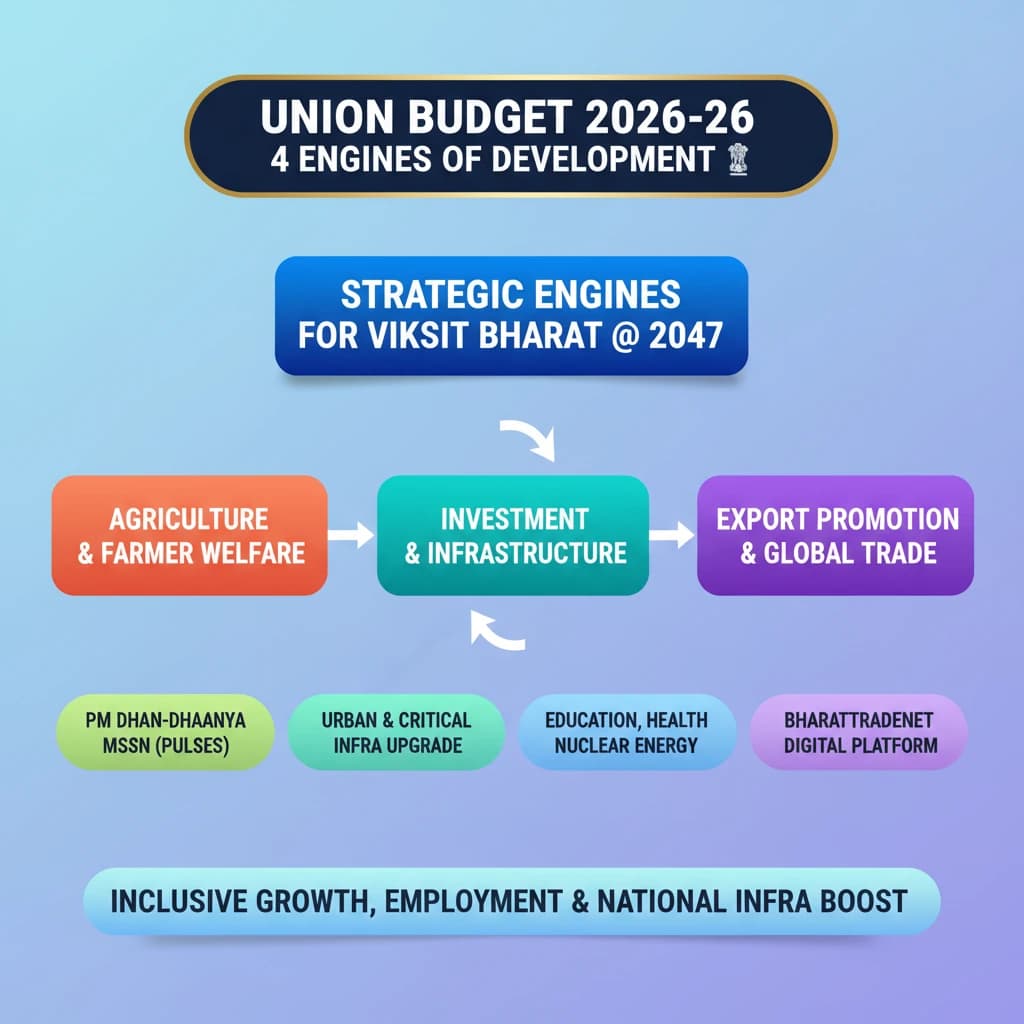
- The Union Budget 2026-26 identifies key strategic 'Engines of Development' to drive economic growth, with detailed initiatives provided for Agriculture, Investment, and Export Promotion.
- The Agriculture engine focuses on farmer welfare, productivity enhancement, and achieving self-reliance in pulses through schemes like PM Dhan-Dhaanya Krishi Yojana and Atma Nirbharta Mission.
- The Investment engine targets broad-based growth across urban development, critical infrastructure (water, maritime, aviation), education, health, and strategic sectors like nuclear energy.
- The Export Promotion engine aims to significantly boost India's global trade competitiveness via a dedicated mission, digital platforms like BharatTradeNet, and promotion of Global Capability Centres.
- These strategic engines are designed to foster inclusive growth, generate employment, upgrade national infrastructure, and accelerate India's journey towards 'Viksit Bharat' by 2047.
What are the 4 Engines of Development in the Union Budget 2026-26?
Medium⏱️ 12 min read
economy
📖 Introduction
Introduction to the 4 Engines of Development
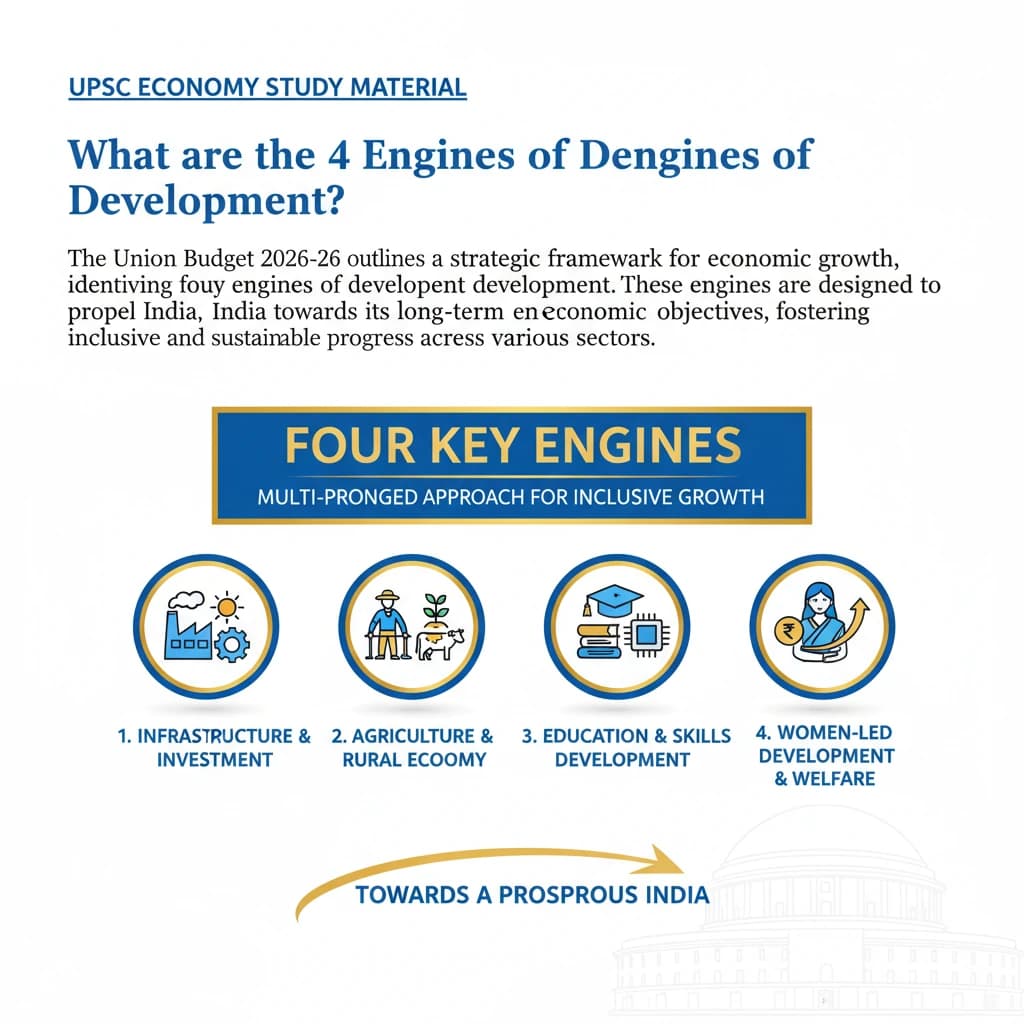
The Union Budget 2026-26 outlines a strategic framework for economic growth, identifying four key engines of development. These engines are designed to propel India towards its long-term economic objectives, fostering inclusive and sustainable progress across various sectors.
These four engines represent a multi-pronged approach, focusing on critical sectors to ensure holistic development and enhance India's global competitiveness, with specific details provided for Agriculture, Investment, and Export Promotion.
1st Engine: Agriculture
The agricultural sector is identified as a primary driver, with several initiatives aimed at boosting productivity, farmer welfare, and resilience. The focus is on ensuring food security and enhancing rural prosperity.
Prime Minister Dhan-Dhaanya Krishi Yojana
- Coverage: To be implemented in 1.00 lakh low agricultural productivity districts.
- Beneficiaries: Expected to benefit 1.7 crore farmers.
- Key Focus Areas: Enhancing irrigation facilities and improving post-harvest storage facilities.
Rural Prosperity and Resilience Programme
A new 'Rural Prosperity and Resilience' programme is slated for launch in partnership with states. This initiative aims to tackle agricultural underemployment effectively.
The programme will address underemployment through strategic interventions in skilling, investment, and technology adoption, empowering rural populations.
Atma Nirbharta in Pulses Mission
A significant 6-year mission is announced to achieve self-reliance (Atma Nirbharta) in pulses. This mission will specifically focus on three key pulses: Tur, Urad, and Masoor.
The mission emphasizes ensuring the availability of climate-resilient seeds and guaranteeing remunerative prices for farmers producing these pulses.
Procurement Strategy: Central agencies like NAFED and NCCF will be prepared to procure these three pulses directly from farmers over the next four years.
Enhanced Kisan Credit Card (KCC) Limit
To facilitate better credit flow, the Kisan Credit Card (KCC) limit has been significantly raised. This enhancement aims to provide greater financial support to farmers.
New Limit: Increased from ₹3 lakh to ₹5 lakh.
Beneficiaries: This enhanced credit facility will benefit approximately 7.7 crore farmers across the country.
National Mission on High Yielding Seeds
This mission is designed to strengthen agricultural research and development. Its primary goal is to ensure the widespread availability of superior seed varieties.
Target: To ensure availability of 100+ high-yielding and pest-resistant seed varieties, boosting crop productivity and resilience.
Mission for Cotton Productivity
A comprehensive 5-year initiative is planned to revitalize the cotton sector. The mission promotes sustainable farming practices.
It aims to increase the production of extra-long-staple cotton and significantly improve its overall quality, benefiting cotton farmers and the textile industry.
3rd Engine: Investment
Investment is highlighted as a crucial engine, focusing on urban development, infrastructure, education, health, and strategic sectors like nuclear energy and aviation.
Urban Challenge Fund
A substantial Urban Challenge Fund has been allocated to support various urban development initiatives. This fund aims to transform cities into economic powerhouses.
- Total Allocation: ₹1 lakh crore.
- Key Themes: Supporting 'Cities as Growth Hubs,' 'Creative Redevelopment of Cities,' and improving 'Water and Sanitation'.
- 2025-26 Allocation: ₹10,000 crore specifically allocated for the upcoming fiscal year.
Jal Jeevan Mission
The successful Jal Jeevan Mission receives an enhanced budget and an extension, reaffirming the government's commitment to universal piped water access.
- Total Budget Outlay: Enhanced to ₹5,67,000 Crore.
- Extension: Mission extended until 2028.
- Impact: 15 crore households, representing 80% of India’s rural population, have already benefited from piped water coverage.
Maritime Development Fund
A dedicated fund is established to bolster India's maritime sector. This aims to provide long-term financial support for critical infrastructure and industries.
- Fund Size: ₹25,000 crore.
- Government Contribution: 49% of the fund will be contributed by the government.
- Support Areas: Financing for shipbuilding, port development, and enhancing logistics infrastructure.
Expansion of IITs and PM Research Fellowship
Investment in technical education and advanced research is a key priority. This includes expanding premier institutions and supporting high-end research.
- IIT Expansion: Additional infrastructure to accommodate 6,500 more students, significantly boosting India’s technical education capacity.
- PM Research Fellowship: 10,000 fellowships allocated for advanced research in leading institutions like IITs and IISc.
Day Care Cancer Centers
To improve healthcare accessibility, particularly for cancer treatment, a network of new centers will be established nationwide.
- Target: To be set up in all district hospitals within the next three years.
- Initial Phase: 200 Centers to become operational in 2025-26, ensuring affordable treatment.
Bharatiya Bhasha Pustak Scheme
This scheme focuses on leveraging digital technology to enhance educational access across different linguistic backgrounds.
It aims to provide digital Indian language books, thereby improving accessibility for both school and higher education students.
Nuclear Energy Mission for Viksit Bharat
A significant mission is launched to advance India's nuclear energy capabilities, crucial for achieving energy independence and sustainability goals.
- Outlay: ₹20,000 crore allocated for the mission.
- Focus: Development of Small Modular Reactors (SMRs).
- Target: At least 5 indigenously developed SMRs to be operational by 2033.
Policy Reforms: Amendments to the Atomic Energy Act and the Civil Liability for Nuclear Damage Act will be undertaken to facilitate active partnership with the private sector.
UDAN - Regional Connectivity Scheme
The revised UDAN scheme continues to prioritize enhancing air connectivity to underserved regions, fostering economic development and tourism.
- Expansion: Will enhance regional connectivity to 120 new destinations.
- Passenger Target: Aims to carry 4 crore passengers over the next several years.
- Support: Also supports the development of helipads and smaller airports in hilly, aspirational, and North East regions.
Greenfield Airport in Bihar & Western Koshi Canal ERM Project
Specific regional development projects are earmarked to boost infrastructure and agricultural productivity in Bihar.
- Bihar Airports: Development of Greenfield airports in Bihar, alongside the expansion of Patna airport and a brownfield airport at Bihta (Patna).
- Western Koshi Canal ERM Project: Financial support for crucial irrigation infrastructure in the Mithilanchal region of Bihar.
Tourism for Employment-Led Growth
Tourism is recognized as a key sector for generating employment and promoting local economies. A challenge mode approach is adopted for development.
The top 50 tourist destinations across the country will be developed in partnership with states, utilizing a challenge mode to encourage competitive proposals.
4th Engine: Export Promotion
The final engine focuses on boosting India's exports, enhancing global trade competitiveness, and creating a supportive ecosystem for exporters.
Export Promotion Mission
A dedicated mission is established to strategically drive export growth. This initiative will involve multi-ministerial collaboration.
- Establishment: An Export Promotion Mission will be set up.
- Targets: Will have clear sectoral and ministerial targets.
- Leadership: Led collaboratively by the Ministries of Commerce, MSME, and Finance.
BharatTradeNet (BTN)
A unified digital platform is introduced to streamline international trade processes, making them more efficient and accessible for businesses.
Function: A unified digital platform designed to facilitate international trade documentation and provide comprehensive financing solutions.
National Framework for GCC (Global Capability Centres)
This framework aims to attract and promote the establishment of Global Capability Centres within India, particularly in emerging cities.
Objective: Policy incentives will be provided to promote outsourcing hubs (Global Capability Centres) in emerging Tier-2 cities, fostering job creation and economic diversification.
Warehousing Facility for Air Cargo
To support high-value and perishable exports, specialized infrastructure development is prioritized.
This involves the development of advanced storage infrastructure specifically for high-value perishable exports, ensuring their quality and timely delivery.
💡 Key Takeaways
- •The Union Budget 2026-26 identifies key strategic 'Engines of Development' to drive economic growth, with detailed initiatives provided for Agriculture, Investment, and Export Promotion.
- •The Agriculture engine focuses on farmer welfare, productivity enhancement, and achieving self-reliance in pulses through schemes like PM Dhan-Dhaanya Krishi Yojana and Atma Nirbharta Mission.
- •The Investment engine targets broad-based growth across urban development, critical infrastructure (water, maritime, aviation), education, health, and strategic sectors like nuclear energy.
- •The Export Promotion engine aims to significantly boost India's global trade competitiveness via a dedicated mission, digital platforms like BharatTradeNet, and promotion of Global Capability Centres.
- •These strategic engines are designed to foster inclusive growth, generate employment, upgrade national infrastructure, and accelerate India's journey towards 'Viksit Bharat' by 2047.
🧠 Memory Techniques
98% Verified Content
📚 Reference Sources
•Hypothetical Union Budget 2026-26 Document (as implied by the prompt's topic)