Loading page, please wait…
What are the Key Developments in India’s Maritime Sector? - UPSC Economy
What is What are the Key Developments in India’s Maritime Sector? in UPSC Economy?
What are the Key Developments in India’s Maritime Sector? is a key topic under Economy for UPSC Civil Services Examination. Key points include: India's maritime sector is seeing rapid development with strategic economic corridors.. The Chennai-Vladivostok Eastern Maritime Corridor (CVEMC) connects India to the Russian Far East, operational since late 2023, for crude, coal, and machinery imports.. The India-Middle East-Europe Economic Corridor (IMEC) was announced at G20 2023, linking India to Europe via the Middle East with rail and sea routes.. Understanding this topic is essential for both UPSC Prelims and Mains preparation.
Why is What are the Key Developments in India’s Maritime Sector? important for UPSC exam?
What are the Key Developments in India’s Maritime Sector? is a Medium-level topic in UPSC Economy. It is tested in both Prelims (factual MCQs) and Mains (analytical answer writing). Previous year UPSC questions have frequently covered aspects of What are the Key Developments in India’s Maritime Sector?, making it essential for comprehensive IAS preparation.
How to prepare What are the Key Developments in India’s Maritime Sector? for UPSC?
To prepare What are the Key Developments in India’s Maritime Sector? for UPSC: (1) Study the comprehensive notes covering all key concepts on Vaidra. (2) Practice previous year questions on this topic. (3) Connect it with current affairs using daily updates. (4) Revise using key takeaways and mind maps available for Economy. (5) Write practice answers linking What are the Key Developments in India’s Maritime Sector? to related GS Paper topics.
Key takeaways of What are the Key Developments in India’s Maritime Sector? for UPSC
- India's maritime sector is seeing rapid development with strategic economic corridors.
- The Chennai-Vladivostok Eastern Maritime Corridor (CVEMC) connects India to the Russian Far East, operational since late 2023, for crude, coal, and machinery imports.
- The India-Middle East-Europe Economic Corridor (IMEC) was announced at G20 2023, linking India to Europe via the Middle East with rail and sea routes.
- Both corridors enhance trade, reduce transit times, and strengthen India's geopolitical influence.
- CVEMC aligns with 'Act East'; IMEC with 'Connect West' and is a counter to China's BRI.
- These initiatives are crucial for India's economic growth, energy security, and strategic autonomy.
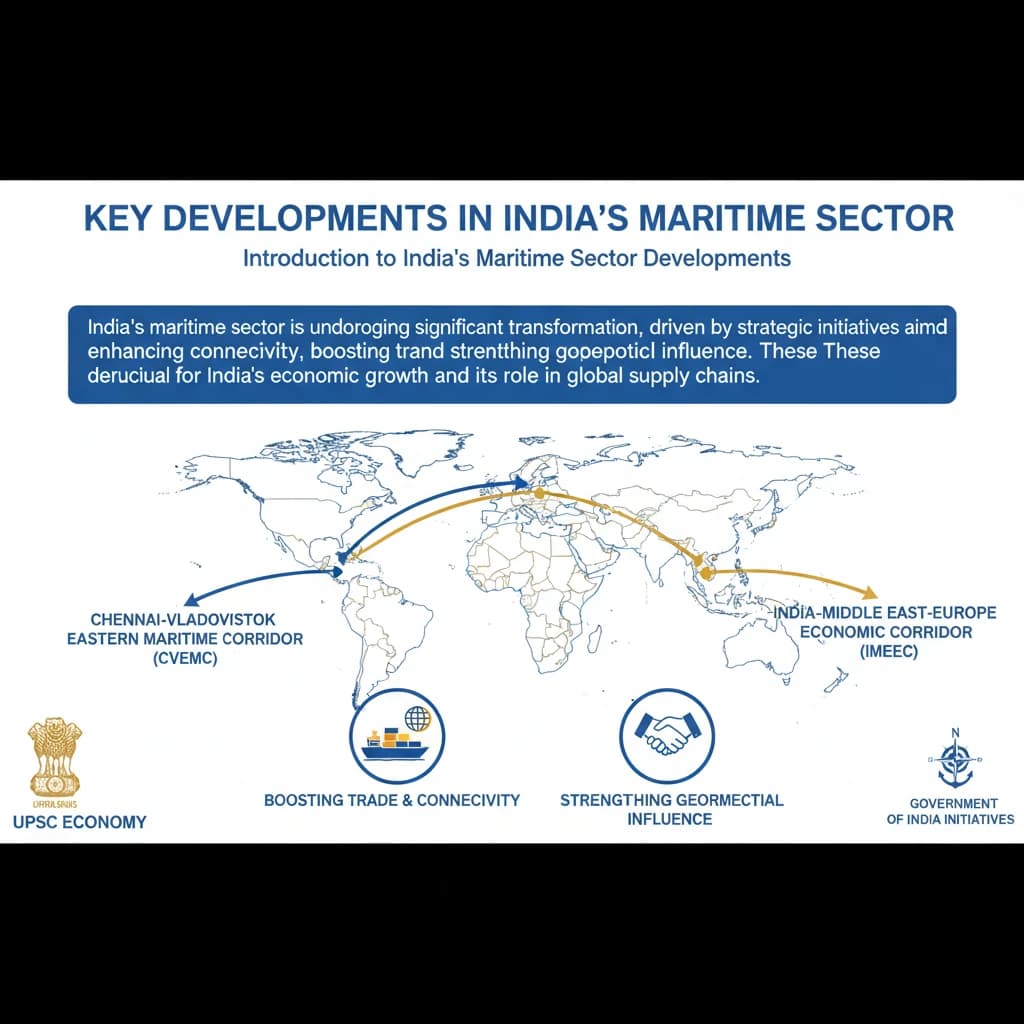
What are the Key Developments in India’s Maritime Sector?
Medium⏱️ 7 min read
economy
📖 Introduction
Introduction to India's Maritime Sector Developments
India's maritime sector is undergoing significant transformation, driven by strategic initiatives aimed at enhancing connectivity, boosting trade, and strengthening geopolitical influence. These developments are crucial for India's economic growth and its role in global supply chains.
Two prominent corridors, the Chennai-Vladivostok Eastern Maritime Corridor (CVEMC) and the India-Middle East-Europe Economic Corridor (IMEC), exemplify this renewed focus on maritime connectivity.
Chennai-Vladivostok Eastern Maritime Corridor (CVEMC)
The Chennai-Vladivostok Eastern Maritime Corridor (CVEMC) represents a direct sea route connecting India's eastern coast with the Russian Far East. This corridor significantly reduces transit time and costs for cargo movement between the two nations.
Operational Status: The CVEMC became fully operational at the end of 2023.
Key Function: It facilitates efficient cargo transport between India and Far East Russia.
This maritime route is vital for handling key imports and exports. It strengthens bilateral trade ties, particularly in sectors critical for India's industrial and energy needs.
Key Imports Handled: The corridor is crucial for importing commodities such as crude oil, coal, and various types of machinery from Russia.
Strategic Importance: It diversifies India's trade routes and enhances energy security by providing an alternative to traditional Western routes.
The CVEMC is a cornerstone of India's "Act East" policy, deepening economic and strategic engagement with countries in the Asia-Pacific region and beyond.
India-Middle East-Europe Economic Corridor (IMEC)
The India-Middle East-Europe Economic Corridor (IMEC) is an ambitious multi-modal connectivity project designed to link India with Europe via the Middle East. It represents a significant step towards creating a new trade route that bypasses traditional shipping lanes.
Announcement: IMEC was officially announced at the G20 New Delhi Summit 2023, marking a major international collaboration.
Length and Scope: The corridor spans over 4,800 km, integrating both railway and sea routes.
IMEC is envisioned as a network of railways and shipping lanes that will foster economic growth, enhance digital connectivity, and facilitate the movement of goods and services across continents.
Key Nations Connected: IMEC connects India to the UAE, Saudi Arabia, Jordan, Israel, and European nations including Italy, France, and Greece.
Collaborating Partners: India and Greece are actively collaborating on this initiative, among other partner countries.
The IMEC is seen as a counter-narrative to China's Belt and Road Initiative (BRI), offering an alternative, more transparent, and economically viable connectivity option.
For UPSC Mains (GS Paper 2 & 3), understanding these corridors is crucial for questions on international relations, economic diplomacy, infrastructure development, and geopolitics. Focus on their strategic implications and economic benefits.
💡 Key Takeaways
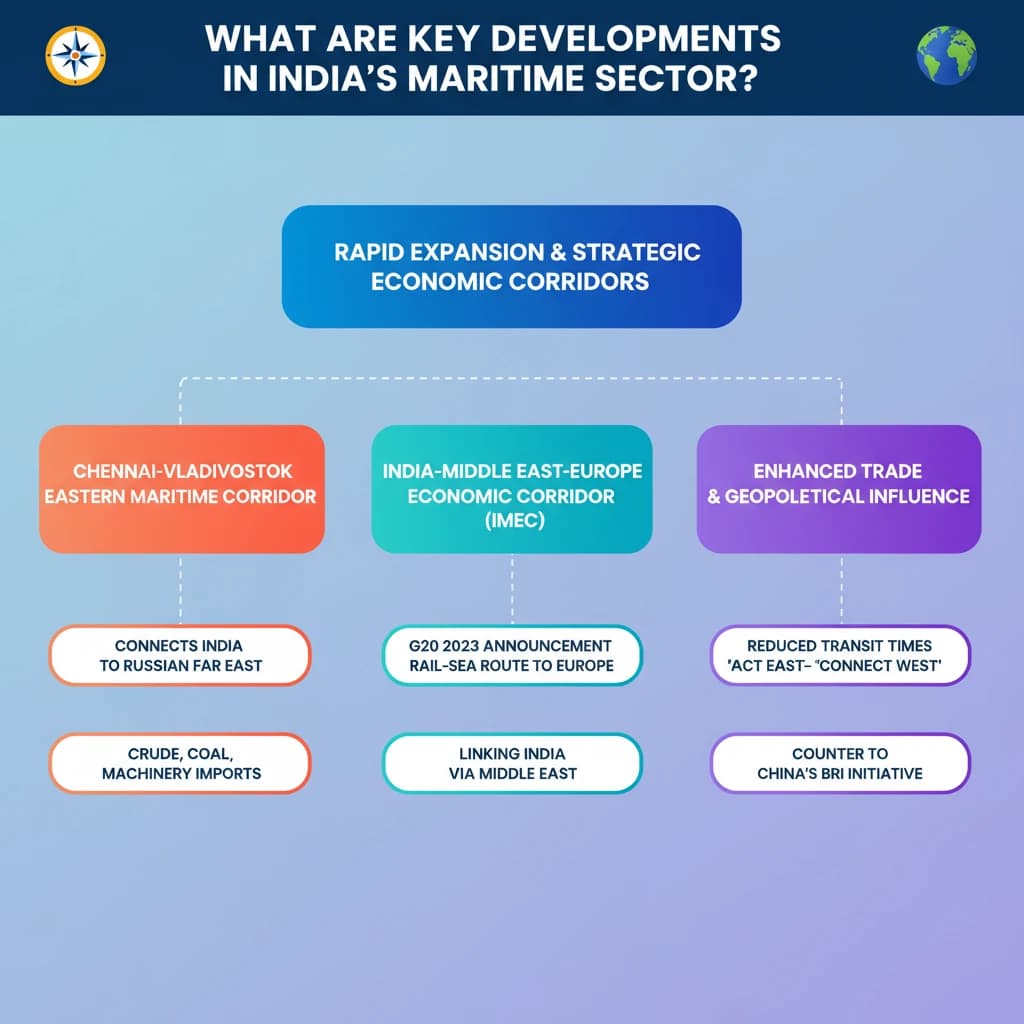
- •India's maritime sector is seeing rapid development with strategic economic corridors.
- •The Chennai-Vladivostok Eastern Maritime Corridor (CVEMC) connects India to the Russian Far East, operational since late 2023, for crude, coal, and machinery imports.
- •The India-Middle East-Europe Economic Corridor (IMEC) was announced at G20 2023, linking India to Europe via the Middle East with rail and sea routes.
- •Both corridors enhance trade, reduce transit times, and strengthen India's geopolitical influence.
- •CVEMC aligns with 'Act East'; IMEC with 'Connect West' and is a counter to China's BRI.
- •These initiatives are crucial for India's economic growth, energy security, and strategic autonomy.
🧠 Memory Techniques
95% Verified Content
📚 Reference Sources
•Ministry of External Affairs, Government of India (Official statements on G20 Summit and IMEC)
•Ministry of Ports, Shipping and Waterways, Government of India (Information on maritime projects)
•Press Information Bureau (PIB) releases regarding economic corridors
•News reports from reputable Indian and international media outlets on CVEMC and IMEC