Loading page, please wait…
What are the Other Platforms that Facilitate Lending in India? - UPSC Economy
What is What are the Other Platforms that Facilitate Lending in India? in UPSC Economy?
What are the Other Platforms that Facilitate Lending in India? is a key topic under Economy for UPSC Civil Services Examination. Key points include: Various platforms like PCR, AA Framework, CICs, TReDS, and P2P lending facilitate credit in India.. Public Credit Registry (PCR) centralizes borrower credit data for better risk assessment.. Account Aggregator (AA) Framework enables consent-based digital sharing of financial information.. Understanding this topic is essential for both UPSC Prelims and Mains preparation.
Why is What are the Other Platforms that Facilitate Lending in India? important for UPSC exam?
What are the Other Platforms that Facilitate Lending in India? is a Medium-level topic in UPSC Economy. It is tested in both Prelims (factual MCQs) and Mains (analytical answer writing). Previous year UPSC questions have frequently covered aspects of What are the Other Platforms that Facilitate Lending in India?, making it essential for comprehensive IAS preparation.
How to prepare What are the Other Platforms that Facilitate Lending in India? for UPSC?
To prepare What are the Other Platforms that Facilitate Lending in India? for UPSC: (1) Study the comprehensive notes covering all key concepts on Vaidra. (2) Practice previous year questions on this topic. (3) Connect it with current affairs using daily updates. (4) Revise using key takeaways and mind maps available for Economy. (5) Write practice answers linking What are the Other Platforms that Facilitate Lending in India? to related GS Paper topics.
Key takeaways of What are the Other Platforms that Facilitate Lending in India? for UPSC
- Various platforms like PCR, AA Framework, CICs, TReDS, and P2P lending facilitate credit in India.
- Public Credit Registry (PCR) centralizes borrower credit data for better risk assessment.
- Account Aggregator (AA) Framework enables consent-based digital sharing of financial information.
- Credit Information Companies (CICs) provide credit scores and reports (e.g., CIBIL).
- Trade Receivables Discounting System (TReDS) helps MSMEs get early payments for invoices.
- Peer-to-Peer (P2P) Lending Platforms connect individual lenders and borrowers directly.
- These platforms collectively reduce information asymmetry, enhance financial inclusion, and improve credit flow efficiency.
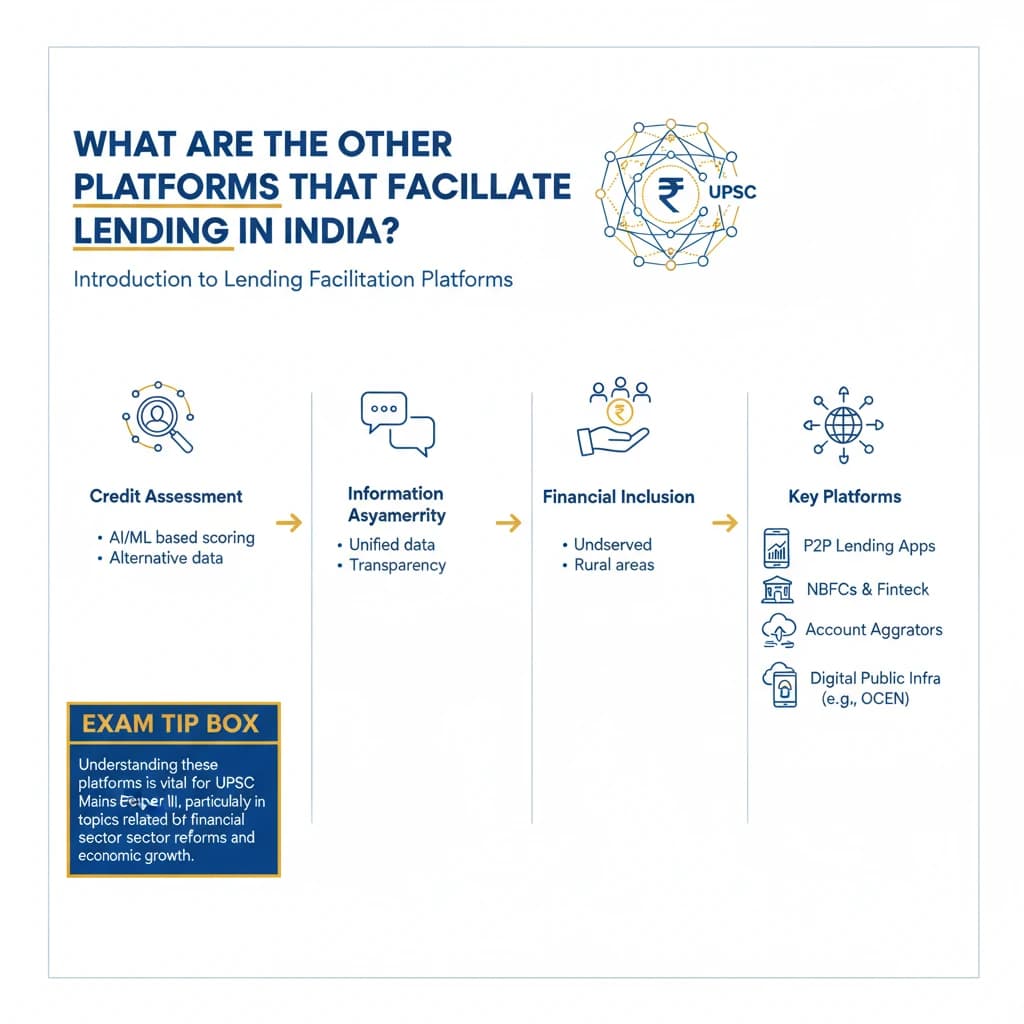
What are the Other Platforms that Facilitate Lending in India?
Medium⏱️ 7 min read
economy
📖 Introduction
Introduction to Lending Facilitation Platforms
India's financial ecosystem is evolving, with various platforms emerging to streamline and enhance the lending process. These platforms play a crucial role in improving credit assessment, reducing information asymmetry, and fostering financial inclusion.
Understanding these platforms is vital for UPSC Mains GS Paper III, particularly in topics related to the Indian Economy, financial markets, and MSME development. Focus on their functions and impact.
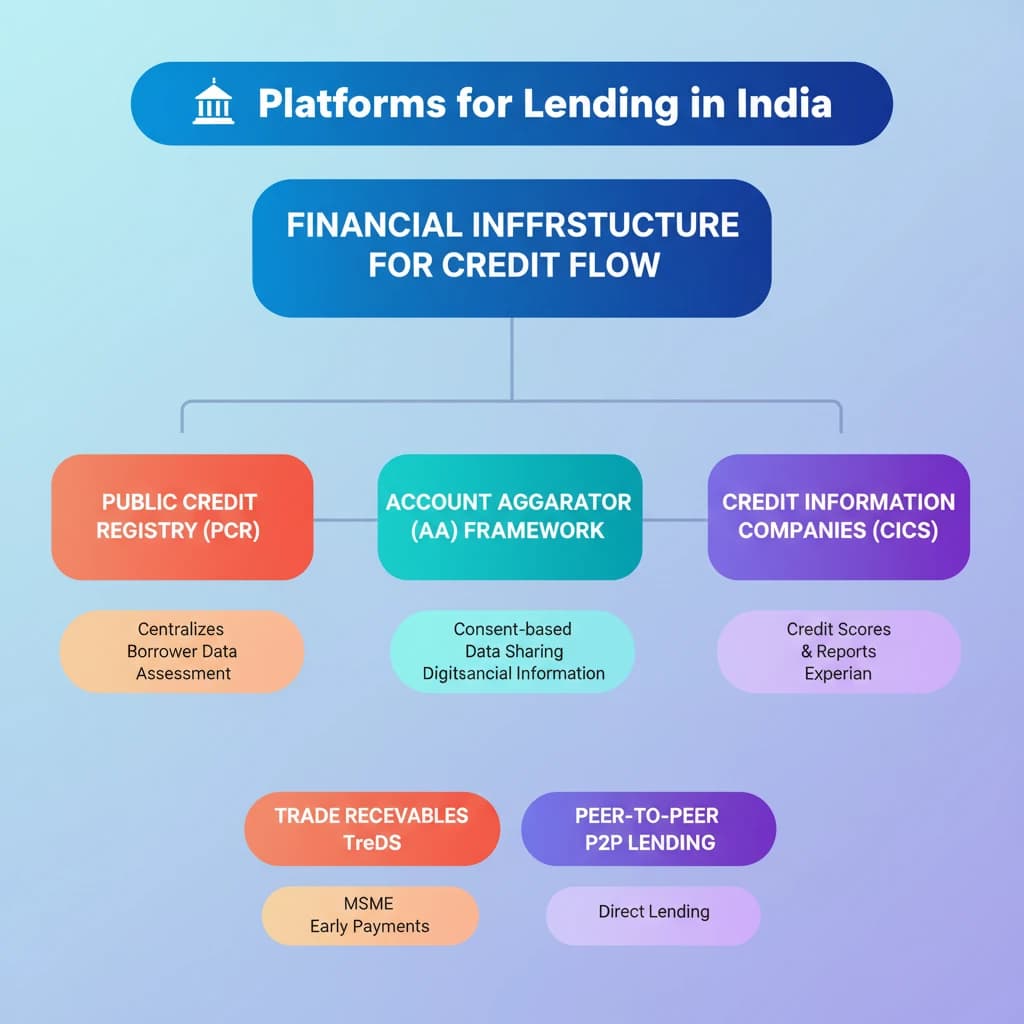
Public Credit Registry (PCR)
The Public Credit Registry (PCR) is a centralized database designed to store comprehensive credit information of borrowers. Its primary objective is to assist lenders in accurately assessing the creditworthiness of applicants.
Function: The PCR aggregates data from various sources, providing a holistic view of a borrower's credit history. This reduces the problem of information asymmetry in the credit market.
Account Aggregator (AA) Framework
The Account Aggregator (AA) Framework is an innovative, consent-based platform regulated by the Reserve Bank of India (RBI). It empowers customers to securely share their financial information across different financial institutions.
Key Feature: This framework streamlines access to financial data for lenders, facilitating quicker and more informed lending decisions. It operates on a principle of explicit customer consent for data sharing.
Credit Information Companies (CICs)
Credit Information Companies (CICs) are specialized entities responsible for collecting and maintaining the credit information of both individuals and businesses. Prominent examples include CIBIL, Equifax, and Experian.
Role: CICs generate credit scores and reports, which are indispensable tools for banks and other lending institutions to evaluate the credit risk associated with potential borrowers.
Trade Receivables Discounting System (TReDS)
The Trade Receivables Discounting System (TReDS) is an electronic platform specifically designed to address the working capital needs of Micro, Small, and Medium Enterprises (MSMEs). It enables them to convert their trade receivables into liquid funds.
Mechanism: Through TReDS, MSMEs can auction their trade receivables (invoices) to multiple financiers (banks, NBFCs) at competitive rates, ensuring timely access to finance and improving cash flow.
Peer-to-Peer (P2P) Lending Platforms
Peer-to-Peer (P2P) Lending Platforms are online marketplaces that directly connect individuals who wish to lend money with those who seek to borrow. This disintermediates traditional financial institutions to some extent.
Examples: Platforms like Faircent and Lendbox facilitate these direct transactions, offering an alternative channel for both borrowing and investing. They are regulated by the RBI to ensure consumer protection.
💡 Key Takeaways
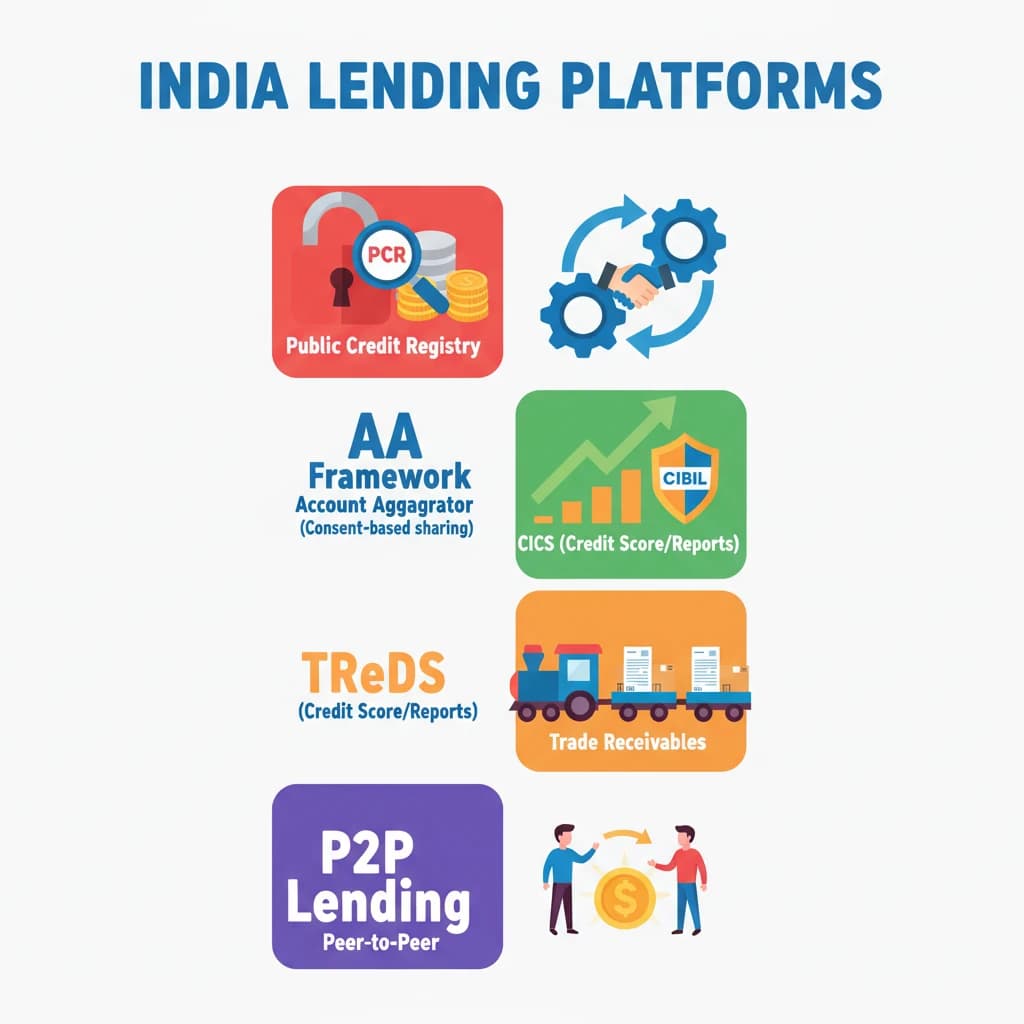
- •Various platforms like PCR, AA Framework, CICs, TReDS, and P2P lending facilitate credit in India.
- •Public Credit Registry (PCR) centralizes borrower credit data for better risk assessment.
- •Account Aggregator (AA) Framework enables consent-based digital sharing of financial information.
- •Credit Information Companies (CICs) provide credit scores and reports (e.g., CIBIL).
- •Trade Receivables Discounting System (TReDS) helps MSMEs get early payments for invoices.
- •Peer-to-Peer (P2P) Lending Platforms connect individual lenders and borrowers directly.
- •These platforms collectively reduce information asymmetry, enhance financial inclusion, and improve credit flow efficiency.
🧠 Memory Techniques
98% Verified Content
📚 Reference Sources
•Reserve Bank of India (RBI) official publications and press releases regarding PCR, AA Framework, and P2P Lending regulations
•National Credit Information Company Limited (NCICL) and other Credit Information Companies (CICs) official websites for their operational details
•SIDBI and Ministry of MSME reports on Trade Receivables Discounting System (TReDS)