Loading page, please wait…
What Differentiates Floating Exchange Rate Dynamics from Stabilized Arrangement? - UPSC Economy
What is What Differentiates Floating Exchange Rate Dynamics from Stabilized Arrangement? in UPSC Economy?
What Differentiates Floating Exchange Rate Dynamics from Stabilized Arrangement? is a key topic under Economy for UPSC Civil Services Examination. Key points include: Floating rates are market-determined with minimal intervention, leading to high volatility.. Stabilized arrangements involve central bank intervention to smooth volatility or maintain a target range.. Floating rates offer monetary policy autonomy and automatic adjustment to shocks.. Understanding this topic is essential for both UPSC Prelims and Mains preparation.
Why is What Differentiates Floating Exchange Rate Dynamics from Stabilized Arrangement? important for UPSC exam?
What Differentiates Floating Exchange Rate Dynamics from Stabilized Arrangement? is a Medium-level topic in UPSC Economy. It is tested in both Prelims (factual MCQs) and Mains (analytical answer writing). Previous year UPSC questions have frequently covered aspects of What Differentiates Floating Exchange Rate Dynamics from Stabilized Arrangement?, making it essential for comprehensive IAS preparation.
How to prepare What Differentiates Floating Exchange Rate Dynamics from Stabilized Arrangement? for UPSC?
To prepare What Differentiates Floating Exchange Rate Dynamics from Stabilized Arrangement? for UPSC: (1) Study the comprehensive notes covering all key concepts on Vaidra. (2) Practice previous year questions on this topic. (3) Connect it with current affairs using daily updates. (4) Revise using key takeaways and mind maps available for Economy. (5) Write practice answers linking What Differentiates Floating Exchange Rate Dynamics from Stabilized Arrangement? to related GS Paper topics.
Key takeaways of What Differentiates Floating Exchange Rate Dynamics from Stabilized Arrangement? for UPSC
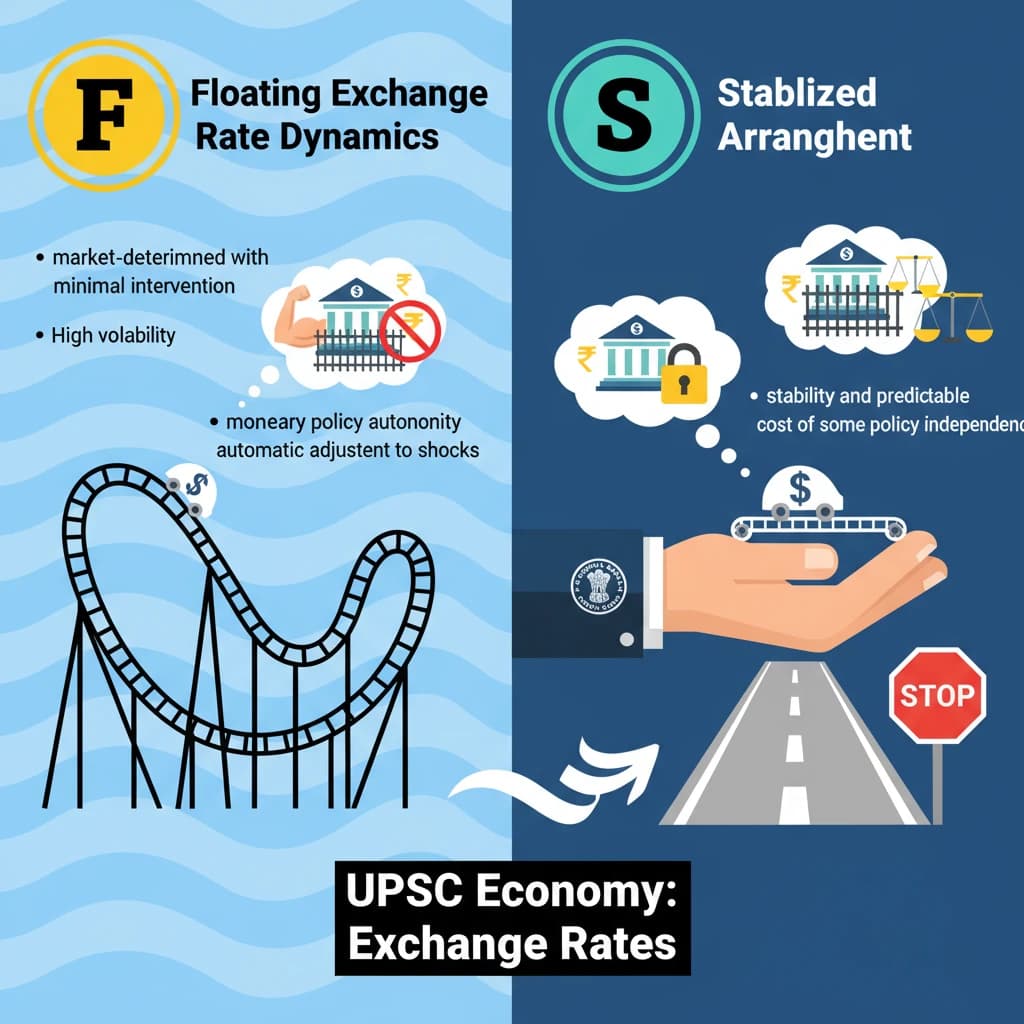
- Floating rates are market-determined with minimal intervention, leading to high volatility.
- Stabilized arrangements involve central bank intervention to smooth volatility or maintain a target range.
- Floating rates offer monetary policy autonomy and automatic adjustment to shocks.
- Stabilized arrangements prioritize stability and predictability, often at the cost of some policy independence.
- India operates a managed float, a form of stabilized arrangement, with active RBI intervention.

What Differentiates Floating Exchange Rate Dynamics from Stabilized Arrangement?
Medium⏱️ 8 min read
economy
📖 Introduction
Understanding Exchange Rate Regimes
The value of a nation's currency relative to others is a critical aspect of its economic health. This value is determined by different mechanisms, broadly categorized into floating exchange rates and stabilized arrangements.
These arrangements dictate the degree of government intervention or central bank involvement in managing the currency's value in the global foreign exchange market.
Floating Exchange Rate Dynamics
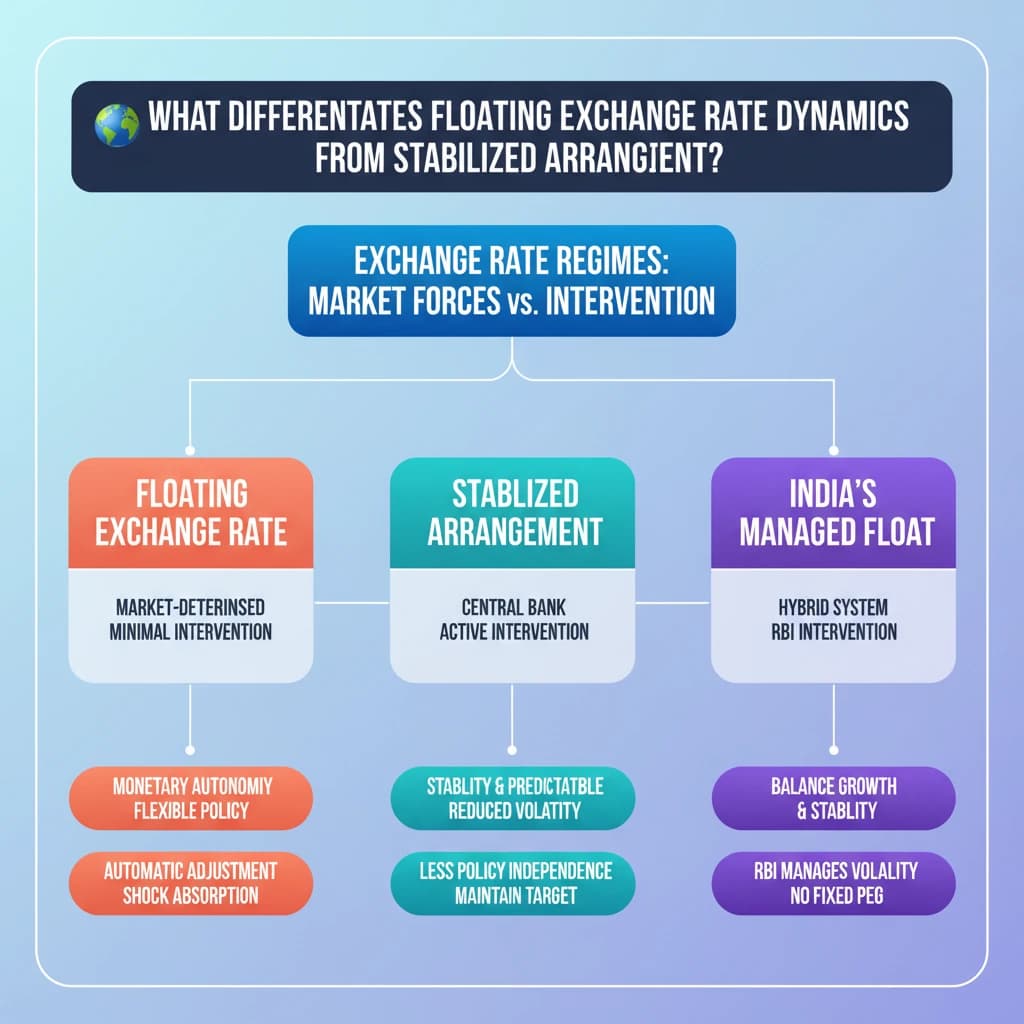
A floating exchange rate system is characterized by the currency's value being determined almost entirely by the forces of supply and demand in the foreign exchange market. Government or central bank intervention is minimal, if any.
In this system, the exchange rate can experience significant and frequent fluctuations. These changes are typically in response to various factors such as economic news, major global or domestic events, or shifts in market sentiment.
Key Characteristics of Floating Exchange Rates:
- Market-determined: Value set by supply and demand.
- High Volatility: Frequent and often significant fluctuations.
- Automatic Adjustment: Helps economies adjust to external shocks.
- Minimal Intervention: Central bank typically does not interfere to fix the rate.
Businesses and individuals operating under a floating regime must constantly adjust to these changing economic conditions. The market itself acts as the primary mechanism for price discovery and adjustment.
Stabilized Arrangement Explained
A stabilized arrangement represents a middle ground between a pure floating rate and a fixed exchange rate. In this system, the government or central bank actively intervenes in the foreign exchange market.
The primary goal of such intervention is to smooth out excessive volatility in the currency's value. While it allows for some degree of fluctuation, it aims to keep the exchange rate within a predefined target range or to prevent sharp, disruptive movements.
Key Characteristics of Stabilized Arrangements:
- Managed Fluctuations: Allows some movement but with limits.
- Central Bank Intervention: Active buying or selling of foreign currency.
- Greater Stability: Aims for more predictability than a pure float.
- Target Range: Often seeks to maintain the rate within a specific band.
This approach seeks to combine the flexibility of a floating rate with the stability benefits of a fixed rate, providing a more predictable environment for trade and investment while still allowing for some market adjustment.
For UPSC, understanding the trade-offs between flexibility and stability is crucial. Analyze how each system impacts a country's monetary policy autonomy, inflation control, and external competitiveness.
💡 Key Takeaways
- •Floating rates are market-determined with minimal intervention, leading to high volatility.
- •Stabilized arrangements involve central bank intervention to smooth volatility or maintain a target range.
- •Floating rates offer monetary policy autonomy and automatic adjustment to shocks.
- •Stabilized arrangements prioritize stability and predictability, often at the cost of some policy independence.
- •India operates a managed float, a form of stabilized arrangement, with active RBI intervention.
🧠 Memory Techniques
95% Verified Content
📚 Reference Sources
•International Monetary Fund (IMF) publications on exchange rate regimes
•Reserve Bank of India (RBI) official statements and reports
•NCERT Economics Textbooks (Macroeconomics)