Loading page, please wait…
What is an Exchange Rate? - UPSC Economy
What is What is an Exchange Rate? in UPSC Economy?
What is an Exchange Rate? is a key topic under Economy for UPSC Civil Services Examination. Key points include: Exchange rate is the value of one currency in terms of another.. Three main types: Fixed (government set), Floating (market determined), and Managed Float (mix of both).. Key factors influencing exchange rates include interest rates, inflation, economic growth, and supply/demand.. Understanding this topic is essential for both UPSC Prelims and Mains preparation.
Why is What is an Exchange Rate? important for UPSC exam?
What is an Exchange Rate? is a Medium-level topic in UPSC Economy. It is tested in both Prelims (factual MCQs) and Mains (analytical answer writing). Previous year UPSC questions have frequently covered aspects of What is an Exchange Rate?, making it essential for comprehensive IAS preparation.
How to prepare What is an Exchange Rate? for UPSC?
To prepare What is an Exchange Rate? for UPSC: (1) Study the comprehensive notes covering all key concepts on Vaidra. (2) Practice previous year questions on this topic. (3) Connect it with current affairs using daily updates. (4) Revise using key takeaways and mind maps available for Economy. (5) Write practice answers linking What is an Exchange Rate? to related GS Paper topics.
Key takeaways of What is an Exchange Rate? for UPSC
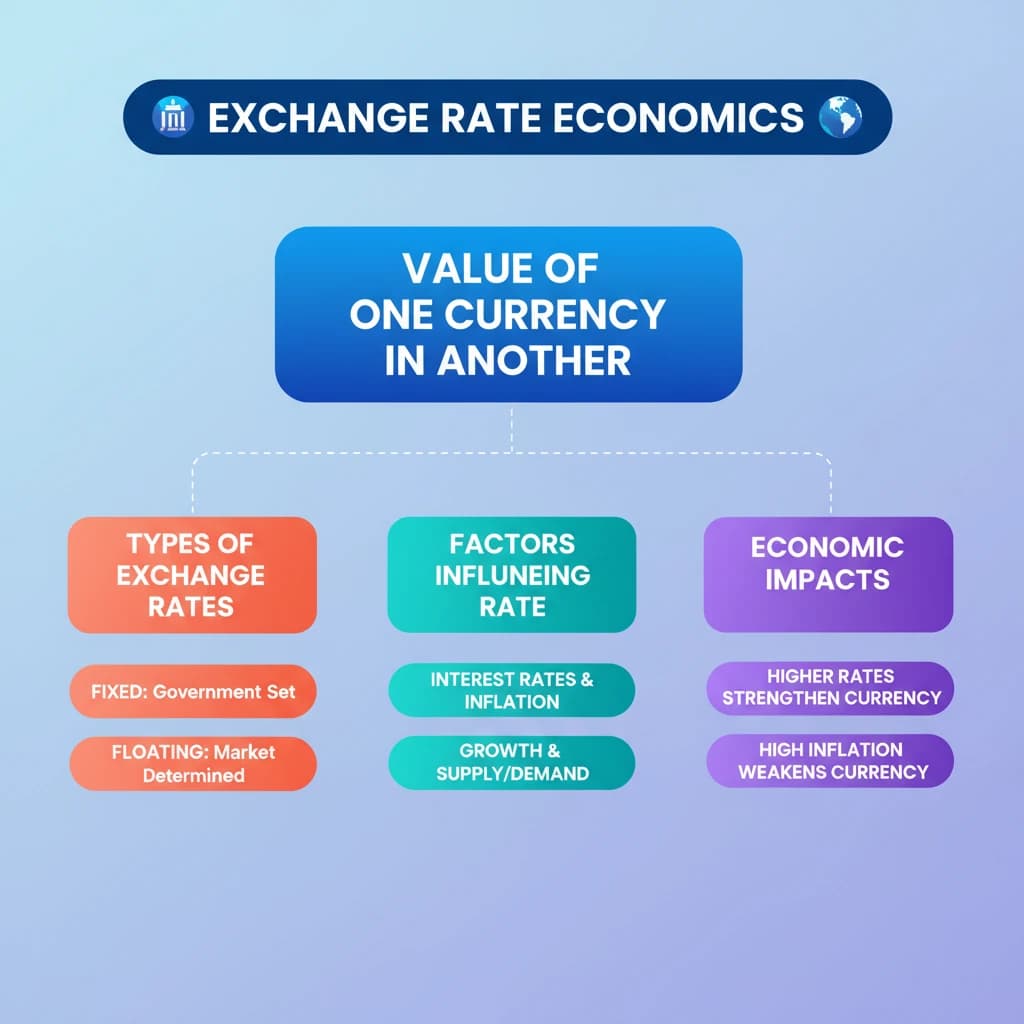
- Exchange rate is the value of one currency in terms of another.
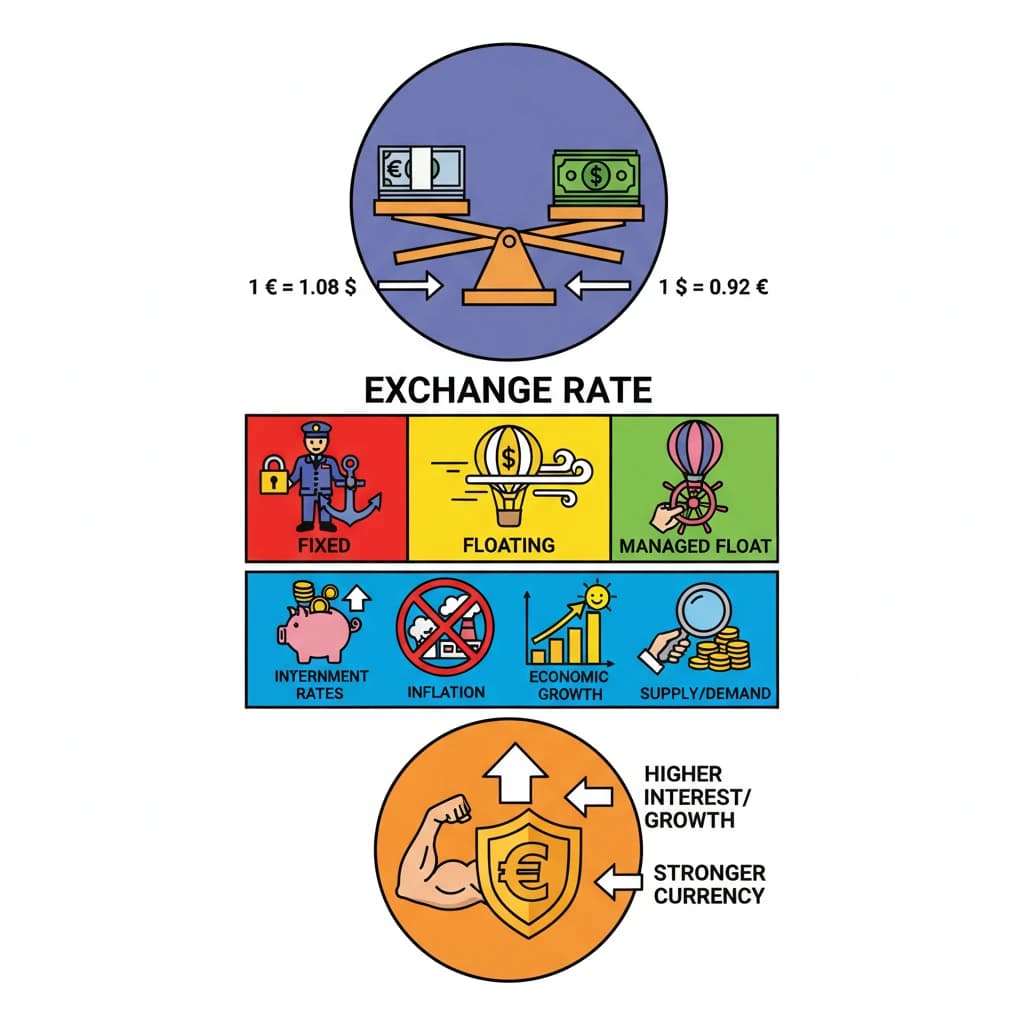
- Three main types: Fixed (government set), Floating (market determined), and Managed Float (mix of both).
- Key factors influencing exchange rates include interest rates, inflation, economic growth, and supply/demand.
- Higher interest rates and strong economic growth typically strengthen a currency.
- Higher inflation generally weakens a currency.
- Central banks often intervene in managed float systems to stabilize currency volatility.
What is an Exchange Rate?
Medium⏱️ 8 min read
economy
📖 Introduction
What is an Exchange Rate?
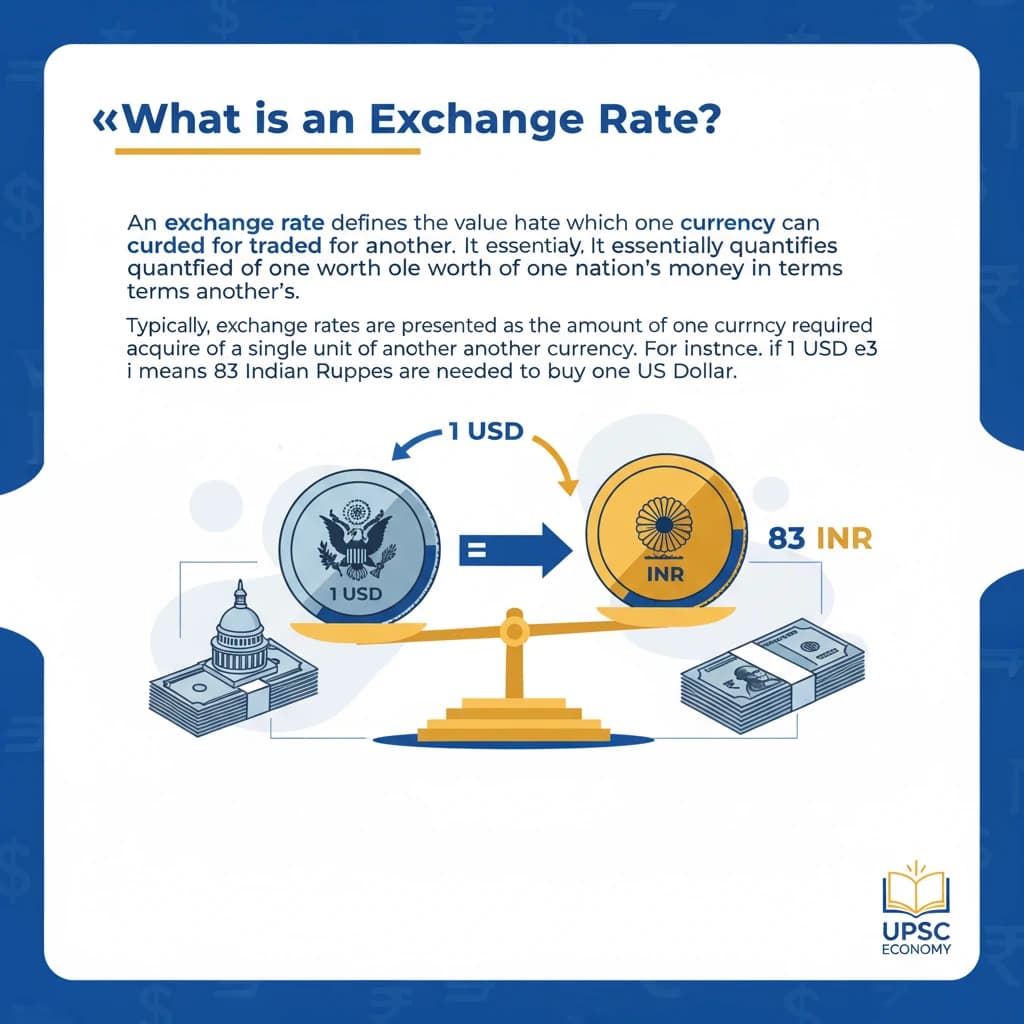
An exchange rate defines the value at which one currency can be traded for another. It essentially quantifies the worth of one nation's money in terms of another's.
Typically, exchange rates are presented as the amount of one currency required to acquire a single unit of another currency. For instance, if 1 USD equals 83 INR, it means 83 Indian Rupees are needed to buy one US Dollar.
Definition: An exchange rate is the rate at which one currency is converted into another, reflecting its relative value.
Types of Exchange Rate Regimes
Different countries adopt various systems to determine their currency's value. These regimes impact how exchange rates fluctuate and are managed.
1. Fixed Exchange Rate: In this system, governments or central banks establish a specific value for their currency relative to other currencies. They actively maintain this fixed value by intervening in the foreign exchange markets, buying or selling their own currency as needed.
2. Floating Exchange Rate: Here, the value of a currency is primarily determined by the forces of supply and demand within the forex market. Most major global currencies, such as the US Dollar and Euro, operate under this flexible system.
3. Managed Float: This system combines elements of both fixed and floating exchange rates. While the market generally determines the currency's value, governments or central banks intervene occasionally to stabilize excessive fluctuations or guide the currency towards a desired range.
Factors Affecting Exchange Rates
Several macroeconomic factors can significantly influence a currency's exchange rate, leading to appreciation or depreciation.
1. Interest Rates: Higher interest rates in a country tend to make its financial assets more attractive to foreign investors. This increased demand for the country's currency to invest leads to a stronger exchange rate.
2. Inflation: If a country experiences higher inflation compared to its trading partners, its goods and services become relatively more expensive. This reduces the purchasing power of its currency, causing it to weaken and its exchange rate to depreciate.
3. Economic Growth: A robust and growing economy fosters investor confidence and attracts foreign direct investment (FDI). This positive sentiment boosts demand for the country's currency, resulting in a stronger exchange rate.
4. Supply and Demand: The fundamental economic principle of supply and demand is crucial. If there is higher demand for a particular currency (e.g., due to increased exports or investment), its exchange rate will strengthen. Conversely, increased supply or reduced demand will weaken it.
UPSC Insight: Understanding the interplay of these factors is vital for questions on Balance of Payments, Monetary Policy, and International Trade. Be prepared to analyze scenarios where multiple factors influence the exchange rate simultaneously.
💡 Key Takeaways
- •Exchange rate is the value of one currency in terms of another.
- •Three main types: Fixed (government set), Floating (market determined), and Managed Float (mix of both).
- •Key factors influencing exchange rates include interest rates, inflation, economic growth, and supply/demand.
- •Higher interest rates and strong economic growth typically strengthen a currency.
- •Higher inflation generally weakens a currency.
- •Central banks often intervene in managed float systems to stabilize currency volatility.
🧠 Memory Techniques
98% Verified Content
📚 Reference Sources
•NCERT Class 12 Macroeconomics - Chapter 6: Open Economy Macroeconomics
•Reserve Bank of India (RBI) publications on Foreign Exchange Management
•IMF (International Monetary Fund) articles on Exchange Rate Regimes