Loading page, please wait…
What is Compressed Natural Gas? - UPSC Economy
What is What is Compressed Natural Gas? in UPSC Economy?
What is Compressed Natural Gas? is a key topic under Economy for UPSC Civil Services Examination. Key points include: CNG is natural gas compressed to 200-250 kg/cm², reducing its volume to less than 1%.. It primarily consists of 80-90% methane and remains in a gaseous state.. CNG differs from LPG (propane/butane mixture) and LNG (liquid natural gas).. Understanding this topic is essential for both UPSC Prelims and Mains preparation.
Why is What is Compressed Natural Gas? important for UPSC exam?
What is Compressed Natural Gas? is a Easy-level topic in UPSC Economy. It is tested in both Prelims (factual MCQs) and Mains (analytical answer writing). Previous year UPSC questions have frequently covered aspects of What is Compressed Natural Gas?, making it essential for comprehensive IAS preparation.
How to prepare What is Compressed Natural Gas? for UPSC?
To prepare What is Compressed Natural Gas? for UPSC: (1) Study the comprehensive notes covering all key concepts on Vaidra. (2) Practice previous year questions on this topic. (3) Connect it with current affairs using daily updates. (4) Revise using key takeaways and mind maps available for Economy. (5) Write practice answers linking What is Compressed Natural Gas? to related GS Paper topics.
Key takeaways of What is Compressed Natural Gas? for UPSC
- CNG is natural gas compressed to 200-250 kg/cm², reducing its volume to less than 1%.
- It primarily consists of 80-90% methane and remains in a gaseous state.
- CNG differs from LPG (propane/butane mixture) and LNG (liquid natural gas).
- BioCNG (biomethane) is a renewable, clean-burning fuel produced by upgrading biogas from organic waste.
- CNG and BioCNG are crucial for cleaner urban transport, reducing air pollution, and enhancing energy security.
What is Compressed Natural Gas?
Easy⏱️ 8 min read
economy
📖 Introduction
What is Compressed Natural Gas (CNG)?
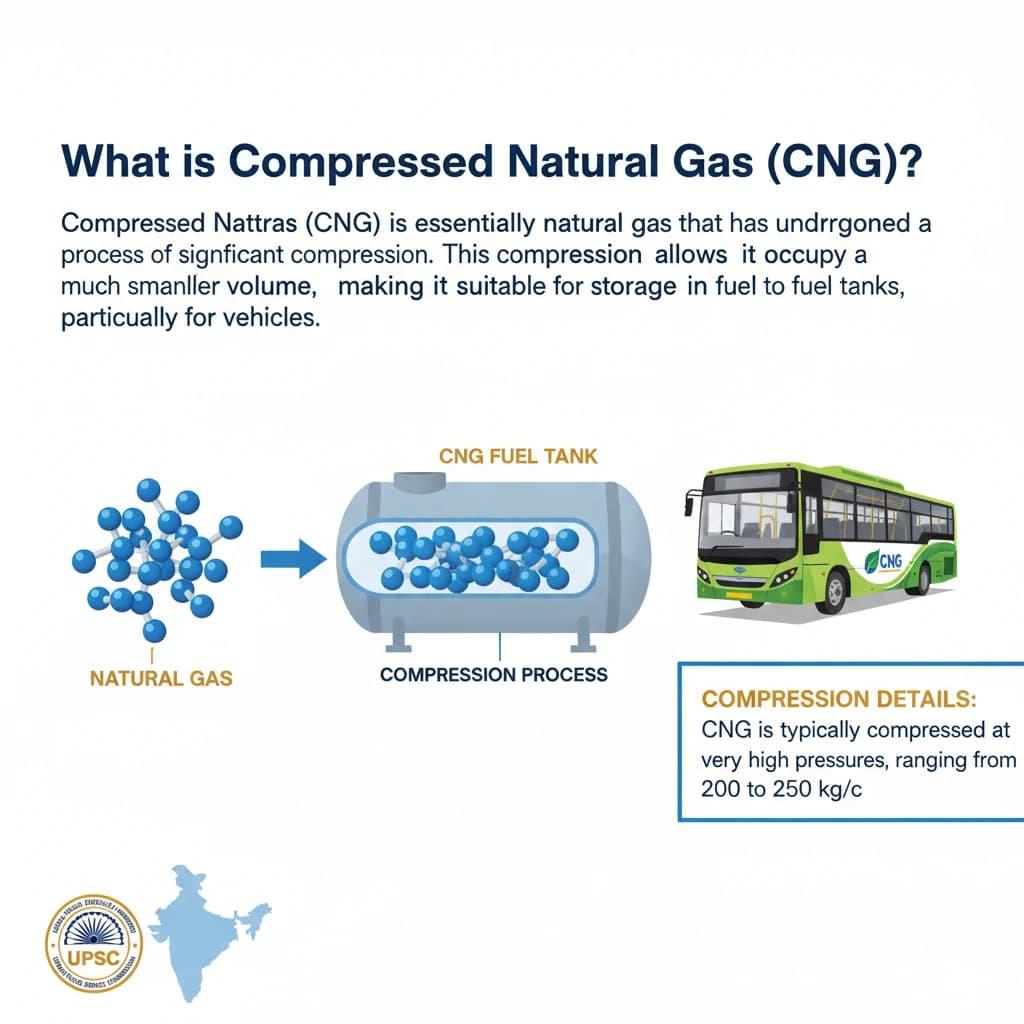
Compressed Natural Gas (CNG) is essentially natural gas that has undergone a process of significant compression. This compression allows it to occupy a much smaller volume, making it suitable for storage in fuel tanks, particularly for vehicles.
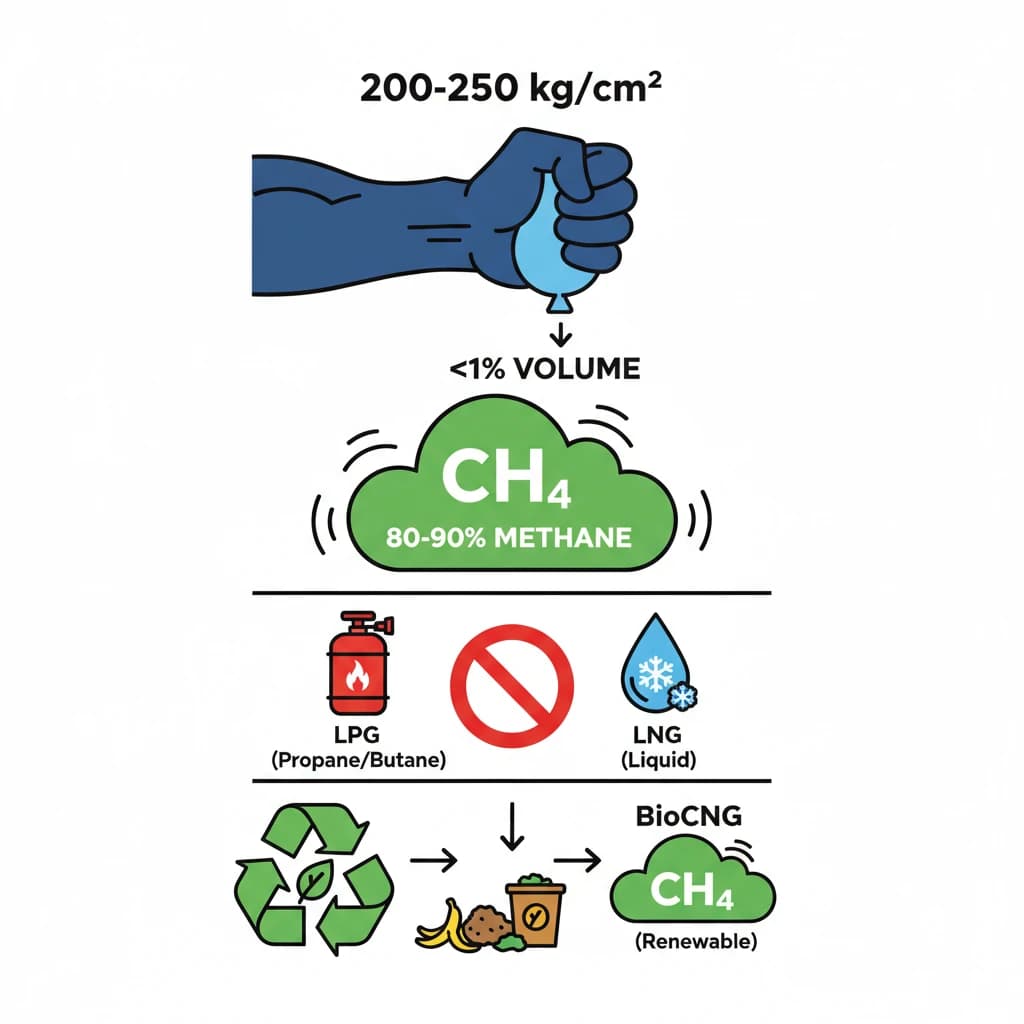
Compression Details: CNG is typically compressed at very high pressures, ranging from 200 to 250 kg/cm². This intense compression reduces its volume to less than 1% of its original size at atmospheric pressure, enabling efficient storage.
Composition of CNG
Unlike Liquefied Petroleum Gas (LPG), which is a blend of compressed propane and butane, CNG has a distinct composition. It primarily consists of methane, making up 80 to 90% of its content, and remains in a gaseous state even after compression.
CNG vs. LNG: Key Differences
The fundamental distinction between CNG and Liquefied Natural Gas (LNG) lies in their physical states. While CNG exists and is stored as a gas, LNG is natural gas cooled to an extremely low temperature to become a liquid, which is then regasified for use.
Physical State is Key: Remember that CNG is a gas under high pressure, whereas LNG is a liquid at cryogenic temperatures.
Understanding BioCNG
BioCNG, also known as biomethane, represents a renewable and environmentally friendly alternative. It is a clean-burning transportation fuel derived from organic waste materials.
The production of BioCNG involves upgrading biogas to achieve the same quality as conventional natural gas. This process makes it a sustainable fuel source, contributing to waste management and renewable energy goals.
BioCNG Attributes: It is a renewable fuel, produced from organic waste, and significantly contributes to reducing carbon footprint as a clean-burning fuel.
💡 Key Takeaways
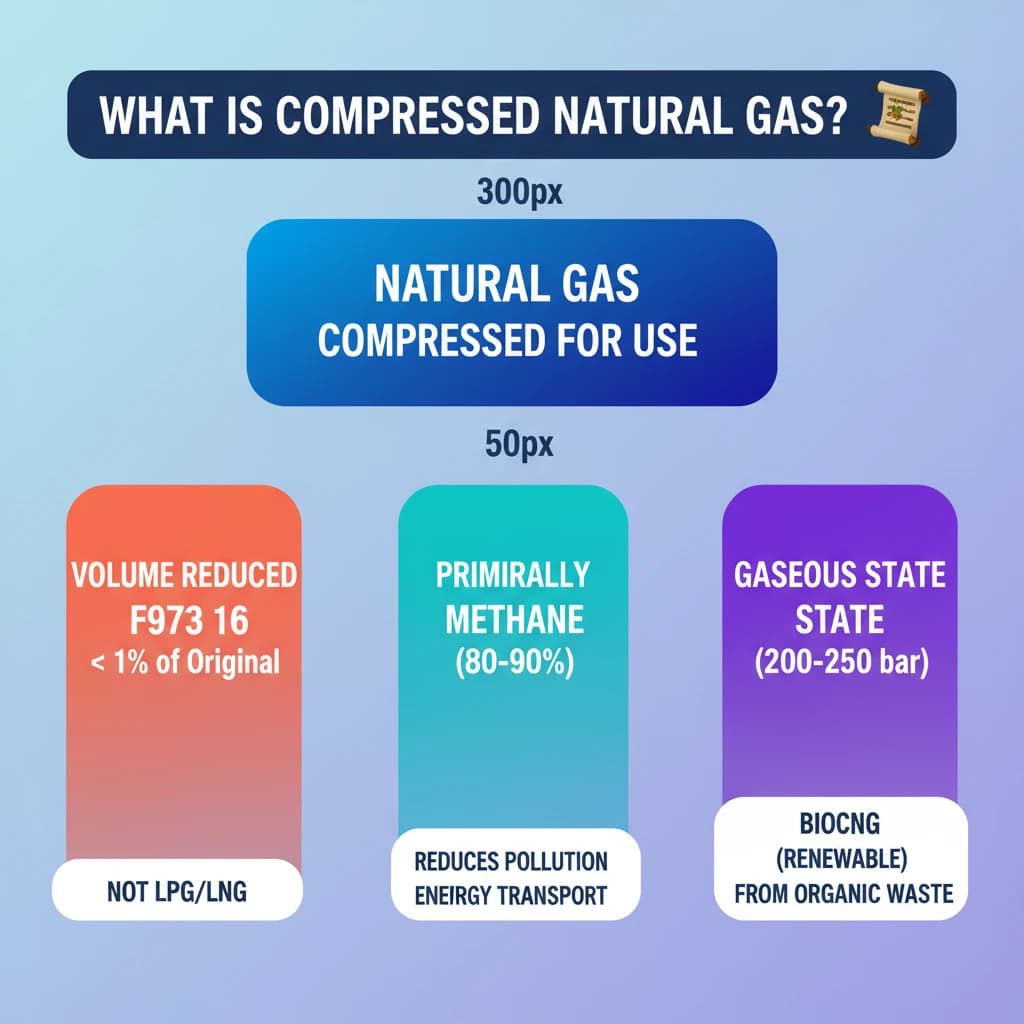
- •CNG is natural gas compressed to 200-250 kg/cm², reducing its volume to less than 1%.
- •It primarily consists of 80-90% methane and remains in a gaseous state.
- •CNG differs from LPG (propane/butane mixture) and LNG (liquid natural gas).
- •BioCNG (biomethane) is a renewable, clean-burning fuel produced by upgrading biogas from organic waste.
- •CNG and BioCNG are crucial for cleaner urban transport, reducing air pollution, and enhancing energy security.
🧠 Memory Techniques
98% Verified Content
📚 Reference Sources
•Ministry of Petroleum and Natural Gas, Government of India official reports
•Petroleum Planning & Analysis Cell (PPAC) data
•National Biofuel Policy 2018 document