Loading page, please wait…
What is Cryptocurrency and How does it Work? - UPSC Economy
What is What is Cryptocurrency and How does it Work? in UPSC Economy?
What is Cryptocurrency and How does it Work? is a key topic under Economy for UPSC Civil Services Examination. Key points include: Cryptocurrency is a decentralised digital currency secured by cryptography.. All transactions are recorded on a public digital ledger called the blockchain.. Decentralisation and cryptography make manipulation or alteration of transactions difficult.. Understanding this topic is essential for both UPSC Prelims and Mains preparation.
Why is What is Cryptocurrency and How does it Work? important for UPSC exam?
What is Cryptocurrency and How does it Work? is a Medium-level topic in UPSC Economy. It is tested in both Prelims (factual MCQs) and Mains (analytical answer writing). Previous year UPSC questions have frequently covered aspects of What is Cryptocurrency and How does it Work?, making it essential for comprehensive IAS preparation.
How to prepare What is Cryptocurrency and How does it Work? for UPSC?
To prepare What is Cryptocurrency and How does it Work? for UPSC: (1) Study the comprehensive notes covering all key concepts on Vaidra. (2) Practice previous year questions on this topic. (3) Connect it with current affairs using daily updates. (4) Revise using key takeaways and mind maps available for Economy. (5) Write practice answers linking What is Cryptocurrency and How does it Work? to related GS Paper topics.
Key takeaways of What is Cryptocurrency and How does it Work? for UPSC
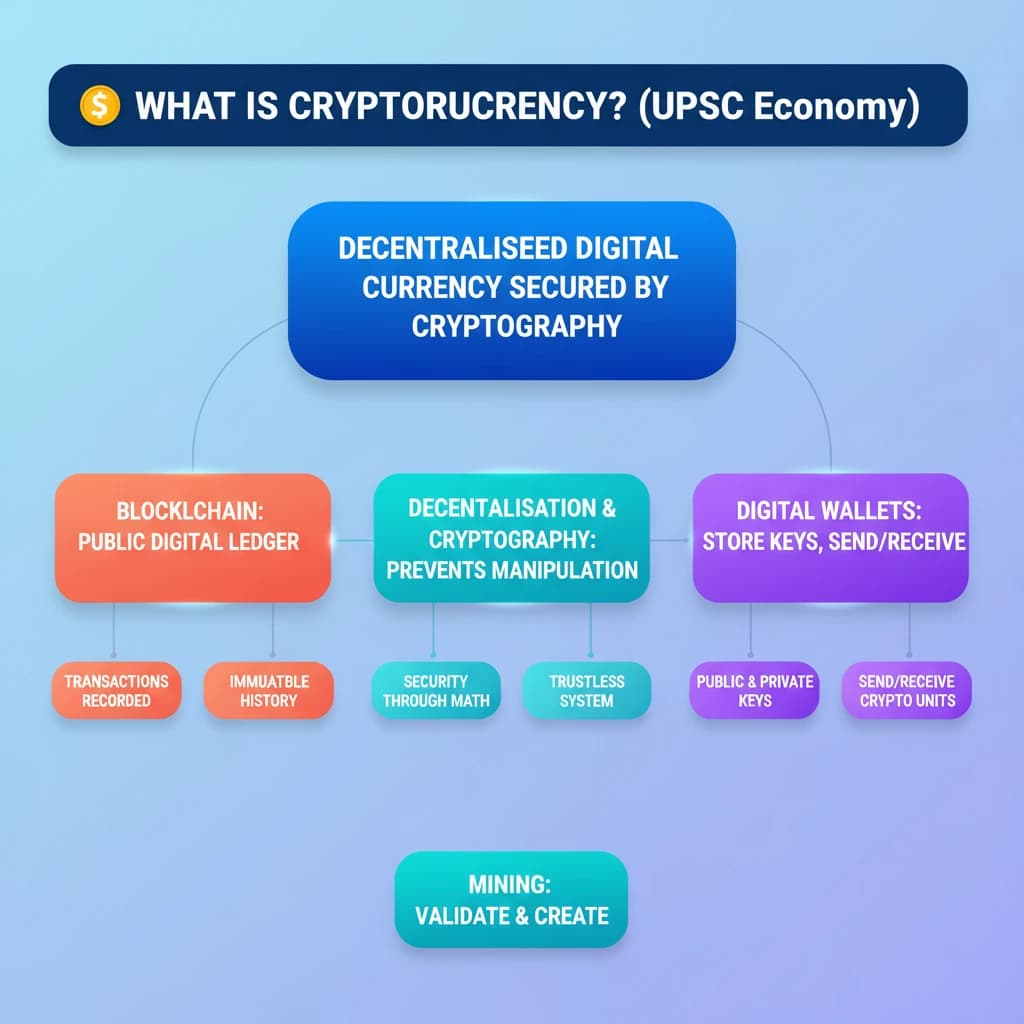
- Cryptocurrency is a decentralised digital currency secured by cryptography.
- All transactions are recorded on a public digital ledger called the blockchain.
- Decentralisation and cryptography make manipulation or alteration of transactions difficult.
- Digital wallets store public and private keys for sending/receiving crypto.
- Mining involves solving complex problems to validate transactions and create new units.
- Examples include Bitcoin, Ethereum, Ripple, and Litecoin.

What is Cryptocurrency and How does it Work?
Medium⏱️ 8 min read
economy
📖 Introduction
What is Cryptocurrency?
A cryptocurrency is a decentralised digital or virtual currency. It employs cryptography to ensure the security of its transactions and to control the creation of new units.
Unlike traditional currencies issued by central banks, cryptocurrencies operate independently of central authorities.
Examples of Cryptocurrencies:
- Bitcoin (BTC)
- Ethereum (ETH)
- Ripple (XRP)
- Litecoin (LTC)
How Cryptocurrency Transactions Work: The Blockchain
All cryptocurrency transactions are recorded on a public digital ledger known as the blockchain. This ledger is an immutable and transparent record of every transaction ever made.
The blockchain is maintained by a vast, decentralised network of computers spread globally. These computers work together to verify and add new transactions to the chain.
The combination of decentralisation and advanced cryptographic techniques makes it extremely difficult for any single entity to manipulate the currency or alter transactions once they are recorded on the blockchain.
Digital Wallets: Your Gateway to Crypto
To participate in cryptocurrency transactions, individuals or businesses need a digital wallet. This is a software application designed to securely store a user's public and private keys.
These keys are fundamental for sending and receiving cryptocurrency. They are also essential for verifying transactions on the blockchain, ensuring only the rightful owner can initiate transfers.
Cryptocurrency Mining: Creating New Units
New cryptocurrencies are typically generated through a process called mining. This involves using significant computational power to solve complex mathematical problems.
The mining process serves a dual purpose: it validates and records new transactions onto the blockchain, and in return, the successful 'miner' is rewarded with a certain amount of cryptocurrency.
UPSC Insight: Understanding decentralisation, blockchain technology, and cryptography is crucial. These concepts have broader implications for digital governance and cybersecurity, often appearing in GS Paper III.
💡 Key Takeaways
- •Cryptocurrency is a decentralised digital currency secured by cryptography.
- •All transactions are recorded on a public digital ledger called the blockchain.
- •Decentralisation and cryptography make manipulation or alteration of transactions difficult.
- •Digital wallets store public and private keys for sending/receiving crypto.
- •Mining involves solving complex problems to validate transactions and create new units.
- •Examples include Bitcoin, Ethereum, Ripple, and Litecoin.
🧠 Memory Techniques

95% Verified Content