Loading page, please wait…
What is Effective Exchange Rate (EER)? - UPSC Economy
What is What is Effective Exchange Rate (EER)? in UPSC Economy?
What is Effective Exchange Rate (EER)? is a key topic under Economy for UPSC Civil Services Examination. Key points include: EER is a weighted average of a currency's exchange rates against a basket of others, adjusted for inflation and trade.. NEER is a type of EER that does NOT adjust for inflation, measuring only nominal changes.. Currency weights for EER/NEER are based on trade shares with partner countries.. Understanding this topic is essential for both UPSC Prelims and Mains preparation.
Why is What is Effective Exchange Rate (EER)? important for UPSC exam?
What is Effective Exchange Rate (EER)? is a Medium-level topic in UPSC Economy. It is tested in both Prelims (factual MCQs) and Mains (analytical answer writing). Previous year UPSC questions have frequently covered aspects of What is Effective Exchange Rate (EER)?, making it essential for comprehensive IAS preparation.
How to prepare What is Effective Exchange Rate (EER)? for UPSC?
To prepare What is Effective Exchange Rate (EER)? for UPSC: (1) Study the comprehensive notes covering all key concepts on Vaidra. (2) Practice previous year questions on this topic. (3) Connect it with current affairs using daily updates. (4) Revise using key takeaways and mind maps available for Economy. (5) Write practice answers linking What is Effective Exchange Rate (EER)? to related GS Paper topics.
Key takeaways of What is Effective Exchange Rate (EER)? for UPSC
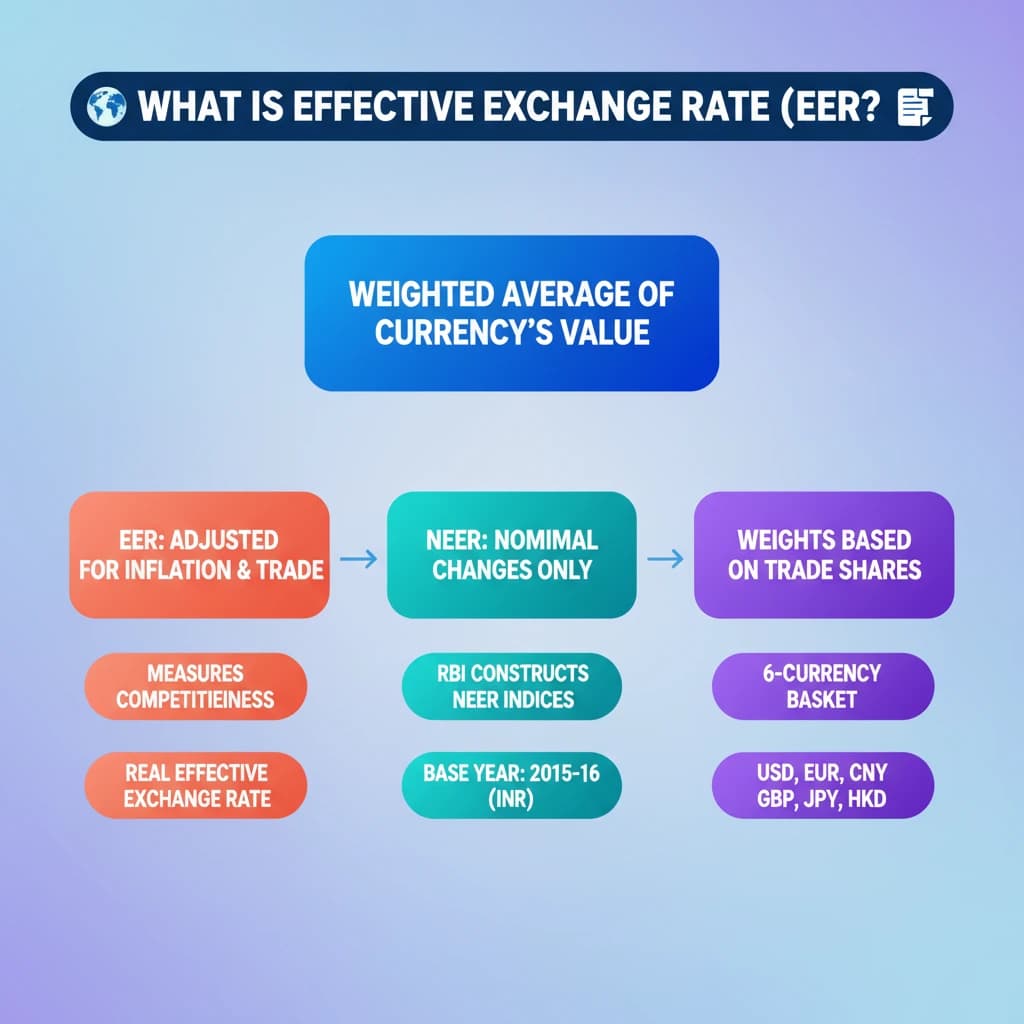
- EER is a weighted average of a currency's exchange rates against a basket of others, adjusted for inflation and trade.
- NEER is a type of EER that does NOT adjust for inflation, measuring only nominal changes.
- Currency weights for EER/NEER are based on trade shares with partner countries.
- RBI constructs NEER indices for the Indian Rupee, with 2015-16 as the base year.
- The 6-currency basket for RBI's NEER includes USD, Euro, CNY, GBP, JPY, and HKD.
- EER/NEER is crucial for assessing trade competitiveness, imported inflation, and guiding monetary policy.

What is Effective Exchange Rate (EER)?
Medium⏱️ 8 min read
economy
📖 Introduction
Understanding Effective Exchange Rate (EER)
The Effective Exchange Rate (EER) of a currency, such as the Indian Rupee, is a crucial economic indicator. It represents a weighted average of its exchange rates against a basket of other major currencies.
This calculation is typically adjusted for inflation and also considers the country's overall trade competitiveness. It provides a more holistic view than a simple bilateral exchange rate.
Key Principle: The currency weights used in EER calculation are derived from the share of individual countries in India’s total foreign trade. This ensures the index reflects actual trade patterns.
Nominal Effective Exchange Rate (NEER)
The Nominal Effective Exchange Rate (NEER) is a specific type of EER. It is calculated as a simple average of bilateral exchange rates between the domestic currency and the currencies of its major trading partners.
These bilateral rates are also weighted by their respective trade shares. A critical distinction is that NEER measures the overall strength or weakness of a currency without adjusting for inflation.
NEER vs. EER: While EER generally implies inflation adjustment, NEER specifically excludes inflation adjustment, focusing solely on nominal exchange rate movements against a basket of currencies.
NEER Indices and Base Values
NEER indices are typically presented with reference to a base value of 100. This allows for easy comparison of currency movements over time.
For India, the base year for NEER indices is 2015-16. This provides a consistent benchmark for evaluating the rupee's performance.
RBI's NEER Indices for the Rupee
The Reserve Bank of India (RBI) is responsible for constructing and publishing NEER indices for the Indian Rupee. These indices are calculated against different baskets of currencies.
The RBI has constructed NEER indices of the rupee against two different baskets of currencies, though the source specifically details one prominent basket.
The 6-Currency Basket
One of the key baskets used by the RBI for NEER calculation is the 6-Currency Basket. This is a trade-weighted average rate at which the rupee is exchangeable with these specific currencies.
Currencies in the 6-Currency Basket:
- US dollar
- Euro
- Chinese yuan
- British pound
- Japanese yen
- Hong Kong dollar
UPSC Insight: Understanding NEER and its components is vital for GS Paper III (Economy). Questions often relate to its impact on trade, inflation, and RBI policy. Be prepared to explain the difference between nominal and real effective exchange rates.
💡 Key Takeaways
- •EER is a weighted average of a currency's exchange rates against a basket of others, adjusted for inflation and trade.
- •NEER is a type of EER that does NOT adjust for inflation, measuring only nominal changes.
- •Currency weights for EER/NEER are based on trade shares with partner countries.
- •RBI constructs NEER indices for the Indian Rupee, with 2015-16 as the base year.
- •The 6-currency basket for RBI's NEER includes USD, Euro, CNY, GBP, JPY, and HKD.
- •EER/NEER is crucial for assessing trade competitiveness, imported inflation, and guiding monetary policy.
🧠 Memory Techniques

95% Verified Content
📚 Reference Sources
•Reserve Bank of India (RBI) publications on Exchange Rate Management