Loading page, please wait…
What is Green Gross Domestic Product (Green GDP)? - UPSC Economy
What is What is Green Gross Domestic Product (Green GDP)? in UPSC Economy?
What is Green Gross Domestic Product (Green GDP)? is a key topic under Economy for UPSC Civil Services Examination. Key points include: Traditional GDP measures economic output but ignores environmental costs.. Green GDP adjusts traditional GDP by subtracting costs of natural resource depletion and environmental degradation.. Simon Kuznets, GDP's creator, acknowledged its limitations regarding welfare and environment.. Understanding this topic is essential for both UPSC Prelims and Mains preparation.
Why is What is Green Gross Domestic Product (Green GDP)? important for UPSC exam?
What is Green Gross Domestic Product (Green GDP)? is a Medium-level topic in UPSC Economy. It is tested in both Prelims (factual MCQs) and Mains (analytical answer writing). Previous year UPSC questions have frequently covered aspects of What is Green Gross Domestic Product (Green GDP)?, making it essential for comprehensive IAS preparation.
How to prepare What is Green Gross Domestic Product (Green GDP)? for UPSC?
To prepare What is Green Gross Domestic Product (Green GDP)? for UPSC: (1) Study the comprehensive notes covering all key concepts on Vaidra. (2) Practice previous year questions on this topic. (3) Connect it with current affairs using daily updates. (4) Revise using key takeaways and mind maps available for Economy. (5) Write practice answers linking What is Green Gross Domestic Product (Green GDP)? to related GS Paper topics.
Key takeaways of What is Green Gross Domestic Product (Green GDP)? for UPSC
- Traditional GDP measures economic output but ignores environmental costs.
- Green GDP adjusts traditional GDP by subtracting costs of natural resource depletion and environmental degradation.
- Simon Kuznets, GDP's creator, acknowledged its limitations regarding welfare and environment.
- Green GDP aims to provide a more holistic measure of national welfare and sustainable economic progress.
- It is crucial for informed policy-making towards sustainable development and resource conservation.
What is Green Gross Domestic Product (Green GDP)?
Medium⏱️ 6 min read
economy
📖 Introduction
What is Green Gross Domestic Product (Green GDP)?
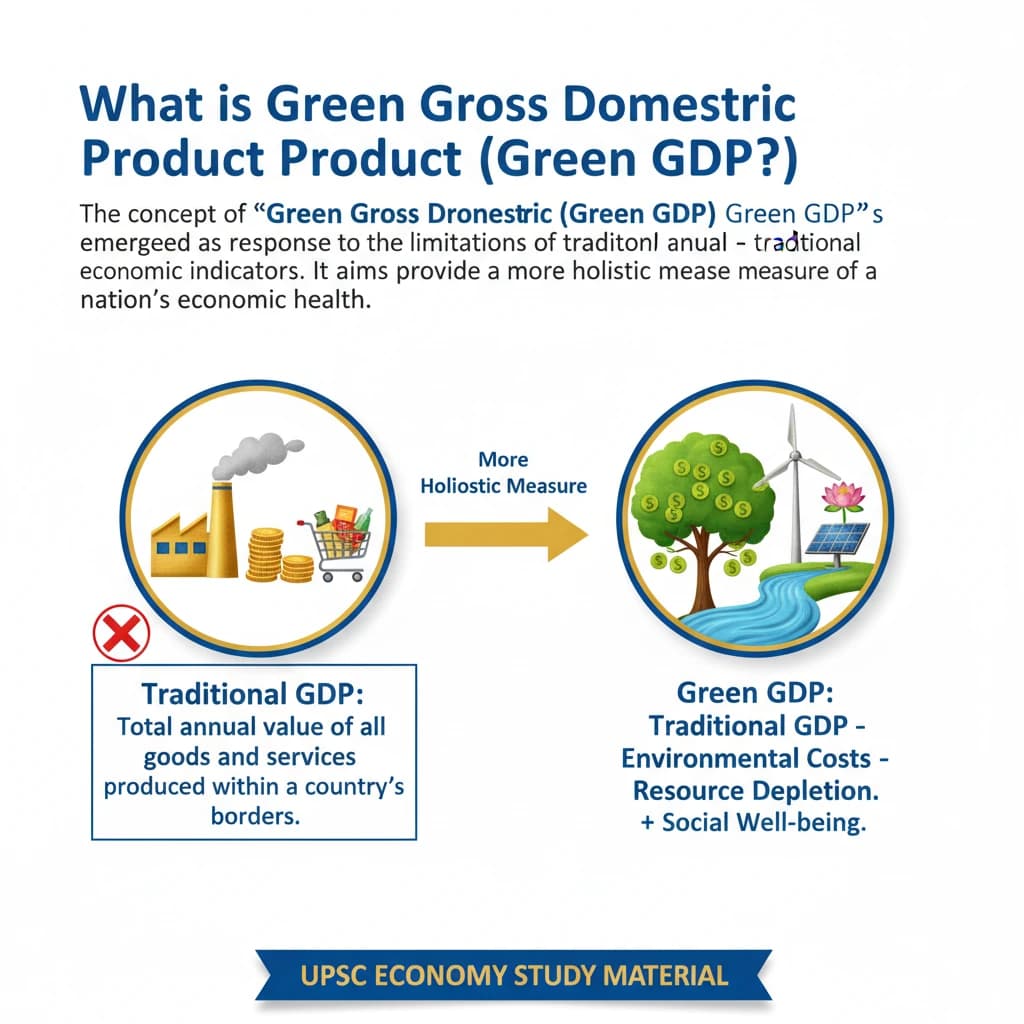
The concept of Green Gross Domestic Product (Green GDP) emerged as a response to the limitations of traditional economic indicators. It aims to provide a more holistic measure of a nation's economic health.
Traditional GDP: This metric represents the total annual value of all goods and services produced within a country's borders. It has served as the global standard for economic measurement since 1944.
However, the creator of GDP, economist Simon Kuznets, himself acknowledged its shortcomings. He stated that GDP does not accurately reflect a nation's true welfare.
This is because traditional GDP overlooks crucial aspects such as environmental health and overall social well-being, focusing purely on economic output.
Green GDP: This is a modified version of the conventional GDP. Its primary objective is to incorporate the environmental costs associated with economic activities into the national accounting framework.
It explicitly accounts for negative externalities. These include factors like the depletion of natural resources, the extent of environmental degradation, and the loss of biodiversity resulting from production and consumption.
Understanding the distinction between Traditional GDP and Green GDP is vital for UPSC Mains GS-III (Economy & Environment). Questions often revolve around sustainable development indicators.
💡 Key Takeaways
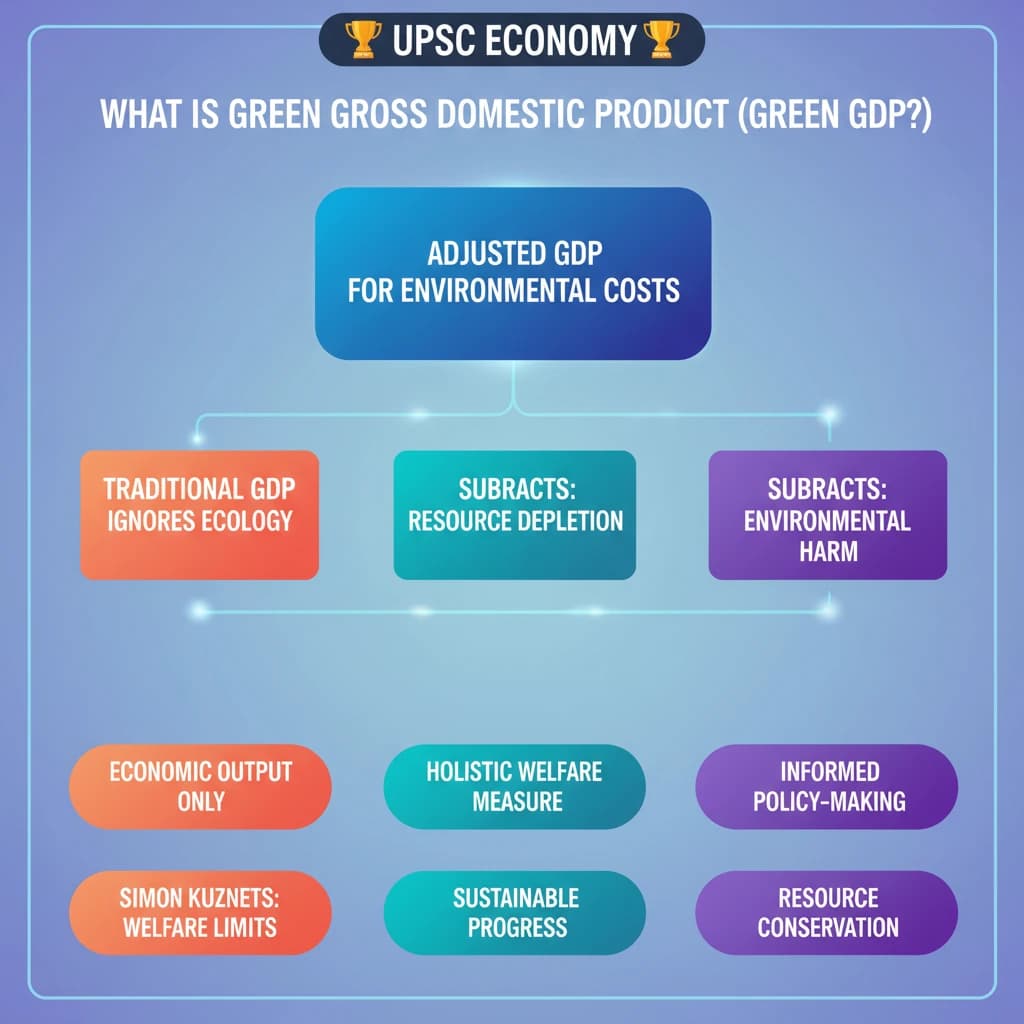
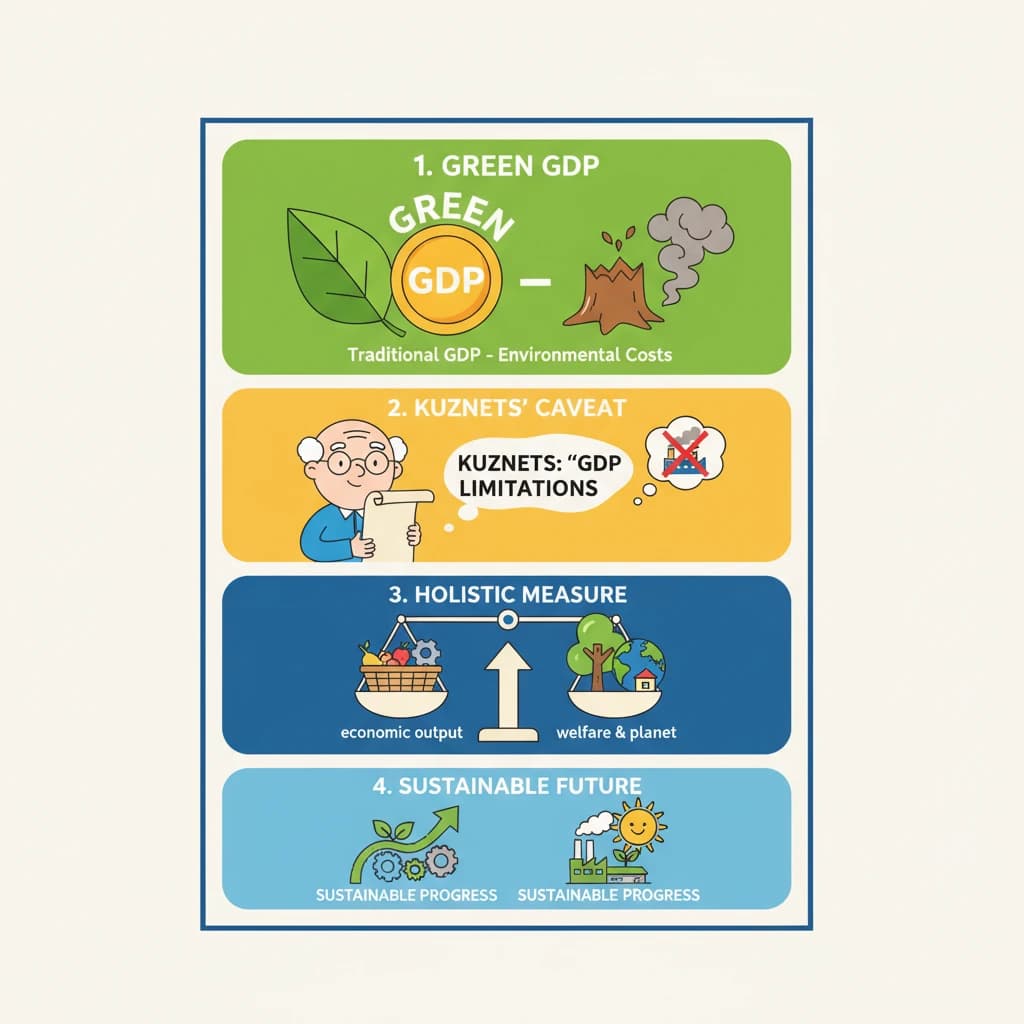
- •Traditional GDP measures economic output but ignores environmental costs.
- •Green GDP adjusts traditional GDP by subtracting costs of natural resource depletion and environmental degradation.
- •Simon Kuznets, GDP's creator, acknowledged its limitations regarding welfare and environment.
- •Green GDP aims to provide a more holistic measure of national welfare and sustainable economic progress.
- •It is crucial for informed policy-making towards sustainable development and resource conservation.
🧠 Memory Techniques
95% Verified Content
📚 Reference Sources
•United Nations Environment Programme (UNEP) reports on Green Economy
•World Bank publications on environmental accounting