Loading page, please wait…
What is NEER and REER, and their Significance? - UPSC Economy
What is What is NEER and REER, and their Significance? in UPSC Economy?
What is NEER and REER, and their Significance? is a key topic under Economy for UPSC Civil Services Examination. Key points include: NEER is the Nominal Effective Exchange Rate, a weighted average of bilateral exchange rates, reflecting nominal currency strength.. REER is the Real Effective Exchange Rate, which adjusts NEER for relative inflation, reflecting real purchasing power and competitiveness.. A rising NEER indicates nominal appreciation; a rising REER indicates a loss of real competitiveness (exports become more expensive).. Understanding this topic is essential for both UPSC Prelims and Mains preparation.
Why is What is NEER and REER, and their Significance? important for UPSC exam?
What is NEER and REER, and their Significance? is a Medium-level topic in UPSC Economy. It is tested in both Prelims (factual MCQs) and Mains (analytical answer writing). Previous year UPSC questions have frequently covered aspects of What is NEER and REER, and their Significance?, making it essential for comprehensive IAS preparation.
How to prepare What is NEER and REER, and their Significance? for UPSC?
To prepare What is NEER and REER, and their Significance? for UPSC: (1) Study the comprehensive notes covering all key concepts on Vaidra. (2) Practice previous year questions on this topic. (3) Connect it with current affairs using daily updates. (4) Revise using key takeaways and mind maps available for Economy. (5) Write practice answers linking What is NEER and REER, and their Significance? to related GS Paper topics.
Key takeaways of What is NEER and REER, and their Significance? for UPSC
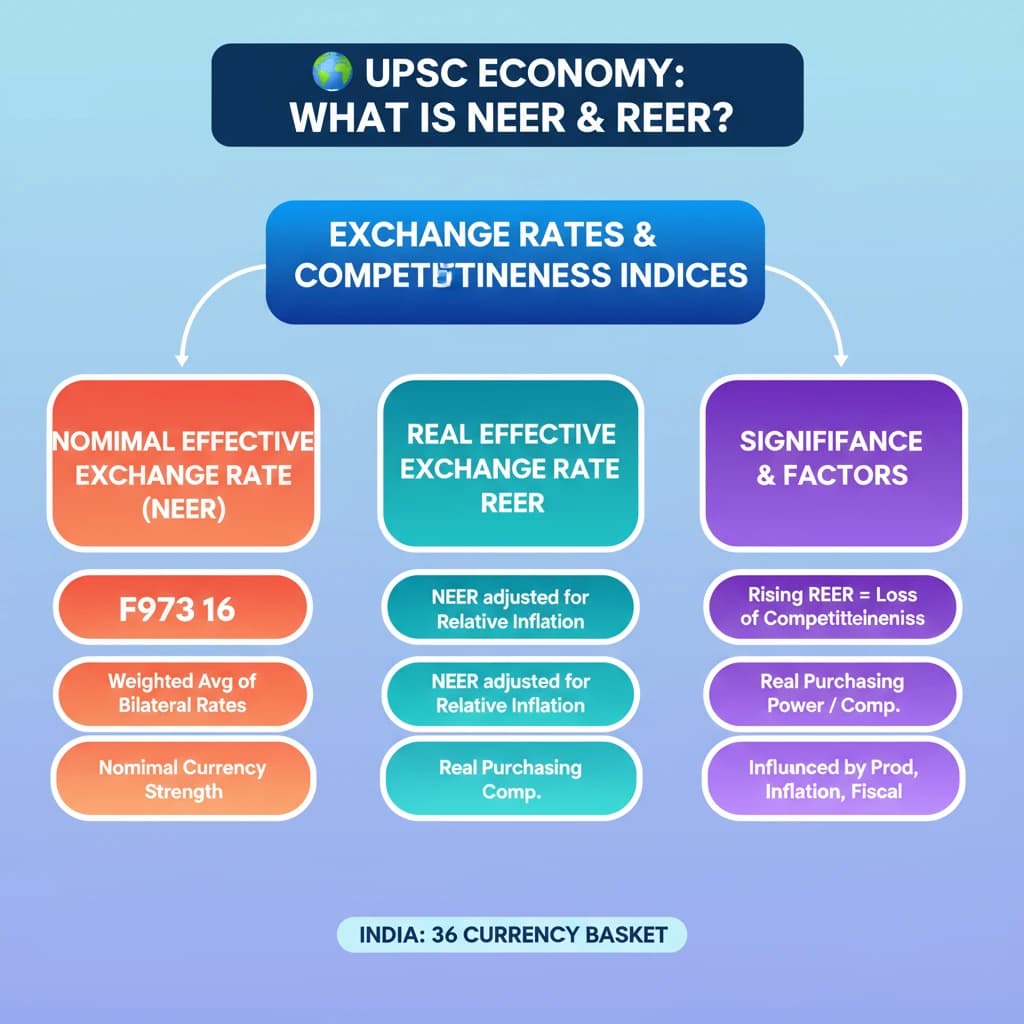
- NEER is the Nominal Effective Exchange Rate, a weighted average of bilateral exchange rates, reflecting nominal currency strength.
- REER is the Real Effective Exchange Rate, which adjusts NEER for relative inflation, reflecting real purchasing power and competitiveness.
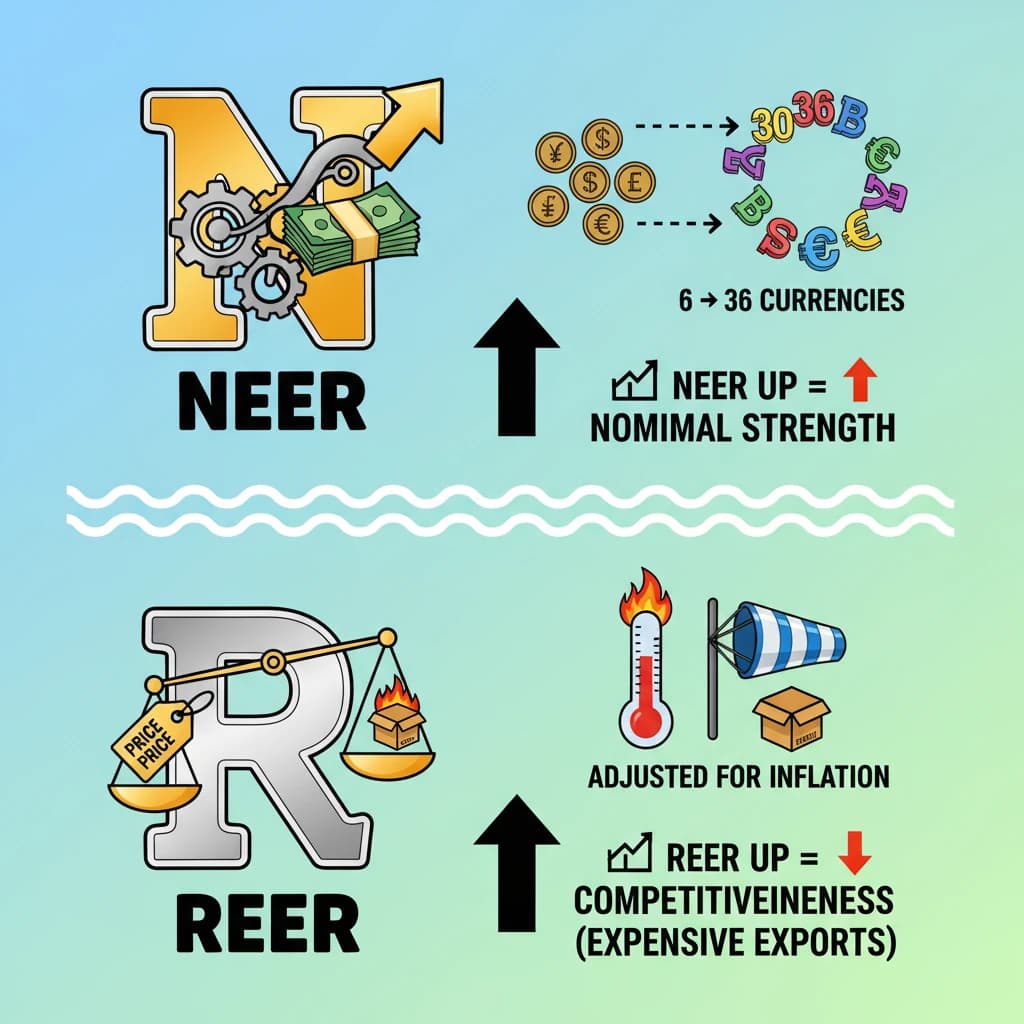
- A rising NEER indicates nominal appreciation; a rising REER indicates a loss of real competitiveness (exports become more expensive).
- India's NEER/REER indices now include a basket of 36 currencies, up from an initial 6.
- Factors like productivity, terms of trade, inflation, and fiscal spending influence NEER and REER trends.
- REER is a more accurate indicator of a country's trade competitiveness than NEER.
- RBI and policymakers use NEER/REER for monetary policy, trade analysis, and inflation management.

What is NEER and REER, and their Significance?
Medium⏱️ 8 min read
economy
📖 Introduction
Understanding Nominal Effective Exchange Rate (NEER)
The Nominal Effective Exchange Rate (NEER) serves as a crucial indicator of a currency's overall strength against a basket of other currencies. It provides a weighted average perspective.
Definition: NEER is a weighted average of a currency’s bilateral exchange rates relative to multiple trading partner currencies.
This measure reflects the nominal currency strength without considering the impact of inflation or existing price level differences across countries.
A sustained rise in the NEER signifies a nominal appreciation of the domestic currency. Conversely, a fall indicates a nominal depreciation against the basket of currencies.
Understanding Real Effective Exchange Rate (REER)
The Real Effective Exchange Rate (REER) offers a more refined and economically meaningful measure compared to NEER. It adjusts for crucial macroeconomic factors.
Definition: REER improves upon NEER by adjusting for relative price levels (inflation) between the domestic economy and its trading partners.
This adjustment makes REER a purchasing power parity (PPP)-adjusted measure. It provides a better indication of a country's international competitiveness.
The calculation for REER involves multiplying the NEER by the ratio of domestic price indices to foreign price indices. This accounts for inflation differentials.
Key Distinction: While NEER shows nominal currency movement, REER reflects the real competitiveness and purchasing power of a currency, factoring in inflation.
Evolution of NEER/REER Indices for India
The basket of currencies used to calculate India's NEER/REER indices has been periodically updated to reflect changing trade patterns and economic realities.
Initially, the NEER/REER indices for India included six major currencies:
- US Dollar (USD)
- Euro (EUR)
- Japanese Yen (JPY)
- British Pound (GBP)
- Chinese Yuan (CNY)
- Singapore Dollar (SGD)
These indices have since been revised to include a broader basket of 36 currencies. This expansion provides a more comprehensive and representative picture of India's trade-weighted currency performance.
Factors Influencing NEER and REER
Several economic variables can significantly impact the trends observed in both NEER and REER. These factors highlight the dynamic nature of exchange rates.
- Productivity Differences: Variations in productivity between countries affect their competitiveness in global markets. Higher productivity can lead to currency appreciation.
- Terms of Trade: Changes in the ratio of export prices to import prices can influence a country's export/import balance. Favorable terms of trade can strengthen the currency.
- Inflation: Higher domestic inflation relative to trading partners can erode a currency's real value, leading to a fall in REER, even if NEER remains stable or appreciates nominally.
- Fiscal Spending: Government spending policies can affect economic stability, demand, and ultimately, the currency's value. Large fiscal deficits can put downward pressure on the currency.
💡 Key Takeaways
- •NEER is the Nominal Effective Exchange Rate, a weighted average of bilateral exchange rates, reflecting nominal currency strength.
- •REER is the Real Effective Exchange Rate, which adjusts NEER for relative inflation, reflecting real purchasing power and competitiveness.
- •A rising NEER indicates nominal appreciation; a rising REER indicates a loss of real competitiveness (exports become more expensive).
- •India's NEER/REER indices now include a basket of 36 currencies, up from an initial 6.
- •Factors like productivity, terms of trade, inflation, and fiscal spending influence NEER and REER trends.
- •REER is a more accurate indicator of a country's trade competitiveness than NEER.
- •RBI and policymakers use NEER/REER for monetary policy, trade analysis, and inflation management.
🧠 Memory Techniques
98% Verified Content
📚 Reference Sources
•Economic Survey of India (Various Editions)
•Ministry of Finance, Government of India Documents
•Standard Macroeconomics Textbooks (e.g., Dornbusch, Fischer, Startz; Mankiw)