Loading page, please wait…
What is the Divisible Pool of Taxes? - UPSC Economy
What is What is the Divisible Pool of Taxes? in UPSC Economy?
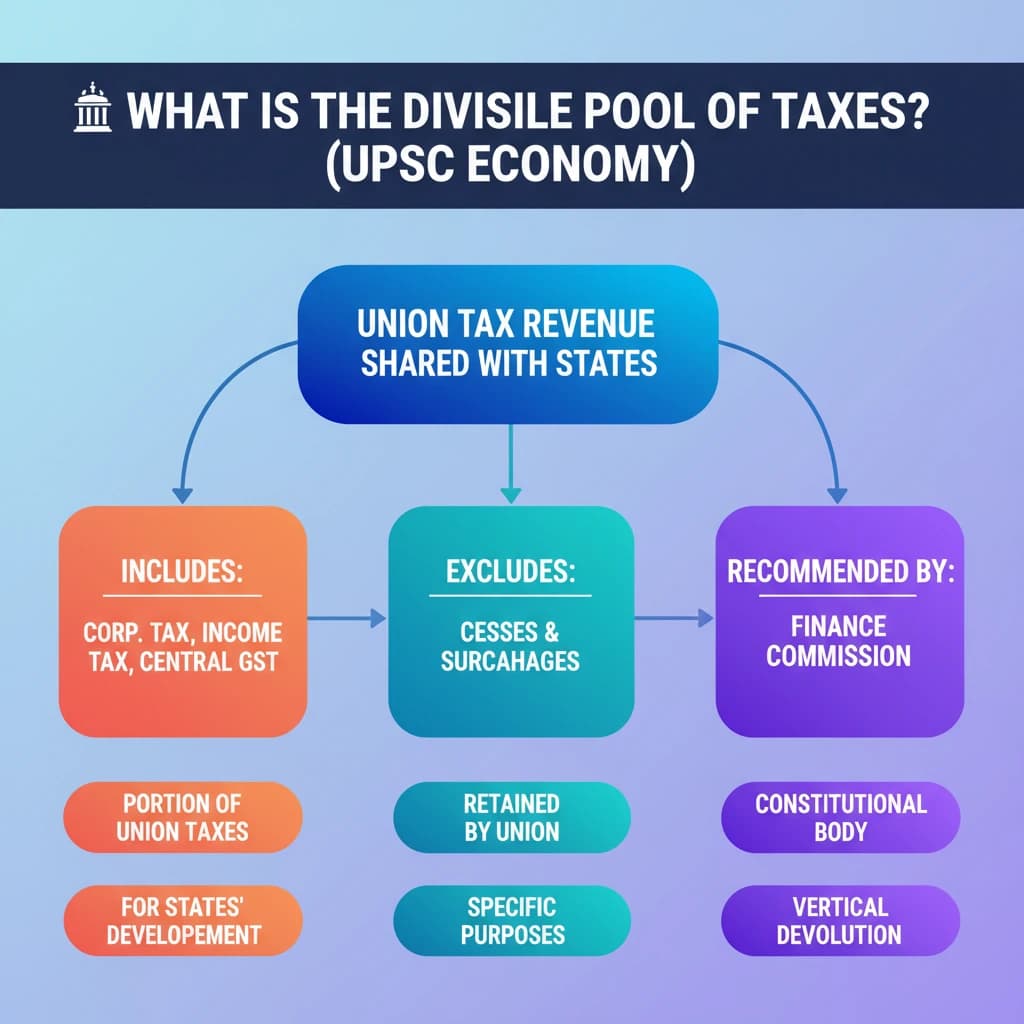
What is the Divisible Pool of Taxes? is a key topic under Economy for UPSC Civil Services Examination. Key points include: Divisible Pool: Portion of Union tax revenue shared with states.. Includes: Corporation Tax, Personal Income Tax, Central GST.. Excludes: Cesses and Surcharges (retained by Union).. Understanding this topic is essential for both UPSC Prelims and Mains preparation.
Why is What is the Divisible Pool of Taxes? important for UPSC exam?
What is the Divisible Pool of Taxes? is a Medium-level topic in UPSC Economy. It is tested in both Prelims (factual MCQs) and Mains (analytical answer writing). Previous year UPSC questions have frequently covered aspects of What is the Divisible Pool of Taxes?, making it essential for comprehensive IAS preparation.
How to prepare What is the Divisible Pool of Taxes? for UPSC?
To prepare What is the Divisible Pool of Taxes? for UPSC: (1) Study the comprehensive notes covering all key concepts on Vaidra. (2) Practice previous year questions on this topic. (3) Connect it with current affairs using daily updates. (4) Revise using key takeaways and mind maps available for Economy. (5) Write practice answers linking What is the Divisible Pool of Taxes? to related GS Paper topics.
Key takeaways of What is the Divisible Pool of Taxes? for UPSC
- Divisible Pool: Portion of Union tax revenue shared with states.
- Includes: Corporation Tax, Personal Income Tax, Central GST.
- Excludes: Cesses and Surcharges (retained by Union).
- Finance Commission: Constitutional body recommending distribution every five years.
- Vertical Devolution: Union vs. States' collective share.
- Horizontal Devolution: Distribution among individual states based on criteria (e.g., income distance, population, area, tax effort).
- Crucial for fiscal federalism and state financial autonomy.
What is the Divisible Pool of Taxes?
Medium⏱️ 8 min read
economy
📖 Introduction
Understanding the Divisible Pool of Taxes
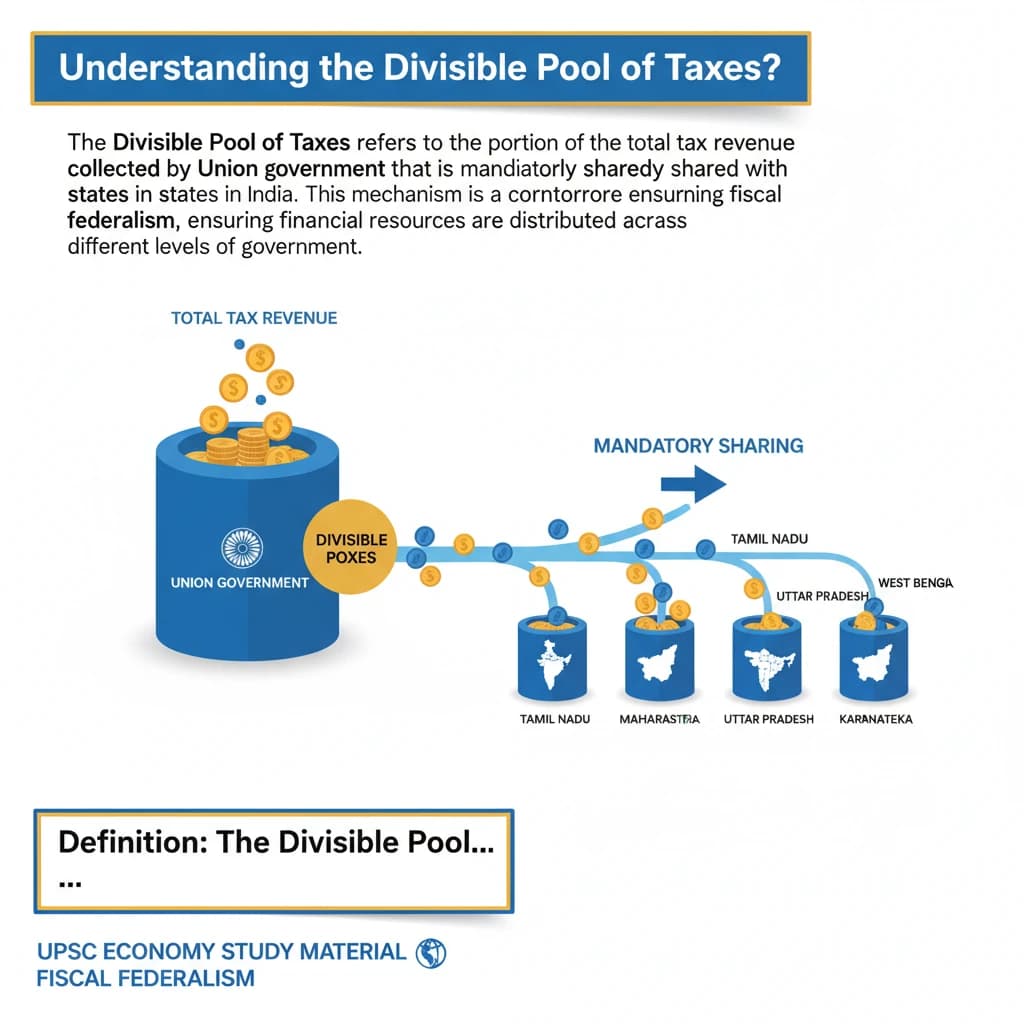
The Divisible Pool of Taxes refers to the portion of the total tax revenue collected by the Union government that is mandatorily shared with the states in India. This mechanism is a cornerstone of fiscal federalism, ensuring financial resources are distributed across different levels of government.
Definition: The Divisible Pool is the aggregate of certain taxes collected by the Union, earmarked for sharing with states as per constitutional provisions and Finance Commission recommendations.
Key Components of the Divisible Pool
The divisible pool primarily includes major tax revenues collected by the Union government. These are significant sources of income that contribute to both central and state exchequers.
- Corporation Tax: Tax levied on the net income or profit of corporate entities.
- Personal Income Tax: Tax levied on the income of individuals.
- Central Goods and Services Tax (GST): A consumption tax levied on the supply of goods and services, shared between the Centre and states.
These taxes form the core of the shared revenue, enabling states to fund their developmental and administrative expenditures.
Role of the Finance Commission
The distribution of the Divisible Pool of Taxes is not arbitrary. It is based on the meticulous recommendations of the Finance Commission, a constitutional body constituted every five years by the President of India.
The Finance Commission plays a crucial role in balancing the financial needs and resources of the Union and the States, ensuring an equitable distribution of funds.
UPSC often asks about the Finance Commission's mandate and its impact on Centre-State financial relations. Understanding its role in the Divisible Pool is vital.
Vertical Devolution Explained
Vertical Devolution refers to the proportion of the Divisible Pool that is allocated between the Union government and the States collectively. It determines how much of the total shared tax revenue goes to the Centre and how much is available for distribution among all states.
For instance, if the Finance Commission recommends 41% of the Divisible Pool for states, this 41% represents the vertical devolution share for all states combined.
Horizontal Devolution Explained
Once the states' collective share (vertical devolution) is determined, Horizontal Devolution dictates how this share is distributed among the individual states. This distribution is based on various criteria recommended by the Finance Commission.
Factors typically considered for horizontal devolution include population, income disparity (often measured by per capita income), area, forest and ecology, demographic performance, and tax efforts made by the states.
Horizontal devolution aims to address regional imbalances and incentivize fiscal prudence among states.
Exclusions from the Divisible Pool
It is important to note that not all central government revenues are part of the Divisible Pool. Specifically, Cesses and Surcharges levied by the Union government are explicitly excluded from this sharing mechanism.
These revenues are retained entirely by the Union government, often earmarked for specific purposes or for meeting urgent expenditure needs. This exclusion can sometimes be a point of contention between the Centre and states.
💡 Key Takeaways
- •Divisible Pool: Portion of Union tax revenue shared with states.
- •Includes: Corporation Tax, Personal Income Tax, Central GST.
- •Excludes: Cesses and Surcharges (retained by Union).
- •Finance Commission: Constitutional body recommending distribution every five years.
- •Vertical Devolution: Union vs. States' collective share.
- •Horizontal Devolution: Distribution among individual states based on criteria (e.g., income distance, population, area, tax effort).
- •Crucial for fiscal federalism and state financial autonomy.
🧠 Memory Techniques

98% Verified Content
📚 Reference Sources
•The Constitution of India (Articles 270, 280)
•Reports of the 15th Finance Commission
•Ministry of Finance, Government of India publications