Loading page, please wait…
What is the International Energy Agency? - UPSC Economy
What is What is the International Energy Agency? in UPSC Economy?
What is the International Energy Agency? is a key topic under Economy for UPSC Civil Services Examination. Key points include: The International Energy Agency (IEA) was established in 1974.. It is an autonomous agency headquartered in Paris, France.. Founded by member countries of the OECD in response to the mid-1970s oil crisis.. Understanding this topic is essential for both UPSC Prelims and Mains preparation.
Why is What is the International Energy Agency? important for UPSC exam?
What is the International Energy Agency? is a Easy-level topic in UPSC Economy. It is tested in both Prelims (factual MCQs) and Mains (analytical answer writing). Previous year UPSC questions have frequently covered aspects of What is the International Energy Agency?, making it essential for comprehensive IAS preparation.
How to prepare What is the International Energy Agency? for UPSC?
To prepare What is the International Energy Agency? for UPSC: (1) Study the comprehensive notes covering all key concepts on Vaidra. (2) Practice previous year questions on this topic. (3) Connect it with current affairs using daily updates. (4) Revise using key takeaways and mind maps available for Economy. (5) Write practice answers linking What is the International Energy Agency? to related GS Paper topics.
Key takeaways of What is the International Energy Agency? for UPSC
- The International Energy Agency (IEA) was established in 1974.
- It is an autonomous agency headquartered in Paris, France.
- Founded by member countries of the OECD in response to the mid-1970s oil crisis.
- Its original mandate was to ensure energy security through collective action and strategic oil reserves.
- The IEA's role has expanded to include clean energy transitions, climate change, and sustainable energy policies.
- It publishes the influential World Energy Outlook (WEO) annually.
What is the International Energy Agency?
Easy⏱️ 7 min read
economy
📖 Introduction
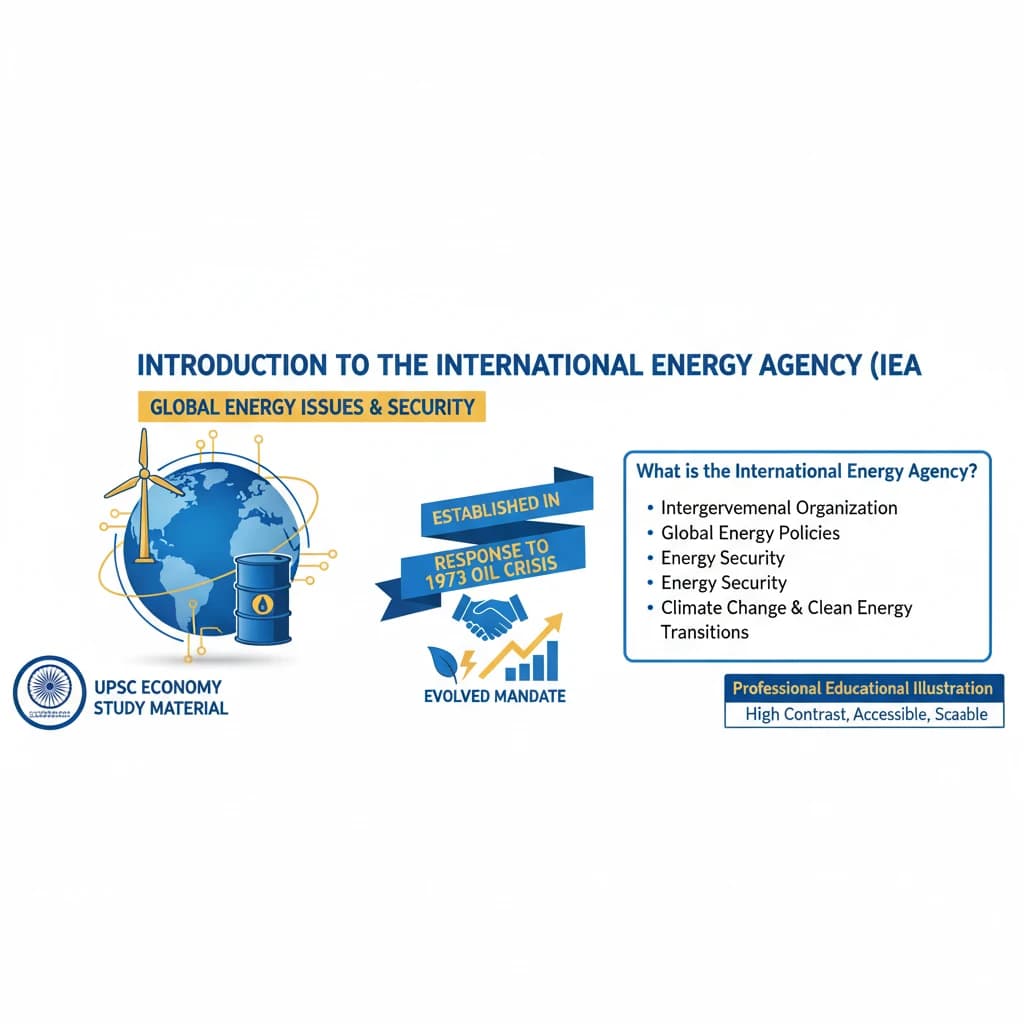
Introduction to the International Energy Agency (IEA)
The International Energy Agency (IEA) is a prominent intergovernmental organization focused on global energy issues. It plays a crucial role in shaping energy policies and promoting energy security worldwide.
Established in response to a significant global event, the IEA has evolved its mandate to address contemporary energy challenges, including climate change and clean energy transitions.
Establishment and Mandate
The IEA was set up as an autonomous agency in 1974. Its formation was a direct response to the severe mid-1970s oil crisis, which highlighted the vulnerability of industrialized nations to oil supply disruptions.
Its primary initial mandate was to coordinate a collective response to major oil supply emergencies and to promote international cooperation on energy policy.
Founding Context: The 1973 Oil Embargo led to significant economic turmoil and underscored the need for international energy cooperation and strategic reserves.
Membership and Affiliation
The IEA was founded by member countries of the Organisation for Economic Co-operation and Development (OECD). Membership requires countries to hold oil stocks equivalent to 90 days of net oil imports.
This requirement ensures that member states have a buffer against potential supply shocks and can contribute to collective emergency responses.
Key Affiliation: The IEA operates under the framework of the OECD, a group of developed countries committed to market economy principles.
Headquarters and Structure
The headquarters of the International Energy Agency are located in Paris, France. From this central location, it coordinates its activities and research efforts.
As an autonomous agency, it maintains its own distinct structure and operational independence, while still collaborating closely with the OECD.
Headquarters: 📍 Paris, France
Year of Establishment: 📅 1974
Evolving Role and Objectives
While energy security remains a core mission, the IEA's scope has significantly broadened. It now focuses on the '3 Es' of energy policy: Energy Security, Economic Development, and Environmental Protection.
The agency actively promotes sustainable energy policies, including the transition to clean energy technologies and addressing climate change.
For UPSC Mains (GS-III), understanding the IEA's dual role in energy security and clean energy transition is vital. It serves as a key reference for global energy trends and policy recommendations.
💡 Key Takeaways
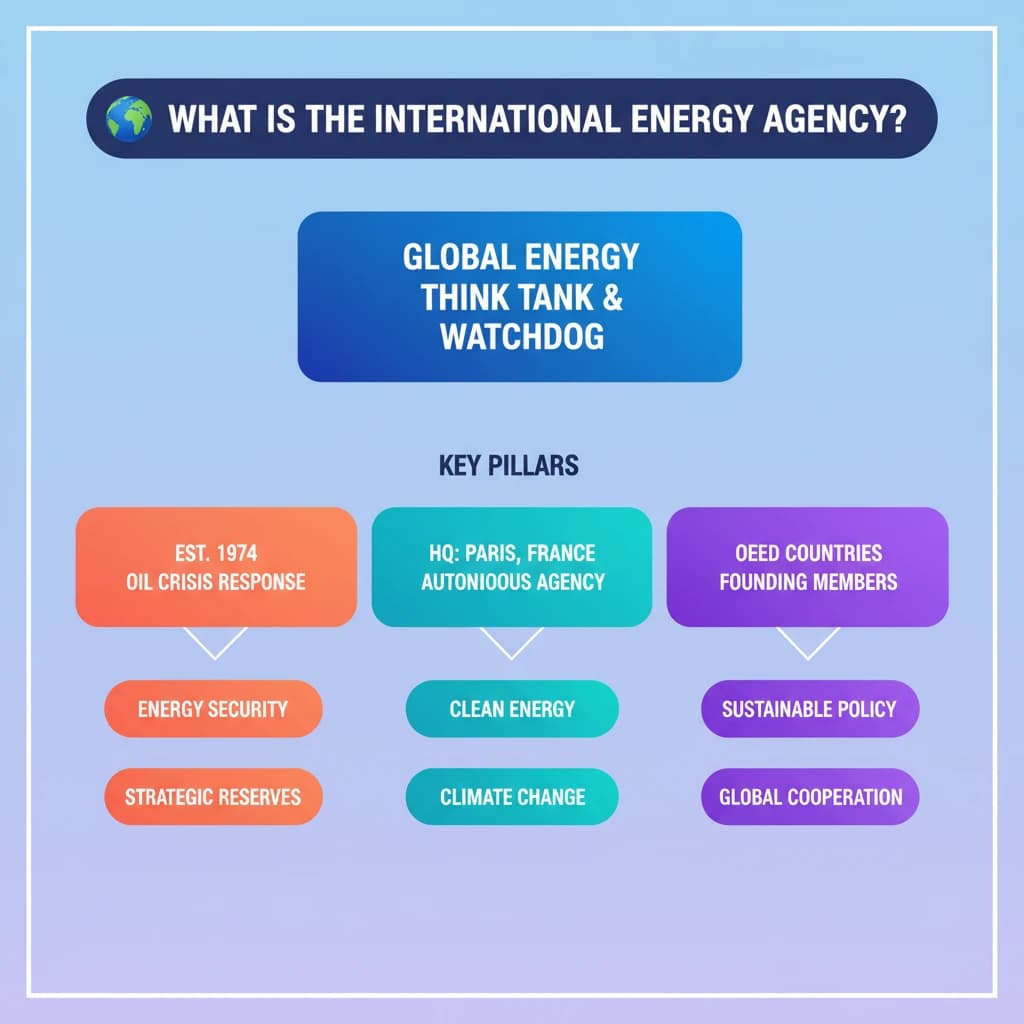
- •The International Energy Agency (IEA) was established in 1974.
- •It is an autonomous agency headquartered in Paris, France.
- •Founded by member countries of the OECD in response to the mid-1970s oil crisis.
- •Its original mandate was to ensure energy security through collective action and strategic oil reserves.
- •The IEA's role has expanded to include clean energy transitions, climate change, and sustainable energy policies.
- •It publishes the influential World Energy Outlook (WEO) annually.
🧠 Memory Techniques
98% Verified Content
📚 Reference Sources
•Organisation for Economic Co-operation and Development (OECD) Official Website (oecd.org)
•Britannica Encyclopedia (britannica.com) - Entry on IEA and 1973 Oil Crisis
•World Energy Outlook (IEA Publications)