Loading page, please wait…
Why are RRBs Facing High Attrition Rates? - UPSC Economy
What is Why are RRBs Facing High Attrition Rates? in UPSC Economy?
Why are RRBs Facing High Attrition Rates? is a key topic under Economy for UPSC Civil Services Examination. Key points include: RRBs face high attrition due to lack of employee benefits, challenging rural work environments, and slower career growth.. NABARD data shows a significant decline in RRB employees (95,833 in FY22 to 91,664 in FY23) despite a slight increase in branches.. Scheduled Commercial Banks (SCBs) offer superior facilities and better career prospects, attracting RRB talent.. Understanding this topic is essential for both UPSC Prelims and Mains preparation.
Why is Why are RRBs Facing High Attrition Rates? important for UPSC exam?
Why are RRBs Facing High Attrition Rates? is a Medium-level topic in UPSC Economy. It is tested in both Prelims (factual MCQs) and Mains (analytical answer writing). Previous year UPSC questions have frequently covered aspects of Why are RRBs Facing High Attrition Rates?, making it essential for comprehensive IAS preparation.
How to prepare Why are RRBs Facing High Attrition Rates? for UPSC?
To prepare Why are RRBs Facing High Attrition Rates? for UPSC: (1) Study the comprehensive notes covering all key concepts on Vaidra. (2) Practice previous year questions on this topic. (3) Connect it with current affairs using daily updates. (4) Revise using key takeaways and mind maps available for Economy. (5) Write practice answers linking Why are RRBs Facing High Attrition Rates? to related GS Paper topics.
Key takeaways of Why are RRBs Facing High Attrition Rates? for UPSC
- RRBs face high attrition due to lack of employee benefits, challenging rural work environments, and slower career growth.
- NABARD data shows a significant decline in RRB employees (95,833 in FY22 to 91,664 in FY23) despite a slight increase in branches.
- Scheduled Commercial Banks (SCBs) offer superior facilities and better career prospects, attracting RRB talent.
- Difficulty in adapting to rural life and limited urban amenities contribute significantly to employee dissatisfaction.
- Slower promotions and fewer incentives in RRBs demotivate employees seeking professional advancement.
- Addressing RRB attrition is crucial for sustaining financial inclusion and rural development efforts in India.
Why are RRBs Facing High Attrition Rates?
Medium⏱️ 9 min read
economy
📖 Introduction
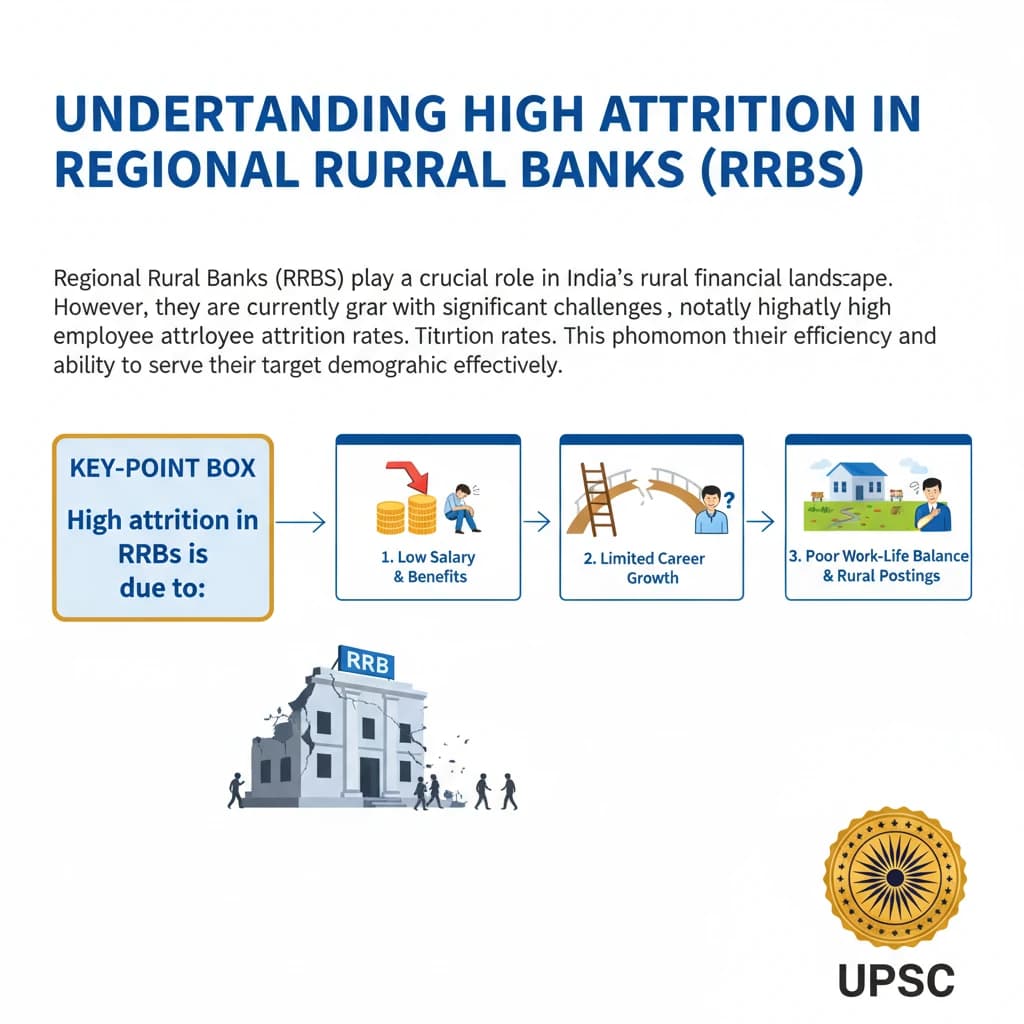
Understanding High Attrition Rates in Regional Rural Banks (RRBs)
Regional Rural Banks (RRBs) play a crucial role in India's financial inclusion agenda, serving remote and rural areas. However, these institutions are currently grappling with significant challenges, notably high employee attrition rates.
This trend poses a threat to their operational efficiency and long-term sustainability. Understanding the underlying causes is essential for devising effective retention strategies and strengthening the rural banking sector.
Key Data on Employee Decline in RRBs
According to the National Bank for Agriculture and Rural Development (NABARD), there has been a notable decline in the total number of employees in Regional Rural Banks (RRBs).
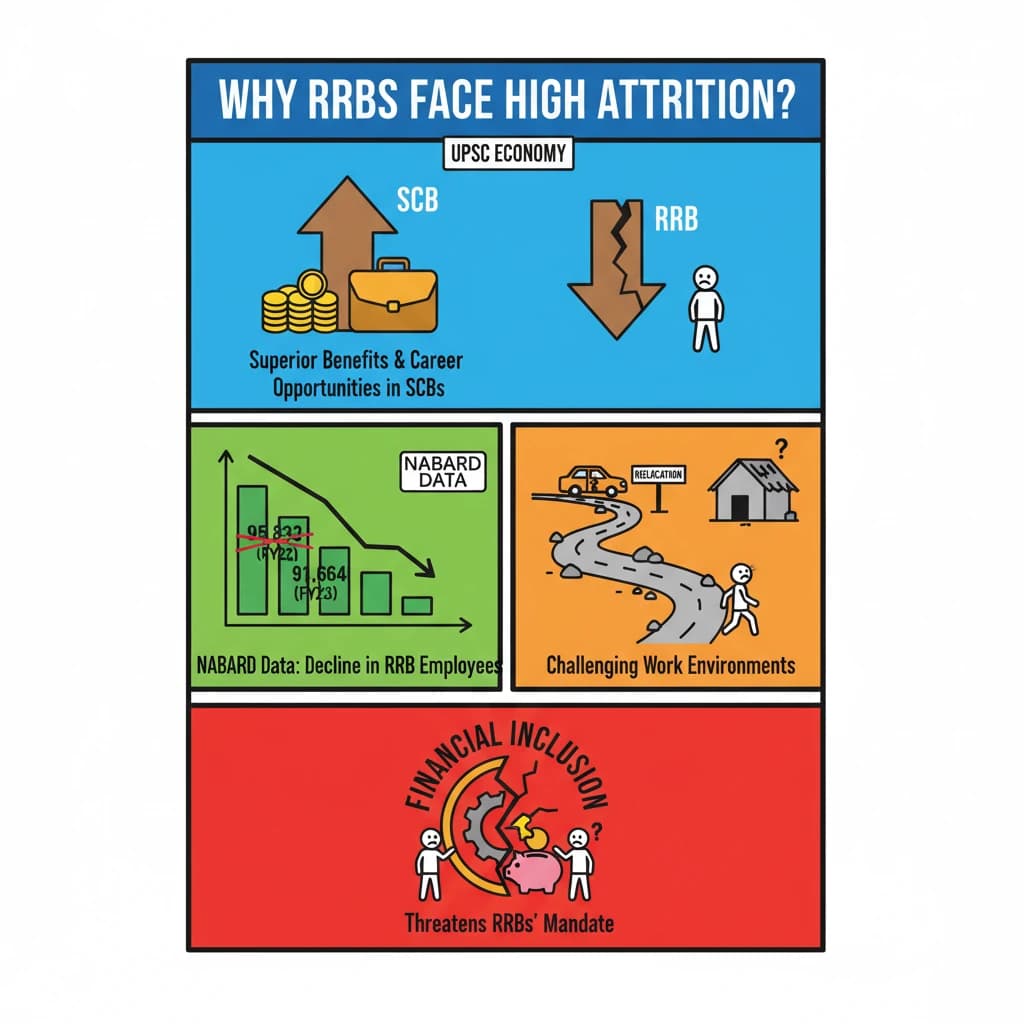
- Total employees in 43 RRBs decreased from 95,833 in FY 2022 to 91,664 in FY 2023.
- Concurrently, the number of RRB branches saw a minor increase from 21,892 in FY 2022 to 21,895 in FY 2023.
This data highlights a growing disparity between increasing branch networks and a shrinking workforce.
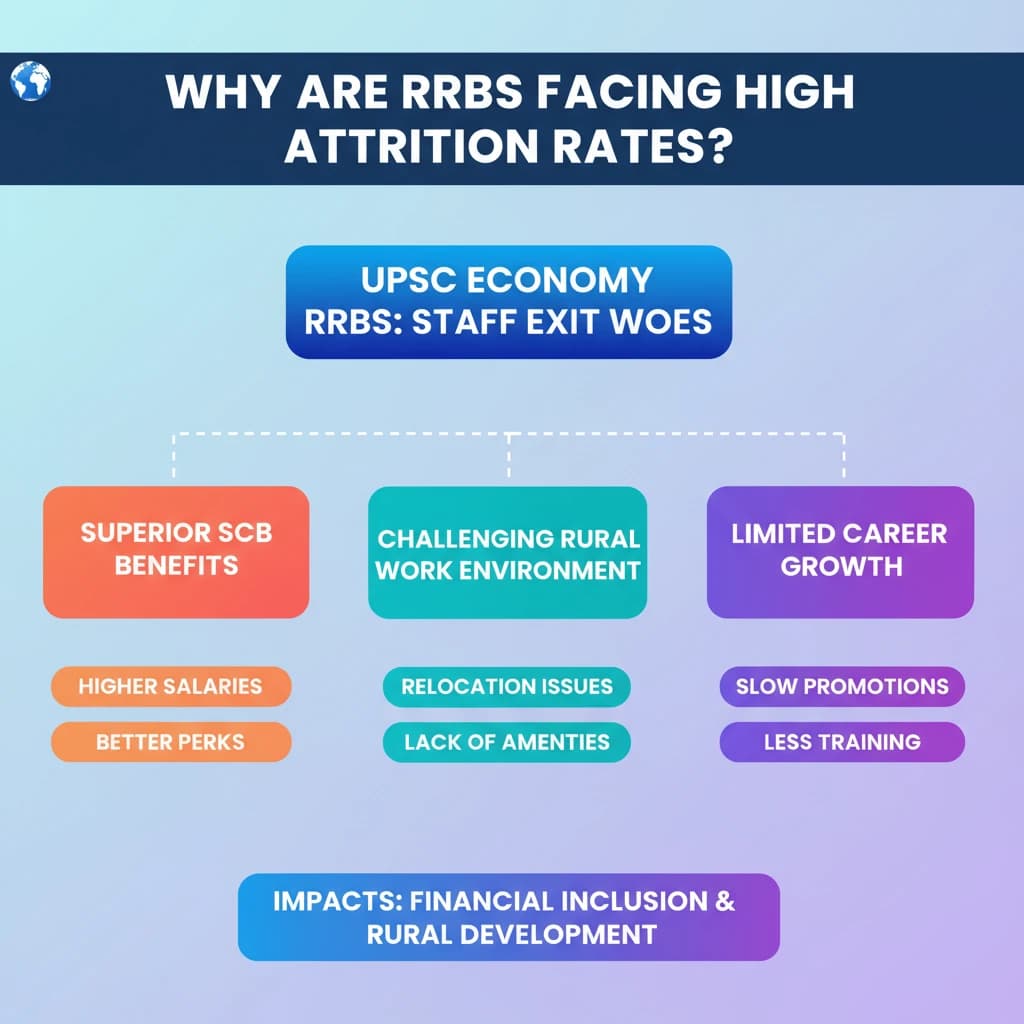
Reason 1: Disparity in Employee Benefits and Facilities
A primary driver of attrition is the perceived lack of superior employee benefits in RRBs compared to Scheduled Commercial Banks (SCBs).
While the pay scales might be similar, SCBs often offer a wider array of facilities, perquisites, and a more urban work environment.
These superior offerings in SCBs make them more attractive, leading RRB employees to seek better opportunities elsewhere.
Reason 2: Challenging Rural Work Environment
Many employees, especially those who relocate from other states or urban backgrounds, find it difficult to adapt to the rural lifestyle associated with RRB postings.
The lack of urban amenities, social infrastructure, and family support systems in remote areas can lead to dissatisfaction.
This struggle to adjust often prompts employees to look for roles in more urban or semi-urban settings, contributing to the high attrition.
Reason 3: Slower Career Growth and Limited Incentives
Compared to their counterparts in Scheduled Commercial Banks (SCBs), employees in RRBs often experience slower career progression.
The promotion cycles in RRBs can be longer, and the opportunities for upward mobility or diverse roles may be fewer.
This limited scope for professional advancement and fewer performance-based incentives can lead to significant dissatisfaction among ambitious employees.
UPSC Insight: Understanding the challenges faced by RRBs is crucial for topics like Financial Inclusion, Rural Development, and Banking Sector Reforms in GS Paper III. Analyze both the socio-economic and human resource aspects.
💡 Key Takeaways
- •RRBs face high attrition due to lack of employee benefits, challenging rural work environments, and slower career growth.
- •NABARD data shows a significant decline in RRB employees (95,833 in FY22 to 91,664 in FY23) despite a slight increase in branches.
- •Scheduled Commercial Banks (SCBs) offer superior facilities and better career prospects, attracting RRB talent.
- •Difficulty in adapting to rural life and limited urban amenities contribute significantly to employee dissatisfaction.
- •Slower promotions and fewer incentives in RRBs demotivate employees seeking professional advancement.
- •Addressing RRB attrition is crucial for sustaining financial inclusion and rural development efforts in India.
🧠 Memory Techniques
95% Verified Content
📚 Reference Sources
•National Bank for Agriculture and Rural Development (NABARD) Annual Reports
•Reserve Bank of India (RBI) publications on Regional Rural Banks
•Ministry of Finance, Government of India reports on banking sector