Loading page, please wait…
Why are RRBs Facing High Attrition Rates? - UPSC Economy
What is Why are RRBs Facing High Attrition Rates? in UPSC Economy?
Why are RRBs Facing High Attrition Rates? is a key topic under Economy for UPSC Civil Services Examination. Key points include: RRBs face high attrition due to superior benefits and career opportunities in SCBs.. NABARD data confirms a significant decline in RRB employees (95,833 in FY22 to 91,664 in FY23).. Challenging work environments, including relocation issues and lack of amenities, push employees away.. Understanding this topic is essential for both UPSC Prelims and Mains preparation.
Why is Why are RRBs Facing High Attrition Rates? important for UPSC exam?
Why are RRBs Facing High Attrition Rates? is a Medium-level topic in UPSC Economy. It is tested in both Prelims (factual MCQs) and Mains (analytical answer writing). Previous year UPSC questions have frequently covered aspects of Why are RRBs Facing High Attrition Rates?, making it essential for comprehensive IAS preparation.
How to prepare Why are RRBs Facing High Attrition Rates? for UPSC?
To prepare Why are RRBs Facing High Attrition Rates? for UPSC: (1) Study the comprehensive notes covering all key concepts on Vaidra. (2) Practice previous year questions on this topic. (3) Connect it with current affairs using daily updates. (4) Revise using key takeaways and mind maps available for Economy. (5) Write practice answers linking Why are RRBs Facing High Attrition Rates? to related GS Paper topics.
Key takeaways of Why are RRBs Facing High Attrition Rates? for UPSC
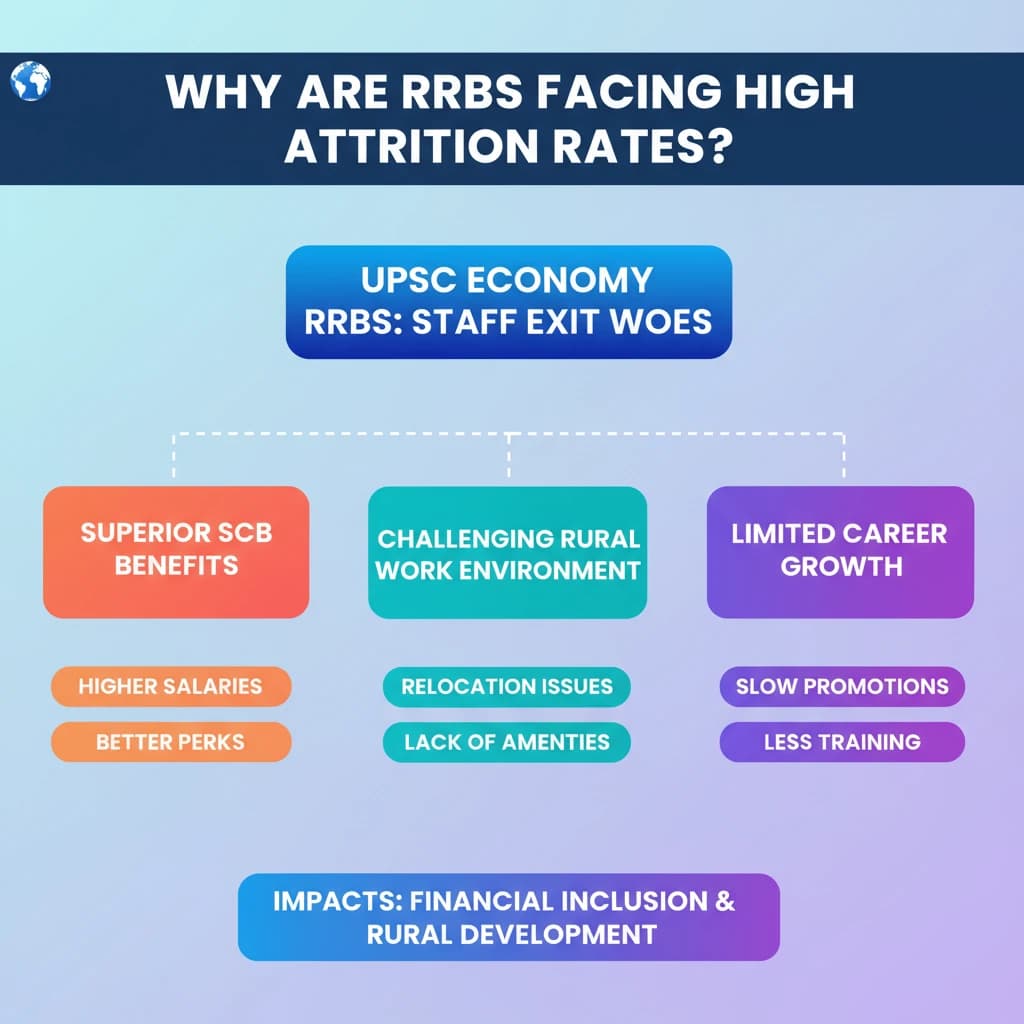
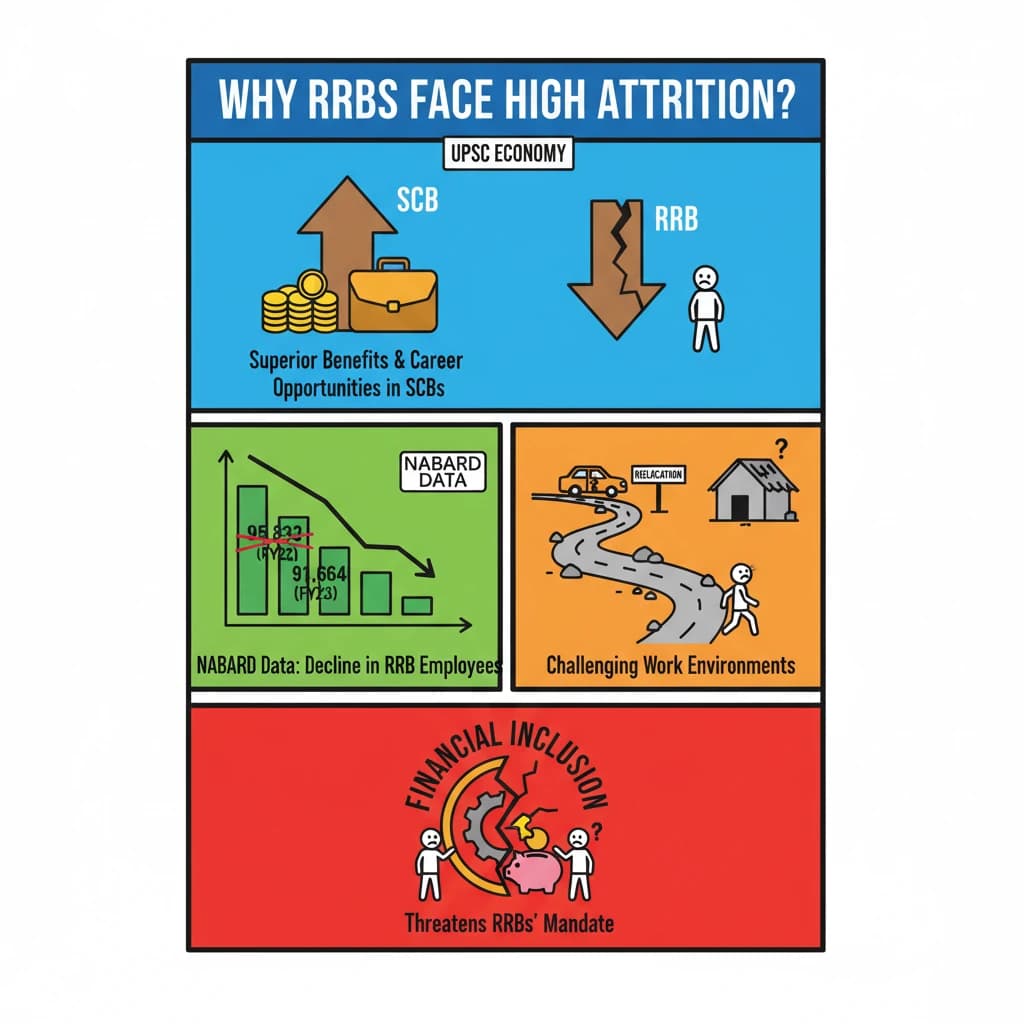
- RRBs face high attrition due to superior benefits and career opportunities in SCBs.
- NABARD data confirms a significant decline in RRB employees (95,833 in FY22 to 91,664 in FY23).
- Challenging work environments, including relocation issues and lack of amenities, push employees away.
- Attrition threatens RRBs' mandate of financial inclusion and rural development.
- Addressing HR issues, career paths, and work environment is crucial for RRB sustainability.
Why are RRBs Facing High Attrition Rates?
Medium⏱️ 8 min read
economy
📖 Introduction
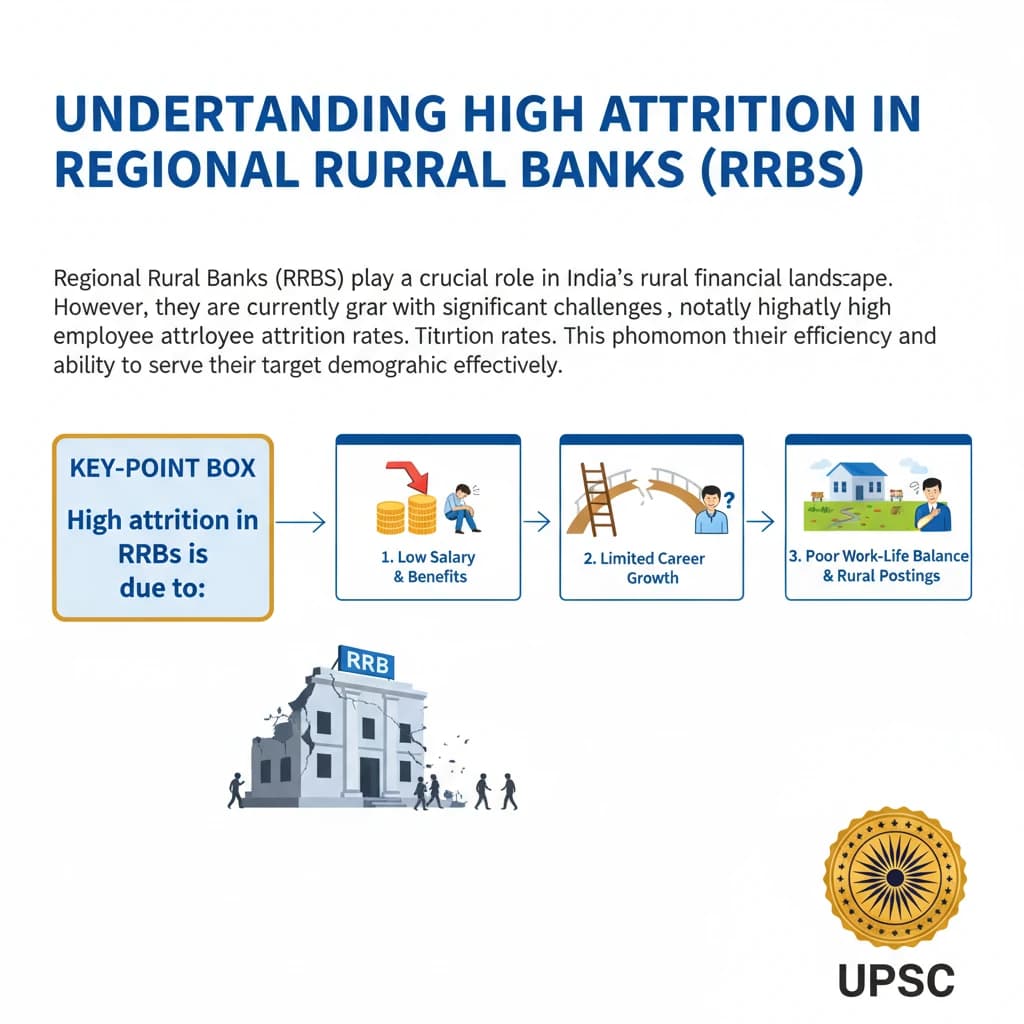
Understanding High Attrition in Regional Rural Banks (RRBs)
Regional Rural Banks (RRBs) play a crucial role in India's rural financial landscape. However, they are currently grappling with significant challenges, notably high employee attrition rates. This phenomenon impacts their operational efficiency and ability to serve their target demographic effectively.
High attrition in RRBs is a critical issue, threatening their mandate of financial inclusion and rural development. Understanding its root causes is essential for policy intervention.
Lack of Employee Benefits and Career Progression
One of the primary drivers of attrition in RRBs is the perceived lack of superior employee benefits compared to Scheduled Commercial Banks (SCBs). Despite often similar pay scales, SCBs typically offer better perks, housing, transfer policies, and overall career growth opportunities.
This disparity makes SCBs more attractive to banking professionals, leading to a continuous outflow of talent from RRBs. Employees seek environments that provide greater job satisfaction and long-term career prospects.
Statistical Evidence of Attrition
Data from the National Bank for Agriculture and Rural Development (NABARD) substantiates the rising attrition. The total number of employees in RRBs has shown a noticeable decline over recent financial years.
NABARD Data (43 RRBs):
- Total Employees FY22: 95,833
- Total Employees FY23: 91,664 (a decrease of 4,169 employees)
- Number of Branches FY22: 21,892
- Number of Branches FY23: 21,895 (a minor increase, indicating higher workload per employee)
This data highlights a worrying trend where the workforce is shrinking while the branch network, and thus the operational burden, remains constant or slightly increases.
Challenging Work Environment and Relocation Issues
Another significant factor contributing to attrition is the challenging work environment often associated with RRBs. Many employees are required to relocate from their home states to work in remote rural areas, which can present substantial personal and professional difficulties.
Employees face issues such as language barriers, lack of urban amenities, limited educational opportunities for children, and social isolation. These factors collectively contribute to dissatisfaction and a desire to seek employment elsewhere.
When analyzing challenges like RRB attrition, remember to consider both structural issues (benefits, career path) and operational issues (work environment, relocation). This holistic approach is crucial for UPSC Mains GS-III answers on the Indian Economy.
💡 Key Takeaways
- •RRBs face high attrition due to superior benefits and career opportunities in SCBs.
- •NABARD data confirms a significant decline in RRB employees (95,833 in FY22 to 91,664 in FY23).
- •Challenging work environments, including relocation issues and lack of amenities, push employees away.
- •Attrition threatens RRBs' mandate of financial inclusion and rural development.
- •Addressing HR issues, career paths, and work environment is crucial for RRB sustainability.
🧠 Memory Techniques
95% Verified Content
📚 Reference Sources
•Reserve Bank of India (RBI) Publications on Regional Rural Banks
•Ministry of Finance, Government of India Reports
•Narasimham Committee Report (1975)