Loading page, please wait…
Vaidra Logo
Vaidra

Top 4 items + smart groups

UPSC GPT
New
Current Affairs
Daily Solutions
Daily Puzzle
Mains Evaluator

Version 2.0.0 • Built with ❤️ for UPSC aspirants

Loading...
Loading...
Loading...
Loading...
Loading...
Loading...
Loading...
Loading...
Loading...
Loading...
Loading...
Loading...
Loading...
Back
All Subjects

Topics

0 topics • 0 completed

Loading topics...
Loading...
Loading...
Loading...
Loading...
Loading...
Overall Progress0%

Climate Change and African Easterly Waves - UPSC Geography

What is Climate Change and African Easterly Waves in UPSC Geography?

Climate Change and African Easterly Waves is a key topic under Geography for UPSC Civil Services Examination. Key points include: African Easterly Waves (AEWs) are summer weather systems over northern Africa, moving east to west towards the Atlantic.. A recent study predicts climate change will increase AEW intensity and frequency, leading to more extreme flooding in the Sahel region.. AEWs are significant precursors to the formation of many Atlantic tropical cyclones.. Understanding this topic is essential for both UPSC Prelims and Mains preparation.

Why is Climate Change and African Easterly Waves important for UPSC exam?

Climate Change and African Easterly Waves is a Medium-level topic in UPSC Geography. It is tested in both Prelims (factual MCQs) and Mains (analytical answer writing). Previous year UPSC questions have frequently covered aspects of Climate Change and African Easterly Waves, making it essential for comprehensive IAS preparation.

How to prepare Climate Change and African Easterly Waves for UPSC?

To prepare Climate Change and African Easterly Waves for UPSC: (1) Study the comprehensive notes covering all key concepts on Vaidra. (2) Practice previous year questions on this topic. (3) Connect it with current affairs using daily updates. (4) Revise using key takeaways and mind maps available for Geography. (5) Write practice answers linking Climate Change and African Easterly Waves to related GS Paper topics.

Key takeaways of Climate Change and African Easterly Waves for UPSC

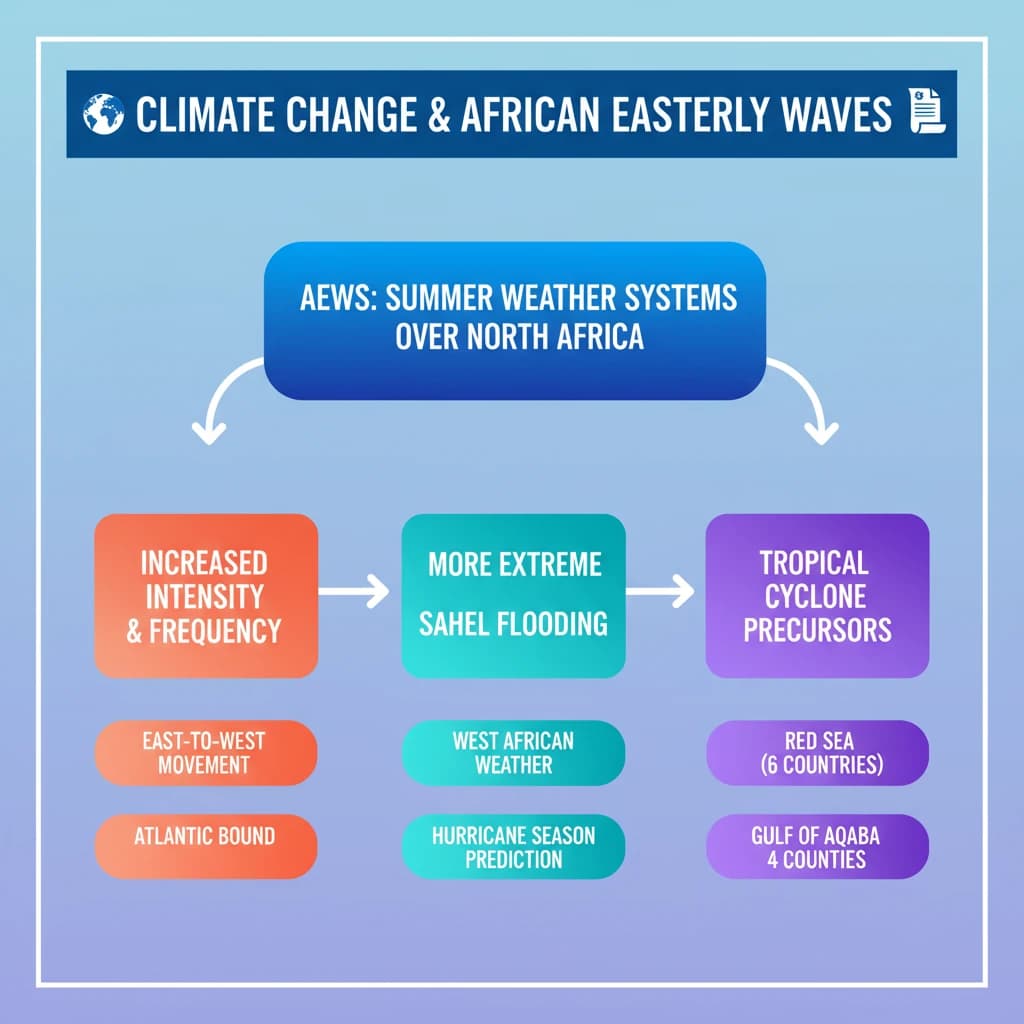
  • African Easterly Waves (AEWs) are summer weather systems over northern Africa, moving east to west towards the Atlantic.
  • A recent study predicts climate change will increase AEW intensity and frequency, leading to more extreme flooding in the Sahel region.
  • AEWs are significant precursors to the formation of many Atlantic tropical cyclones.
  • The Red Sea borders six countries (Yemen, Saudi Arabia, Egypt, Sudan, Eritrea, Djibouti), and the Gulf of Aqaba borders four (Egypt, Israel, Jordan, Saudi Arabia).
  • Understanding AEWs is crucial for predicting West African weather and Atlantic hurricane seasons.
Climate Change and African Easterly Waves

Climate Change and African Easterly Waves

Medium⏱️ 8 min read✓ 95% Verified
geography

📖 Introduction

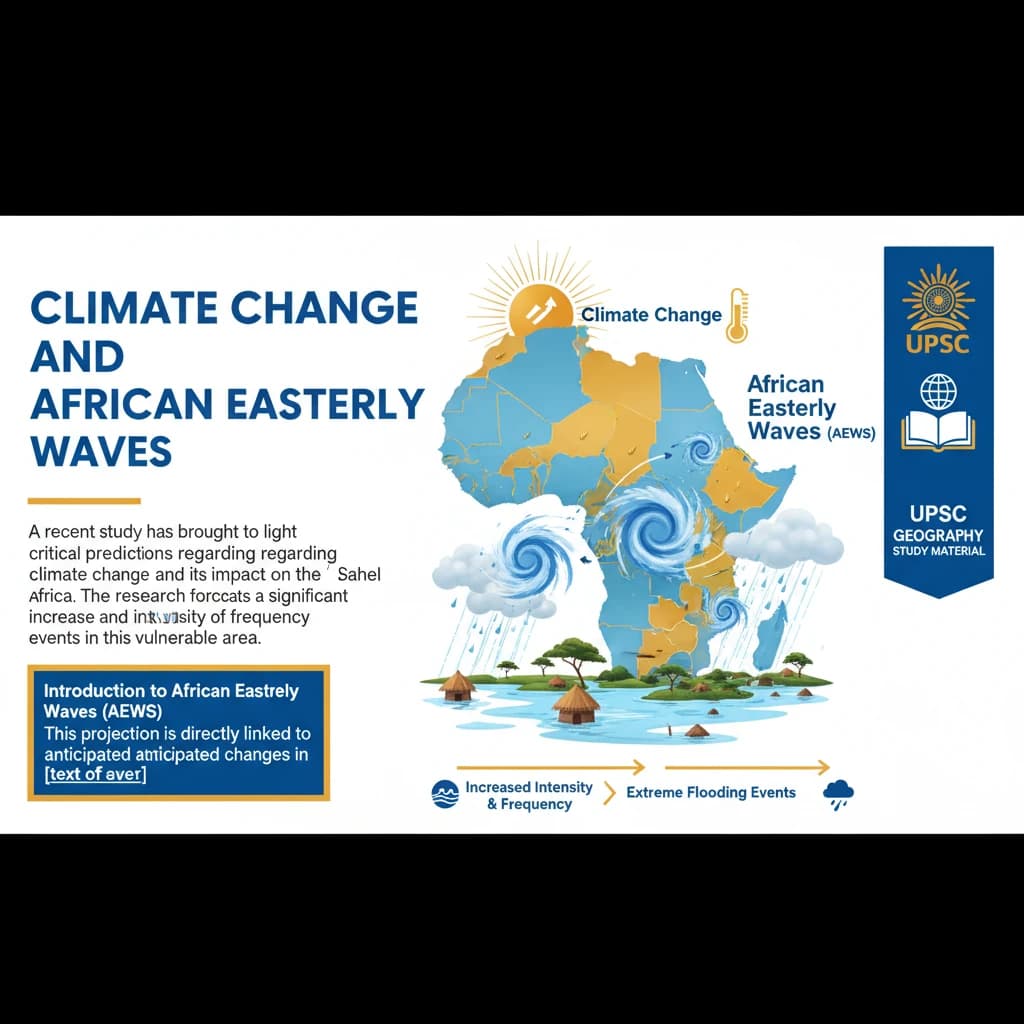
<h4>Introduction to African Easterly Waves (AEWs)</h4><p>A recent study has brought to light critical predictions regarding <strong>climate change</strong> and its impact on the <strong>Sahel region</strong> of Africa.</p><p>The research forecasts a significant increase in the <strong>intensity</strong> and <strong>frequency</strong> of <strong>extreme flooding</strong> events in this vulnerable area.</p><div class='info-box'><p>This projection is directly linked to anticipated changes in <strong>African Easterly Waves (AEWs)</strong>, as detailed in a study published in <strong>Communications Earth & Environment</strong>.</p></div><h4>Definition and Characteristics of AEWs</h4><p><strong>African Easterly Waves (AEWs)</strong> are distinct <strong>weather systems</strong> that play a crucial role in atmospheric dynamics over northern Africa.</p><p>These waves typically form during the <strong>summer months</strong> and exhibit a characteristic movement pattern, propagating from <strong>east to west</strong> towards the <strong>Atlantic Ocean</strong>.</p><div class='key-point-box'><p>AEWs are known to be significant precursors to the formation of <strong>tropical cyclones</strong> in the Atlantic basin, influencing weather patterns across <strong>West Africa</strong>.</p></div><h4>Projected Climate Change Impacts</h4><p>The study specifically predicts that alterations driven by <strong>climate change</strong> will intensify these waves.</p><p>This intensification will, in turn, lead to a higher occurrence and severity of <strong>extreme flooding</strong> in the <strong>Sahel region</strong>.</p><div class='exam-tip-box'><p>Understanding the dynamics of <strong>AEWs</strong> and their climate change linkages is crucial for <strong>UPSC Mains GS Paper 1 (Physical Geography)</strong> and <strong>GS Paper 3 (Disaster Management, Environment)</strong>.</p></div><h4>Geographical Context: Red Sea and Surrounding Regions</h4><p>The <strong>Red Sea</strong> is a vital waterway, strategically bordering six countries, which are divided between its eastern and western shores.</p><ul><li>To the <strong>east</strong>, it borders <strong>Yemen</strong> and <strong>Saudi Arabia</strong>.</li><li>To the <strong>west</strong>, it borders <strong>Egypt</strong>, <strong>Sudan</strong>, <strong>Eritrea</strong>, and <strong>Djibouti</strong>.</li></ul><p>The <strong>Gulf of Aqaba</strong>, an important northern inlet of the Red Sea, is bordered by four nations: <strong>Egypt</strong>, <strong>Israel</strong>, <strong>Jordan</strong>, and <strong>Saudi Arabia</strong>.</p><div class='info-box'><p><strong>Prominent Islands</strong> in the Red Sea region include <strong>Tiran</strong> (near the Gulf of Aqaba), <strong>Shadwan</strong> (at the Gulf of Suez), and <strong>Yemen-controlled islands</strong> such as <strong>Kamaran</strong>, <strong>Perim</strong>, <strong>Hanish</strong>, and <strong>Socotra</strong>.</p></div><p>The largest groups of islands are the <strong>Farasan Islands</strong> located in the east and the <strong>Dahlak Archipelago</strong> situated in the west.</p>
Concept Diagram

💡 Key Takeaways

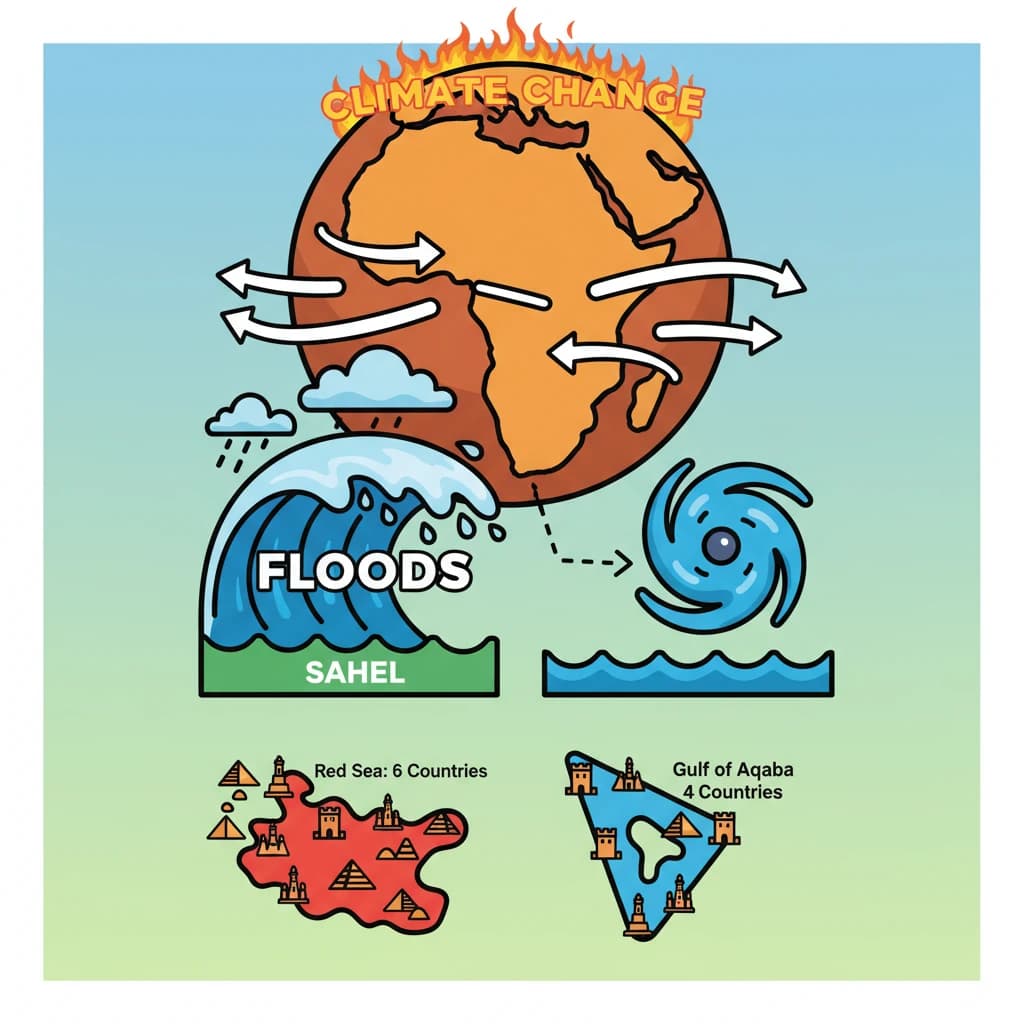
  • •African Easterly Waves (AEWs) are summer weather systems over northern Africa, moving east to west towards the Atlantic.
  • •A recent study predicts climate change will increase AEW intensity and frequency, leading to more extreme flooding in the Sahel region.
  • •AEWs are significant precursors to the formation of many Atlantic tropical cyclones.
  • •The Red Sea borders six countries (Yemen, Saudi Arabia, Egypt, Sudan, Eritrea, Djibouti), and the Gulf of Aqaba borders four (Egypt, Israel, Jordan, Saudi Arabia).
  • •Understanding AEWs is crucial for predicting West African weather and Atlantic hurricane seasons.

🧠 Memory Techniques
Memory Aid
95% Verified Content

📚 Reference Sources

•Communications Earth & Environment (cited study)

Related Topics

Loading related topics...
Explore:Geography Topics·All Subjects·Daily Current Affairs·Editorial Analysis·Previous Year Questions·UPSC GPT
Climate Change and African Easterly Waves - UPSC Geography