Loading page, please wait…
Vaidra Logo
Vaidra

Top 4 items + smart groups

UPSC GPT
New
Current Affairs
Daily Solutions
Daily Puzzle
Mains Evaluator

Version 2.0.0 • Built with ❤️ for UPSC aspirants

Loading...
Loading...
Loading...
Loading...
Loading...
Loading...
Loading...
Loading...
Loading...
Loading...
Loading...
Loading...
Loading...
Back
All Subjects

Topics

0 topics • 0 completed

Loading topics...
Loading...
Loading...
Loading...
Loading...
Loading...
Overall Progress0%

International Mountain Day 2024 - UPSC Geography

What is International Mountain Day 2024 in UPSC Geography?

International Mountain Day 2024 is a key topic under Geography for UPSC Civil Services Examination. Key points include: International Mountain Day (Dec 11) highlights the critical need to protect the Indian Himalayan Region (IHR).. The IHR spans 13 Indian states/UTs, covering approx. 16.2% of India's geographical area over 2,500 km.. It is a tectonically active zone due to the ongoing collision of the Indian and Eurasian Plates, leading to its formation and geological diversity.. Understanding this topic is essential for both UPSC Prelims and Mains preparation.

Why is International Mountain Day 2024 important for UPSC exam?

International Mountain Day 2024 is a Medium-level topic in UPSC Geography. It is tested in both Prelims (factual MCQs) and Mains (analytical answer writing). Previous year UPSC questions have frequently covered aspects of International Mountain Day 2024, making it essential for comprehensive IAS preparation.

How to prepare International Mountain Day 2024 for UPSC?

To prepare International Mountain Day 2024 for UPSC: (1) Study the comprehensive notes covering all key concepts on Vaidra. (2) Practice previous year questions on this topic. (3) Connect it with current affairs using daily updates. (4) Revise using key takeaways and mind maps available for Geography. (5) Write practice answers linking International Mountain Day 2024 to related GS Paper topics.

Key takeaways of International Mountain Day 2024 for UPSC

  • International Mountain Day (Dec 11) highlights the critical need to protect the Indian Himalayan Region (IHR).
  • The IHR spans 13 Indian states/UTs, covering approx. 16.2% of India's geographical area over 2,500 km.
  • It is a tectonically active zone due to the ongoing collision of the Indian and Eurasian Plates, leading to its formation and geological diversity.
  • The IHR is a vital biodiversity hotspot, home to numerous endemic and endangered plant and animal species.
  • Major challenges include climate change impacts (glacier melt, extreme weather), unsustainable development, and disaster vulnerability.
  • Government initiatives like NMSHE and Project Snow Leopard are crucial for sustainable development and conservation in the IHR.
International Mountain Day 2024

International Mountain Day 2024

Medium⏱️ 10 min read✓ 95% Verified
geography

📖 Introduction

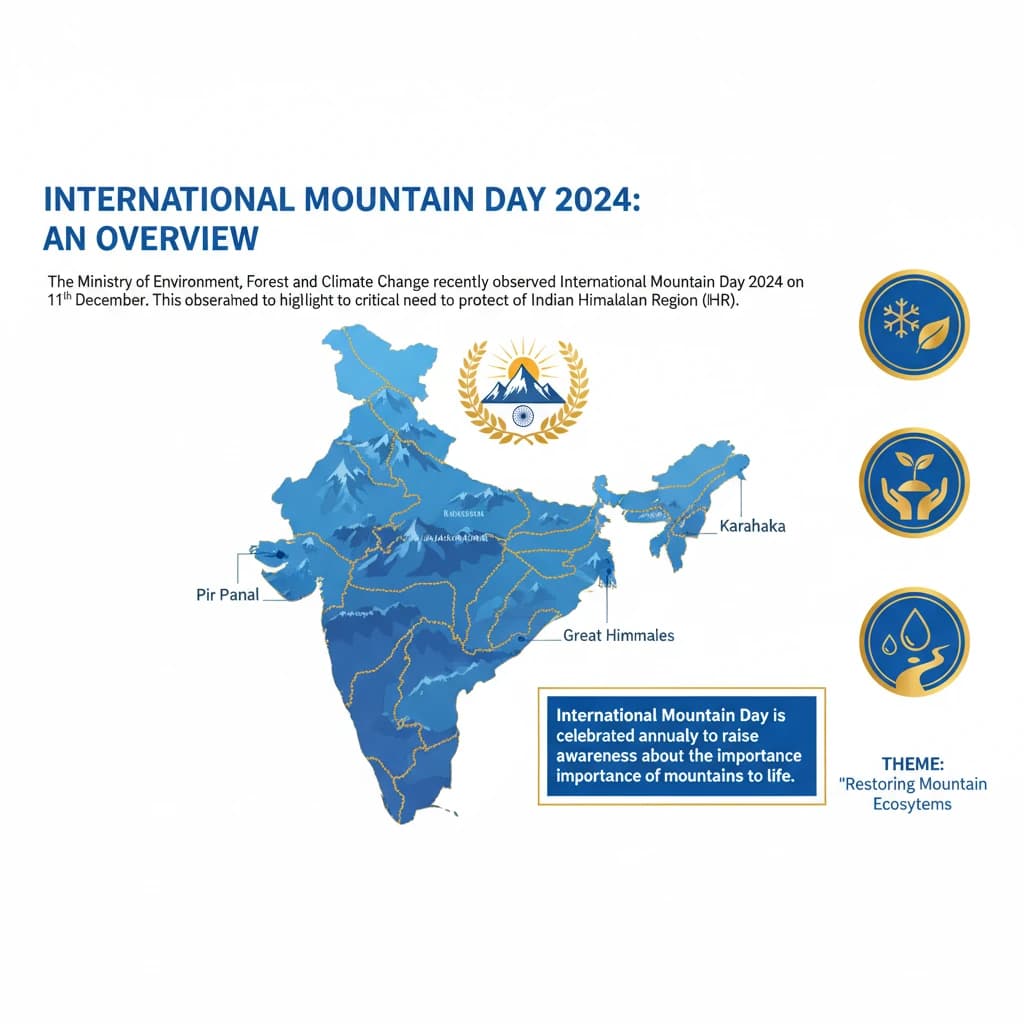
<h4>International Mountain Day 2024: An Overview</h4><p>The <strong>Ministry of Environment, Forest and Climate Change</strong> recently observed <strong>International Mountain Day 2024</strong> on <strong>11th December</strong>. This observance aimed to highlight the critical need to protect the <strong>Indian Himalayan Region (IHR)</strong>.</p><div class='info-box'><p><strong>International Mountain Day</strong> is celebrated annually to raise awareness about the importance of mountains to life, highlight the opportunities and constraints in mountain development, and build alliances that will bring positive change to mountain peoples and environments around the world.</p></div><h4>Key Facts About the Indian Himalayan Region (IHR)</h4><h4>Geographical Extent of IHR</h4><p>The <strong>Indian Himalayan Region (IHR)</strong> is a vast geographical area spanning approximately <strong>2,500 km</strong> from west to east. It covers a significant portion of India's northern frontier.</p><p>This extensive region stretches across <strong>13 Indian states and Union Territories</strong>, showcasing immense diversity in its landscapes and ecosystems.</p><div class='info-box'><p><strong>States/UTs in IHR:</strong><ul><li><strong>Jammu & Kashmir</strong></li><li><strong>Himachal Pradesh</strong></li><li><strong>Uttarakhand</strong></li><li><strong>Sikkim</strong></li><li><strong>Arunachal Pradesh</strong></li><li>Parts of <strong>West Bengal</strong></li><li>Parts of <strong>Assam</strong></li><li><strong>Nagaland</strong></li><li><strong>Manipur</strong></li><li><strong>Mizoram</strong></li><li><strong>Tripura</strong></li><li><strong>Meghalaya</strong></li></ul></p></div><h4>Tectonic Activity and Formation</h4><p>The <strong>IHR</strong> is characterized by its significant <strong>tectonic activity</strong>. This dynamic geological process is a direct result of the ongoing collision between the <strong>Indian Plate</strong> and the <strong>Eurasian Plate</strong>.</p><p>This massive geological event led to the initial formation of the majestic <strong>Himalayan mountains</strong>. The continuous plate movement still actively shapes the region's diverse geological features today.</p><div class='key-point-box'><p>The <strong>Himalayas</strong> are considered young fold mountains, a direct consequence of this powerful <strong>plate tectonics</strong>. This ongoing activity also contributes to the region's seismic vulnerability.</p></div><h4>Geological Diversity of IHR</h4><p>The region boasts remarkable <strong>geological diversity</strong>, featuring a wide array of landforms and rock structures. This complexity is a testament to its dynamic geological history.</p><p>Different sections of the <strong>Himalayas</strong> are home to various rock formations. These include <strong>igneous</strong>, <strong>sedimentary</strong>, and <strong>metamorphic rocks</strong>, each telling a story of the Earth's past processes.</p><div class='info-box'><p>The geological features encompass varying <strong>rock formations</strong>, intricate <strong>fault lines</strong>, and elevated <strong>plateaus</strong>, all contributing to the unique landscape of the <strong>IHR</strong>.</p></div><h4>Significance of the Indian Himalayan Region</h4><p>The <strong>IHR</strong> holds immense ecological and geographical significance for India. It covers approximately <strong>16.2%</strong> of the country’s total geographical area, making it a substantial landmass.</p><p>Recognized globally, the region is a vital <strong>biodiversity hotspot</strong>. It harbors an incredible array of plant and animal species, many of which are unique to this environment.</p><div class='key-point-box'><p>Many species found within the <strong>IHR</strong> are either <strong>endemic</strong> (found nowhere else) or are currently <strong>endangered</strong>, underscoring the critical need for their protection and conservation efforts.</p></div><div class='exam-tip-box'><p>Understanding the <strong>IHR's significance</strong> is crucial for topics related to <strong>Environment & Ecology</strong> (GS Paper III) and <strong>Geography of India</strong> (GS Paper I). Questions often focus on its biodiversity, geological importance, and conservation challenges.</p></div>
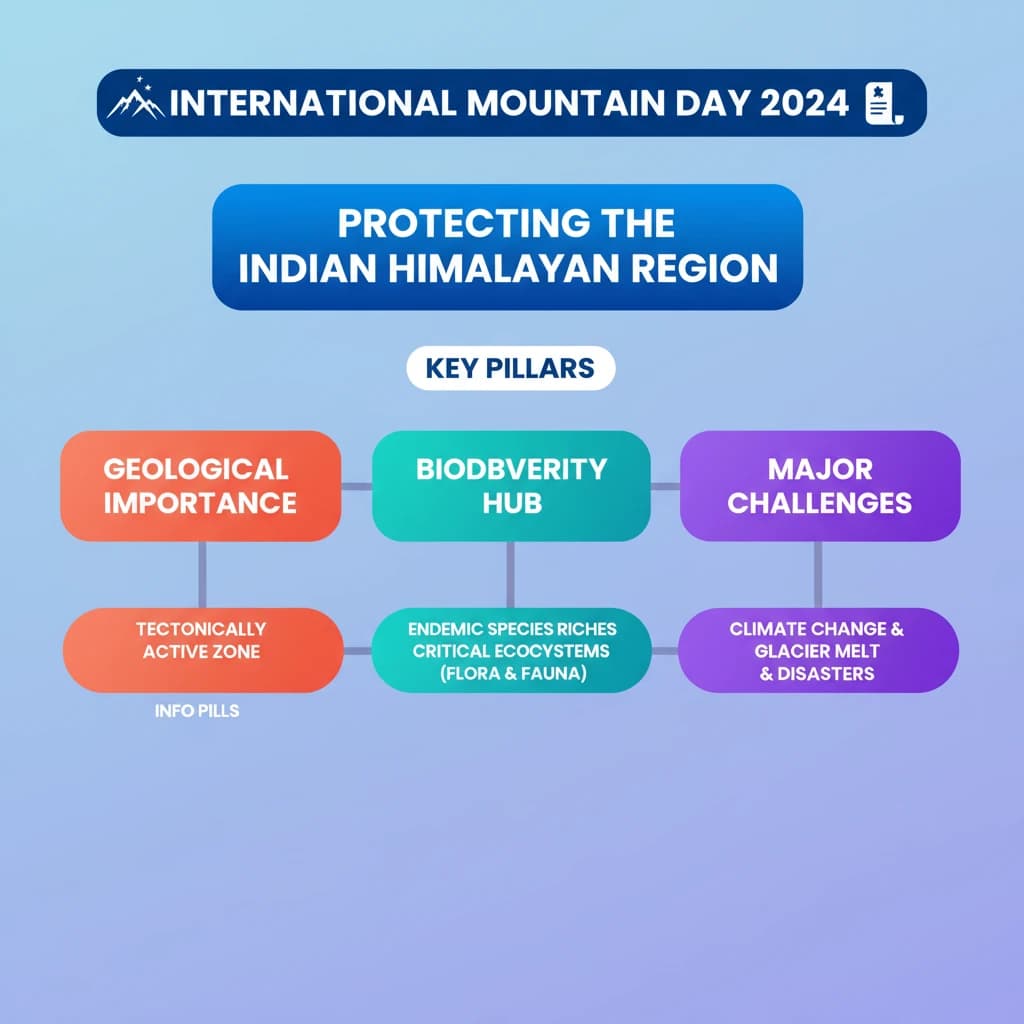
Concept Diagram

💡 Key Takeaways

  • •International Mountain Day (Dec 11) highlights the critical need to protect the Indian Himalayan Region (IHR).
  • •The IHR spans 13 Indian states/UTs, covering approx. 16.2% of India's geographical area over 2,500 km.
  • •It is a tectonically active zone due to the ongoing collision of the Indian and Eurasian Plates, leading to its formation and geological diversity.
  • •The IHR is a vital biodiversity hotspot, home to numerous endemic and endangered plant and animal species.
  • •Major challenges include climate change impacts (glacier melt, extreme weather), unsustainable development, and disaster vulnerability.
  • •Government initiatives like NMSHE and Project Snow Leopard are crucial for sustainable development and conservation in the IHR.

🧠 Memory Techniques
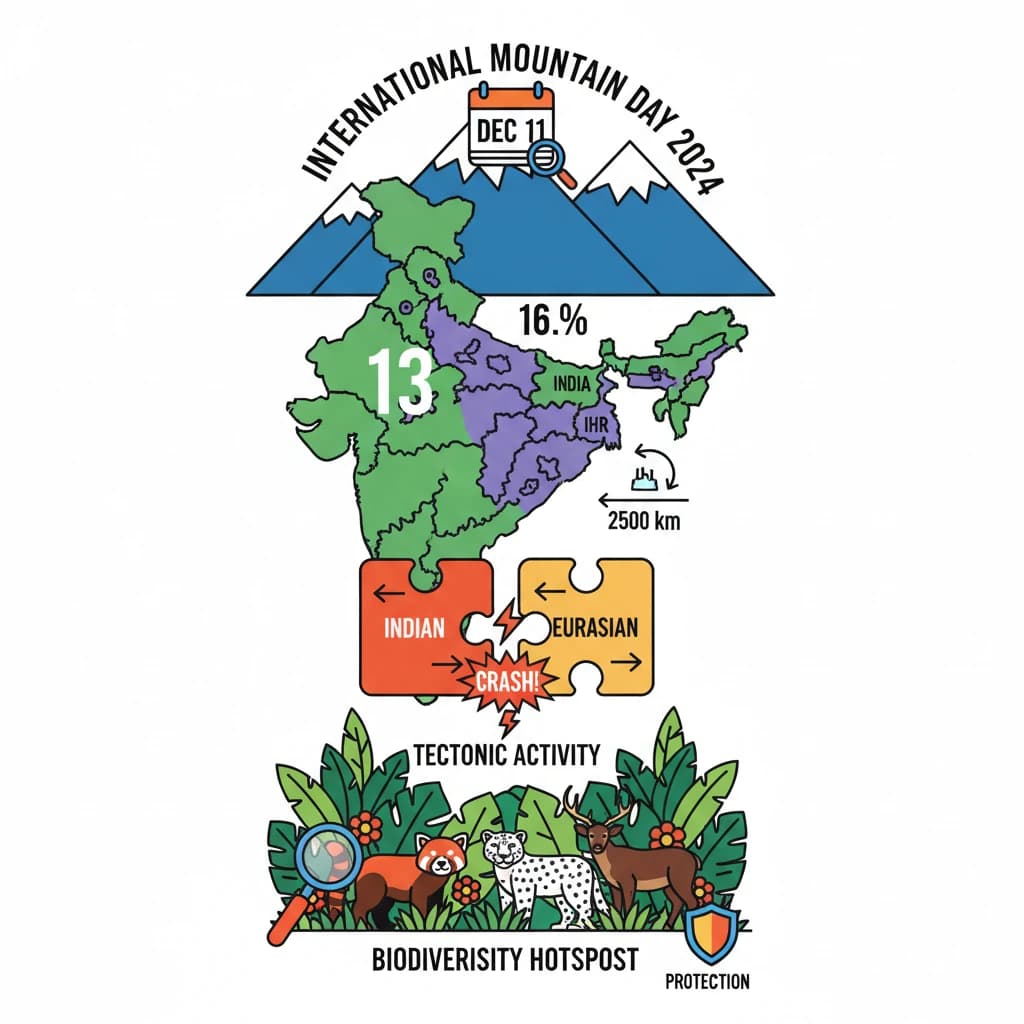
Memory Aid
95% Verified Content

📚 Reference Sources

•Ministry of Environment, Forest and Climate Change (MoEFCC) official communications
•United Nations (UN) resources on International Mountain Day
•UNESCO World Heritage Centre

Related Topics

Loading related topics...
Explore:Geography Topics·All Subjects·Daily Current Affairs·Editorial Analysis·Previous Year Questions·UPSC GPT
International Mountain Day 2024 - UPSC Geography