Loading page, please wait…
Vaidra Logo
Vaidra

Top 4 items + smart groups

UPSC GPT
New
Current Affairs
Daily Solutions
Daily Puzzle
Mains Evaluator

Version 2.0.0 • Built with ❤️ for UPSC aspirants

Loading...
Loading...
Loading...
Loading...
Loading...
Loading...
Loading...
Loading...
Loading...
Loading...
Loading...
Loading...
Loading...
Back
All Subjects

Topics

0 topics • 0 completed

Loading topics...
Loading...
Loading...
Loading...
Loading...
Loading...
Overall Progress0%

Rapid Expansion of Himalayan Glacial Lakes - UPSC Geography

What is Rapid Expansion of Himalayan Glacial Lakes in UPSC Geography?

Rapid Expansion of Himalayan Glacial Lakes is a key topic under Geography for UPSC Civil Services Examination. Key points include: Himalayan glacial lakes are rapidly expanding, increasing by 0.81% over 13 years and 3.7% in India (2011-2021).. NGT has taken suo motu cognizance, highlighting the urgency and demanding central government action.. Expansion is primarily driven by global warming, accelerating glacier melt, glacier retreat, and thawing permafrost.. Understanding this topic is essential for both UPSC Prelims and Mains preparation.

Why is Rapid Expansion of Himalayan Glacial Lakes important for UPSC exam?

Rapid Expansion of Himalayan Glacial Lakes is a Medium-level topic in UPSC Geography. It is tested in both Prelims (factual MCQs) and Mains (analytical answer writing). Previous year UPSC questions have frequently covered aspects of Rapid Expansion of Himalayan Glacial Lakes, making it essential for comprehensive IAS preparation.

How to prepare Rapid Expansion of Himalayan Glacial Lakes for UPSC?

To prepare Rapid Expansion of Himalayan Glacial Lakes for UPSC: (1) Study the comprehensive notes covering all key concepts on Vaidra. (2) Practice previous year questions on this topic. (3) Connect it with current affairs using daily updates. (4) Revise using key takeaways and mind maps available for Geography. (5) Write practice answers linking Rapid Expansion of Himalayan Glacial Lakes to related GS Paper topics.

Key takeaways of Rapid Expansion of Himalayan Glacial Lakes for UPSC

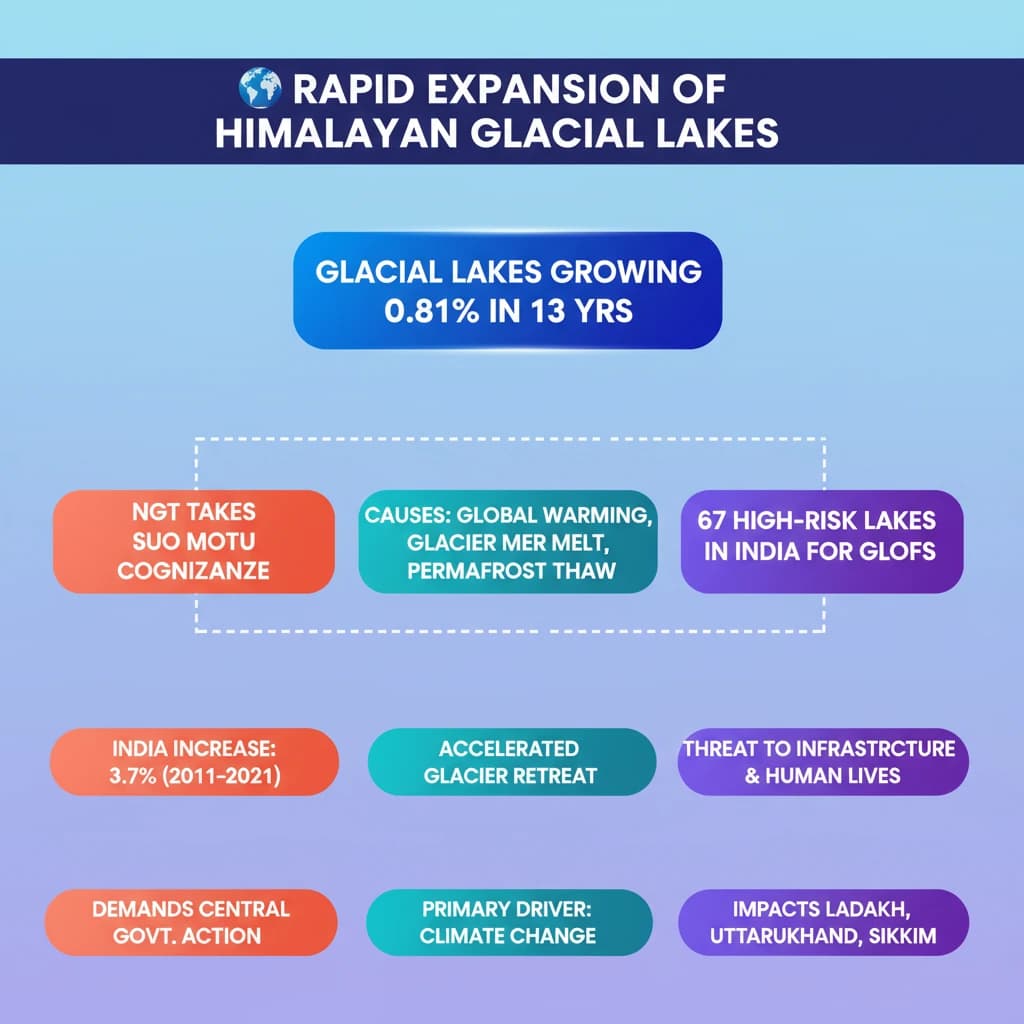
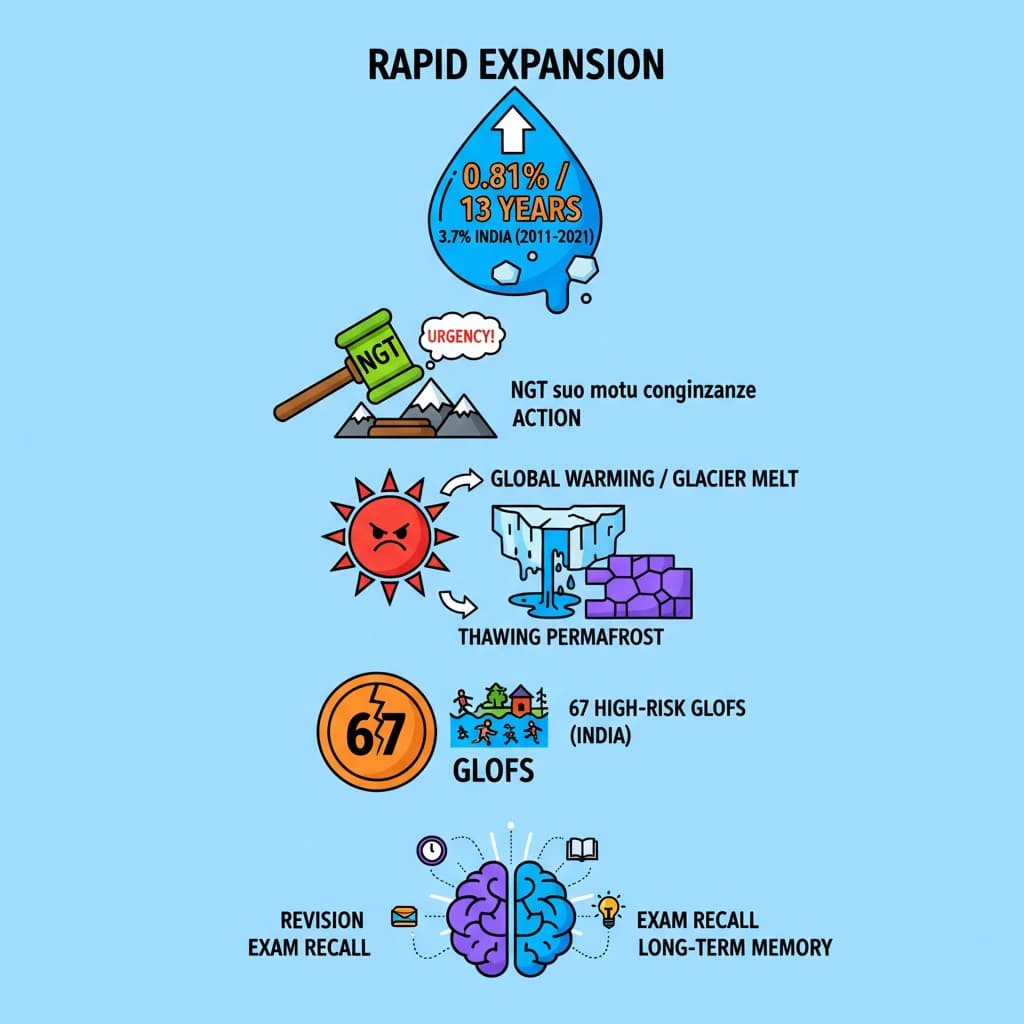
  • Himalayan glacial lakes are rapidly expanding, increasing by 0.81% over 13 years and 3.7% in India (2011-2021).
  • NGT has taken suo motu cognizance, highlighting the urgency and demanding central government action.
  • Expansion is primarily driven by global warming, accelerating glacier melt, glacier retreat, and thawing permafrost.
  • 67 lakes in India are identified as high-risk for Glacial Lake Outburst Floods (GLOFs).
  • GLOFs pose significant threats to infrastructure and human lives in states like Ladakh, Uttarakhand, and Sikkim.
  • Proactive monitoring, early warning systems, and integrated disaster management strategies are crucial for mitigation.
Rapid Expansion of
Himalayan Glacial Lakes

Rapid Expansion of Himalayan Glacial Lakes

Medium⏱️ 7 min read✓ 95% Verified
geography

📖 Introduction

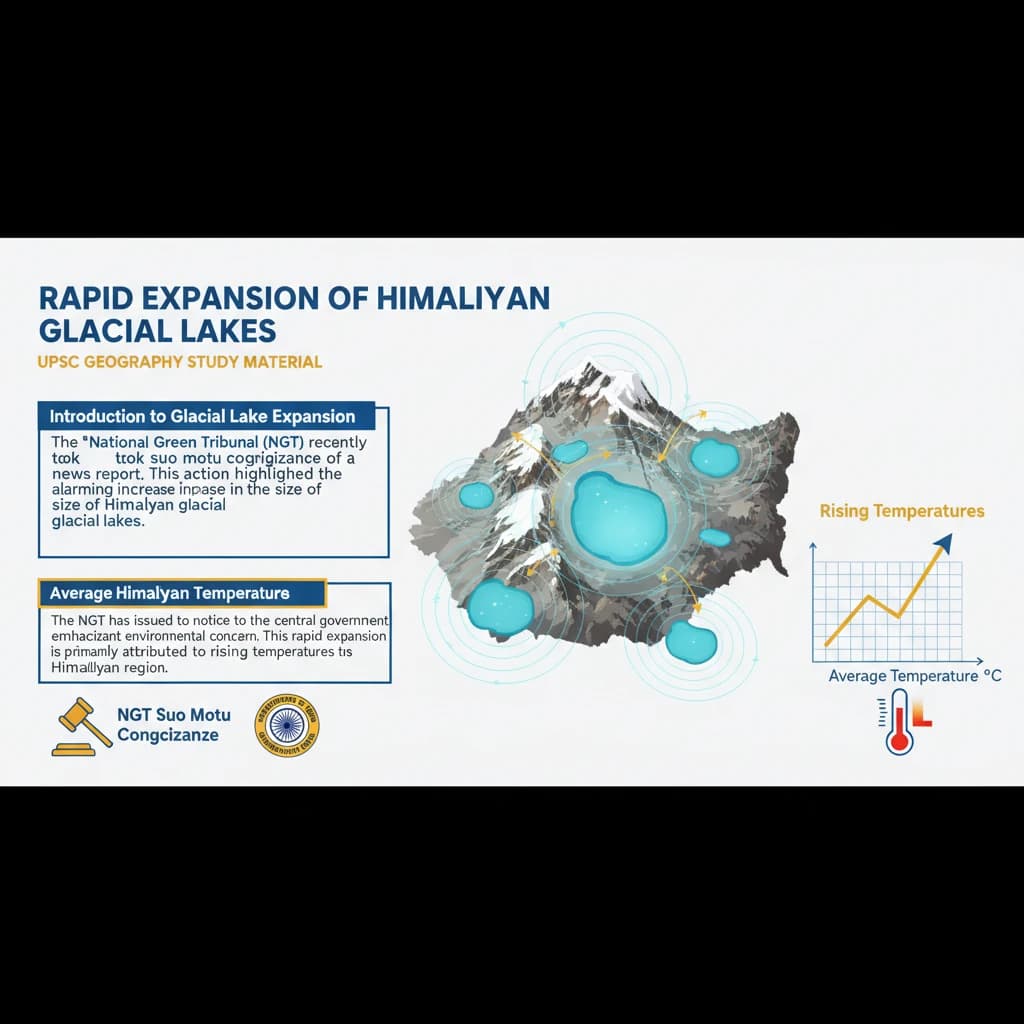
<h4>Introduction to Glacial Lake Expansion</h4><p>The <strong>National Green Tribunal (NGT)</strong> recently took <strong>suo motu cognizance</strong> of a news report. This action highlighted the alarming increase in the size of <strong>Himalayan glacial lakes</strong>.</p><p>The NGT has issued a notice to the central government, emphasizing the significant environmental concern. This rapid expansion is primarily attributed to rising temperatures across the Himalayan region.</p><div class='info-box'><p><strong>Key Statistic:</strong> Himalayan glacial lakes have expanded by approximately <strong>0.81%</strong> over the past <strong>13 years</strong>. This growth is a direct consequence of global warming accelerating glacier melt.</p></div><h4>What are Glacial Lakes?</h4><p>A <strong>glacial lake</strong> is a body of water that forms in connection with a <strong>glacier</strong>. These lakes are typically found at the base of a glacier, but can also develop on, within, or beneath the ice mass.</p><p>Their formation is a natural geological process, intricately linked to the dynamics of glacial movement and retreat.</p><div class='info-box'><p><strong>Definition:</strong> A <strong>glacial lake</strong> is a water body formed when a glacier erodes the land, creating depressions that subsequently fill with <strong>meltwater</strong> as the glacier retreats.</p></div><h4>Formation of Glacial Lakes</h4><p><strong>Glacial lakes</strong> primarily form in depressions carved out by advancing glaciers. As these glaciers retreat, the meltwater accumulates in these newly exposed basins.</p><p>Natural dams, often composed of <strong>ice</strong> or <strong>moraines</strong> (accumulations of glacial debris), can also impound water, leading to the formation of these lakes. However, these natural dams are often unstable.</p><p>The instability of these dams makes them prone to bursting, which can lead to catastrophic events known as <strong>Glacial Lake Outburst Floods (GLOFs)</strong>.</p><h4>Alarming Expansion in India</h4><p>The NGT's notice underscored a critical finding regarding glacial lake expansion specifically within India. The surface area of these lakes has shown a substantial increase in recent years.</p><p>This expansion poses a severe threat to both human settlements and critical infrastructure located downstream in vulnerable regions.</p><div class='info-box'><p><strong>India-Specific Data:</strong> The surface area of glacial lakes in India increased by <strong>3.7%</strong> from <strong>2011 to 2021</strong>. A total of <strong>67 lakes</strong> have been identified as having a <strong>high risk</strong> for <strong>GLOFs</strong>.</p><p><strong>Vulnerable Regions:</strong> This significant threat impacts states and union territories such as <strong>Ladakh</strong>, <strong>Himachal Pradesh</strong>, <strong>Uttarakhand</strong>, <strong>Sikkim</strong>, and <strong>Arunachal Pradesh</strong>.</p></div><div class='exam-tip-box'><p><strong>UPSC Insight:</strong> The <strong>NGT's suo motu cognizance</strong> highlights the role of judicial activism in environmental protection. Questions may arise on its powers, functions, and specific cases related to climate change impacts or disaster management.</p></div><h4>Drivers of Expansion</h4><p>The rapid expansion of <strong>Himalayan glacial lakes</strong> is driven by a combination of climate-related factors. These factors accelerate both the formation of new lakes and the growth of existing ones.</p><ul><li><strong>Global Warming:</strong> Rising global temperatures lead to accelerated <strong>glacier melting</strong> in the Himalayas, directly contributing more water to glacial lakes.</li><li><strong>Glacier Retreat:</strong> As glaciers retreat, they expose new land surfaces. This creates new depressions and allows existing lakes to expand into the newly uncovered terrain.</li><li><strong>Thawing Permafrost:</strong> The thawing of <strong>permafrost</strong> (permanently frozen ground) creates depressions where water can collect. As permafrost thaws, it loses its natural drainage barrier, further expanding glacial lakes.</li></ul>
Concept Diagram

💡 Key Takeaways

  • •Himalayan glacial lakes are rapidly expanding, increasing by 0.81% over 13 years and 3.7% in India (2011-2021).
  • •NGT has taken suo motu cognizance, highlighting the urgency and demanding central government action.
  • •Expansion is primarily driven by global warming, accelerating glacier melt, glacier retreat, and thawing permafrost.
  • •67 lakes in India are identified as high-risk for Glacial Lake Outburst Floods (GLOFs).
  • •GLOFs pose significant threats to infrastructure and human lives in states like Ladakh, Uttarakhand, and Sikkim.
  • •Proactive monitoring, early warning systems, and integrated disaster management strategies are crucial for mitigation.

🧠 Memory Techniques
Memory Aid
95% Verified Content

📚 Reference Sources

•News reports cited by National Green Tribunal (NGT)
•General scientific literature on Himalayan glacier dynamics and climate change impacts

Related Topics

Loading related topics...
Explore:Geography Topics·All Subjects·Daily Current Affairs·Editorial Analysis·Previous Year Questions·UPSC GPT
Rapid Expansion of Himalayan Glacial Lakes - UPSC Geography