Loading page, please wait…
Vaidra Logo
Vaidra

Top 4 items + smart groups

UPSC GPT
New
Current Affairs
Daily Solutions
Daily Puzzle
Mains Evaluator

Version 2.0.0 • Built with ❤️ for UPSC aspirants

Loading...
Loading...
Loading...
Loading...
Loading...
Loading...
Loading...
Loading...
Loading...
Loading...
Loading...
Loading...
Loading...
Back
All Subjects

Topics

0 topics • 0 completed

Loading topics...
Loading...
Loading...
Loading...
Loading...
Loading...
Overall Progress0%

Conserving of Trees - UPSC Geography

What is Conserving of Trees in UPSC Geography?

Conserving of Trees is a key topic under Geography for UPSC Civil Services Examination. Key points include: Prohibition of tree cutting is essential in landslide-prone zones to maintain soil stability.. Extensive plantation work is crucial for conserving vital soil and water resources.. Trees act as natural barriers against erosion, absorb water, and bind soil particles.. Understanding this topic is essential for both UPSC Prelims and Mains preparation.

Why is Conserving of Trees important for UPSC exam?

Conserving of Trees is a Medium-level topic in UPSC Geography. It is tested in both Prelims (factual MCQs) and Mains (analytical answer writing). Previous year UPSC questions have frequently covered aspects of Conserving of Trees, making it essential for comprehensive IAS preparation.

How to prepare Conserving of Trees for UPSC?

To prepare Conserving of Trees for UPSC: (1) Study the comprehensive notes covering all key concepts on Vaidra. (2) Practice previous year questions on this topic. (3) Connect it with current affairs using daily updates. (4) Revise using key takeaways and mind maps available for Geography. (5) Write practice answers linking Conserving of Trees to related GS Paper topics.

Key takeaways of Conserving of Trees for UPSC

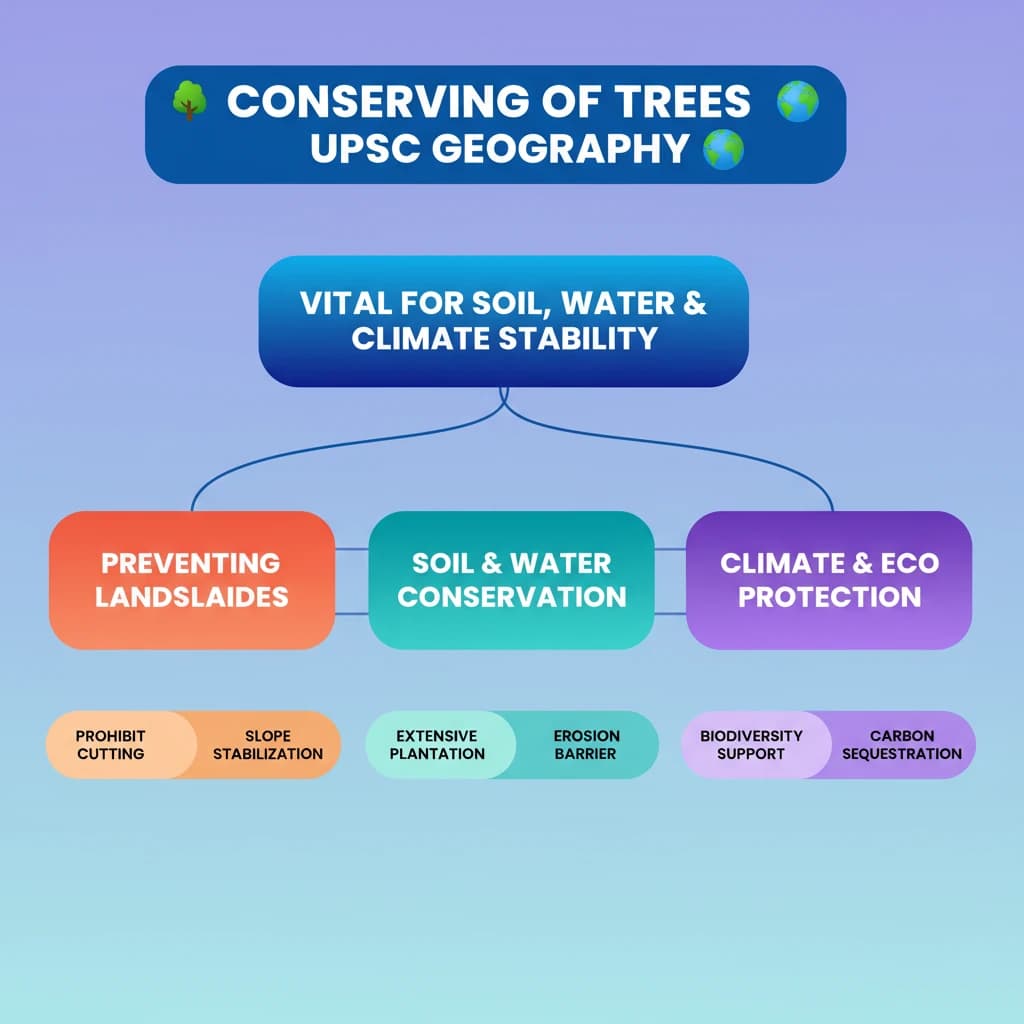
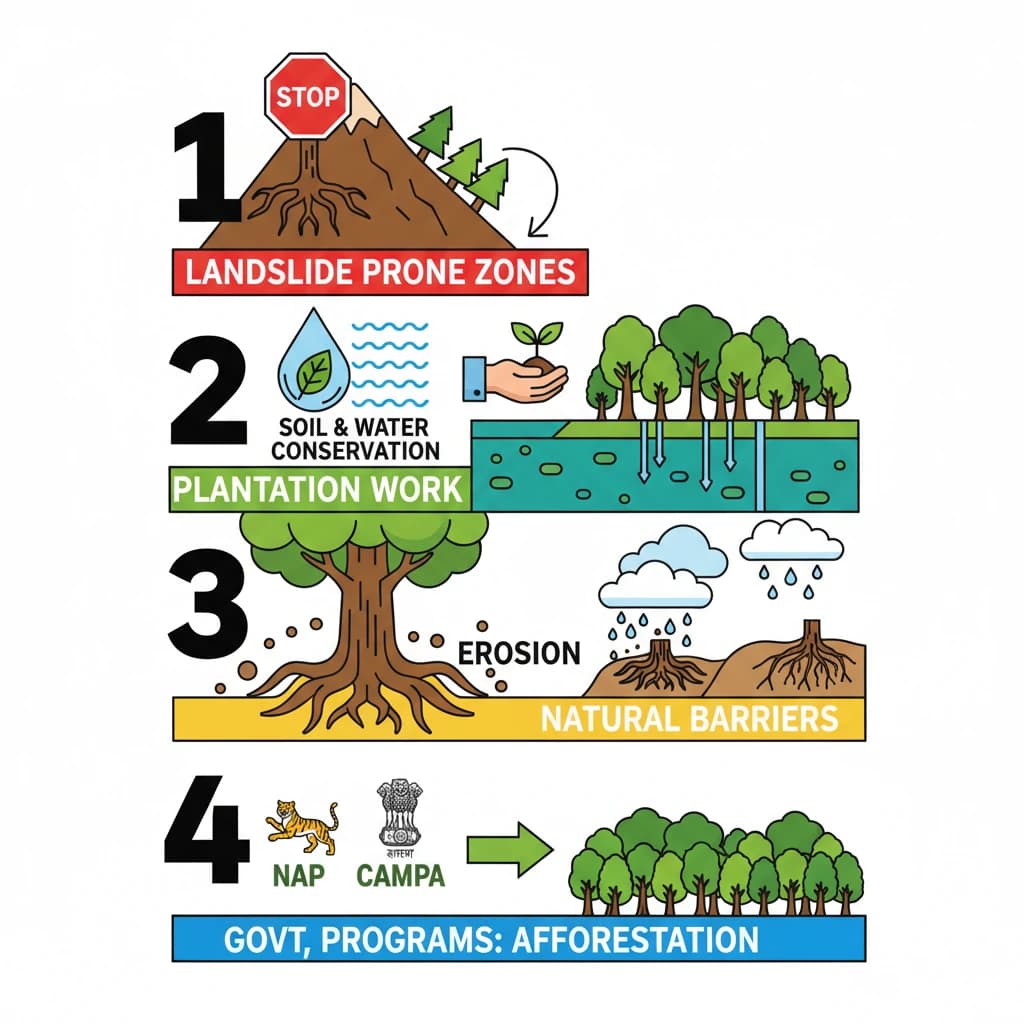
  • Prohibition of tree cutting is essential in landslide-prone zones to maintain soil stability.
  • Extensive plantation work is crucial for conserving vital soil and water resources.
  • Trees act as natural barriers against erosion, absorb water, and bind soil particles.
  • Government programs like NAP and CAMPA actively promote afforestation across India.
  • Tree conservation is vital for climate change mitigation, biodiversity, and disaster risk reduction.
Conserving of Trees

Conserving of Trees

Medium⏱️ 10 min read✓ 95% Verified
geography

📖 Introduction

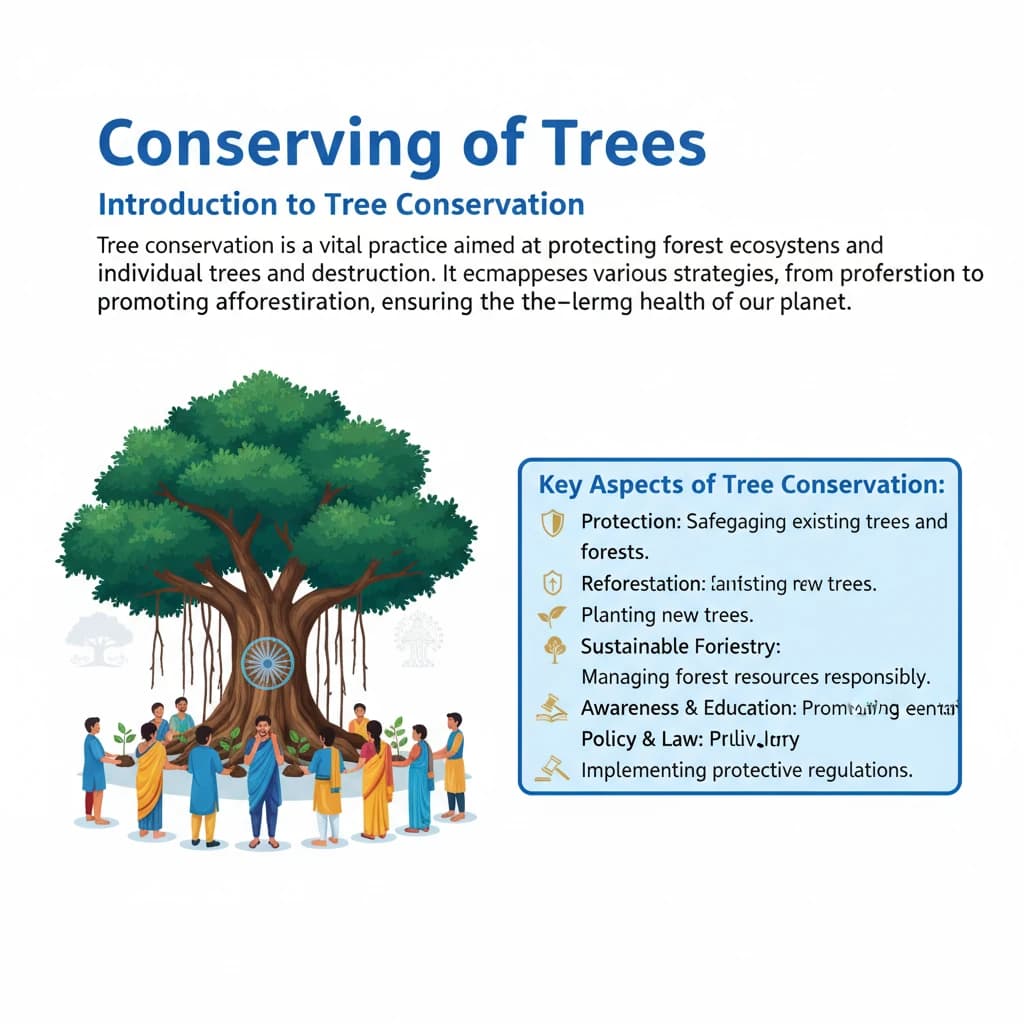
<h4>Introduction to Tree Conservation</h4><p><strong>Tree conservation</strong> is a vital practice aimed at protecting forest ecosystems and individual trees from degradation and destruction. It encompasses various strategies, from preventing deforestation to promoting afforestation, ensuring the long-term health of our planet.</p><div class='info-box'><p><strong>Key Aspects of Tree Conservation:</strong><ul><li><strong>Protection:</strong> Safeguarding existing trees and forests.</li><li><strong>Restoration:</strong> Replanting trees in deforested areas.</li><li><strong>Sustainable Management:</strong> Using forest resources responsibly.</li></ul></p></div><h4>Prohibition in Landslide Zones</h4><p>A crucial aspect of conservation involves specific guidelines for vulnerable areas. It has been strongly advised against the <strong>cutting of trees</strong>, particularly in <strong>landslide zones</strong>. These areas are inherently unstable, and the presence of trees plays a critical role in maintaining soil integrity.</p><div class='key-point-box'><p><strong>Why Trees are Vital in Landslide Zones:</strong><ul><li><strong>Root Systems:</strong> Tree roots bind soil particles together, increasing soil cohesion and stability.</li><li><strong>Water Absorption:</strong> Trees absorb excess moisture, reducing soil saturation and the likelihood of landslides.</li><li><strong>Erosion Control:</strong> Canopy cover reduces the impact of rainfall, preventing surface erosion.</li></ul></p></div><h4>Importance of Extensive Plantation Work</h4><p>To actively combat environmental degradation and enhance natural resource resilience, <strong>extensive plantation work</strong> should be undertaken. This involves planting a large number of trees across various landscapes, especially in areas prone to erosion or resource depletion.</p><p>Such initiatives are fundamental for the long-term health of our ecosystems. They directly contribute to the conservation of both <strong>soil</strong> and <strong>water resources</strong>, which are indispensable for agriculture, biodiversity, and human well-being.</p><div class='exam-tip-box'><p><strong>UPSC Insight:</strong> Questions on environmental conservation often link to <strong>disaster management</strong> (GS-III) and <strong>physical geography</strong> (GS-I). Understanding the role of trees in preventing landslides and conserving resources is critical for integrated answers.</p></div>
Concept Diagram

💡 Key Takeaways

  • •Prohibition of tree cutting is essential in landslide-prone zones to maintain soil stability.
  • •Extensive plantation work is crucial for conserving vital soil and water resources.
  • •Trees act as natural barriers against erosion, absorb water, and bind soil particles.
  • •Government programs like NAP and CAMPA actively promote afforestation across India.
  • •Tree conservation is vital for climate change mitigation, biodiversity, and disaster risk reduction.

🧠 Memory Techniques
Memory Aid
95% Verified Content

📚 Reference Sources

•Ministry of Environment, Forest and Climate Change (MoEFCC) official reports
•National Forest Policy of India documents
•NCERT Geography textbooks (Class XI & XII)
•United Nations Framework Convention on Climate Change (UNFCCC) reports on India's climate actions

Related Topics

Loading related topics...
Explore:Geography Topics·All Subjects·Daily Current Affairs·Editorial Analysis·Previous Year Questions·UPSC GPT
Conserving of Trees - UPSC Geography