Loading page, please wait…
Vaidra Logo
Vaidra

Top 4 items + smart groups

UPSC GPT
New
Current Affairs
Daily Solutions
Daily Puzzle
Mains Evaluator

Version 2.0.0 • Built with ❤️ for UPSC aspirants

Loading...
Loading...
Loading...
Loading...
Loading...
Loading...
Loading...
Loading...
Loading...
Loading...
Loading...
Loading...
Loading...
What is the Polar Vortex? - UPSC Geography
Back
All Subjects

Topics

0 topics • 0 completed

Loading topics...
Loading...
Loading...
Loading...
Loading...
Loading...
Overall Progress0%

What is the Polar Vortex? - UPSC Geography

What is What is the Polar Vortex? in UPSC Geography?

What is the Polar Vortex? is a key topic under Geography for UPSC Civil Services Examination. Key points include: The <strong>polar vortex</strong> is a large low-pressure, cold air system rotating over the poles, present year-round but strongest in winter.. It exists in two types: <strong>Tropospheric</strong> (lower atmosphere, 10-15 km) and <strong>Stratospheric</strong> (higher atmosphere, 15-50 km).. A <strong>strong polar vortex</strong> keeps the <strong>jet stream</strong> stable, confining cold air to the poles.. Understanding this topic is essential for both UPSC Prelims and Mains preparation.

Why is What is the Polar Vortex? important for UPSC exam?

What is the Polar Vortex? is a Medium-level topic in UPSC Geography. It is tested in both Prelims (factual MCQs) and Mains (analytical answer writing). Previous year UPSC questions have frequently covered aspects of What is the Polar Vortex?, making it essential for comprehensive IAS preparation.

How to prepare What is the Polar Vortex? for UPSC?

To prepare What is the Polar Vortex? for UPSC: (1) Study the comprehensive notes covering all key concepts on Vaidra. (2) Practice previous year questions on this topic. (3) Connect it with current affairs using daily updates. (4) Revise using key takeaways and mind maps available for Geography. (5) Write practice answers linking What is the Polar Vortex? to related GS Paper topics.

Key takeaways of What is the Polar Vortex? for UPSC

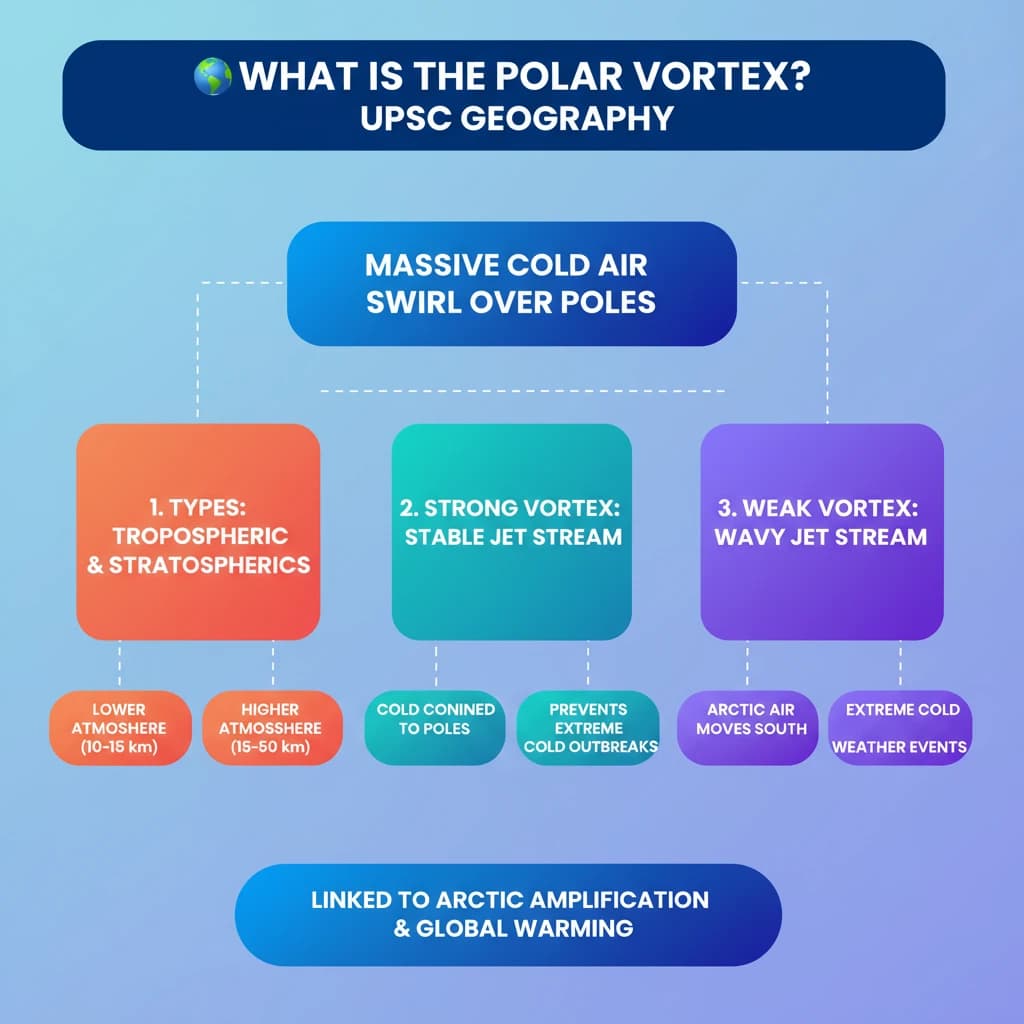
  • The <strong>polar vortex</strong> is a large low-pressure, cold air system rotating over the poles, present year-round but strongest in winter.
  • It exists in two types: <strong>Tropospheric</strong> (lower atmosphere, 10-15 km) and <strong>Stratospheric</strong> (higher atmosphere, 15-50 km).
  • A <strong>strong polar vortex</strong> keeps the <strong>jet stream</strong> stable, confining cold air to the poles.
  • A <strong>weak polar vortex</strong> leads to a wavy <strong>jet stream</strong>, allowing frigid <strong>Arctic air</strong> to move southward, causing extreme cold.
  • This phenomenon is increasingly linked to <strong>Arctic amplification</strong>, where the Arctic warms faster than the global average, a key aspect of <strong>global warming</strong>.
What is the Polar Vortex?

What is the Polar Vortex?

Medium⏱️ 8 min read✓ 95% Verified
geography

📖 Introduction

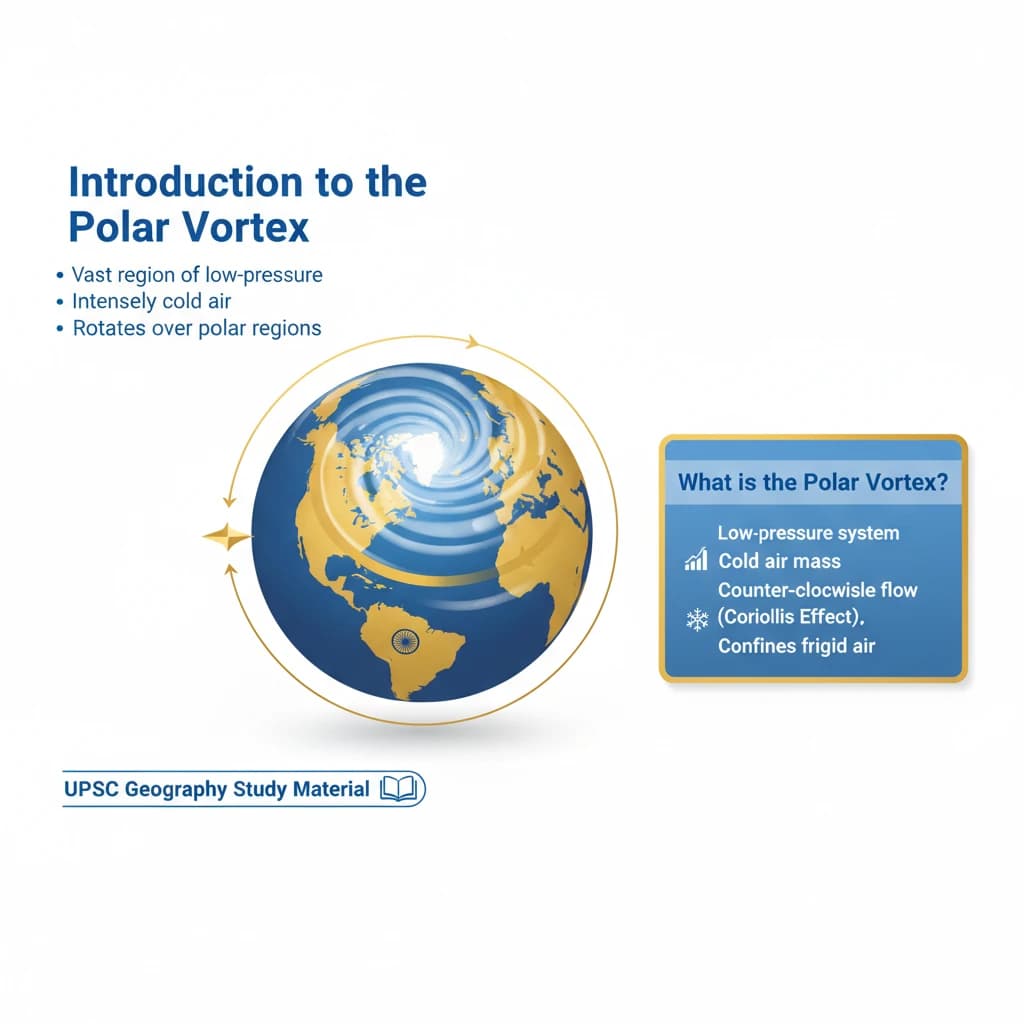
<h4>Introduction to the Polar Vortex</h4><p>The <strong>polar vortex</strong> is a vast region of <strong>low-pressure</strong> and intensely <strong>cold air</strong> that consistently rotates over the Earth’s <strong>polar regions</strong>.</p><p>The term "<strong>vortex</strong>" accurately describes the characteristic <strong>counter-clockwise flow of air</strong>. This rotational movement is crucial as it effectively traps and confines the frigid air near the poles.</p><div class='info-box'><p>The <strong>polar vortex</strong> is a permanent atmospheric feature, existing throughout the year. However, its strength fluctuates seasonally, becoming significantly <strong>weaker in summer</strong> and much <strong>stronger in winter</strong>.</p></div><h4>Types of Polar Vortex</h4><p>The <strong>polar vortex</strong> is observed at different altitudes within the Earth's atmosphere, leading to its classification into two primary types:</p><ul><li><strong>Tropospheric Polar Vortex</strong>: This type is situated in the <strong>lowest layer of the atmosphere</strong>, extending from the Earth's surface up to an altitude of approximately <strong>10-15 km</strong>. Most common <strong>weather phenomena</strong> occur within this layer.</li><li><strong>Stratospheric Polar Vortex</strong>: Occurring at much higher altitudes, this vortex is found between <strong>15 km to 50 km</strong> above the Earth's surface. It reaches its peak strength during <strong>autumn</strong> and typically dissipates by the <strong>summer months</strong>.</li></ul><div class='info-box'><p>Changes in the <strong>stratospheric polar vortex</strong> are heavily influenced by the movement of air and the transfer of heat within the polar regions. During <strong>autumn</strong>, circumpolar winds intensify, which strengthens the vortex and helps form a cohesive, rotating mass of polar air in the stratosphere.</p></div><h4>Mechanism of Extreme Cold Weather</h4><p>The behavior of the <strong>polar vortex</strong> directly impacts weather patterns, particularly the movement of cold air. A <strong>strong polar vortex</strong> plays a critical role in maintaining a stable atmospheric condition.</p><div class='key-point-box'><p>When the <strong>polar vortex is strong</strong>, it effectively keeps the <strong>jet stream</strong> stable and relatively straight. This stability acts as a barrier, preventing the intensely cold Arctic air from migrating southward into lower latitudes.</p></div><p>Conversely, a <strong>weakening of the polar vortex</strong> can lead to significant atmospheric disturbances. This weakening causes the <strong>jet stream</strong>, normally a narrow band of strong winds flowing in a relatively straight path, to become highly <strong>wavy and disrupted</strong>.</p><p>This disruption allows the frigid <strong>Arctic air</strong> to escape its usual confines and flow much farther south than typical. The consequence is a surge of extremely low temperatures, often accompanied by severe storms, heavy snowfall, and freezing rain in affected regions.</p><h4>Global Warming and Arctic Amplification</h4><p>Contemporary research highlights a crucial connection between <strong>global warming</strong> and the behavior of the <strong>polar vortex</strong>. Scientists observe that the <strong>Arctic region</strong> is experiencing warming at a rate significantly faster than the global average.</p><div class='info-box'><p>This accelerated warming phenomenon in the Arctic is termed <strong>Arctic amplification</strong>. It is a key area of study for understanding how climate change might influence extreme weather events linked to the polar vortex.</p></div><div class='exam-tip-box'><p>Understanding the interplay between <strong>Arctic amplification</strong>, the <strong>jet stream</strong>, and the <strong>polar vortex</strong> is crucial for UPSC exams, especially in questions related to <strong>climate change impacts</strong> and <strong>extreme weather patterns</strong> (<strong>GS Paper 1: Geography, GS Paper 3: Environment</strong>).</p></div>
Concept Diagram

💡 Key Takeaways

  • •The <strong>polar vortex</strong> is a large low-pressure, cold air system rotating over the poles, present year-round but strongest in winter.
  • •It exists in two types: <strong>Tropospheric</strong> (lower atmosphere, 10-15 km) and <strong>Stratospheric</strong> (higher atmosphere, 15-50 km).
  • •A <strong>strong polar vortex</strong> keeps the <strong>jet stream</strong> stable, confining cold air to the poles.
  • •A <strong>weak polar vortex</strong> leads to a wavy <strong>jet stream</strong>, allowing frigid <strong>Arctic air</strong> to move southward, causing extreme cold.
  • •This phenomenon is increasingly linked to <strong>Arctic amplification</strong>, where the Arctic warms faster than the global average, a key aspect of <strong>global warming</strong>.

🧠 Memory Techniques

Memory Aid
95% Verified Content

📚 Reference Sources

•National Oceanic and Atmospheric Administration (NOAA) - Arctic Report Card
•National Aeronautics and Space Administration (NASA) - Earth Observatory
•Intergovernmental Panel on Climate Change (IPCC) Reports

Related Topics

Loading related topics...
Explore:Geography Topics·All Subjects·Daily Current Affairs·Editorial Analysis·Previous Year Questions·UPSC GPT