Loading page, please wait…
Vaidra Logo
Vaidra

Top 4 items + smart groups

UPSC GPT
New
Current Affairs
Daily Solutions
Daily Puzzle
Mains Evaluator

Version 2.0.0 • Built with ❤️ for UPSC aspirants

Loading...
Loading...
Loading...
Loading...
Loading...
Loading...
Loading...
Loading...
Loading...
Loading...
Loading...
Loading...
Loading...
Back
All Subjects

Topics

0 topics • 0 completed

Loading topics...
Loading...
Loading...
Loading...
Loading...
Loading...
Overall Progress0%

Implications of No Snowfall In Kashmir - UPSC Geography

What is Implications of No Snowfall In Kashmir in UPSC Geography?

Implications of No Snowfall In Kashmir is a key topic under Geography for UPSC Civil Services Examination. Key points include: Kashmir is experiencing unprecedented snowfall deficit, severely impacting tourism and local economy.. Primary causes include a decline in Western Disturbances, amplified by Climate Change and the current El Nino event.. The deficit has led to significant rainfall shortages in J&K and Ladakh (80% in Dec 2023, 100% in Jan 2024).. Understanding this topic is essential for both UPSC Prelims and Mains preparation.

Why is Implications of No Snowfall In Kashmir important for UPSC exam?

Implications of No Snowfall In Kashmir is a Medium-level topic in UPSC Geography. It is tested in both Prelims (factual MCQs) and Mains (analytical answer writing). Previous year UPSC questions have frequently covered aspects of Implications of No Snowfall In Kashmir, making it essential for comprehensive IAS preparation.

How to prepare Implications of No Snowfall In Kashmir for UPSC?

To prepare Implications of No Snowfall In Kashmir for UPSC: (1) Study the comprehensive notes covering all key concepts on Vaidra. (2) Practice previous year questions on this topic. (3) Connect it with current affairs using daily updates. (4) Revise using key takeaways and mind maps available for Geography. (5) Write practice answers linking Implications of No Snowfall In Kashmir to related GS Paper topics.

Key takeaways of Implications of No Snowfall In Kashmir for UPSC

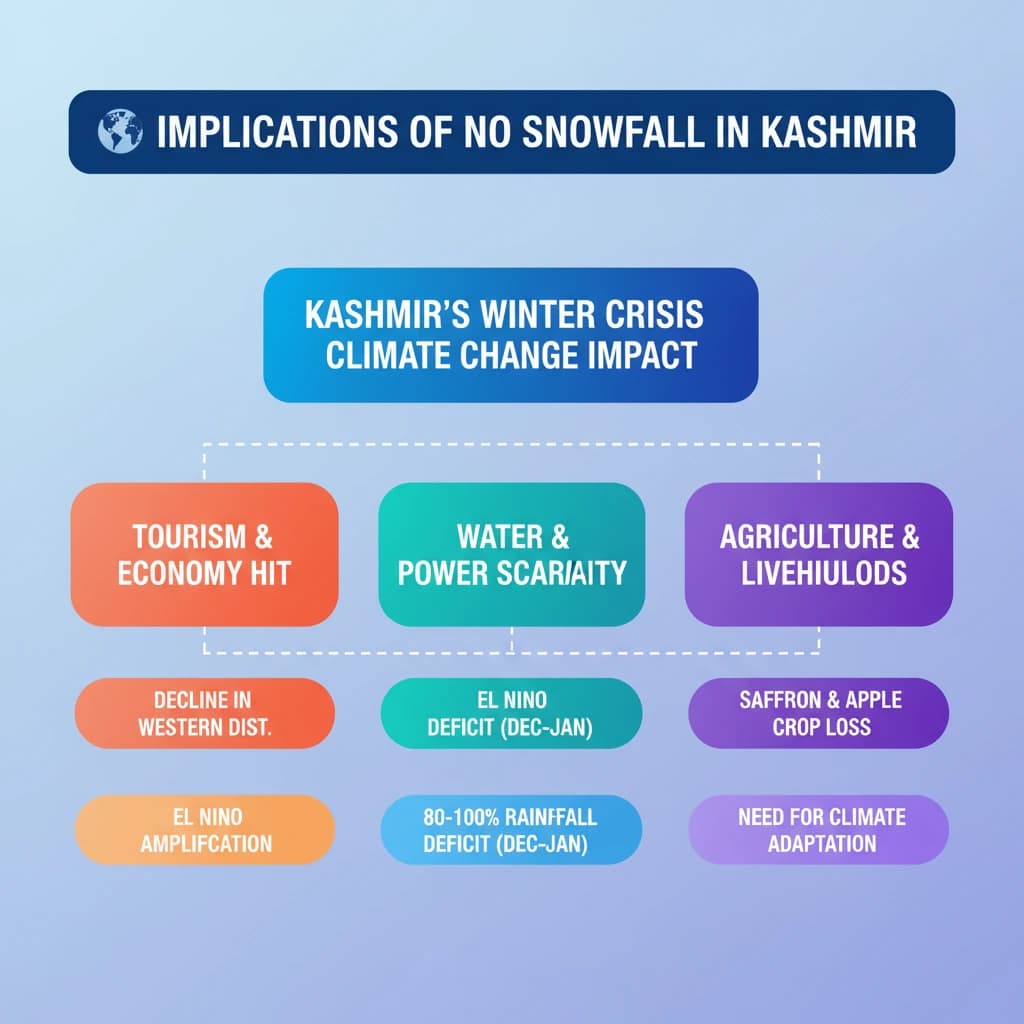
  • Kashmir is experiencing unprecedented snowfall deficit, severely impacting tourism and local economy.
  • Primary causes include a decline in Western Disturbances, amplified by Climate Change and the current El Nino event.
  • The deficit has led to significant rainfall shortages in J&K and Ladakh (80% in Dec 2023, 100% in Jan 2024).
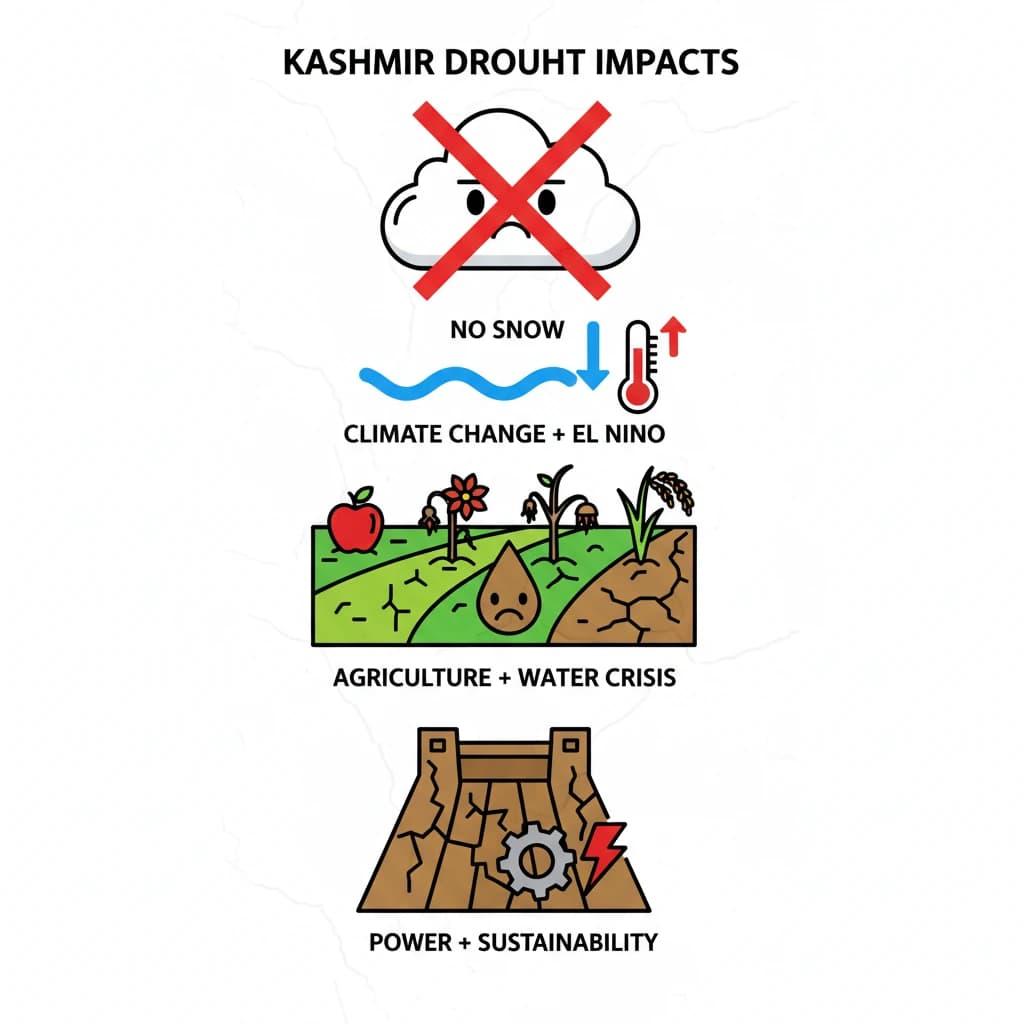
  • Impacts extend to agriculture (saffron, apples), water resources, and hydropower generation, threatening long-term sustainability.
  • The phenomenon highlights the urgent need for climate adaptation strategies and diversified livelihoods in vulnerable Himalayan regions.
Implications of No Snowfall In Kashmir

Implications of No Snowfall In Kashmir

Medium⏱️ 8 min read✓ 95% Verified
geography

📖 Introduction

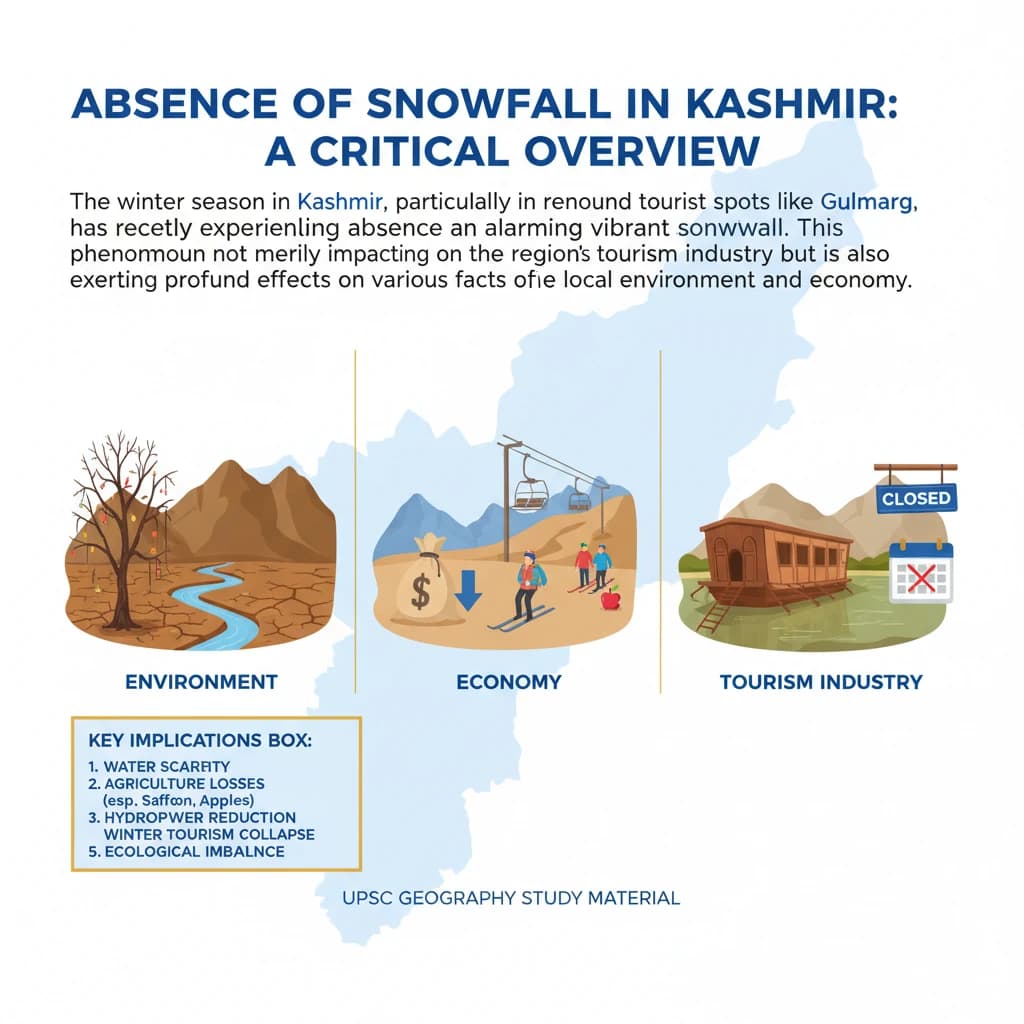
<h4>Absence of Snowfall in Kashmir: A Critical Overview</h4><p>The winter season in <strong>Kashmir</strong>, particularly in renowned tourist spots like <strong>Gulmarg</strong>, has recently experienced an alarming absence of snowfall. This phenomenon is not merely impacting the region's vibrant <strong>tourism industry</strong> but is also exerting profound effects on various facets of the local <strong>environment</strong> and <strong>economy</strong>.</p><div class='exam-tip-box'><p><strong>UPSC Relevance:</strong> This topic is crucial for <strong>GS Paper 1 (Geography)</strong> concerning climatic phenomena and their regional impacts, and <strong>GS Paper 3 (Environment & Economy)</strong> regarding climate change, sustainable development, and economic challenges.</p></div><h4>Understanding the Causes of No Snowfall in Kashmir</h4><p>The lack of significant winter precipitation in <strong>Jammu and Kashmir</strong> and <strong>Ladakh</strong> regions has been a major concern. These areas typically rely on snowfall for their winter moisture.</p><div class='info-box'><p><strong>Precipitation Deficit:</strong> The region recorded an approximate <strong>80% rainfall deficit</strong> in <strong>December 2023</strong>. Alarmingly, <strong>January 2024</strong> witnessed a <strong>100% (no rain) deficit</strong> so far, highlighting a severe dry spell.</p></div><h4>Decline in Western Disturbances</h4><p>A primary reason for the decreasing snowfall trend is the observed decline in the frequency and intensity of <strong>Western Disturbance</strong> events. These systems are the crucial source of winter precipitation for the <strong>Himalayan region</strong>.</p><div class='key-point-box'><p><strong>What are Western Disturbances?</strong> These are large, eastward-moving <strong>rain-bearing wind systems</strong>. They originate beyond <strong>Afghanistan</strong> and <strong>Iran</strong>, gathering significant moisture from as far as the <strong>Mediterranean Sea</strong> and even the <strong>Atlantic Ocean</strong> before reaching the Indian subcontinent.</p></div><p>The number of these vital weather events has been consistently declining. This reduction directly contributes to less overall precipitation, predominantly snowfall, during the critical winter months.</p><h4>Role of Climate Change and El Nino</h4><p><strong>Climate Change</strong> is widely recognized as a significant contributing factor to the dwindling snowfall in <strong>Kashmir</strong>. Numerous studies indicate its role in altering regional weather patterns.</p><p>A concerning trend is the higher rate of <strong>temperature increase</strong> observed in <strong>upper elevation areas</strong> compared to the plains. This warming directly impacts the snowline and the persistence of snow cover.</p><div class='key-point-box'><p>The ongoing <strong>El Nino event</strong> in the <strong>eastern Pacific Ocean</strong> is also implicated. <strong>El Nino</strong> can influence global atmospheric circulation, potentially contributing to the deficit precipitation experienced in the Himalayan region during this period.</p></div>
Concept Diagram

💡 Key Takeaways

  • •Kashmir is experiencing unprecedented snowfall deficit, severely impacting tourism and local economy.
  • •Primary causes include a decline in Western Disturbances, amplified by Climate Change and the current El Nino event.
  • •The deficit has led to significant rainfall shortages in J&K and Ladakh (80% in Dec 2023, 100% in Jan 2024).
  • •Impacts extend to agriculture (saffron, apples), water resources, and hydropower generation, threatening long-term sustainability.
  • •The phenomenon highlights the urgent need for climate adaptation strategies and diversified livelihoods in vulnerable Himalayan regions.

🧠 Memory Techniques
Memory Aid
95% Verified Content

📚 Reference Sources

•General knowledge on Western Disturbances, El Nino, and Himalayan geography

Related Topics

Loading related topics...
Explore:Geography Topics·All Subjects·Daily Current Affairs·Editorial Analysis·Previous Year Questions·UPSC GPT
Implications of No Snowfall In Kashmir - UPSC Geography