Loading page, please wait…
Vaidra Logo
Vaidra

Top 4 items + smart groups

UPSC GPT
New
Current Affairs
Daily Solutions
Daily Puzzle
Mains Evaluator

Version 2.0.0 • Built with ❤️ for UPSC aspirants

Loading...
Loading...
Loading...
Loading...
Loading...
Loading...
Loading...
Loading...
Loading...
Loading...
Loading...
Loading...
Loading...
Back
All Subjects

Topics

0 topics • 0 completed

Loading topics...
Loading...
Loading...
Loading...
Loading...
Loading...
Overall Progress0%

India’s Deep Drill Mission - UPSC Geography

What is India’s Deep Drill Mission in UPSC Geography?

India’s Deep Drill Mission is a key topic under Geography for UPSC Civil Services Examination. Key points include: India's Deep Drill Mission is led by the Ministry of Earth Science in Karad, Maharashtra.. The mission aims to drill 6 km deep into the Earth's crust using the Borehole Geophysics Research Laboratory (BGRL).. Scientific Deep Drilling studies Earth's composition, structure, and processes for geological insights.. Understanding this topic is essential for both UPSC Prelims and Mains preparation.

Why is India’s Deep Drill Mission important for UPSC exam?

India’s Deep Drill Mission is a Medium-level topic in UPSC Geography. It is tested in both Prelims (factual MCQs) and Mains (analytical answer writing). Previous year UPSC questions have frequently covered aspects of India’s Deep Drill Mission, making it essential for comprehensive IAS preparation.

How to prepare India’s Deep Drill Mission for UPSC?

To prepare India’s Deep Drill Mission for UPSC: (1) Study the comprehensive notes covering all key concepts on Vaidra. (2) Practice previous year questions on this topic. (3) Connect it with current affairs using daily updates. (4) Revise using key takeaways and mind maps available for Geography. (5) Write practice answers linking India’s Deep Drill Mission to related GS Paper topics.

Key takeaways of India’s Deep Drill Mission for UPSC

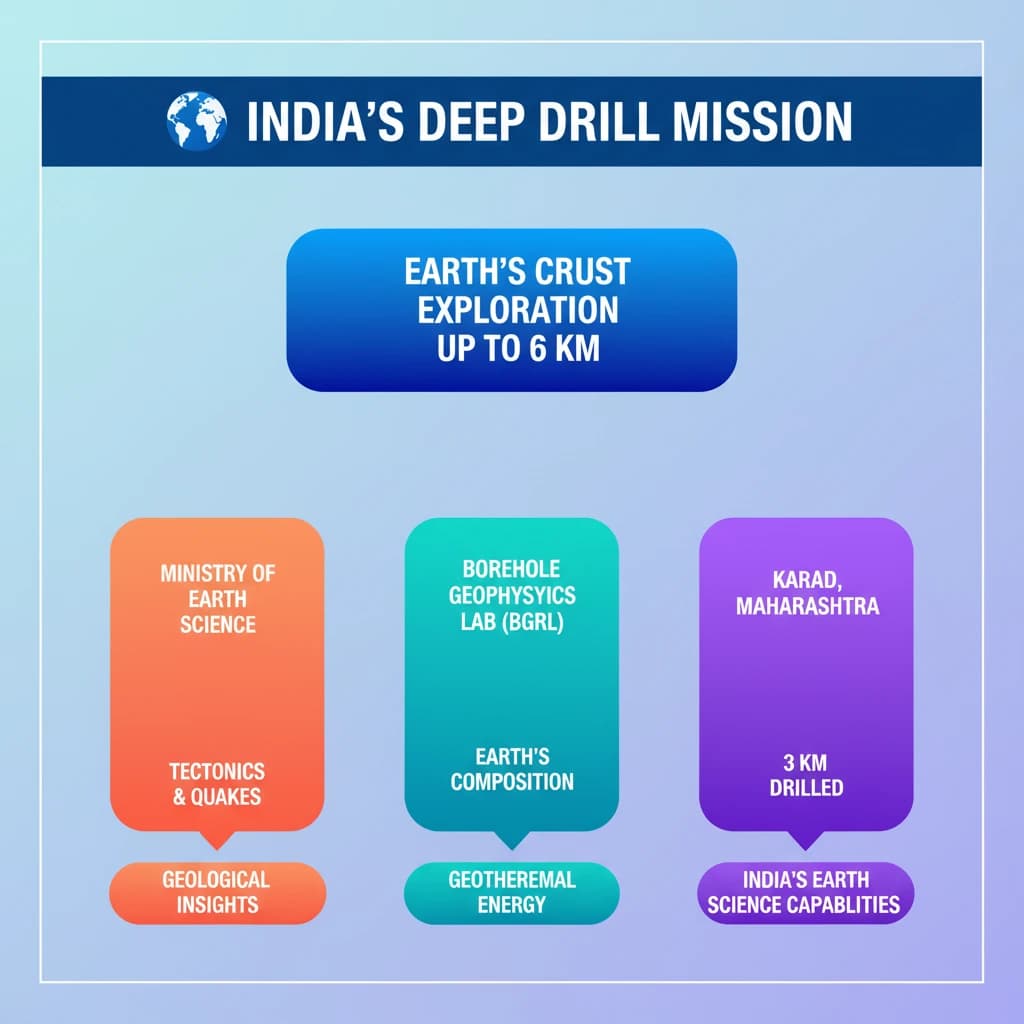
  • India's Deep Drill Mission is led by the Ministry of Earth Science in Karad, Maharashtra.
  • The mission aims to drill 6 km deep into the Earth's crust using the Borehole Geophysics Research Laboratory (BGRL).
  • Scientific Deep Drilling studies Earth's composition, structure, and processes for geological insights.
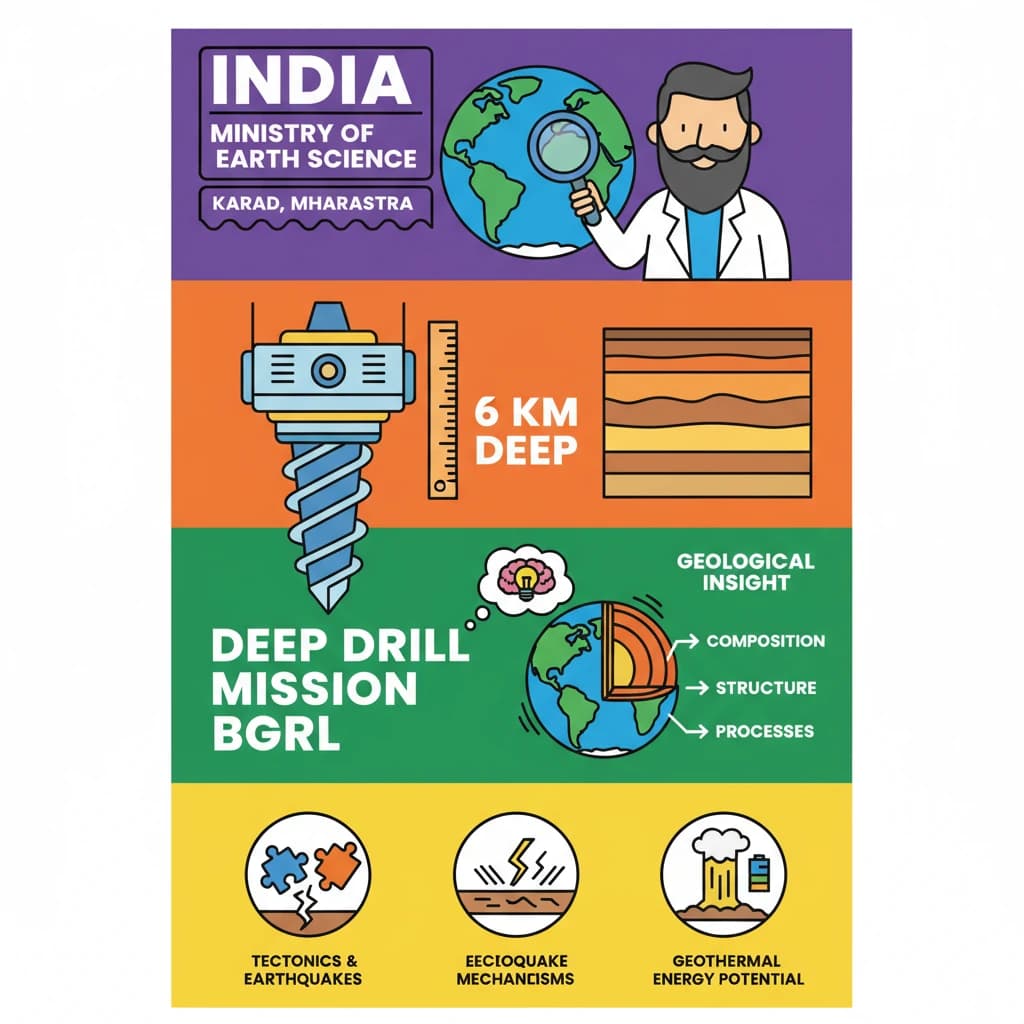
  • Key objectives include understanding tectonics, earthquake mechanisms, and geothermal energy potential.
  • The project has already completed 3 km of drilling, contributing to India's Earth Science capabilities.
India’s Deep Drill Mission

India’s Deep Drill Mission

Medium⏱️ 5 min read✓ 95% Verified
geography

📖 Introduction

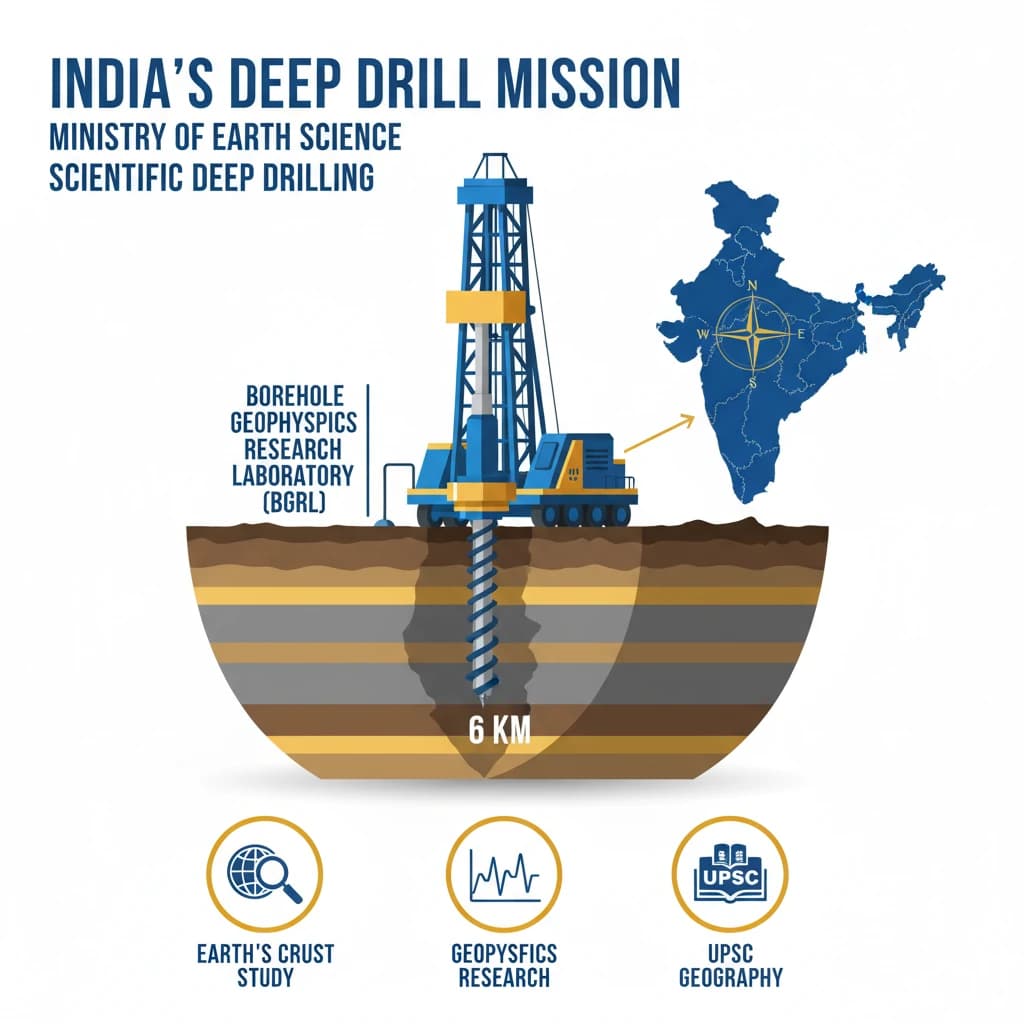
<h4>Introduction to India's Deep Drill Mission</h4><p>The <strong>Ministry of Earth Science</strong> has launched a significant initiative: <strong>India's Deep Drill Mission</strong>. This project involves <strong>Scientific Deep Drilling</strong> into the Earth's crust.</p><p>The mission aims to reach an impressive depth of <strong>6 km</strong>. It utilizes a specialized machine known as the <strong>Borehole Geophysics Research Laboratory (BGRL)</strong>.</p><p>The drilling operations are being carried out in <strong>Karad, Maharashtra</strong>, a strategically chosen location for geological studies.</p><div class='info-box'><p><strong>Current Status:</strong> The mission has already successfully completed drilling to a depth of <strong>3 km</strong>, marking a significant milestone in its progress.</p></div><div class='exam-tip-box'><p><strong>UPSC Relevance:</strong> This mission is crucial for <strong>GS Paper 1 (Geography)</strong> for understanding Earth's internal structure and <strong>GS Paper 3 (Science & Technology)</strong> for advancements in Earth Sciences and resource exploration.</p></div><h4>What is Scientific Deep Drilling?</h4><div class='key-point-box'><p><strong>Definition:</strong> <strong>Scientific Deep Drilling</strong> is a specialized process that involves drilling deep into the <strong>Earth's crust</strong> to thoroughly investigate its composition, structure, and ongoing geological processes.</p></div><p>This advanced research methodology is vital for gaining profound insights into various aspects of our planet.</p><ul><li>Understanding <strong>geological formations</strong> and their evolution over millennia.</li><li>Identifying potential <strong>natural resources</strong> hidden within the Earth's depths.</li><li>Reconstructing <strong>Earth's history</strong> by analyzing ancient rock samples and geological layers.</li></ul><p>Deep drilling projects are primarily designed to significantly enhance our scientific comprehension in several critical areas:</p><ul><li>Advancing the understanding of <strong>plate tectonics</strong> and crustal dynamics.</li><li>Elucidating <strong>earthquake mechanisms</strong> and improving seismic hazard assessment.</li><li>Assessing the immense potential for <strong>geothermal energy</strong>, a sustainable power source.</li></ul><div class='info-box'><p><strong>Key Objectives:</strong> Beyond exploration, these missions contribute to fundamental research, helping scientists model Earth's interior and predict future geological events.</p></div>
Concept Diagram

💡 Key Takeaways

  • •India's Deep Drill Mission is led by the Ministry of Earth Science in Karad, Maharashtra.
  • •The mission aims to drill 6 km deep into the Earth's crust using the Borehole Geophysics Research Laboratory (BGRL).
  • •Scientific Deep Drilling studies Earth's composition, structure, and processes for geological insights.
  • •Key objectives include understanding tectonics, earthquake mechanisms, and geothermal energy potential.
  • •The project has already completed 3 km of drilling, contributing to India's Earth Science capabilities.

🧠 Memory Techniques
Memory Aid
95% Verified Content

📚 Reference Sources

•Ministry of Earth Sciences, Government of India official reports
•Geological Survey of India publications
•National Centre for Seismology (NCS) documents

Related Topics

Loading related topics...
Explore:Geography Topics·All Subjects·Daily Current Affairs·Editorial Analysis·Previous Year Questions·UPSC GPT
India’s Deep Drill Mission - UPSC Geography