Loading page, please wait…
Vaidra Logo
Vaidra

Top 4 items + smart groups

UPSC GPT
New
Current Affairs
Daily Solutions
Daily Puzzle
Mains Evaluator

Version 2.0.0 • Built with ❤️ for UPSC aspirants

Loading...
Loading...
Loading...
Loading...
Loading...
Loading...
Loading...
Loading...
Loading...
Loading...
Loading...
Loading...
Loading...
Back
All Subjects

Topics

0 topics • 0 completed

Loading topics...
Loading...
Loading...
Loading...
Loading...
Loading...
Overall Progress0%

River Training: Structural Measures for Flow Guidance - UPSC Geography

What is River Training: Structural Measures for Flow Guidance in UPSC Geography?

River Training: Structural Measures for Flow Guidance is a key topic under Geography for UPSC Civil Services Examination. Key points include: River training involves constructing structures to guide river flow for stability and protection.. Key objectives include flood control, erosion prevention, and navigation improvement.. Structures like guide banks, spurs, revetments, and embankments are commonly used.. Understanding this topic is essential for both UPSC Prelims and Mains preparation.

Why is River Training: Structural Measures for Flow Guidance important for UPSC exam?

River Training: Structural Measures for Flow Guidance is a Medium-level topic in UPSC Geography. It is tested in both Prelims (factual MCQs) and Mains (analytical answer writing). Previous year UPSC questions have frequently covered aspects of River Training: Structural Measures for Flow Guidance, making it essential for comprehensive IAS preparation.

How to prepare River Training: Structural Measures for Flow Guidance for UPSC?

To prepare River Training: Structural Measures for Flow Guidance for UPSC: (1) Study the comprehensive notes covering all key concepts on Vaidra. (2) Practice previous year questions on this topic. (3) Connect it with current affairs using daily updates. (4) Revise using key takeaways and mind maps available for Geography. (5) Write practice answers linking River Training: Structural Measures for Flow Guidance to related GS Paper topics.

Key takeaways of River Training: Structural Measures for Flow Guidance for UPSC

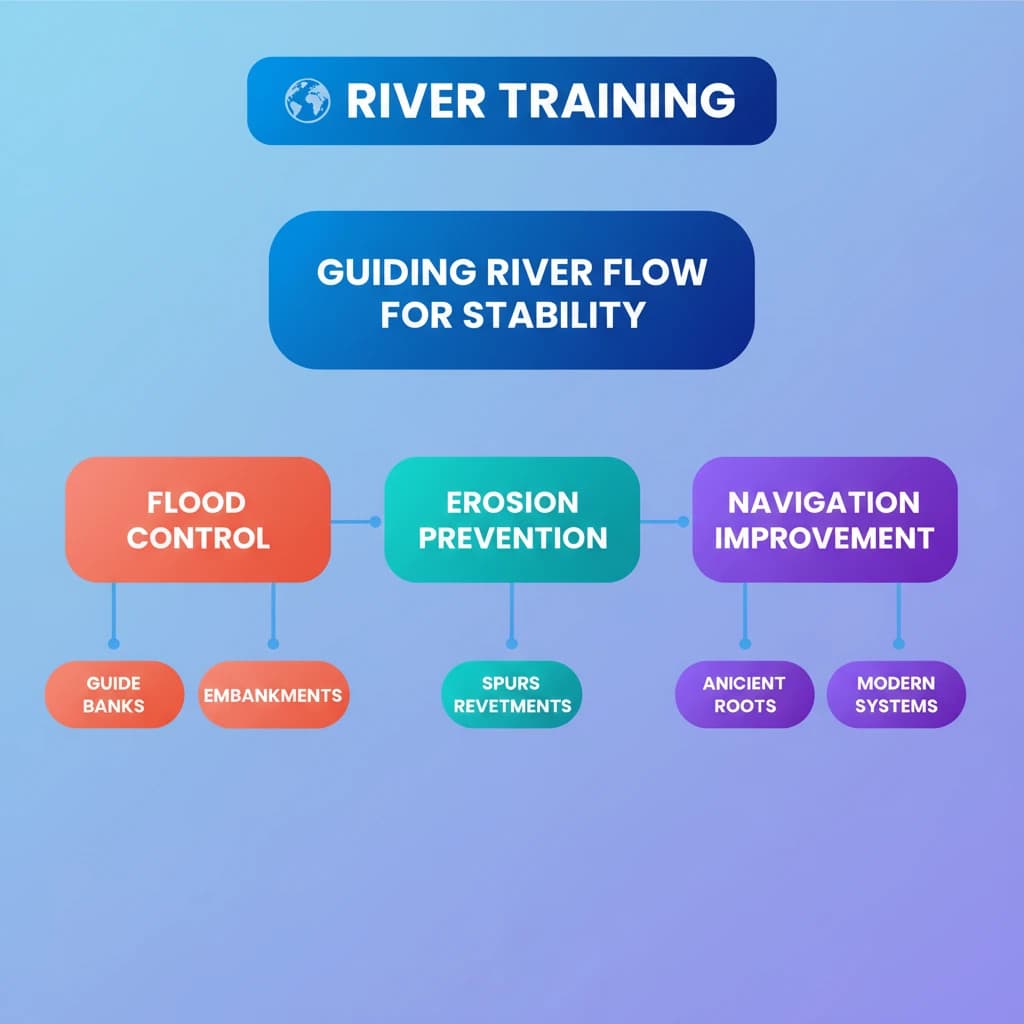
  • River training involves constructing structures to guide river flow for stability and protection.
  • Key objectives include flood control, erosion prevention, and navigation improvement.
  • Structures like guide banks, spurs, revetments, and embankments are commonly used.
  • Historical context shows ancient roots, with modern engineering bringing systematic approaches.
  • Currently vital for flood management, waterways, and infrastructure, requiring sustainable practices.
River Training: Structural Measures for Flow Guidance

River Training: Structural Measures for Flow Guidance

Medium⏱️ 8 min read✓ 95% Verified
geography

📖 Introduction

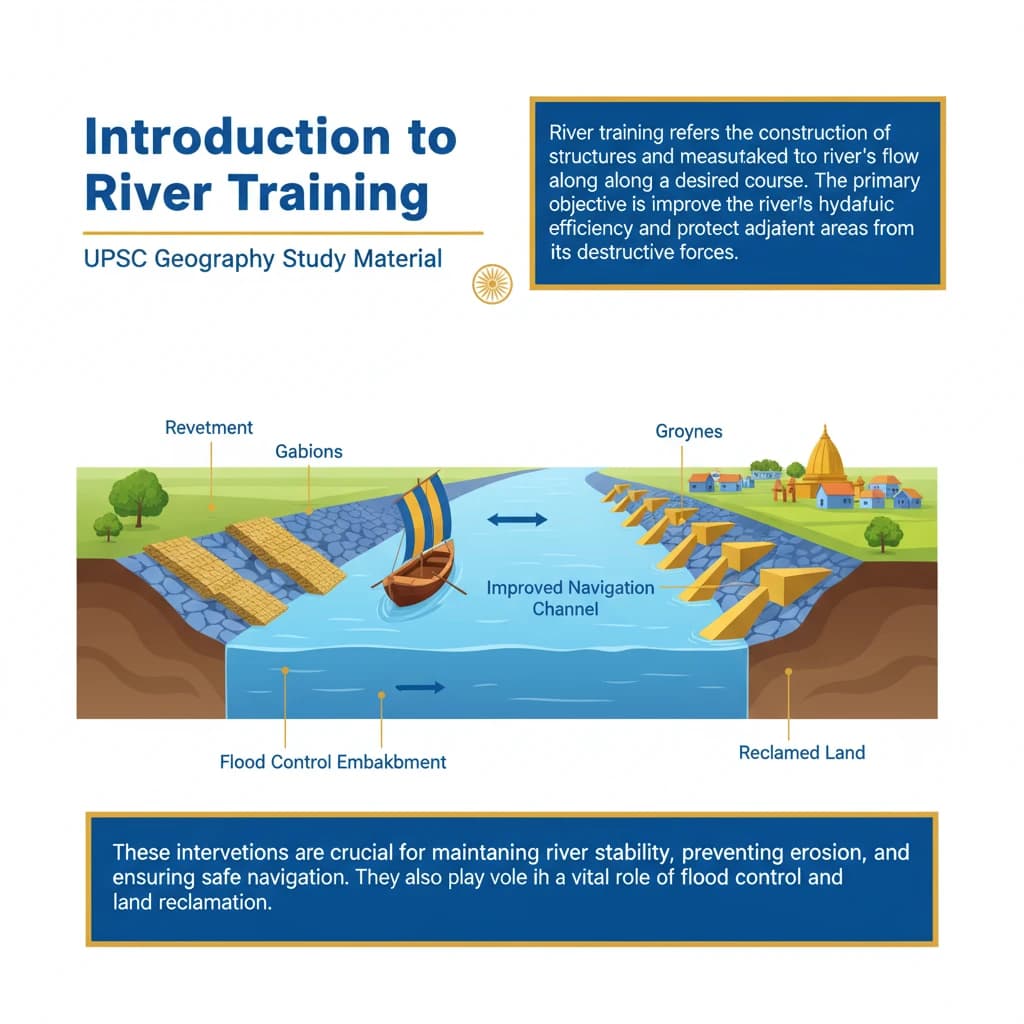
<h4>Introduction to River Training</h4><p><strong>River training</strong> refers to the construction of structures and measures undertaken to guide the river's flow along a desired course. The primary objective is to improve the river's hydraulic efficiency and protect adjacent areas from its destructive forces.</p><p>These interventions are crucial for maintaining river stability, preventing erosion, and ensuring safe navigation. They also play a vital role in flood control and land reclamation efforts.</p><div class='key-point-box'><p><strong>Key Concept:</strong> <strong>River training</strong> aims to stabilize river channels, control sediment movement, and protect river banks and infrastructure from damage caused by natural river dynamics.</p></div><h4>Core Components of River Training</h4><p>The source material highlights two fundamental aspects of river training:</p><ul><li><strong>Construction of structures to guide the river’s flow:</strong> This involves engineering works designed to direct the water current, control its velocity, and prevent it from eroding banks or changing its course.</li><li><strong>Providing appropriate support for hanging boulders on the foothills:</strong> This specific measure addresses localized instability, preventing landslides and ensuring the structural integrity of the river system, especially in hilly or mountainous terrains.</li></ul><h4>Objectives of River Training</h4><p>River training projects are typically undertaken with multiple objectives:</p><ul><li><strong>Flood Control:</strong> Guiding the river flow to prevent inundation of adjacent areas.</li><li><strong>Erosion Control:</strong> Protecting river banks and agricultural land from scour and erosion.</li><li><strong>Navigation Improvement:</strong> Maintaining adequate depth and width for safe passage of vessels.</li><li><strong>Sediment Management:</strong> Controlling deposition and scour to prevent silting of channels or reservoirs.</li><li><strong>Land Reclamation:</strong> Stabilizing banks to reclaim land for agriculture or infrastructure.</li></ul><h4>Types of River Training Works</h4><p>River training can be broadly categorized based on its primary purpose:</p><ul><li><strong>High Water Training:</strong> Focuses on controlling floods by confining high flows within a defined channel.</li><li><strong>Low Water Training:</strong> Aims to maintain navigable depths during lean periods, often through dredging or flow concentration.</li><li><strong>Mean Water Training:</strong> Seeks to manage the river's behavior under average flow conditions, balancing flood and navigation needs.</li></ul><div class='info-box'><p><strong>Common River Training Structures:</strong></p><ul><li><strong>Guide Banks:</strong> Extend upstream and downstream from a bridge or barrage to guide the river flow smoothly.</li><li><strong>Spurs (Groynes):</strong> Project into the river to deflect currents away from banks or to create deposition.</li><li><strong>Revetments:</strong> Protective coverings on river banks (e.g., stone pitching, concrete blocks) to prevent erosion.</li><li><strong>Embankments/Levees:</strong> Raised structures along river banks to contain floodwaters.</li></ul></div><div class='exam-tip-box'><p><strong>UPSC Insight:</strong> River training is a crucial topic for <strong>GS Paper I (Geography)</strong> and <strong>GS Paper III (Disaster Management, Infrastructure)</strong>. Questions often relate to flood control measures, river morphology, and sustainable development practices. Understanding the types of structures and their purposes is key.</p></div>
Concept Diagram

💡 Key Takeaways

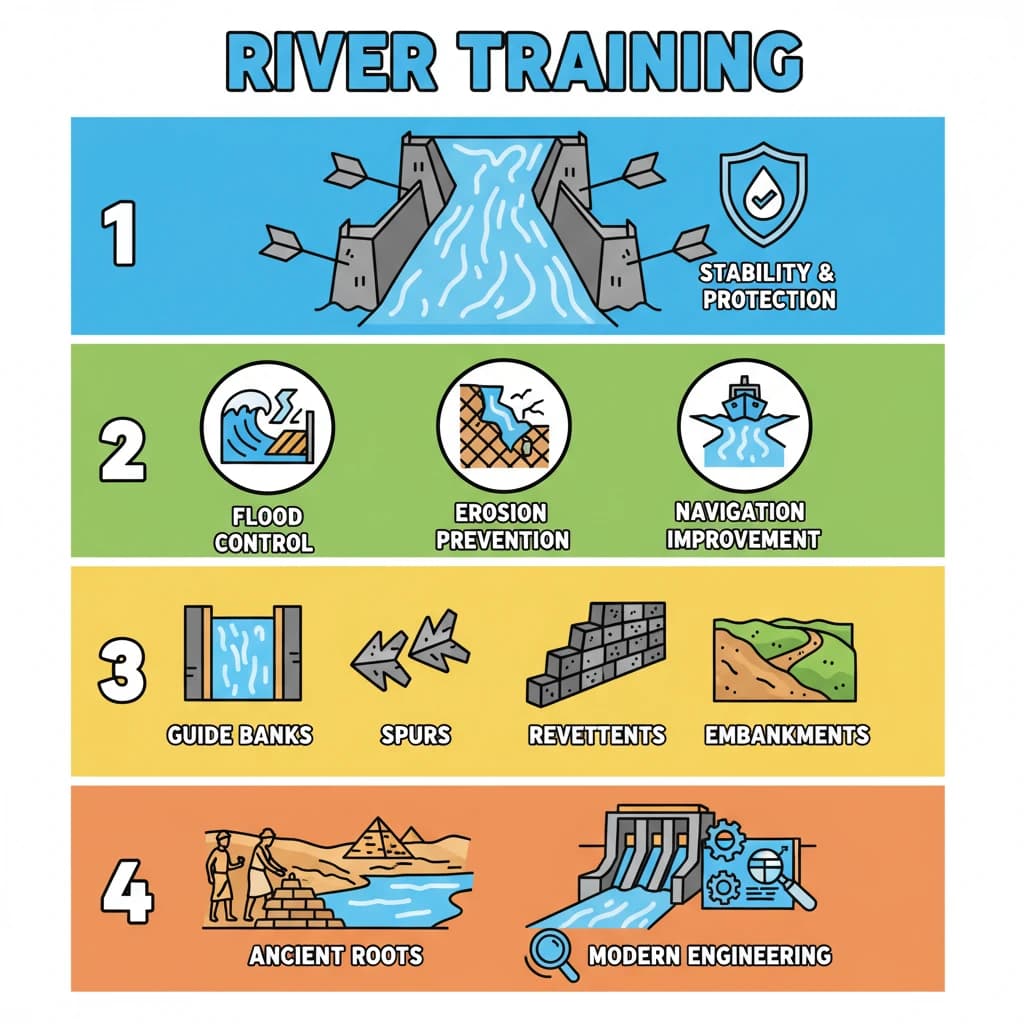
  • •River training involves constructing structures to guide river flow for stability and protection.
  • •Key objectives include flood control, erosion prevention, and navigation improvement.
  • •Structures like guide banks, spurs, revetments, and embankments are commonly used.
  • •Historical context shows ancient roots, with modern engineering bringing systematic approaches.
  • •Currently vital for flood management, waterways, and infrastructure, requiring sustainable practices.

🧠 Memory Techniques
Memory Aid
95% Verified Content

📚 Reference Sources

•National Water Policy (2012), Government of India
•Drishti IAS Study Material (provided as source)
•Standard textbooks on Fluvial Geomorphology and Hydraulic Engineering
•Reports from Central Water Commission (CWC)

Related Topics

Loading related topics...
Explore:Geography Topics·All Subjects·Daily Current Affairs·Editorial Analysis·Previous Year Questions·UPSC GPT
River Training: Structural Measures for Flow Guidance - UPSC Geography