Loading page, please wait…
Vaidra Logo
Vaidra

Top 4 items + smart groups

UPSC GPT
New
Current Affairs
Daily Solutions
Daily Puzzle
Mains Evaluator

Version 2.0.0 • Built with ❤️ for UPSC aspirants

Loading...
Loading...
Loading...
Loading...
Loading...
Loading...
Loading...
Loading...
Loading...
Loading...
Loading...
Loading...
Loading...
La Nina: Impacts, Mechanisms, and Predictions - UPSC Geography
Back
All Subjects

Topics

0 topics • 0 completed

Loading topics...
Loading...
Loading...
Loading...
Loading...
Loading...
Overall Progress0%

La Nina: Impacts, Mechanisms, and Predictions - UPSC Geography

What is La Nina: Impacts, Mechanisms, and Predictions in UPSC Geography?

La Nina: Impacts, Mechanisms, and Predictions is a key topic under Geography for UPSC Civil Services Examination. Key points include: La Niña is the 'cool phase' of the El Niño Southern Oscillation (ENSO), characterized by colder-than-normal sea surface temperatures in the eastern Pacific.. Its mechanism involves strengthened trade winds pushing warm water westward, leading to upwelling of cool water in the eastern Pacific.. La Niña occurs in irregular cycles (2-7 years) and often follows an El Niño event.. Understanding this topic is essential for both UPSC Prelims and Mains preparation.

Why is La Nina: Impacts, Mechanisms, and Predictions important for UPSC exam?

La Nina: Impacts, Mechanisms, and Predictions is a Medium-level topic in UPSC Geography. It is tested in both Prelims (factual MCQs) and Mains (analytical answer writing). Previous year UPSC questions have frequently covered aspects of La Nina: Impacts, Mechanisms, and Predictions, making it essential for comprehensive IAS preparation.

How to prepare La Nina: Impacts, Mechanisms, and Predictions for UPSC?

To prepare La Nina: Impacts, Mechanisms, and Predictions for UPSC: (1) Study the comprehensive notes covering all key concepts on Vaidra. (2) Practice previous year questions on this topic. (3) Connect it with current affairs using daily updates. (4) Revise using key takeaways and mind maps available for Geography. (5) Write practice answers linking La Nina: Impacts, Mechanisms, and Predictions to related GS Paper topics.

Key takeaways of La Nina: Impacts, Mechanisms, and Predictions for UPSC

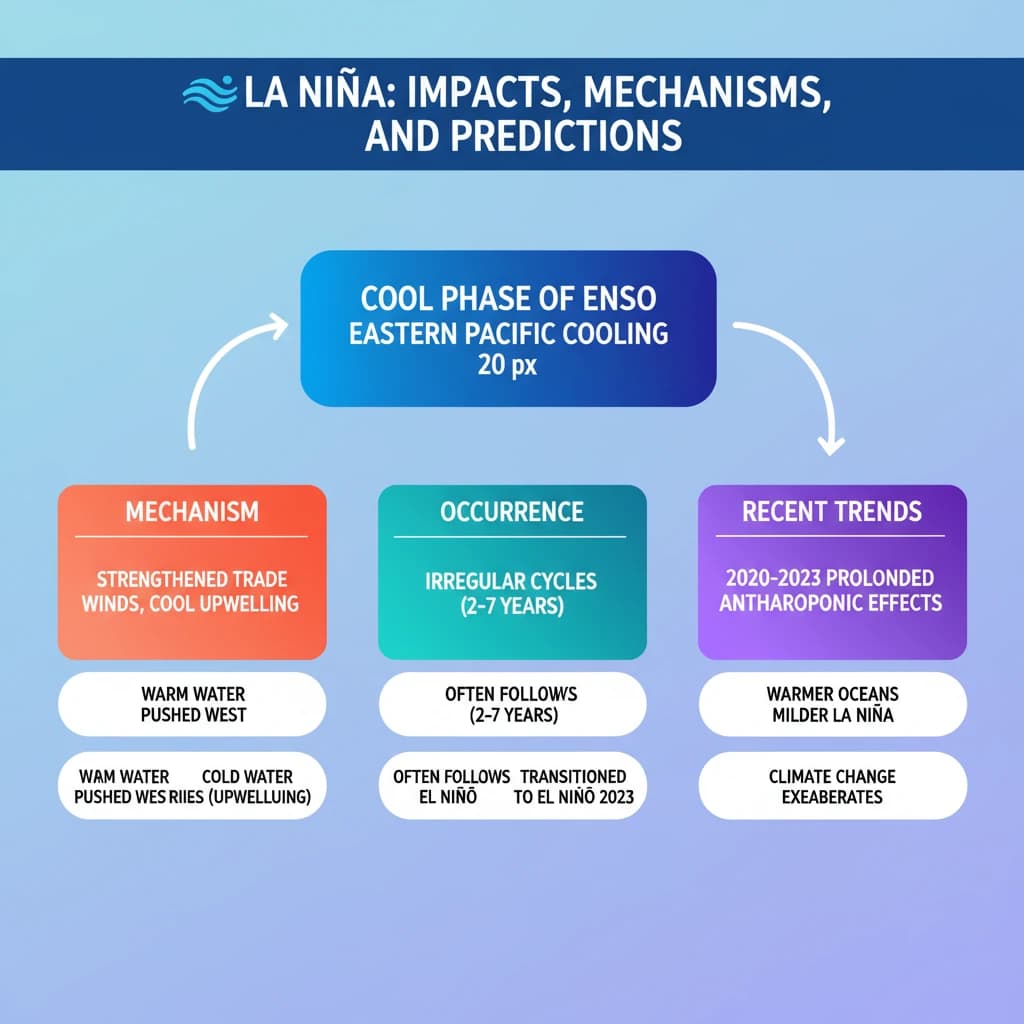
  • La Niña is the 'cool phase' of the El Niño Southern Oscillation (ENSO), characterized by colder-than-normal sea surface temperatures in the eastern Pacific.
  • Its mechanism involves strengthened trade winds pushing warm water westward, leading to upwelling of cool water in the eastern Pacific.
  • La Niña occurs in irregular cycles (2-7 years) and often follows an El Niño event.
  • The most recent prolonged La Niña phase was from 2020 to 2023, transitioning to El Niño in mid-2023.
  • Anthropogenic climate change exacerbates La Niña's impacts, with warmer global oceans potentially influencing its delayed arrival and mildness.
La Nina: Impacts, Mechanisms, and Predictions

La Nina: Impacts, Mechanisms, and Predictions

Medium⏱️ 4 min read✓ 95% Verified
geography

📖 Introduction

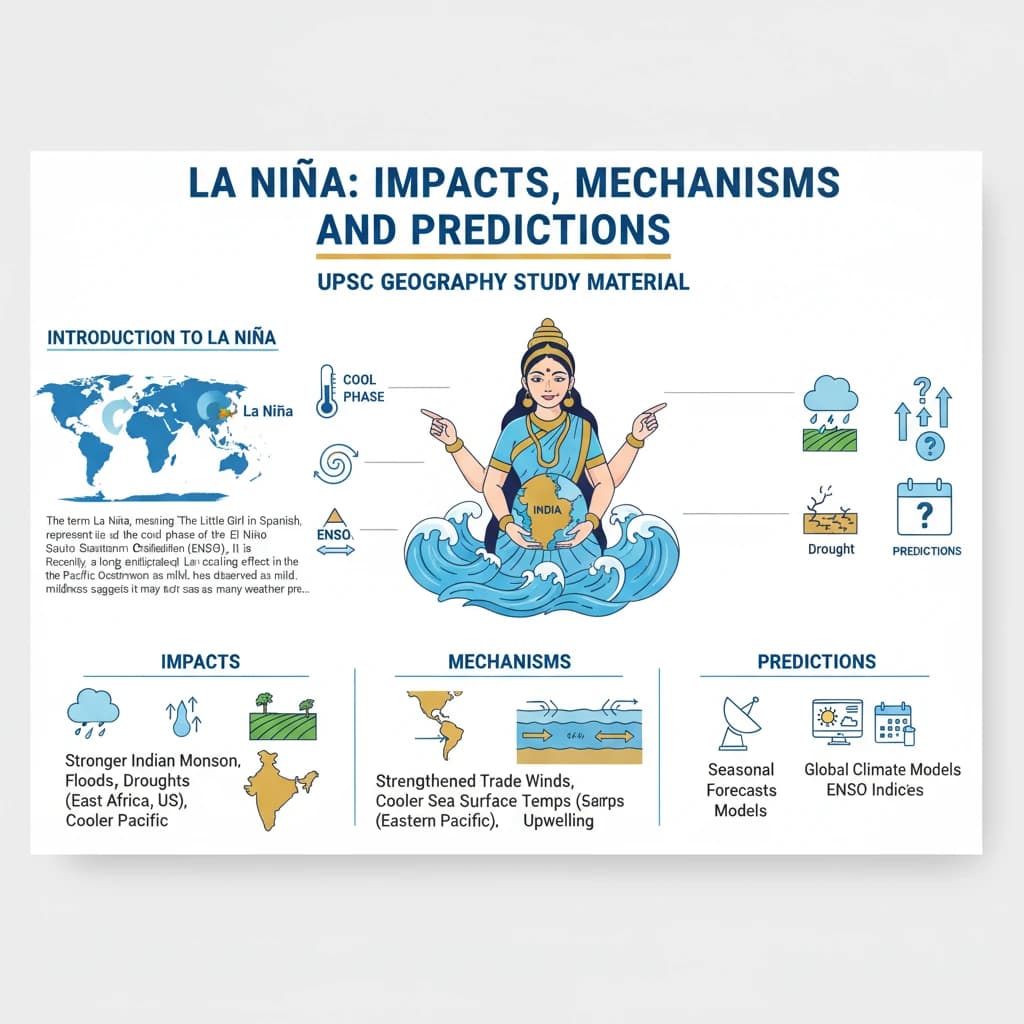
<h4>Introduction to La Niña</h4><p>The term <strong>La Niña</strong>, meaning "The Little Girl" in Spanish, represents the <strong>cool phase</strong> of the <strong>El Niño Southern Oscillation (ENSO)</strong>. It is a significant climate pattern that influences weather globally.</p><p>Recently, a long-anticipated <strong>La Niña</strong> emerged, though its cooling effect in the <strong>Pacific Ocean</strong> has been observed as mild. This mildness suggests it may not cause as many weather problems as typically expected.</p><h4>Defining La Niña</h4><div class='info-box'><p><strong>La Niña</strong> is characterized by <strong>colder-than-normal sea surface temperatures (SSTs)</strong> in the <strong>eastern Pacific Ocean</strong>. It stands in contrast to <strong>El Niño</strong>, which is the warm phase, and the neutral phase, together forming the three states of <strong>ENSO</strong>.</p></div><p>These conditions typically emerge in the <strong>tropical Pacific</strong> during <strong>December</strong>, setting the stage for its global weather impacts.</p><h4>Mechanism of La Niña</h4><p>The fundamental mechanism behind <strong>La Niña</strong> involves a strengthening of the <strong>trade winds</strong>. These easterly winds become unusually strong, pushing vast amounts of warm surface water further <strong>westward</strong> across the Pacific Ocean.</p><p>As warm water accumulates in the <strong>western Pacific</strong>, cooler, nutrient-rich waters from the ocean's depths rise to the surface in the <strong>eastern Pacific</strong>. This process, known as <strong>upwelling</strong>, causes a significant temperature drop in that region, defining the characteristic cold SSTs of <strong>La Niña</strong>.</p><h4>Cycles and Recent Occurrences</h4><p><strong>La Niña</strong> events occur in irregular cycles, typically lasting anywhere from <strong>two to seven years</strong>. It is common for a <strong>La Niña</strong> event to follow an <strong>El Niño</strong> event, as the system attempts to rebalance itself.</p><div class='info-box'><p>The most recent significant <strong>La Niña phase</strong> spanned from <strong>2020 to 2023</strong>. Following this period, the climate pattern transitioned into an <strong>El Niño phase</strong> in <strong>mid-2023</strong>.</p></div><h4>Influence of Climate Change</h4><p>The intensity and severity of <strong>La Niña's impacts</strong>, such as extreme temperatures and unusual weather patterns, are increasingly being <strong>exacerbated by anthropogenic climate change</strong>.</p><p>The delayed arrival of the recent <strong>La Niña</strong> and its mild cooling may have been influenced by the world's oceans being significantly <strong>warmer</strong> than in previous years, a trend linked to global warming.</p><div class='exam-tip-box'><p><strong>UPSC Insight:</strong> When discussing <strong>La Niña</strong>, it's crucial to link its natural variability with the overarching influence of <strong>anthropogenic climate change</strong>. This demonstrates a comprehensive understanding of current environmental dynamics for <strong>GS Paper 1 (Geography)</strong> and <strong>GS Paper 3 (Environment)</strong>.</p></div>
Concept Diagram

💡 Key Takeaways

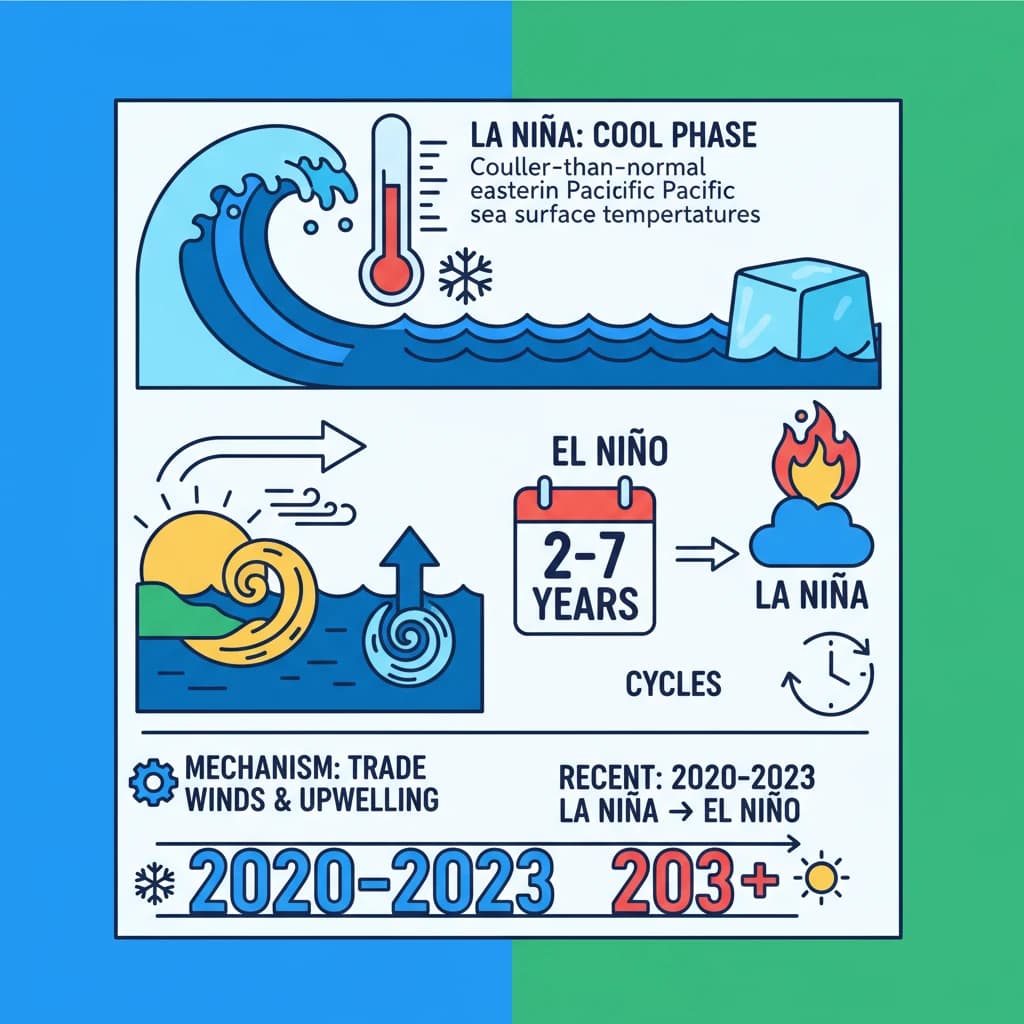
  • •La Niña is the 'cool phase' of the El Niño Southern Oscillation (ENSO), characterized by colder-than-normal sea surface temperatures in the eastern Pacific.
  • •Its mechanism involves strengthened trade winds pushing warm water westward, leading to upwelling of cool water in the eastern Pacific.
  • •La Niña occurs in irregular cycles (2-7 years) and often follows an El Niño event.
  • •The most recent prolonged La Niña phase was from 2020 to 2023, transitioning to El Niño in mid-2023.
  • •Anthropogenic climate change exacerbates La Niña's impacts, with warmer global oceans potentially influencing its delayed arrival and mildness.

🧠 Memory Techniques
Memory Aid
95% Verified Content

Related Topics

Loading related topics...
Explore:Geography Topics·All Subjects·Daily Current Affairs·Editorial Analysis·Previous Year Questions·UPSC GPT