Loading page, please wait…
Vaidra Logo
Vaidra

Top 4 items + smart groups

UPSC GPT
New
Current Affairs
Daily Solutions
Daily Puzzle
Mains Evaluator

Version 2.0.0 • Built with ❤️ for UPSC aspirants

Loading...
Loading...
Loading...
Loading...
Loading...
Loading...
Loading...
Loading...
Loading...
Loading...
Loading...
Loading...
Loading...
What is Deccan Volcanism Theory? - UPSC Geography

What is Deccan Volcanism Theory? - UPSC Geography

What is What is Deccan Volcanism Theory? in UPSC Geography?

What is Deccan Volcanism Theory? is a key topic under Geography for UPSC Civil Services Examination. Key points include: Deccan Volcanism Theory links massive eruptions to the K-Pg mass extinction 66 million years ago.. Deccan Traps are a large volcanic plateau in India formed by fissure eruptions.. Formation was caused by the Indian Plate moving over the Réunion mantle hotspot.. Understanding this topic is essential for both UPSC Prelims and Mains preparation.

Why is What is Deccan Volcanism Theory? important for UPSC exam?

What is Deccan Volcanism Theory? is a Medium-level topic in UPSC Geography. It is tested in both Prelims (factual MCQs) and Mains (analytical answer writing). Previous year UPSC questions have frequently covered aspects of What is Deccan Volcanism Theory?, making it essential for comprehensive IAS preparation.

How to prepare What is Deccan Volcanism Theory? for UPSC?

To prepare What is Deccan Volcanism Theory? for UPSC: (1) Study the comprehensive notes covering all key concepts on Vaidra. (2) Practice previous year questions on this topic. (3) Connect it with current affairs using daily updates. (4) Revise using key takeaways and mind maps available for Geography. (5) Write practice answers linking What is Deccan Volcanism Theory? to related GS Paper topics.

Key takeaways of What is Deccan Volcanism Theory? for UPSC

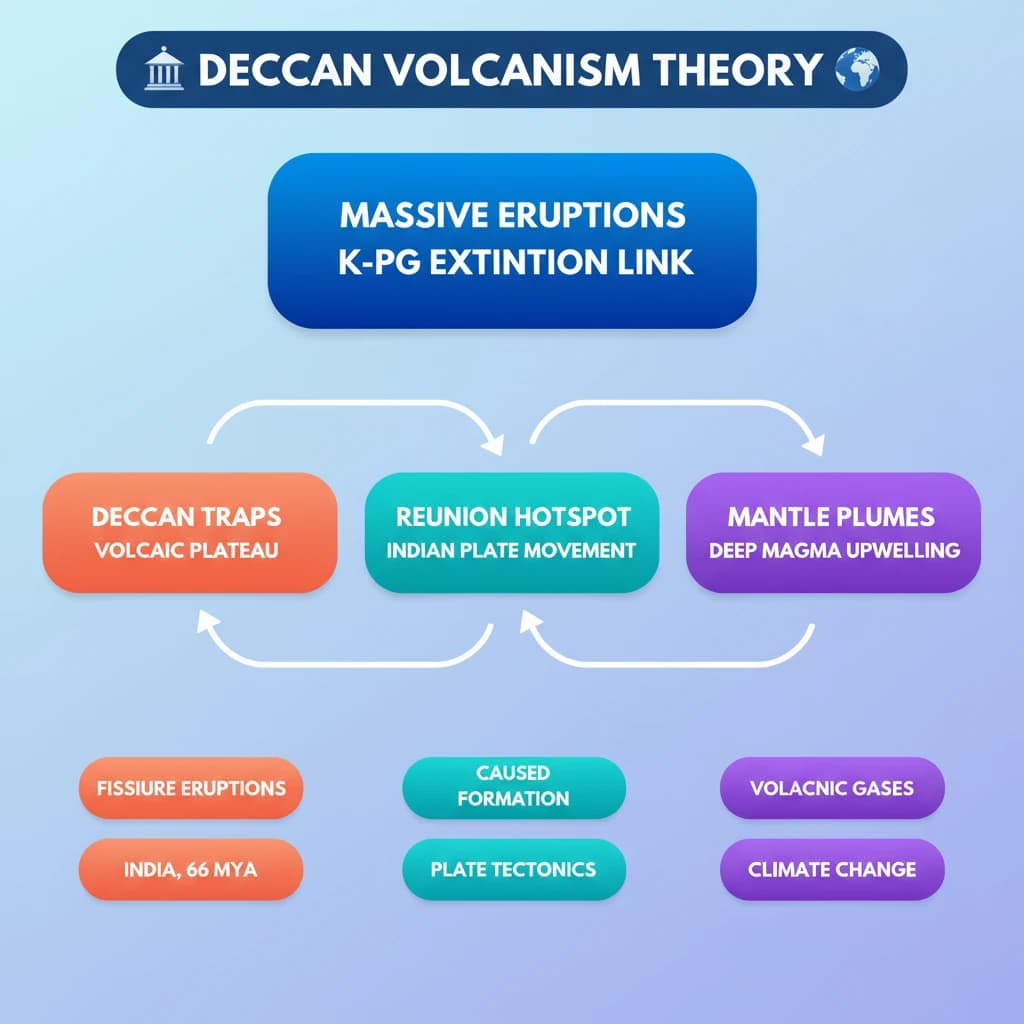
  • Deccan Volcanism Theory links massive eruptions to the K-Pg mass extinction 66 million years ago.
  • Deccan Traps are a large volcanic plateau in India formed by fissure eruptions.
  • Formation was caused by the Indian Plate moving over the Réunion mantle hotspot.
  • Mantle plumes are hot magma upwellings not linked to plate boundaries.
  • Volcanic gas emissions from the Traps likely caused significant climate and environmental changes.
What is Deccan Volcanism Theory?

What is Deccan Volcanism Theory?

Medium⏱️ 8 min read✓ 98% Verified
geography

📖 Introduction

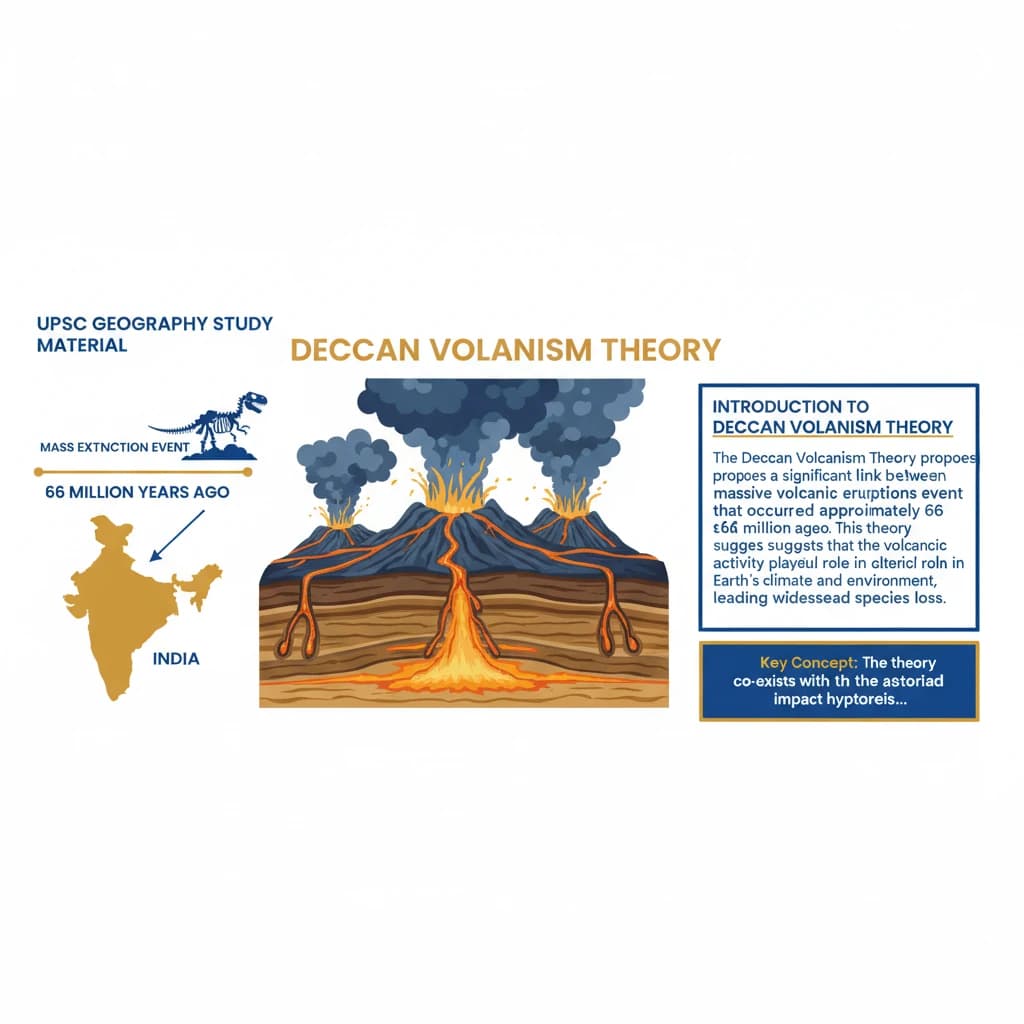
<h4>Introduction to Deccan Volcanism Theory</h4><p>The <strong>Deccan Volcanism Theory</strong> proposes a significant link between massive volcanic eruptions and the <strong>mass extinction event</strong> that occurred approximately <strong>66 million years ago</strong>. This theory suggests that the volcanic activity played a crucial role in altering Earth's climate and environment, leading to widespread species loss.</p><div class='key-point-box'><p><strong>Key Concept:</strong> The theory connects large-scale geological events (volcanism) with biological catastrophes (mass extinctions).</p></div><h4>Understanding the Deccan Traps</h4><p>The <strong>Deccan Traps</strong> constitute an expansive <strong>large volcanic plateau</strong> situated in <strong>peninsular India</strong>. This geological feature was primarily formed by a series of intense <strong>fissure volcanic eruptions</strong>.</p><div class='info-box'><p><strong>Formation:</strong> The Deccan Traps are composed of vast layers of <strong>basaltic lava flows</strong>, indicating prolonged and extensive volcanic activity.</p></div><h4>Fissure Volcanic Eruptions Explained</h4><p>Unlike eruptions from a central volcanic cone, <strong>fissure volcanic eruptions</strong> occur when molten rock, or <strong>magma</strong>, is extruded through elongated cracks or fissures in the Earth's crust. This process results in widespread lava flows rather than localized volcanic cones.</p><h4>Role of the Deccan Mantle Plume</h4><p>The formation of the <strong>Deccan Traps</strong> is attributed to vigorous volcanic activity driven by the <strong>Deccan mantle plume</strong>. This geological phenomenon involved continuous eruptions over several hundred thousand years, depositing immense volumes of lava.</p><div class='info-box'><p><strong>Mantle Plume Definition:</strong> A <strong>mantle plume</strong> is characterized as a cylindrical upwelling of extremely hot <strong>magma</strong> originating from deep within the Earth's <strong>mantle</strong>. These plumes are responsible for creating <strong>volcanic hotspots</strong> that are not directly associated with conventional <strong>plate boundaries</strong>.</p></div><h4>Connection to Indian Plate Movement</h4><p>The movement of the <strong>Indian Plate</strong> played a critical role in the formation of the <strong>Deccan Traps</strong>. Approximately <strong>200 million years ago</strong>, the landmass that is now India began its northward journey, initially situated as a large island off the <strong>Australian coast</strong>.</p><p>As the <strong>Indian Plate</strong> traversed over the stationary <strong>Réunion hotspot</strong>, the underlying <strong>mantle plume</strong> caused repeated <strong>fissure volcanic eruptions</strong>. This interaction led to the progressive formation of the extensive <strong>Deccan Traps</strong>.</p><div class='info-box'><p><strong>Réunion Hotspot:</strong> This is a prominent <strong>volcanic hotspot</strong> located in the <strong>Indian Ocean</strong>, near the island of <strong>Réunion</strong>. Its stationary nature beneath the moving Indian Plate was instrumental in the Deccan volcanism.</p></div><div class='exam-tip-box'><p><strong>UPSC Insight:</strong> Understanding the interplay between <strong>mantle plumes</strong>, <strong>plate tectonics</strong>, and their environmental consequences is crucial for both <strong>Physical Geography</strong> (GS Paper 1) and <strong>Environmental Science</strong> (GS Paper 3).</p></div>
Concept Diagram

💡 Key Takeaways

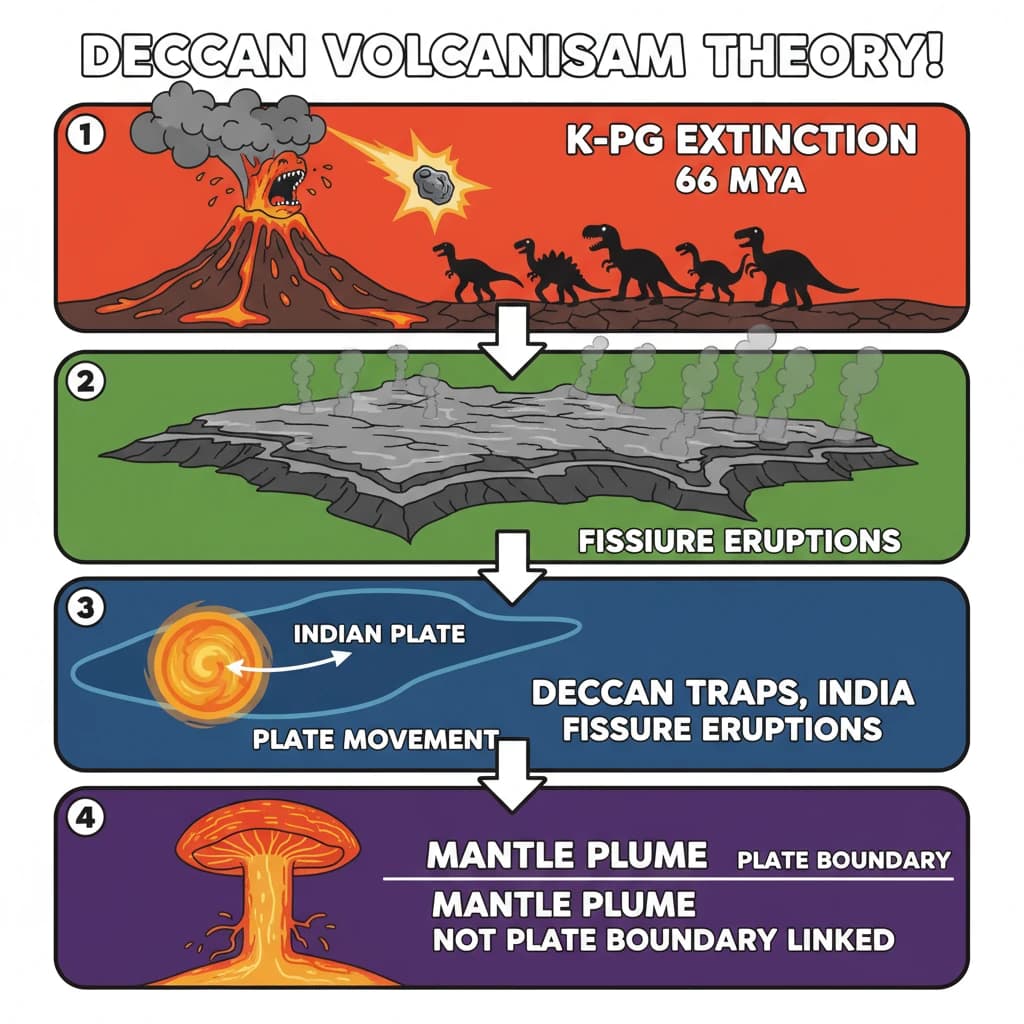
  • •Deccan Volcanism Theory links massive eruptions to the K-Pg mass extinction 66 million years ago.
  • •Deccan Traps are a large volcanic plateau in India formed by fissure eruptions.
  • •Formation was caused by the Indian Plate moving over the Réunion mantle hotspot.
  • •Mantle plumes are hot magma upwellings not linked to plate boundaries.
  • •Volcanic gas emissions from the Traps likely caused significant climate and environmental changes.

🧠 Memory Techniques
Memory Aid
98% Verified Content

📚 Reference Sources

•NCERT Geography Textbooks (Class XI, Physical Geography)
•Physical Geography by Savindra Singh
•Geological Survey of India (GSI) publications
•Scientific articles on Deccan Traps and K-Pg extinction (e.g., Science, Nature)

Related Topics

Loading related topics...
Explore:Geography Topics·All Subjects·Daily Current Affairs·Editorial Analysis·Previous Year Questions·UPSC GPT
Back
All Subjects

Topics

0 topics • 0 completed

Loading topics...
Loading...
Loading...
Loading...
Loading...
Loading...
Overall Progress0%