Loading page, please wait…
Vaidra Logo
Vaidra

Top 4 items + smart groups

UPSC GPT
New
Current Affairs
Daily Solutions
Daily Puzzle
Mains Evaluator

Version 2.0.0 • Built with ❤️ for UPSC aspirants

Loading...
Loading...
Loading...
Loading...
Loading...
Loading...
Loading...
Loading...
Loading...
Loading...
Loading...
Loading...
Loading...
Bangladesh - Major river basins - UPSC Geography
Back
All Subjects

Topics

0 topics • 0 completed

Loading topics...
Loading...
Loading...
Loading...
Loading...
Loading...
Overall Progress0%

Bangladesh - Major river basins - UPSC Geography

What is Bangladesh - Major river basins in UPSC Geography?

Bangladesh - Major river basins is a key topic under Geography for UPSC Civil Services Examination. Key points include: Bangladesh's major rivers (Feni, Kushiyara, Brahmaputra/Jamuna, Meghna) are predominantly transboundary, originating in India or Tibet.. The Brahmaputra (Jamuna) and Ganga (Padma) rivers merge in Bangladesh before joining the Meghna, forming the world's largest delta.. The Feni River hosts the Maitri Setu bridge, enhancing India-Bangladesh connectivity.. Understanding this topic is essential for both UPSC Prelims and Mains preparation.

Why is Bangladesh - Major river basins important for UPSC exam?

Bangladesh - Major river basins is a Medium-level topic in UPSC Geography. It is tested in both Prelims (factual MCQs) and Mains (analytical answer writing). Previous year UPSC questions have frequently covered aspects of Bangladesh - Major river basins, making it essential for comprehensive IAS preparation.

How to prepare Bangladesh - Major river basins for UPSC?

To prepare Bangladesh - Major river basins for UPSC: (1) Study the comprehensive notes covering all key concepts on Vaidra. (2) Practice previous year questions on this topic. (3) Connect it with current affairs using daily updates. (4) Revise using key takeaways and mind maps available for Geography. (5) Write practice answers linking Bangladesh - Major river basins to related GS Paper topics.

Key takeaways of Bangladesh - Major river basins for UPSC

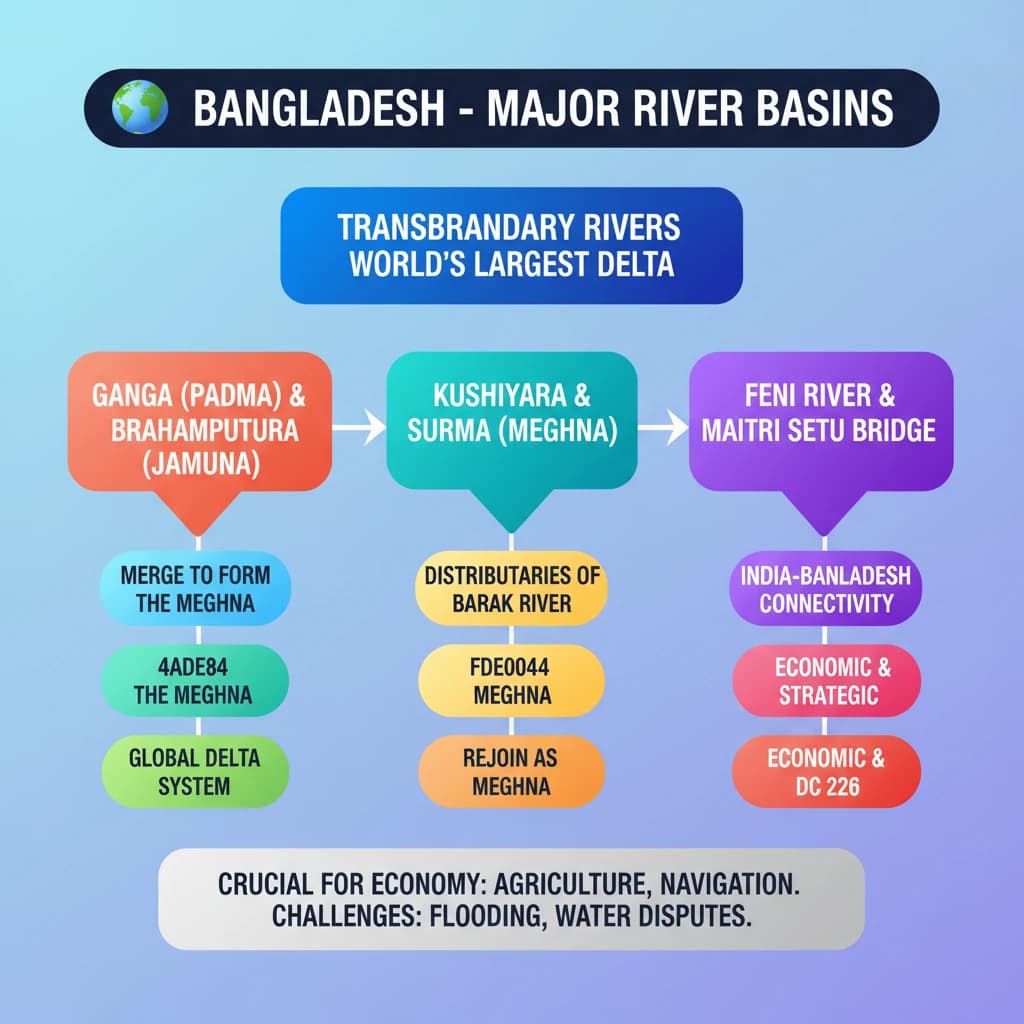
  • Bangladesh's major rivers (Feni, Kushiyara, Brahmaputra/Jamuna, Meghna) are predominantly transboundary, originating in India or Tibet.
  • The Brahmaputra (Jamuna) and Ganga (Padma) rivers merge in Bangladesh before joining the Meghna, forming the world's largest delta.
  • The Feni River hosts the Maitri Setu bridge, enhancing India-Bangladesh connectivity.
  • Kushiyara and Surma are distributaries of the Barak River, rejoining to form the Meghna.
  • River basins are crucial for Bangladesh's economy (agriculture, navigation) but also pose challenges like flooding and water sharing disputes.
Bangladesh - Major river basins

Bangladesh - Major river basins

Medium⏱️ 6 min read✓ 95% Verified
geography

📖 Introduction

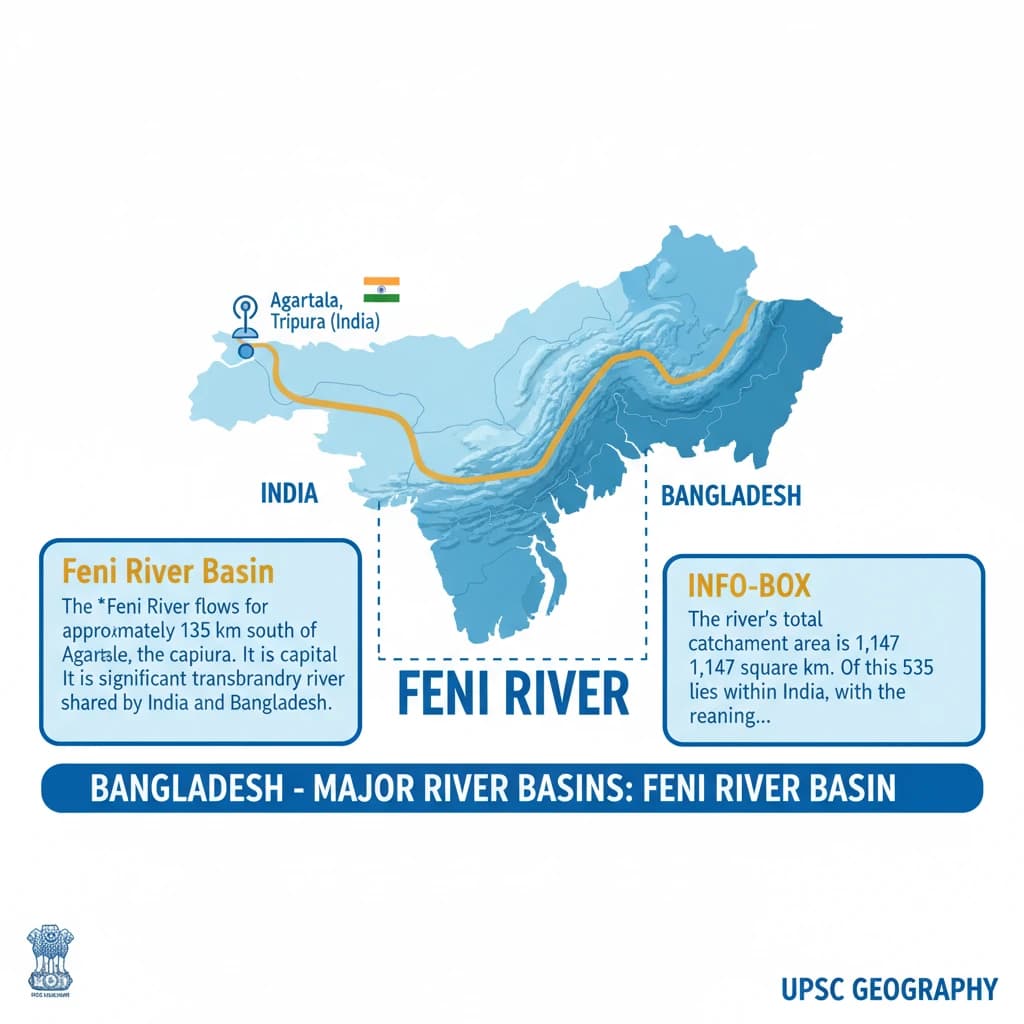
<h4>Feni River Basin</h4><p>The <strong>Feni River</strong> flows for approximately <strong>135 km</strong> south of <strong>Agartala</strong>, the capital of <strong>Tripura</strong>. It is a significant transboundary river shared by <strong>India</strong> and <strong>Bangladesh</strong>.</p><div class='info-box'><p>The river's total <strong>catchment area</strong> is <strong>1,147 square km</strong>. Of this, <strong>535 square km</strong> lies within <strong>India</strong>, with the remaining portion in <strong>Bangladesh</strong>.</p></div><p>The <strong>Feni River</strong> plays a crucial role in forming a part of the <strong>Indo-Bangladesh border</strong>, delineating the international boundary in certain stretches.</p><p>The <strong>Maitri Setu</strong>, a <strong>1.9 km long bridge</strong>, has been constructed over the <strong>Feni River</strong> in <strong>Tripura</strong>. This bridge serves as a vital link connecting <strong>India</strong> and <strong>Bangladesh</strong>, enhancing trade and connectivity.</p><ul><li><strong>Notable tributaries</strong> of the <strong>Feni River</strong> include the <strong>Muhuri River</strong>, <strong>Raidak River</strong>, <strong>Chandkhira River</strong>, <strong>Ryang River</strong>, and <strong>Kushiyara River</strong>.</li></ul><h4>Kushiyara River Basin</h4><p>The <strong>Kushiyara River</strong> is an important <strong>distributary</strong> of the <strong>Barak River</strong>. Its origin point is the <strong>Amlshid bifurcation point</strong> located on the <strong>India-Bangladesh border</strong>.</p><div class='info-box'><p>At the <strong>Amlshid bifurcation</strong>, the <strong>Barak River</strong> divides into two main streams: the <strong>Kushiyara River</strong> and the <strong>Surma River</strong>.</p></div><p>The <strong>Kushiyara River</strong> begins its journey in <strong>Assam</strong>, <strong>India</strong>, and collects water from various tributaries originating in <strong>Nagaland</strong> and <strong>Manipur</strong> before flowing into <strong>Bangladesh</strong>.</p><h4>Brahmaputra River Basin</h4><p>The <strong>Brahmaputra River</strong> is one of Asia's largest rivers, originating from the <strong>Chemayungdung glacier</strong> near <strong>Yarlung Tsangpo</strong> in <strong>Tibet</strong>, close to <strong>Mount Kailash</strong>.</p><p>It flows through <strong>Tibet</strong>, <strong>India</strong>, and <strong>Bangladesh</strong>, acting as a natural geographical feature between regions.</p><p>Within <strong>India</strong>, the <strong>Brahmaputra</strong> passes through <strong>Arunachal Pradesh</strong>, <strong>Assam</strong>, and <strong>Meghalaya</strong>. Upon entering <strong>Bangladesh</strong>, it is known as the <strong>Jamuna River</strong>.</p><ul><li><strong>Major tributaries in India</strong> include the <strong>Subansiri</strong>, <strong>Kameng</strong>, <strong>Manas</strong>, and <strong>Dhansiri rivers</strong>.</li><li>The <strong>Teesta River</strong> is a significant tributary that joins the <strong>Brahmaputra</strong> (Jamuna) in <strong>Bangladesh</strong>.</li></ul><p>In <strong>Bangladesh</strong>, the <strong>Brahmaputra River</strong> (Jamuna) merges with the <strong>Ganga River</strong>, forming the combined stream known as the <strong>Padma River</strong>. The <strong>Padma</strong> then further merges with the <strong>Meghna River</strong>.</p><div class='key-point-box'><p>The combined waters of the <strong>Padma</strong> and <strong>Meghna</strong> rivers ultimately flow into the <strong>Bay of Bengal</strong> through the extensive <strong>Meghna Estuary</strong>, forming one of the world's largest deltas.</p></div><h4>Meghna River Basin</h4><p>The <strong>Meghna River</strong> system has a complex origin. In <strong>India</strong>, specifically in <strong>Karimganj district</strong> in <strong>Assam</strong>, the <strong>Barak River</strong> splits into two distinct streams: the <strong>Surma</strong> and the <strong>Kushiyara</strong>.</p><p>These two distributaries, the <strong>Surma</strong> and <strong>Kushiyara</strong>, later rejoin in <strong>Kishoreganj district</strong> in <strong>Bangladesh</strong>. From this confluence point, the combined river is known as the <strong>Meghna</strong>.</p><div class='info-box'><p>Up to <strong>Chandpur</strong> in <strong>Bangladesh</strong>, this river is referred to as the <strong>Upper Meghna</strong>. After meeting the <strong>Padma River</strong> at <strong>Chandpur</strong>, it becomes known as the <strong>Lower Meghna</strong>.</p></div>
Concept Diagram

💡 Key Takeaways

  • •Bangladesh's major rivers (Feni, Kushiyara, Brahmaputra/Jamuna, Meghna) are predominantly transboundary, originating in India or Tibet.
  • •The Brahmaputra (Jamuna) and Ganga (Padma) rivers merge in Bangladesh before joining the Meghna, forming the world's largest delta.
  • •The Feni River hosts the Maitri Setu bridge, enhancing India-Bangladesh connectivity.
  • •Kushiyara and Surma are distributaries of the Barak River, rejoining to form the Meghna.
  • •River basins are crucial for Bangladesh's economy (agriculture, navigation) but also pose challenges like flooding and water sharing disputes.

🧠 Memory Techniques

Memory Aid
95% Verified Content

Related Topics

Loading related topics...
Explore:Geography Topics·All Subjects·Daily Current Affairs·Editorial Analysis·Previous Year Questions·UPSC GPT