Loading page, please wait…
Vaidra Logo
Vaidra

Top 4 items + smart groups

UPSC GPT
New
Current Affairs
Daily Solutions
Daily Puzzle
Mains Evaluator

Version 2.0.0 • Built with ❤️ for UPSC aspirants

Loading...
Loading...
Loading...
Loading...
Loading...
Loading...
Loading...
Loading...
Loading...
Loading...
Loading...
Loading...
Loading...
Back
All Subjects

Topics

0 topics • 0 completed

Loading topics...
Loading...
Loading...
Loading...
Loading...
Loading...
Overall Progress0%

What are Key Facts About Hanle Observatory - UPSC Geography

What is What are Key Facts About Hanle Observatory in UPSC Geography?

What are Key Facts About Hanle Observatory is a key topic under Geography for UPSC Civil Services Examination. Key points include: Auroras are caused by solar storm particles interacting with Earth's magnetosphere in the ionosphere.. Hanle Observatory in Ladakh is a high-altitude (4,500m) Indian Astronomical Observatory.. Hanle is recognized for exceptionally dark, cloudless skies, ideal for astronomy.. Understanding this topic is essential for both UPSC Prelims and Mains preparation.

Why is What are Key Facts About Hanle Observatory important for UPSC exam?

What are Key Facts About Hanle Observatory is a Medium-level topic in UPSC Geography. It is tested in both Prelims (factual MCQs) and Mains (analytical answer writing). Previous year UPSC questions have frequently covered aspects of What are Key Facts About Hanle Observatory, making it essential for comprehensive IAS preparation.

How to prepare What are Key Facts About Hanle Observatory for UPSC?

To prepare What are Key Facts About Hanle Observatory for UPSC: (1) Study the comprehensive notes covering all key concepts on Vaidra. (2) Practice previous year questions on this topic. (3) Connect it with current affairs using daily updates. (4) Revise using key takeaways and mind maps available for Geography. (5) Write practice answers linking What are Key Facts About Hanle Observatory to related GS Paper topics.

Key takeaways of What are Key Facts About Hanle Observatory for UPSC

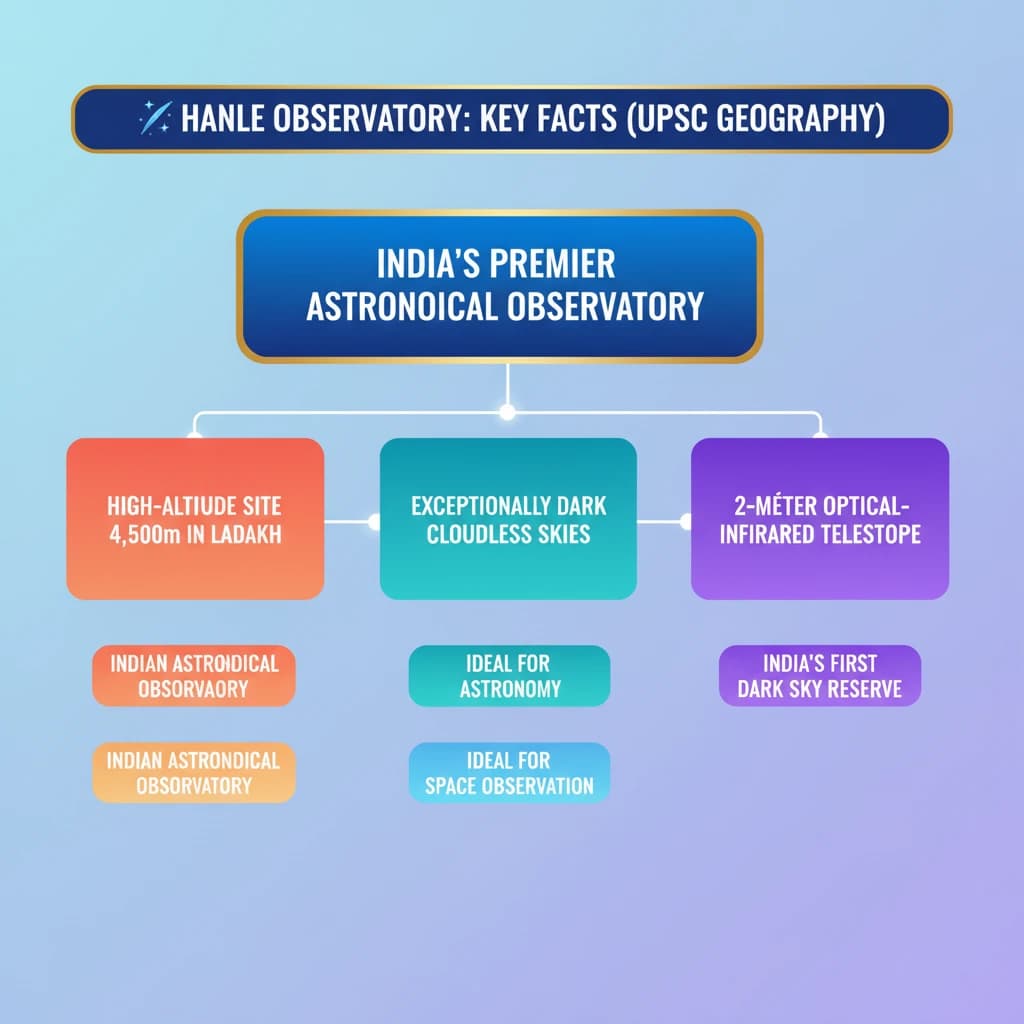
  • Auroras are caused by solar storm particles interacting with Earth's magnetosphere in the ionosphere.
  • Hanle Observatory in Ladakh is a high-altitude (4,500m) Indian Astronomical Observatory.
  • Hanle is recognized for exceptionally dark, cloudless skies, ideal for astronomy.
  • It houses a 2-meter optical-infrared telescope for space observation.
  • Hanle is India's first Dark Sky Reserve, protecting night skies from light pollution.
  • Auroras also occur on other planets with atmospheres and magnetic fields, like Jupiter and Saturn.
What are Key Facts About Hanle Observatory

What are Key Facts About Hanle Observatory

Medium⏱️ 7 min read✓ 98% Verified
geography

📖 Introduction

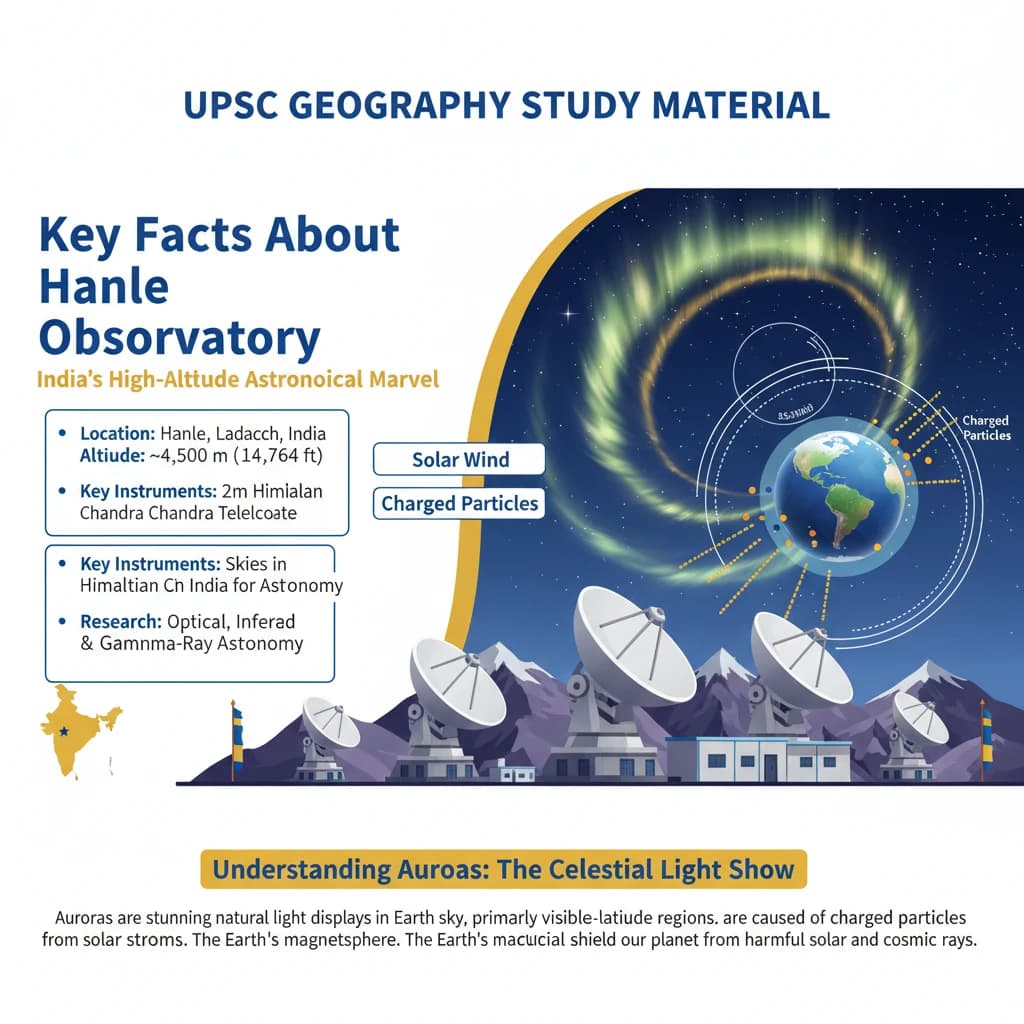
<h4>Understanding Auroras: The Celestial Light Show</h4><p><strong>Auroras</strong> are stunning natural light displays in Earth's sky, primarily visible in high-latitude regions. They are caused by the interaction of <strong>charged particles</strong> from <strong>solar storms</strong> with the Earth's <strong>magnetosphere</strong>.</p><p>The <strong>Earth's magnetosphere</strong> acts as a crucial shield, protecting our planet from harmful solar and cosmic rays. Without it, life as we know it would be impossible due to intense radiation.</p><div class='info-box'><p><strong>Solar storms</strong> occur when the Sun's magnetic field intensifies and weakens. This allows highly charged particles to penetrate the Earth's magnetic field, leading to various space weather phenomena, including auroras.</p></div><p><strong>Auroras</strong> specifically form when <strong>charged ions</strong> from the <strong>solar wind</strong> collide with <strong>oxygen</strong> and <strong>nitrogen atoms</strong> in the Earth's <strong>ionosphere</strong>. This typically happens at altitudes ranging between <strong>97 and 1,000 kilometers</strong> above the Earth's surface.</p><p>While the <strong>Earth's magnetosphere</strong> deflects most of the <strong>solar wind</strong>, some ions manage to get trapped. These trapped ions are then funneled towards the <strong>geomagnetic poles</strong>, creating the spectacular light displays we know as auroras.</p><div class='key-point-box'><p>The scientific study of auroras has advanced significantly with dedicated missions. <strong>NASA's IMAGE satellite</strong>, operational until <strong>2005</strong>, was specifically designed for this purpose. It gathered important data using <strong>ultraviolet and radio waves</strong> to understand aurora formation and behavior.</p></div><p>Auroras are not unique to Earth. Planets possessing both an <strong>atmosphere</strong> and a <strong>magnetic field</strong> are likely to experience similar phenomena. For instance, breathtaking auroras have been observed on gas giants like <strong>Jupiter</strong> and <strong>Saturn</strong>, showcasing universal astrophysical principles.</p><h4>Hanle Observatory: India's High-Altitude Astronomical Gem</h4><p>The <strong>Hanle Observatory</strong>, officially known as the <strong>Indian Astronomical Observatory (IAO)</strong>, is a premier astronomical research facility in India. It is managed by the <strong>Indian Institute of Astrophysics (IIA)</strong>.</p><div class='info-box'><p><strong>Location:</strong> The observatory is situated on <strong>Mt. Saraswati</strong> in the <strong>Nilamkhul Plain</strong>, within the <strong>Hanle Valley</strong> of <strong>Ladakh</strong>. It stands at an impressive height of approximately <strong>4,500 metres (14,764 feet)</strong> above sea level.</p></div><p>This strategic location provides the observatory with exceptionally clear, dark, and cloudless skies. These conditions are optimal for <strong>stargazing</strong> and conducting advanced <strong>astronomical observations</strong>, making it one of the best sites globally.</p><p>The <strong>Hanle Observatory</strong> is equipped with a powerful <strong>2-meter optical-infrared telescope</strong>. This instrument allows scientists to conduct in-depth space observations, studying distant galaxies, stars, and other celestial objects.</p><div class='key-point-box'><p>Significantly, <strong>Hanle</strong> has been designated as a <strong>Dark Sky Reserve</strong> by the <strong>International Dark-Sky Association (IDA)</strong>. This recognition is crucial for protecting the pristine quality of its night skies by actively minimizing <strong>light pollution</strong>, ensuring its continued utility for astronomical research and promoting astrotourism.</p></div>
Concept Diagram

💡 Key Takeaways

  • •Auroras are caused by solar storm particles interacting with Earth's magnetosphere in the ionosphere.
  • •Hanle Observatory in Ladakh is a high-altitude (4,500m) Indian Astronomical Observatory.
  • •Hanle is recognized for exceptionally dark, cloudless skies, ideal for astronomy.
  • •It houses a 2-meter optical-infrared telescope for space observation.
  • •Hanle is India's first Dark Sky Reserve, protecting night skies from light pollution.
  • •Auroras also occur on other planets with atmospheres and magnetic fields, like Jupiter and Saturn.

🧠 Memory Techniques
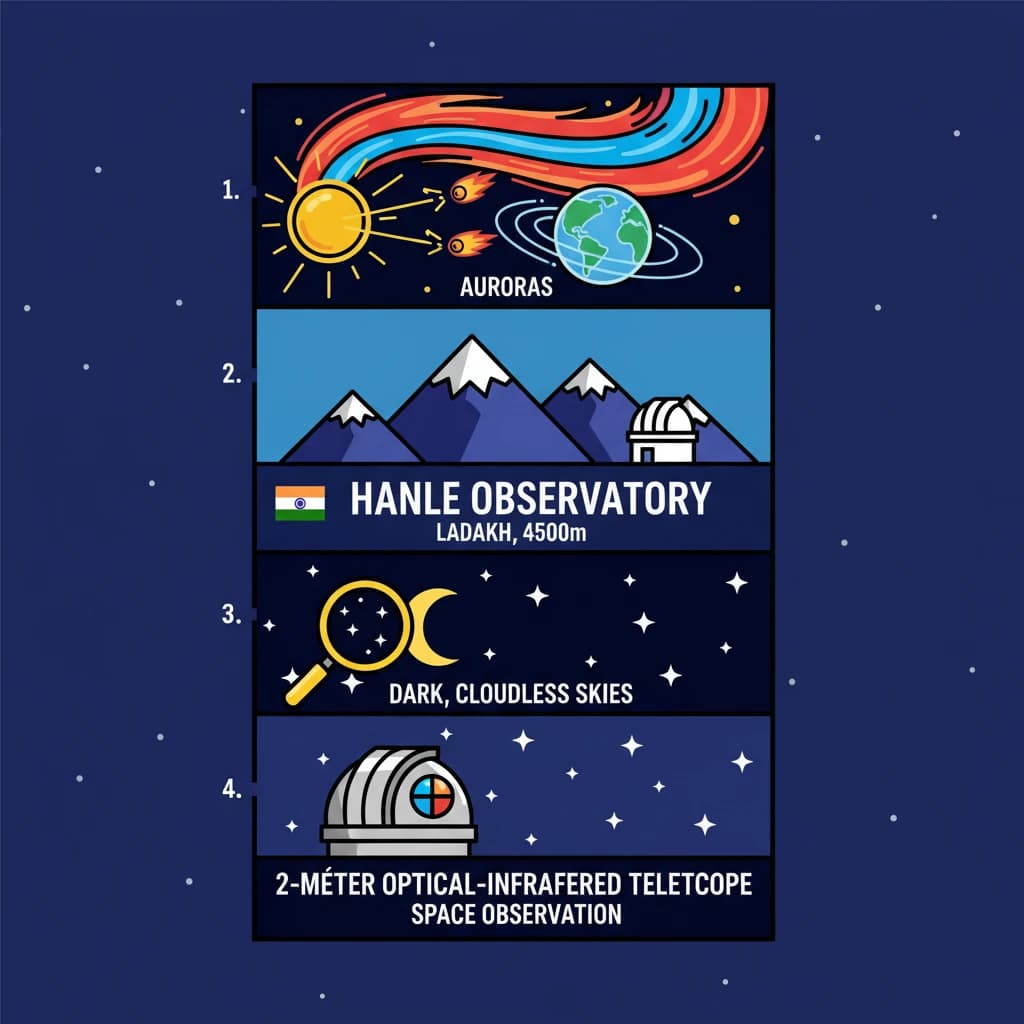
Memory Aid
98% Verified Content

📚 Reference Sources

•Indian Institute of Astrophysics (IIA) official website
•International Dark-Sky Association (IDA) official website
•NASA official resources on auroras and IMAGE satellite

Related Topics

Loading related topics...
Explore:Geography Topics·All Subjects·Daily Current Affairs·Editorial Analysis·Previous Year Questions·UPSC GPT
What are Key Facts About Hanle Observatory - UPSC Geography