Loading page, please wait…
Vaidra Logo
Vaidra

Top 4 items + smart groups

UPSC GPT
New
Current Affairs
Daily Solutions
Daily Puzzle
Mains Evaluator

Version 2.0.0 • Built with ❤️ for UPSC aspirants

Loading...
Loading...
Loading...
Loading...
Loading...
Loading...
Loading...
Loading...
Loading...
Loading...
Loading...
Loading...
Loading...
Back
All Subjects

Topics

0 topics • 0 completed

Loading topics...
Loading...
Loading...
Loading...
Loading...
Loading...
Overall Progress0%

Land Subsidence in Chenab Valley - UPSC Geography

What is Land Subsidence in Chenab Valley in UPSC Geography?

Land Subsidence in Chenab Valley is a key topic under Geography for UPSC Civil Services Examination. Key points include: Land subsidence is the sinking of ground due to underground material movement.. It is caused by both natural factors (earthquakes, soil erosion, compaction) and human activities (removal of water, oil, natural resources, mining).. Chenab Valley (Ramban, Kishtwar, Doda) has seen an increase in land subsidence over the last 10-15 years, distinct from traditional landslides.. Understanding this topic is essential for both UPSC Prelims and Mains preparation.

Why is Land Subsidence in Chenab Valley important for UPSC exam?

Land Subsidence in Chenab Valley is a Medium-level topic in UPSC Geography. It is tested in both Prelims (factual MCQs) and Mains (analytical answer writing). Previous year UPSC questions have frequently covered aspects of Land Subsidence in Chenab Valley, making it essential for comprehensive IAS preparation.

How to prepare Land Subsidence in Chenab Valley for UPSC?

To prepare Land Subsidence in Chenab Valley for UPSC: (1) Study the comprehensive notes covering all key concepts on Vaidra. (2) Practice previous year questions on this topic. (3) Connect it with current affairs using daily updates. (4) Revise using key takeaways and mind maps available for Geography. (5) Write practice answers linking Land Subsidence in Chenab Valley to related GS Paper topics.

Key takeaways of Land Subsidence in Chenab Valley for UPSC

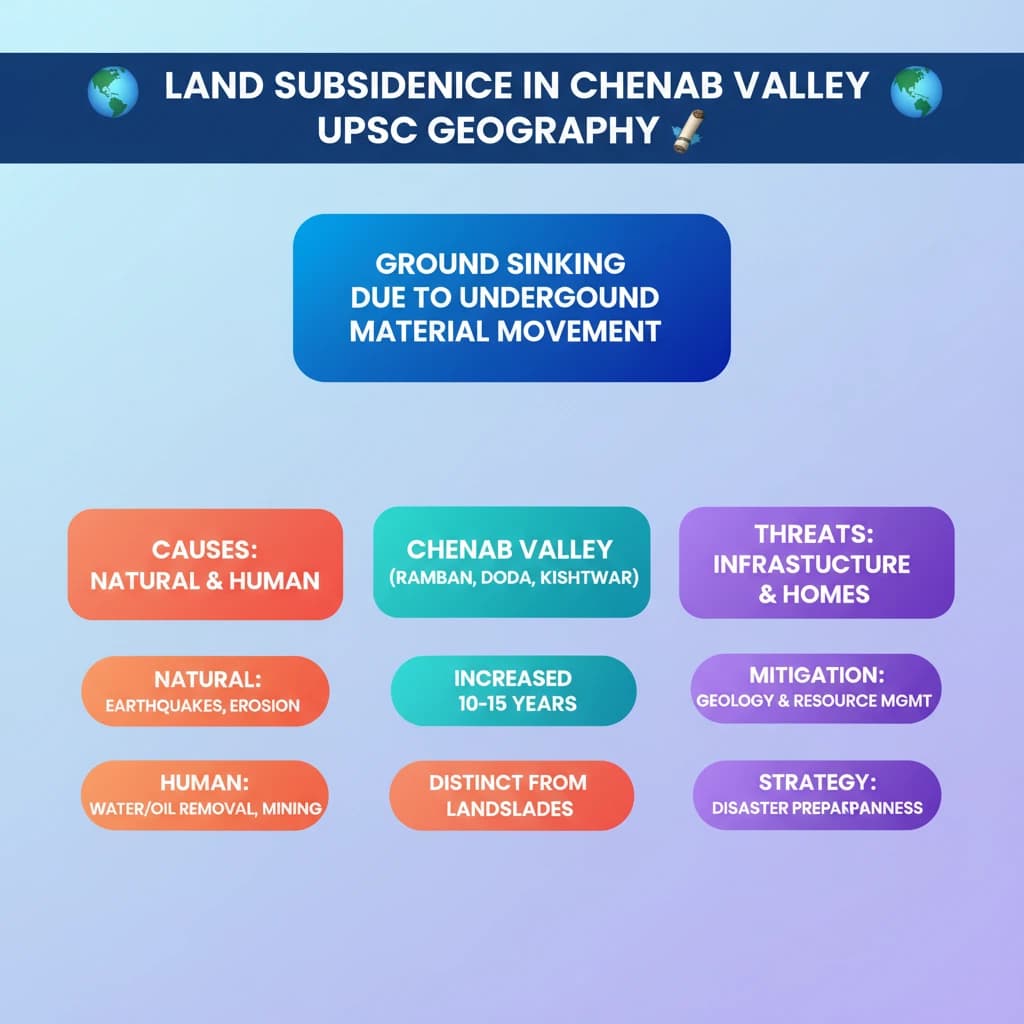
  • Land subsidence is the sinking of ground due to underground material movement.
  • It is caused by both natural factors (earthquakes, soil erosion, compaction) and human activities (removal of water, oil, natural resources, mining).
  • Chenab Valley (Ramban, Kishtwar, Doda) has seen an increase in land subsidence over the last 10-15 years, distinct from traditional landslides.
  • This phenomenon poses significant threats to infrastructure and human settlements in the affected regions.
  • Effective mitigation requires understanding geological vulnerabilities and implementing sustainable resource management and disaster preparedness strategies.
Land Subsidence in Chenab Valley

Land Subsidence in Chenab Valley

Medium⏱️ 8 min read✓ 95% Verified
geography

📖 Introduction

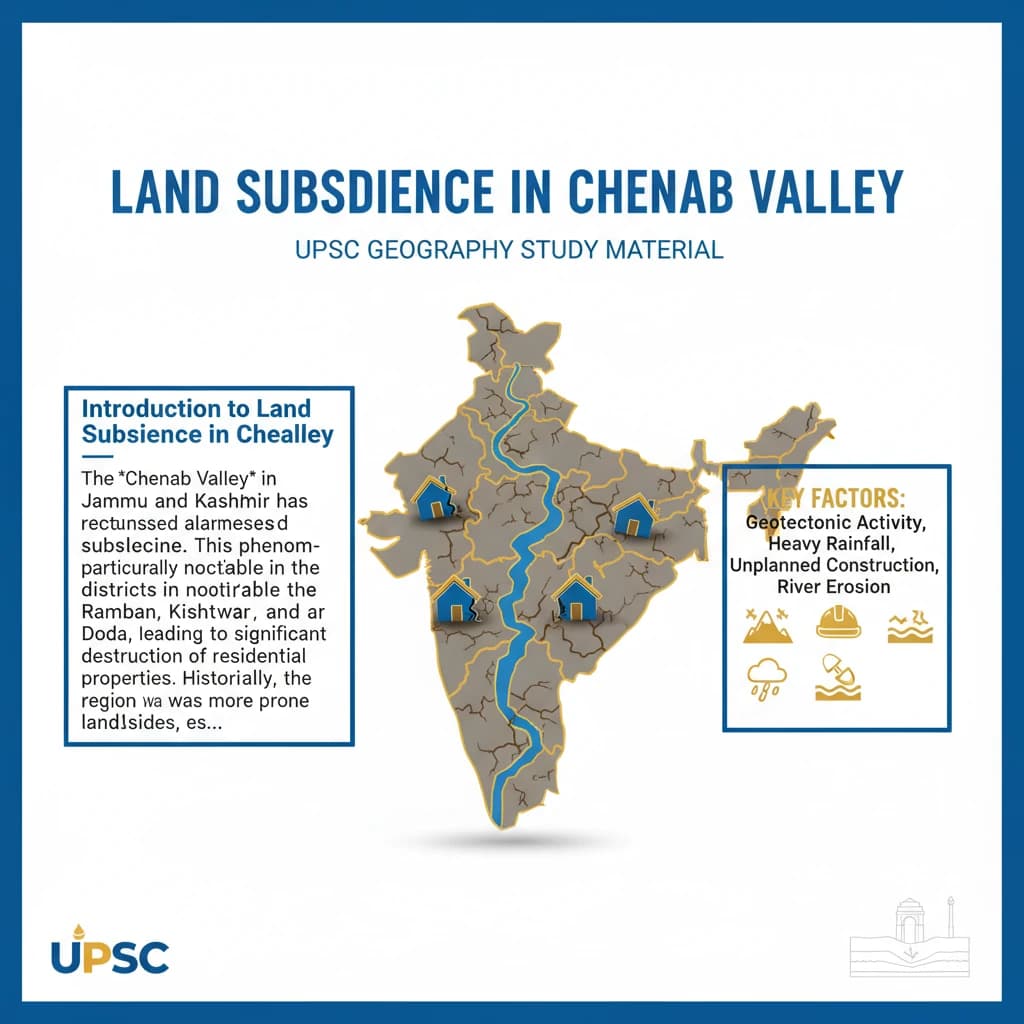
<h4>Introduction to Land Subsidence in Chenab Valley</h4><p>The <strong>Chenab Valley</strong> in <strong>Jammu and Kashmir</strong> has recently witnessed alarming reports of <strong>land subsidence</strong>. This phenomenon has been particularly noticeable in the districts of <strong>Ramban</strong>, <strong>Kishtwar</strong>, and <strong>Doda</strong>, leading to significant destruction of residential properties.</p><p>Historically, the region was more prone to <strong>landslides</strong>, especially during periods of heavy rain and snowfall. However, there has been a notable shift, with <strong>land subsidence</strong> becoming a more frequent occurrence over the last <strong>10-15 years</strong>.</p><div class='exam-tip-box'><p><strong>UPSC Insight:</strong> Understanding regional geological vulnerabilities like those in the <strong>Chenab Valley</strong> is crucial for topics like <strong>Disaster Management (GS-III)</strong> and <strong>Indian Geography (GS-I)</strong>. Note the shift from traditional landslides to increasing subsidence.</p></div><h4>Understanding Land Subsidence</h4><p><strong>Land subsidence</strong> refers to the sinking or settling of the ground surface. This geological process is primarily caused by the movement or compaction of underground materials, leading to a downward shift of the land.</p><div class='info-box'><p><strong>Definition:</strong> According to the <strong>National Oceanic and Atmospheric Administration (NOAA)</strong>, <strong>land subsidence</strong> is defined as the "sinking of the ground because of <strong>underground material movement</strong>."</p></div><p>This phenomenon can manifest over various scales, ranging from very localized areas to extensive regions covering entire states or provinces. Its impact can be gradual and imperceptible or sudden and catastrophic.</p><h4>Causes of Land Subsidence</h4><p>The causes of <strong>land subsidence</strong> are diverse, encompassing both natural geological processes and human-induced activities. A combination of these factors often contributes to the severity and frequency of subsidence events.</p><div class='key-point-box'><p><strong>Key Causes:</strong></p><ul><li><strong>Removal of Underground Resources:</strong> Extraction of materials like <strong>water</strong> (groundwater), <strong>oil</strong>, or <strong>natural gas</strong> can create voids, leading to compaction of overlying sediments.</li><li><strong>Mining Activities:</strong> Subsurface <strong>mining operations</strong> can weaken the ground structure, causing collapse or gradual sinking.</li><li><strong>Natural Geological Processes:</strong><ul><li><strong>Earthquakes:</strong> Seismic activity can cause liquefaction or compaction of unconsolidated sediments.</li><li><strong>Soil Erosion:</strong> Removal of surface soil by wind or water can lead to instability.</li><li><strong>Soil Compaction:</strong> Natural consolidation of loose sediments over time, especially under heavy loads or due to changes in moisture content.</li></ul></li></ul></div>
Concept Diagram

💡 Key Takeaways

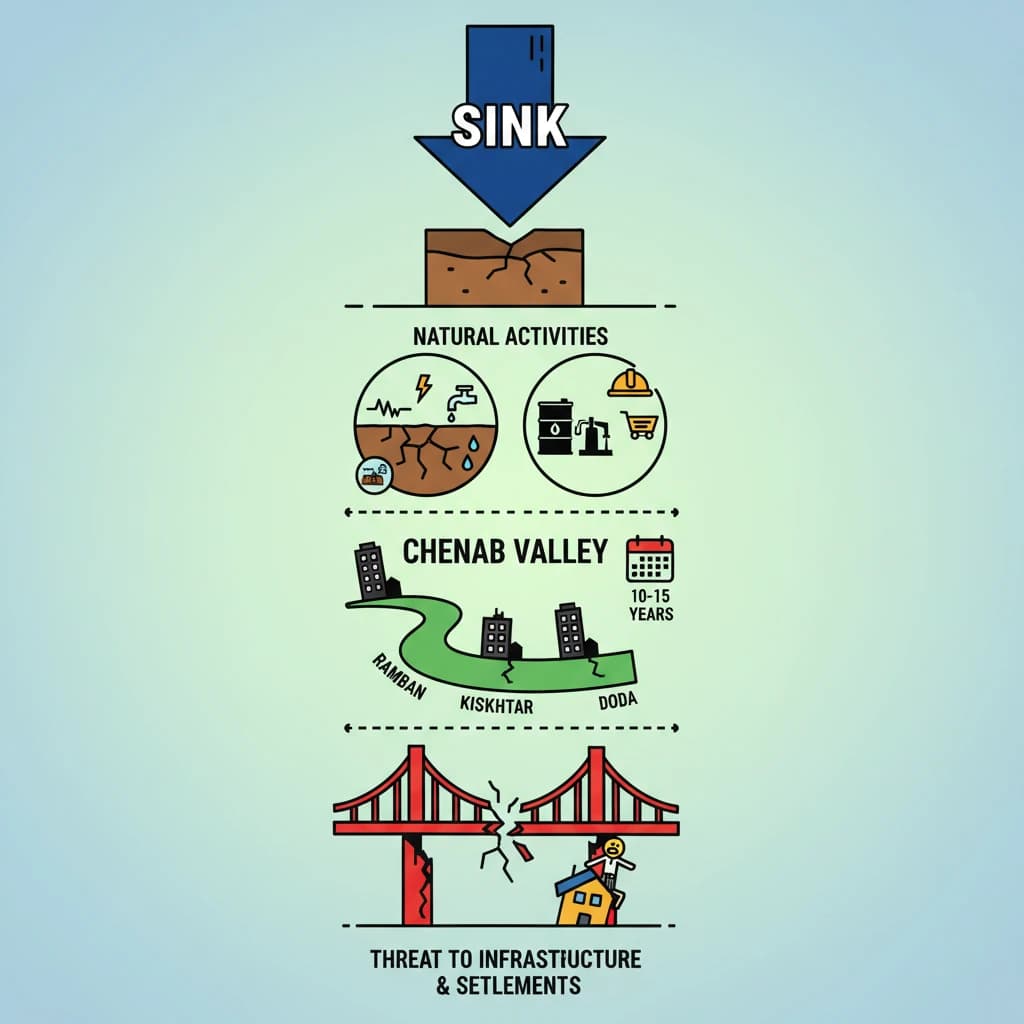
  • •Land subsidence is the sinking of ground due to underground material movement.
  • •It is caused by both natural factors (earthquakes, soil erosion, compaction) and human activities (removal of water, oil, natural resources, mining).
  • •Chenab Valley (Ramban, Kishtwar, Doda) has seen an increase in land subsidence over the last 10-15 years, distinct from traditional landslides.
  • •This phenomenon poses significant threats to infrastructure and human settlements in the affected regions.
  • •Effective mitigation requires understanding geological vulnerabilities and implementing sustainable resource management and disaster preparedness strategies.

🧠 Memory Techniques
Memory Aid
95% Verified Content

📚 Reference Sources

•National Oceanic and Atmospheric Administration (NOAA) for definition of land subsidence

Related Topics

Loading related topics...
Explore:Geography Topics·All Subjects·Daily Current Affairs·Editorial Analysis·Previous Year Questions·UPSC GPT
Land Subsidence in Chenab Valley - UPSC Geography