Loading page, please wait…
Vaidra Logo
Vaidra

Top 4 items + smart groups

UPSC GPT
New
Current Affairs
Daily Solutions
Daily Puzzle
Mains Evaluator

Version 2.0.0 • Built with ❤️ for UPSC aspirants

Loading...
Loading...
Loading...
Loading...
Loading...
Loading...
Loading...
Loading...
Loading...
Loading...
Loading...
Loading...
Loading...
Back
All Subjects

Topics

0 topics • 0 completed

Loading topics...
Loading...
Loading...
Loading...
Loading...
Loading...
Overall Progress0%

2024 Arctic Report Card - UPSC Geography

What is 2024 Arctic Report Card in UPSC Geography?

2024 Arctic Report Card is a key topic under Geography for UPSC Civil Services Examination. Key points include: The 2024 Arctic Report Card by NOAA confirms unprecedented Arctic warming.. Arctic tundra is transitioning from a carbon sink to a carbon source due to permafrost thaw.. Significant decline in sea ice extent and thickness accelerates warming via the albedo effect.. Understanding this topic is essential for both UPSC Prelims and Mains preparation.

Why is 2024 Arctic Report Card important for UPSC exam?

2024 Arctic Report Card is a Medium-level topic in UPSC Geography. It is tested in both Prelims (factual MCQs) and Mains (analytical answer writing). Previous year UPSC questions have frequently covered aspects of 2024 Arctic Report Card, making it essential for comprehensive IAS preparation.

How to prepare 2024 Arctic Report Card for UPSC?

To prepare 2024 Arctic Report Card for UPSC: (1) Study the comprehensive notes covering all key concepts on Vaidra. (2) Practice previous year questions on this topic. (3) Connect it with current affairs using daily updates. (4) Revise using key takeaways and mind maps available for Geography. (5) Write practice answers linking 2024 Arctic Report Card to related GS Paper topics.

Key takeaways of 2024 Arctic Report Card for UPSC

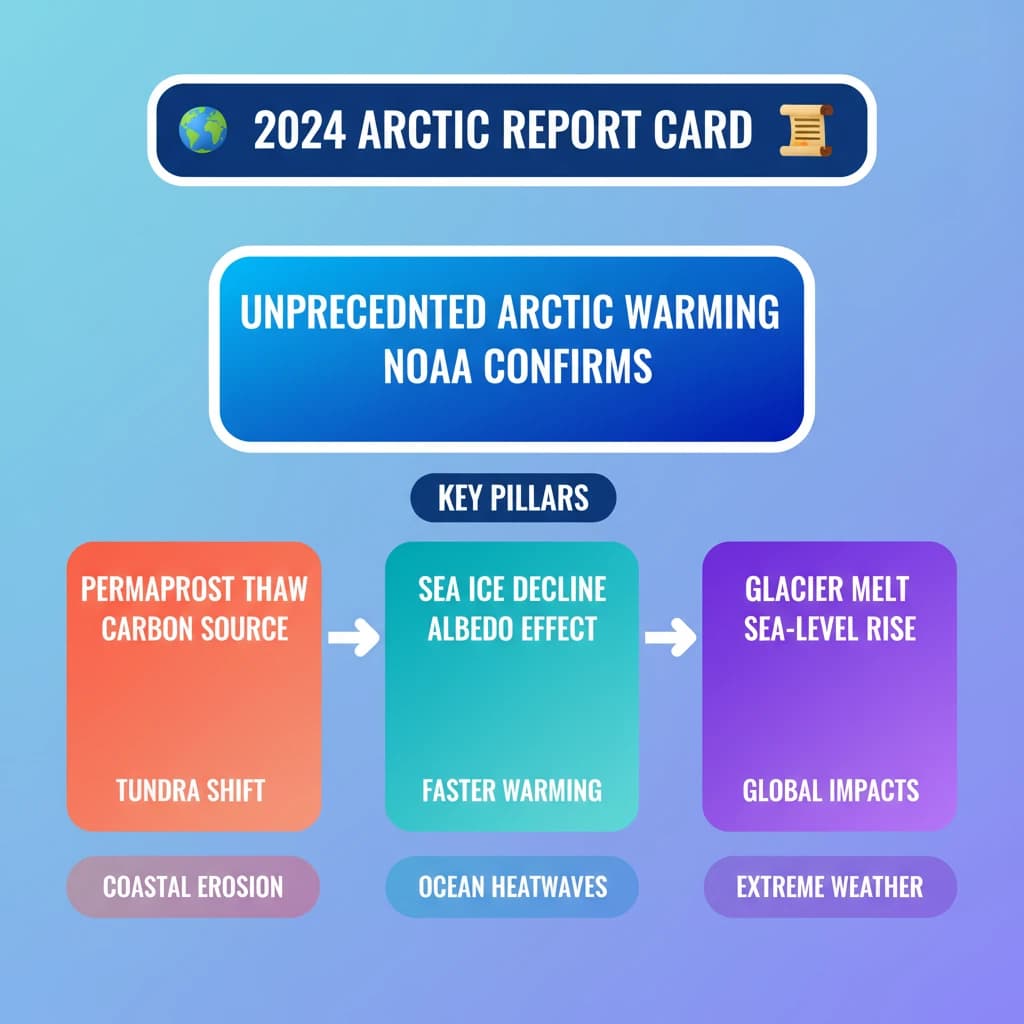
  • The 2024 Arctic Report Card by NOAA confirms unprecedented Arctic warming.
  • Arctic tundra is transitioning from a carbon sink to a carbon source due to permafrost thaw.
  • Significant decline in sea ice extent and thickness accelerates warming via the albedo effect.
  • Melting glaciers and the Greenland Ice Sheet contribute to global sea-level rise.
  • Arctic changes have severe global implications, including extreme weather and coastal flooding.
2024 Arctic Report Card

2024 Arctic Report Card

Medium⏱️ 8 min read✓ 95% Verified
geography

📖 Introduction

<h4>Understanding the 2024 Arctic Report Card</h4><p>The <strong>2024 Arctic Report Card</strong>, released by the <strong>National Oceanic and Atmospheric Administration (NOAA)</strong>, presents critical insights into the rapidly changing Arctic region. This annual report highlights significant environmental shifts impacting global climate patterns.</p><div class='info-box'><p>The <strong>Arctic Report Card</strong> has been issued annually since <strong>2006</strong>. It provides reliable and concise environmental information on the Arctic’s current state, comparing it against historical records to identify trends.</p></div><div class='info-box'><p><strong>NOAA</strong> is a federal agency of the <strong>United States</strong>. Its primary mission is to understand and predict environmental changes, manage coastal and marine resources, and support informed decision-making.</p></div><h4>Key Findings: Accelerated Arctic Warming</h4><p>The Arctic is experiencing warming at an unprecedented and accelerated rate. The year <strong>2024</strong> has been recorded as the <strong>second-warmest year</strong> since comprehensive records began in <strong>1900</strong>.</p><p>The summer of <strong>2024</strong> was particularly notable, ranking as the <strong>third warmest on record</strong> for the Arctic. Regions such as <strong>Alaska</strong> and <strong>Canada</strong> witnessed severe and prolonged <strong>extreme heat waves</strong> during this period.</p><h4>Arctic Tundra: From Carbon Sink to Carbon Source</h4><div class='key-point-box'><p>A critical finding is the transformation of the <strong>Arctic tundra</strong> from a traditional <strong>carbon sink</strong> to an active <strong>carbon source</strong>. This shift is primarily driven by extensive <strong>permafrost thaw</strong> across the region.</p></div><p>The decomposition of organic matter within the thawing <strong>permafrost</strong> releases significant quantities of greenhouse gases. These include both <strong>carbon dioxide (CO2)</strong> and <strong>methane (CH4)</strong>, further accelerating the process of <strong>global warming</strong>.</p><p>Furthermore, the frequency and intensity of <strong>wildfires</strong> in the Arctic are increasing. These fires release substantial amounts of stored carbon, contributing to atmospheric carbon load and extending the overall <strong>wildfire season</strong>.</p><h4>Declining Sea Ice and Melting Glaciers</h4><p>The <strong>extent and thickness of Arctic sea ice</strong> have significantly reduced over recent decades. This reduction leads to a shorter <strong>sea ice season</strong> each year.</p><p>A shorter sea ice season means more dark ocean surfaces are exposed to solar radiation for longer periods. These dark surfaces absorb more heat, creating a feedback loop that further contributes to <strong>Arctic warming</strong>.</p><p>Arctic glaciers and the massive <strong>Greenland Ice Sheet</strong> continue to melt at an alarming rate. The meltwater from these ice bodies directly contributes to rising global <strong>sea levels</strong>, posing a threat to coastal communities worldwide.</p><h4>Global Implications of Arctic Changes</h4><p>The profound environmental changes occurring in the Arctic have far-reaching implications that extend beyond the polar region. These changes contribute to several significant global challenges.</p><ul><li><strong>Coastal Flooding:</strong> Rising sea levels, driven by melting ice, exacerbate coastal flooding in low-lying areas globally.</li><li><strong>Extreme Weather Events:</strong> Alterations in Arctic climate patterns can influence atmospheric circulation, potentially leading to more frequent and intense extreme weather events in mid-latitudes.</li><li><strong>Wildfires:</strong> Increased Arctic wildfires contribute to global air pollution and carbon emissions, impacting climate and ecosystems worldwide.</li></ul><div class='exam-tip-box'><p>Understanding the <strong>Arctic Report Card's findings</strong> is crucial for UPSC. It connects directly to topics like <strong>Climate Change (GS-III)</strong>, <strong>Physical Geography (GS-I)</strong>, and <strong>Environmental Degradation (GS-III)</strong>. Be prepared to discuss feedback loops and global impacts.</p></div>
Concept Diagram

💡 Key Takeaways

  • •The 2024 Arctic Report Card by NOAA confirms unprecedented Arctic warming.
  • •Arctic tundra is transitioning from a carbon sink to a carbon source due to permafrost thaw.
  • •Significant decline in sea ice extent and thickness accelerates warming via the albedo effect.
  • •Melting glaciers and the Greenland Ice Sheet contribute to global sea-level rise.
  • •Arctic changes have severe global implications, including extreme weather and coastal flooding.

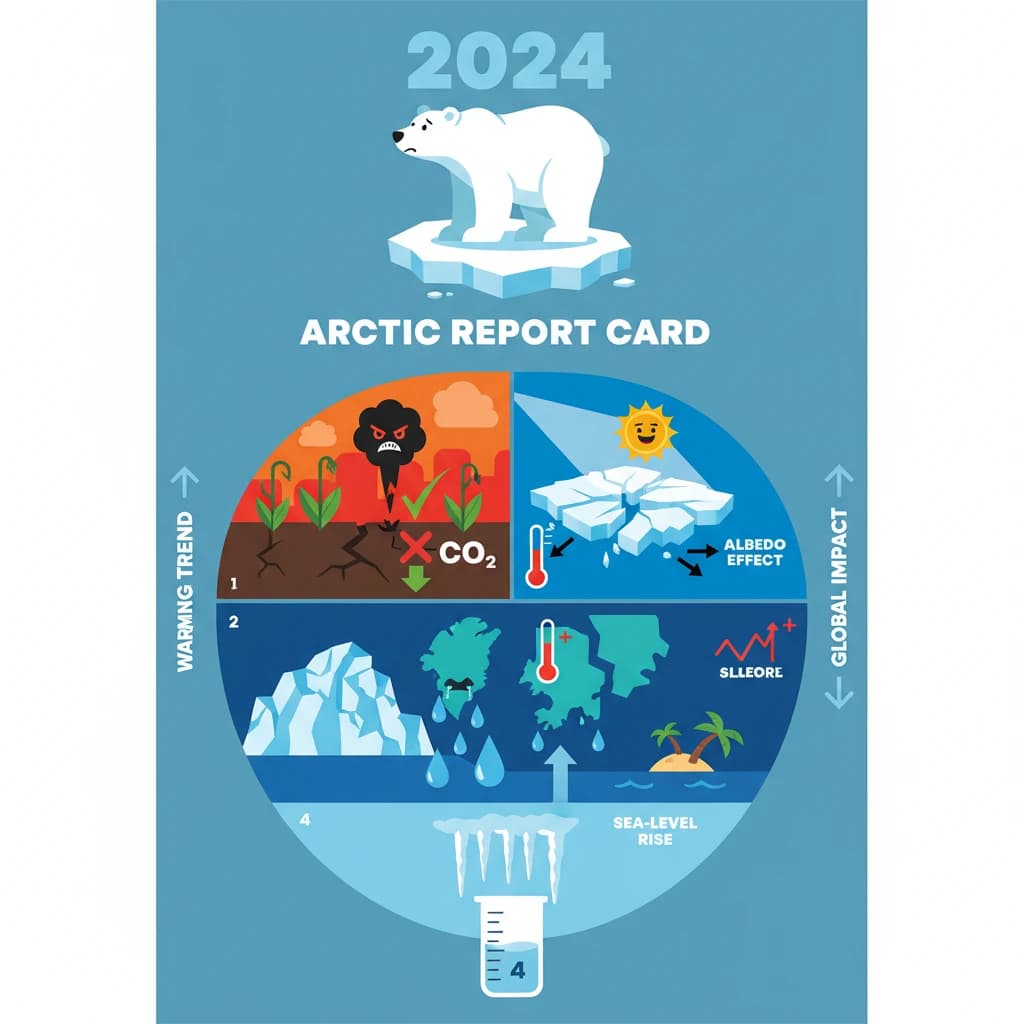
🧠 Memory Techniques
Memory Aid
95% Verified Content

📚 Reference Sources

•Drishti IAS Summary on 2024 Arctic Report Card

Related Topics

Loading related topics...
Explore:Geography Topics·All Subjects·Daily Current Affairs·Editorial Analysis·Previous Year Questions·UPSC GPT
2024 Arctic Report Card - UPSC Geography