Loading page, please wait…
Vaidra Logo
Vaidra

Top 4 items + smart groups

UPSC GPT
New
Current Affairs
Daily Solutions
Daily Puzzle
Mains Evaluator

Version 2.0.0 • Built with ❤️ for UPSC aspirants

Loading...
Loading...
Loading...
Loading...
Loading...
Loading...
Loading...
Loading...
Loading...
Loading...
Loading...
Loading...
Loading...
Antarctica’s Deep Winter Heatwaves - UPSC Geography
Back
All Subjects

Topics

0 topics • 0 completed

Loading topics...
Loading...
Loading...
Loading...
Loading...
Loading...
Overall Progress0%

Antarctica’s Deep Winter Heatwaves - UPSC Geography

What is Antarctica’s Deep Winter Heatwaves in UPSC Geography?

Antarctica’s Deep Winter Heatwaves is a key topic under Geography for UPSC Civil Services Examination. Key points include: Antarctica is experiencing unprecedented deep-winter heatwaves, with temperatures up to 28°C above normal.. Key causes include a weakened polar vortex, record low Antarctic sea ice, and rapid global warming.. Antarctica warms at nearly double the global average, driven by anthropogenic climate change.. Understanding this topic is essential for both UPSC Prelims and Mains preparation.

Why is Antarctica’s Deep Winter Heatwaves important for UPSC exam?

Antarctica’s Deep Winter Heatwaves is a Medium-level topic in UPSC Geography. It is tested in both Prelims (factual MCQs) and Mains (analytical answer writing). Previous year UPSC questions have frequently covered aspects of Antarctica’s Deep Winter Heatwaves, making it essential for comprehensive IAS preparation.

How to prepare Antarctica’s Deep Winter Heatwaves for UPSC?

To prepare Antarctica’s Deep Winter Heatwaves for UPSC: (1) Study the comprehensive notes covering all key concepts on Vaidra. (2) Practice previous year questions on this topic. (3) Connect it with current affairs using daily updates. (4) Revise using key takeaways and mind maps available for Geography. (5) Write practice answers linking Antarctica’s Deep Winter Heatwaves to related GS Paper topics.

Key takeaways of Antarctica’s Deep Winter Heatwaves for UPSC

  • Antarctica is experiencing unprecedented deep-winter heatwaves, with temperatures up to 28°C above normal.
  • Key causes include a weakened polar vortex, record low Antarctic sea ice, and rapid global warming.
  • Antarctica warms at nearly double the global average, driven by anthropogenic climate change.
  • The warming Southern Ocean creates a feedback loop, exacerbating air temperature increases.
  • These events have critical implications for global climate, sea level, and polar ecosystems.
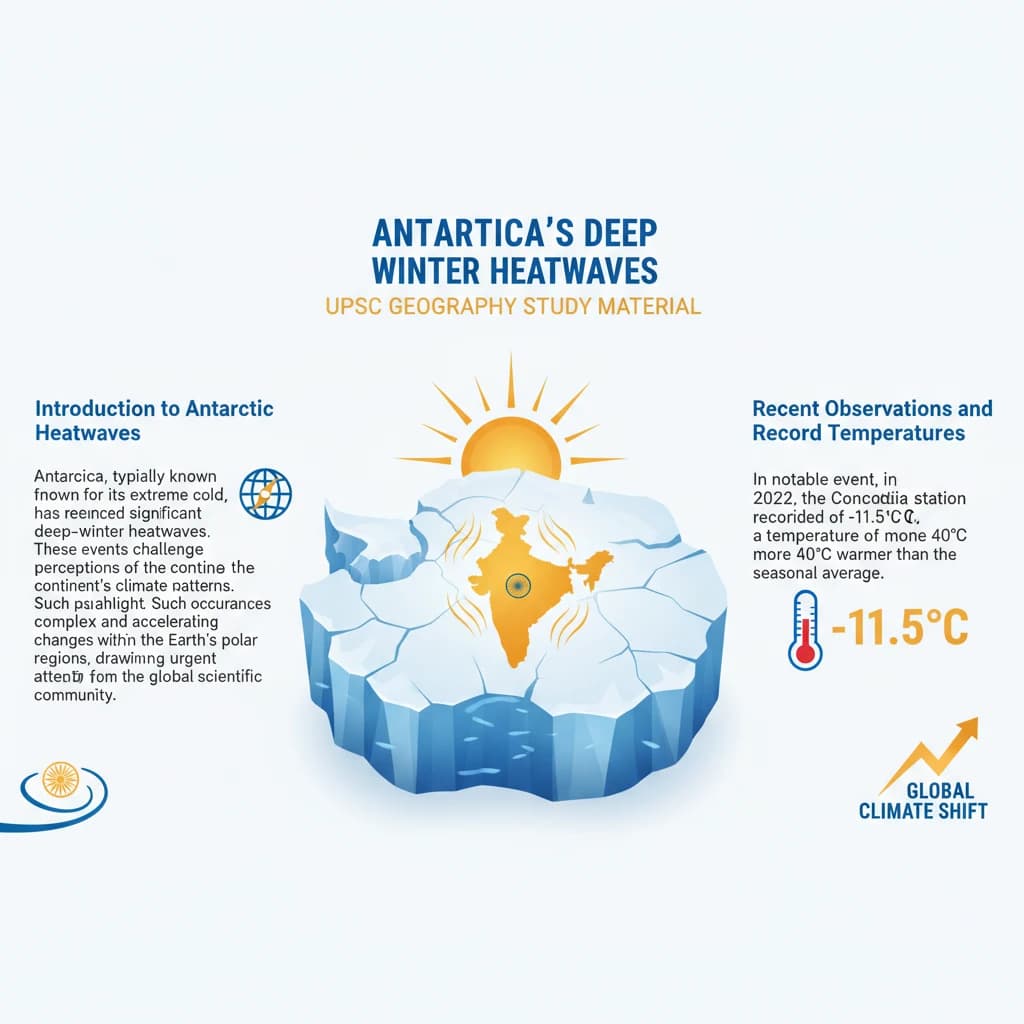
Antarctica’s Deep Winter Heatwaves

Antarctica’s Deep Winter Heatwaves

Medium⏱️ 7 min read✓ 95% Verified
geography

📖 Introduction

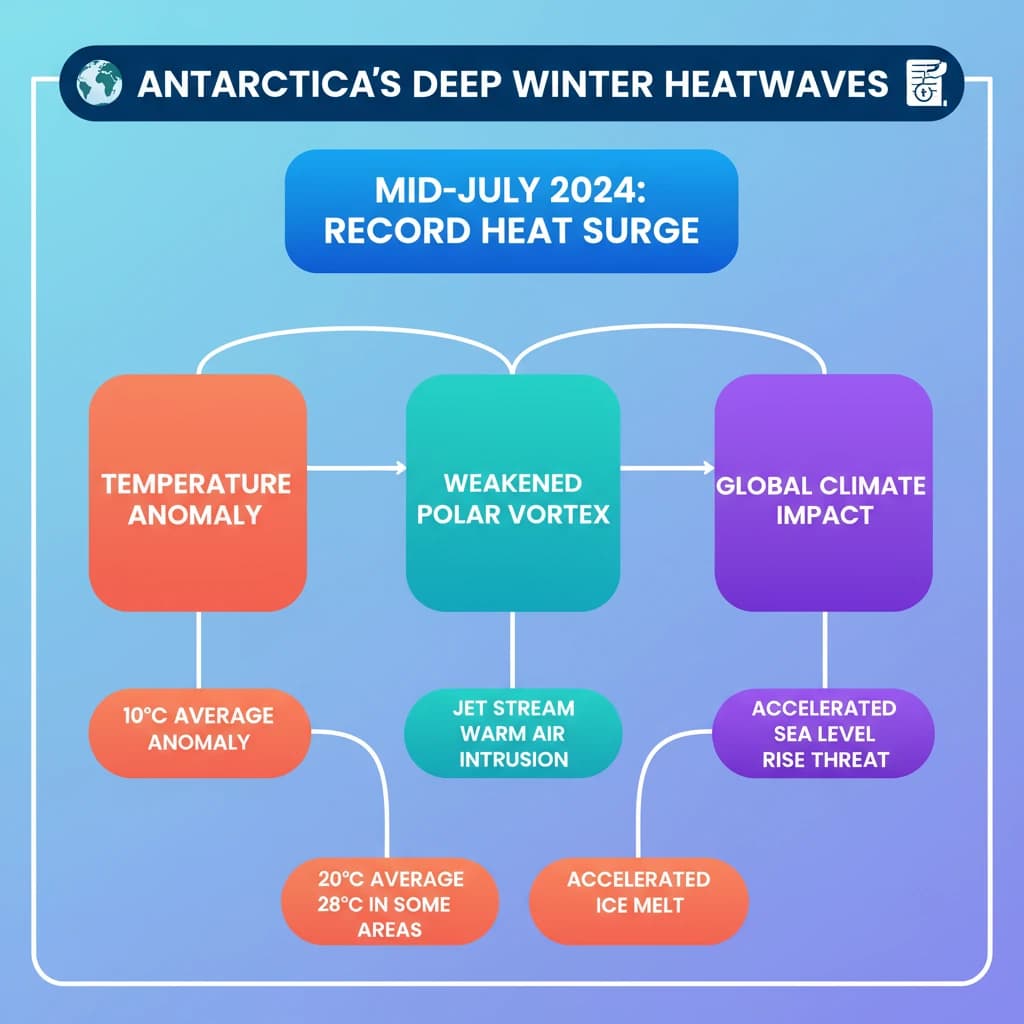
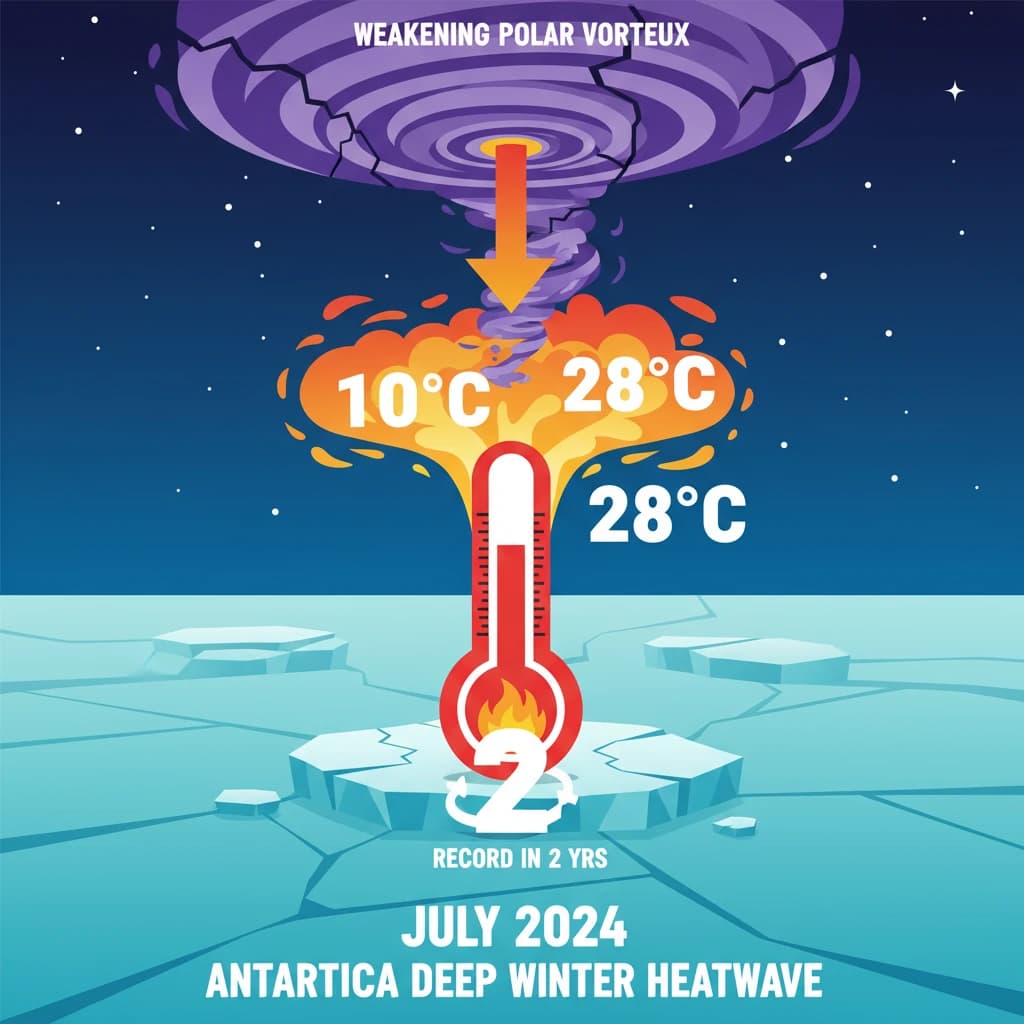
<h4>Recent Antarctic Deep-Winter Heatwave</h4><p><strong>Antarctica</strong> has recently experienced a significant <strong>deep-winter heatwave</strong>, marking the second such instance of record-breaking temperatures in just two years.</p><div class='info-box'><p>Ground temperatures have risen by an average of <strong>10 degrees Celsius</strong> above normal since mid-July 2024. Some areas have witnessed increases of up to <strong>28 degrees Celsius</strong>.</p></div><h4>Causes of Deep-Winter Heatwaves</h4><p>Several interconnected factors contribute to these extreme temperature anomalies in <strong>Antarctica</strong>.</p><h4>Weakening of the Polar Vortex</h4><p>The <strong>polar vortex</strong> is a crucial atmospheric phenomenon. It refers to the counterclockwise flow of air that typically keeps colder air confined near the <strong>Earth's poles</strong>.</p><div class='key-point-box'><p>The <strong>polar vortex</strong> naturally weakens in summer and strengthens in winter, but its recent disruption is a key concern.</p></div><p>Higher temperatures and powerful <strong>atmospheric waves</strong> (periodic disturbances in atmospheric variables) have disrupted the stability of the <strong>polar vortex</strong>.</p><p>This disruption allows <strong>cold air</strong> to escape from the pole and facilitates the descent of <strong>warm air</strong> from higher altitudes. The arrival of this warmer air leads to a sharp increase in regional temperatures.</p><h4>Reduction of Antarctic Sea Ice</h4><p><strong>Antarctic sea ice</strong> has reached historically low levels, significantly diminishing its capacity to reflect solar energy back into space.</p><p>Sea ice also acts as a vital barrier, insulating the cold polar air from warmer ocean waters. Its reduction exposes more ocean surface to the atmosphere.</p><div class='info-box'><p>The loss of <strong>sea ice</strong> reduces the <strong>albedo effect</strong>, contributing to increased absorption of solar radiation and accelerating global warming.</p></div><h4>High Rate of Global Warming</h4><p><strong>Antarctica</strong> is warming at an alarming rate, nearly double the global average. This accelerated warming is a primary driver of extreme weather events.</p><div class='info-box'><p>The continent is warming at an estimated rate of <strong>0.22 to 0.32 degrees Celsius per decade</strong>, compared to the Earth's overall warming rate of <strong>0.14-0.18 degrees Celsius per decade</strong> (as per <strong>IPCC estimates</strong>).</p></div><p>This rapid warming is predominantly driven by <strong>anthropogenic climate change</strong>, which intensifies the effects of natural climate variability.</p><h4>Impact of the Southern Ocean</h4><p>The <strong>Southern Ocean</strong> plays a critical role. With reduced <strong>sea ice</strong>, it absorbs more heat from the atmosphere and sunlight.</p><p>This increased heat absorption by the ocean creates a dangerous <strong>feedback loop</strong>, further raising air temperatures over <strong>Antarctica</strong> and escalating the risk of extreme weather events like heatwaves.</p>
Concept Diagram

💡 Key Takeaways

  • •Antarctica is experiencing unprecedented deep-winter heatwaves, with temperatures up to 28°C above normal.
  • •Key causes include a weakened polar vortex, record low Antarctic sea ice, and rapid global warming.
  • •Antarctica warms at nearly double the global average, driven by anthropogenic climate change.
  • •The warming Southern Ocean creates a feedback loop, exacerbating air temperature increases.
  • •These events have critical implications for global climate, sea level, and polar ecosystems.

🧠 Memory Techniques
Memory Aid
95% Verified Content

Related Topics

Loading related topics...
Explore:Geography Topics·All Subjects·Daily Current Affairs·Editorial Analysis·Previous Year Questions·UPSC GPT