📖 Introduction
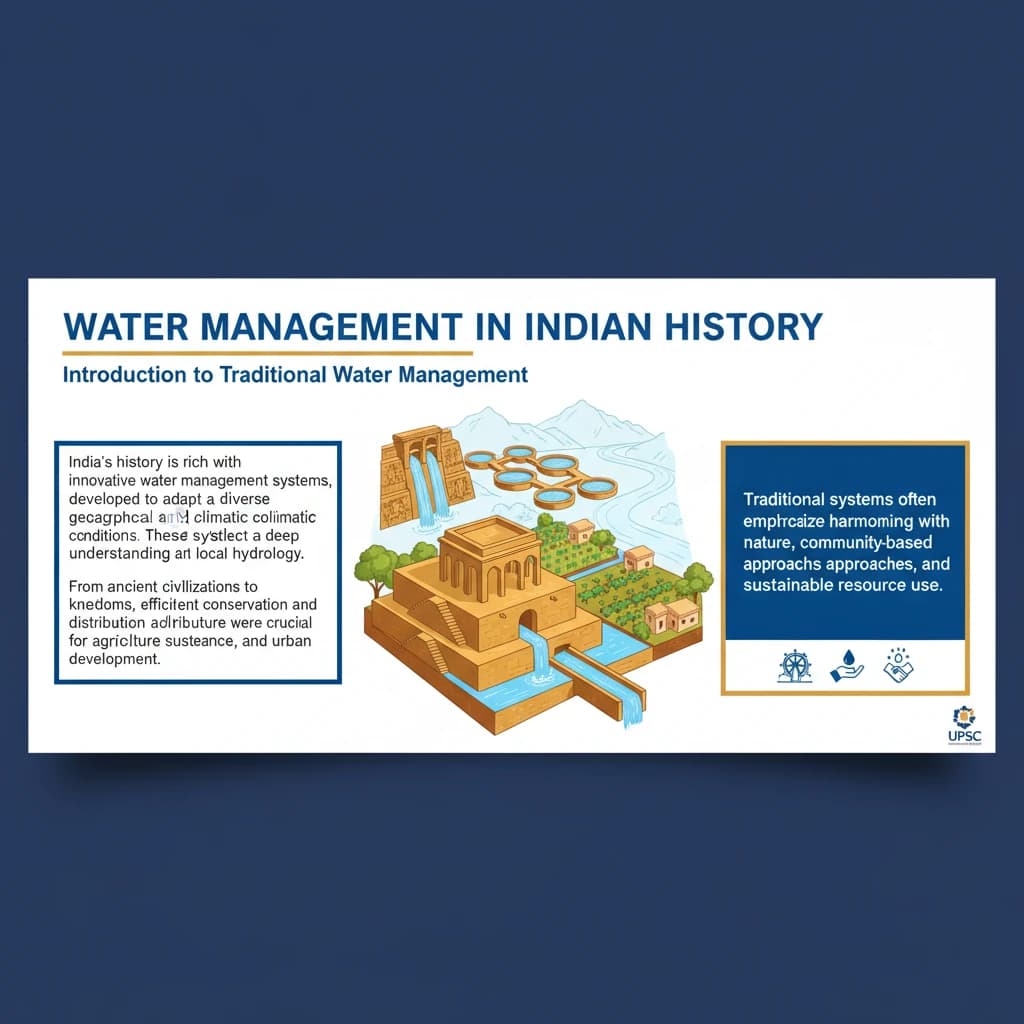
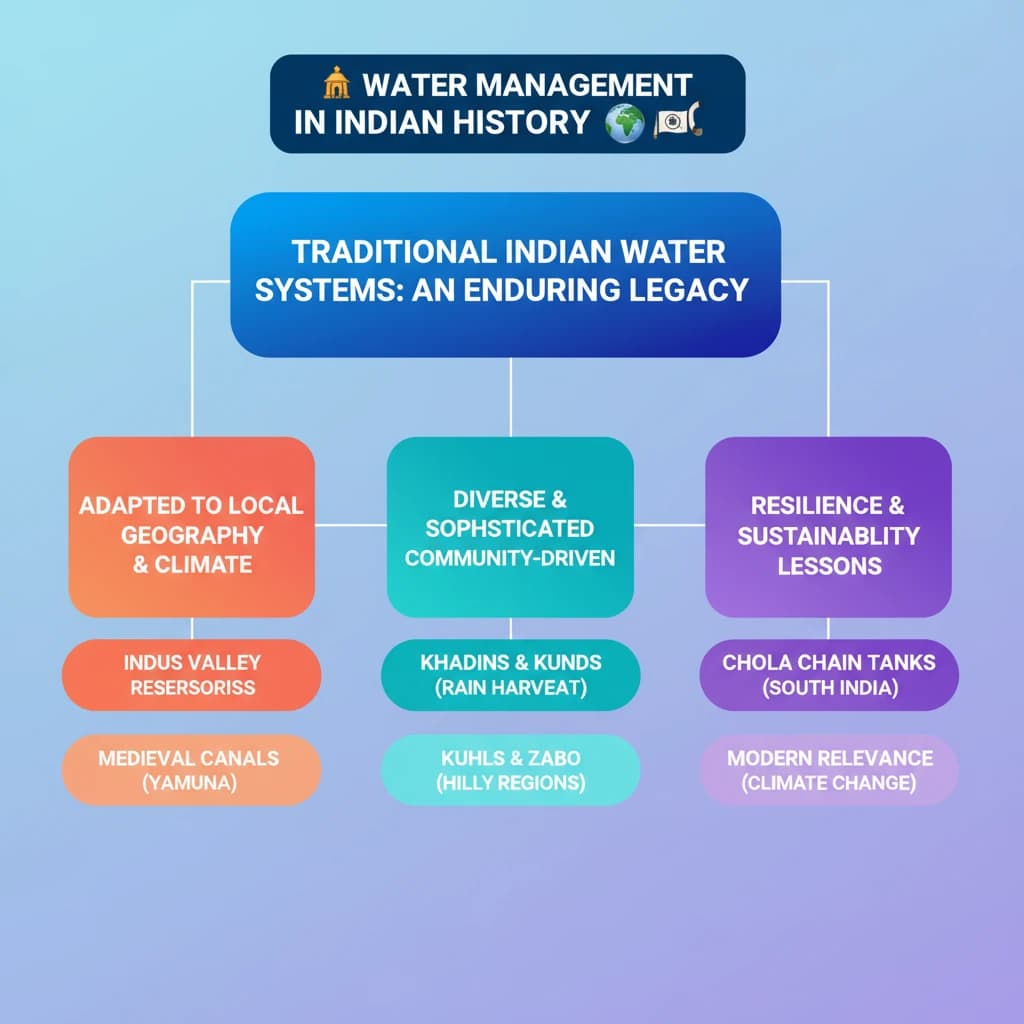
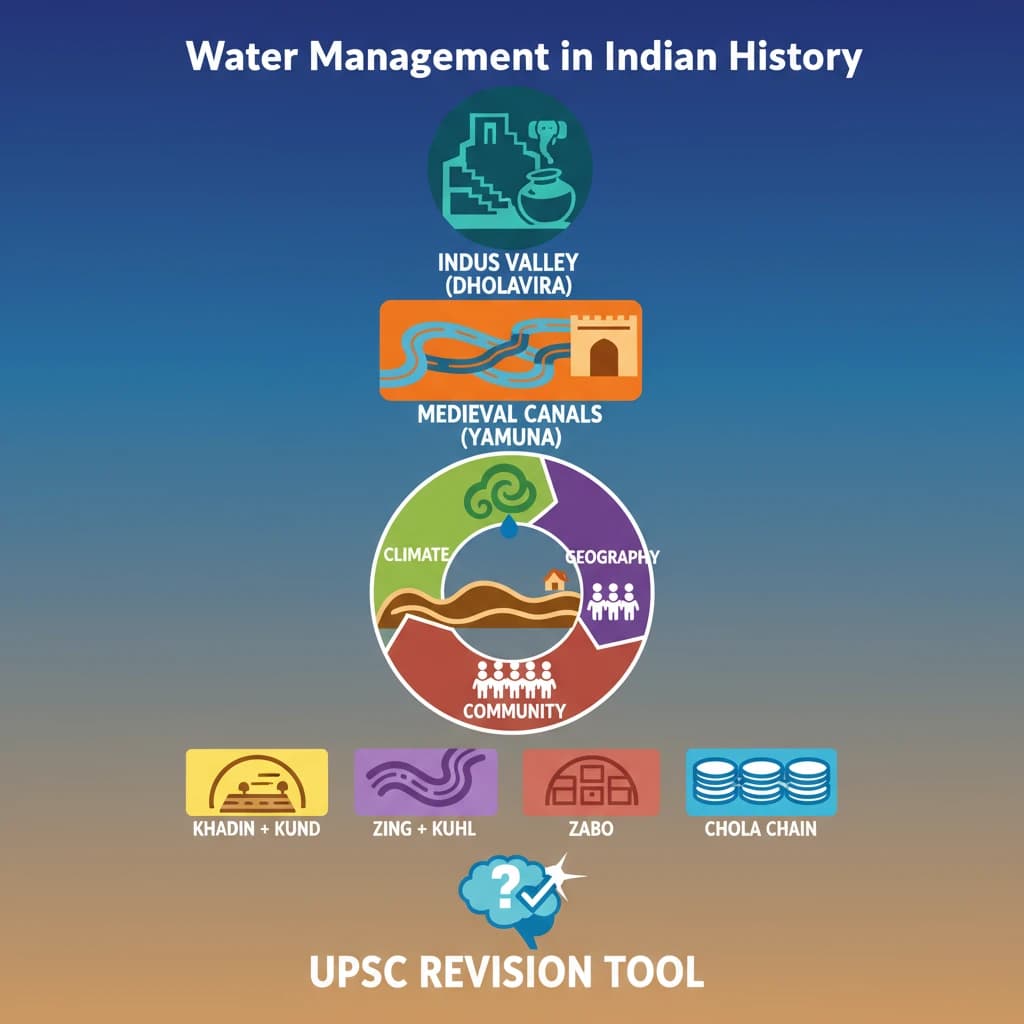
<h4>Introduction to Traditional Water Management</h4><p>India's history is rich with innovative <strong>water management systems</strong>, developed to adapt to diverse geographical and climatic conditions. These systems reflect a deep understanding of local hydrology.</p><p>From ancient civilizations to medieval kingdoms, efficient water conservation and distribution were crucial for agriculture, sustenance, and urban development.</p><div class='key-point-box'><p>Traditional systems often emphasized <strong>community participation</strong>, <strong>sustainability</strong>, and minimal environmental impact, offering valuable lessons for modern challenges.</p></div><h4>Key Traditional Water Harvesting Systems</h4><p>Across different regions, unique methods evolved to collect, store, and utilize water. These systems were ingeniously designed to suit local terrain and water availability.</p><ul><li><strong>Panam Keni</strong>: Cylindrical wells made from <strong>soaked toddy palm stems</strong>, considered sacred, found in <strong>Wayanad, Kerala</strong>.</li><li><strong>Khadin (Dhora)</strong>: Long <strong>earthen embankments</strong> built across <strong>hill slopes</strong> in <strong>Jaisalmer, Rajasthan</strong>. They collect surface runoff for agriculture.</li><li><strong>Kund</strong>: A <strong>saucer-shaped catchment area</strong> with a central <strong>circular underground well</strong>. Traditionally lined with <strong>lime and ash</strong>, found across various regions.</li><li><strong>Zing</strong>: Small tanks in <strong>Ladakh</strong> that collect <strong>glacier meltwater</strong>, often turning into streams by afternoon.</li><li><strong>Kuhls</strong>: <strong>Surface water channels</strong> in <strong>Himachal Pradesh</strong>, carrying <strong>glacial waters</strong> to agricultural fields.</li><li><strong>Zabo System</strong>: An integrated system in <strong>Nagaland</strong> combining <strong>rainwater conservation</strong> with <strong>forestry, agriculture, and animal care</strong>, using pond-like structures on terraced hillsides.</li><li><strong>Jackwells</strong>: Pits surrounded by <strong>bunds made of hardwood logs</strong>, practiced by the <strong>Shompen tribe</strong> in the <strong>Great Nicobar Islands</strong>.</li></ul><h4>Water Management in Ancient India</h4><p>The earliest evidence of sophisticated water management dates back to the <strong>Indus Valley Civilization</strong>, showcasing advanced urban planning.</p><div class='info-box'><ul><li><strong>Dholavira</strong>: Featured large <strong>reservoirs</strong> to collect and store rainwater.</li><li><strong>Lothal and Inamgaon</strong>: Utilized small <strong>bunds</strong> to store water for irrigation and drinking purposes.</li></ul></div><p>During the <strong>Mauryan Empire</strong>, water management became a state-regulated affair, vital for agricultural productivity and imperial administration.</p><div class='info-box'><p>The <strong>Arthashastra of Kautilya</strong> records extensive <strong>irrigation systems</strong>, including <strong>dams and bunds</strong>. These were managed under strict regulations, with taxes imposed based on water source and extraction method.</p></div><h4>Innovations in Early Medieval India</h4><p>The early medieval period witnessed further advancements and diversification of water management techniques, reflecting regional ingenuity.</p><ul><li>The <strong>Katayanas</strong> introduced <strong>brick and ring wells</strong>, improving access to groundwater.</li><li>The <strong>Chola period</strong> in South India was renowned for its advanced <strong>chain tanks</strong> – interconnected tank systems ensuring efficient water distribution.</li><li>The <strong>Rajputs</strong> constructed large reservoirs, such as the famous <strong>Bhopal Lake</strong> built under <strong>King Bhoja</strong>.</li><li>In eastern India, the <strong>Pal and Sen dynasties</strong> were responsible for numerous <strong>tanks and lakes</strong>.</li></ul><h4>Medieval Period Advancements</h4><p>The medieval era saw the construction of large-scale canal systems and tanks, often patronized by powerful rulers to boost agricultural output and support urban centers.</p><div class='info-box'><ul><li><strong>Feroze Shah Tughlaq</strong>: Credited with building the <strong>Western Yamuna Canal</strong>.</li><li><strong>Emperor Shahjahan</strong>: Developed the significant <strong>Bari Doab</strong> or <strong>Hasli Canal</strong>.</li><li><strong>Vijayanagar Kingdom</strong>: Constructed impressive tanks like the <strong>Anantraj Sagar</strong> and the <strong>Korangal Dam</strong>.</li><li><strong>Sultan Zain Uddin</strong>: Established an extensive <strong>canal network</strong> in <strong>Kashmir</strong>.</li></ul></div><div class='exam-tip-box'><p>Remember specific examples like <strong>Dholavira's reservoirs</strong>, <strong>Chola chain tanks</strong>, and <strong>Tughlaq's canals</strong>. These are frequently asked in <strong>UPSC Prelims</strong> and can enrich answers in <strong>Mains (GS-I History, GS-III Environment/Agriculture)</strong>.</p></div>