Loading page, please wait…
Vaidra Logo
Vaidra

Top 4 items + smart groups

UPSC GPT
New
Current Affairs
Daily Solutions
Daily Puzzle
Mains Evaluator

Version 2.0.0 • Built with ❤️ for UPSC aspirants

Loading...
Loading...
Loading...
Loading...
Loading...
Loading...
Loading...
Loading...
Loading...
Loading...
Loading...
Loading...
Loading...
Back
All Subjects

Topics

0 topics • 0 completed

Loading topics...
Loading...
Loading...
Loading...
Loading...
Loading...
Overall Progress0%

What is the Arctic? - UPSC Geography

What is What is the Arctic? in UPSC Geography?

What is the Arctic? is a key topic under Geography for UPSC Civil Services Examination. Key points include: The Arctic is the northernmost polar region, critical for global climate regulation.. Its diminishing carbon storage and ecological impacts (e.g., reindeer decline) highlight urgent climate action.. Geopolitically significant due to vast natural resources (oil, gas, minerals) and new shipping routes.. Understanding this topic is essential for both UPSC Prelims and Mains preparation.

Why is What is the Arctic? important for UPSC exam?

What is the Arctic? is a Easy-level topic in UPSC Geography. It is tested in both Prelims (factual MCQs) and Mains (analytical answer writing). Previous year UPSC questions have frequently covered aspects of What is the Arctic?, making it essential for comprehensive IAS preparation.

How to prepare What is the Arctic? for UPSC?

To prepare What is the Arctic? for UPSC: (1) Study the comprehensive notes covering all key concepts on Vaidra. (2) Practice previous year questions on this topic. (3) Connect it with current affairs using daily updates. (4) Revise using key takeaways and mind maps available for Geography. (5) Write practice answers linking What is the Arctic? to related GS Paper topics.

Key takeaways of What is the Arctic? for UPSC

  • The Arctic is the northernmost polar region, critical for global climate regulation.
  • Its diminishing carbon storage and ecological impacts (e.g., reindeer decline) highlight urgent climate action.
  • Geopolitically significant due to vast natural resources (oil, gas, minerals) and new shipping routes.
  • India's engagement began with the Svalbard Treaty (1920) and established Himadri research base (2008).
  • India holds observer status in the Arctic Council (2013) and launched a comprehensive Arctic Policy in 2022.
  • NCPOR is the nodal agency for India's Arctic Policy, focusing on climate research.
What is the Arctic?

What is the Arctic?

Easy⏱️ 5 min read✓ 95% Verified
geography

📖 Introduction

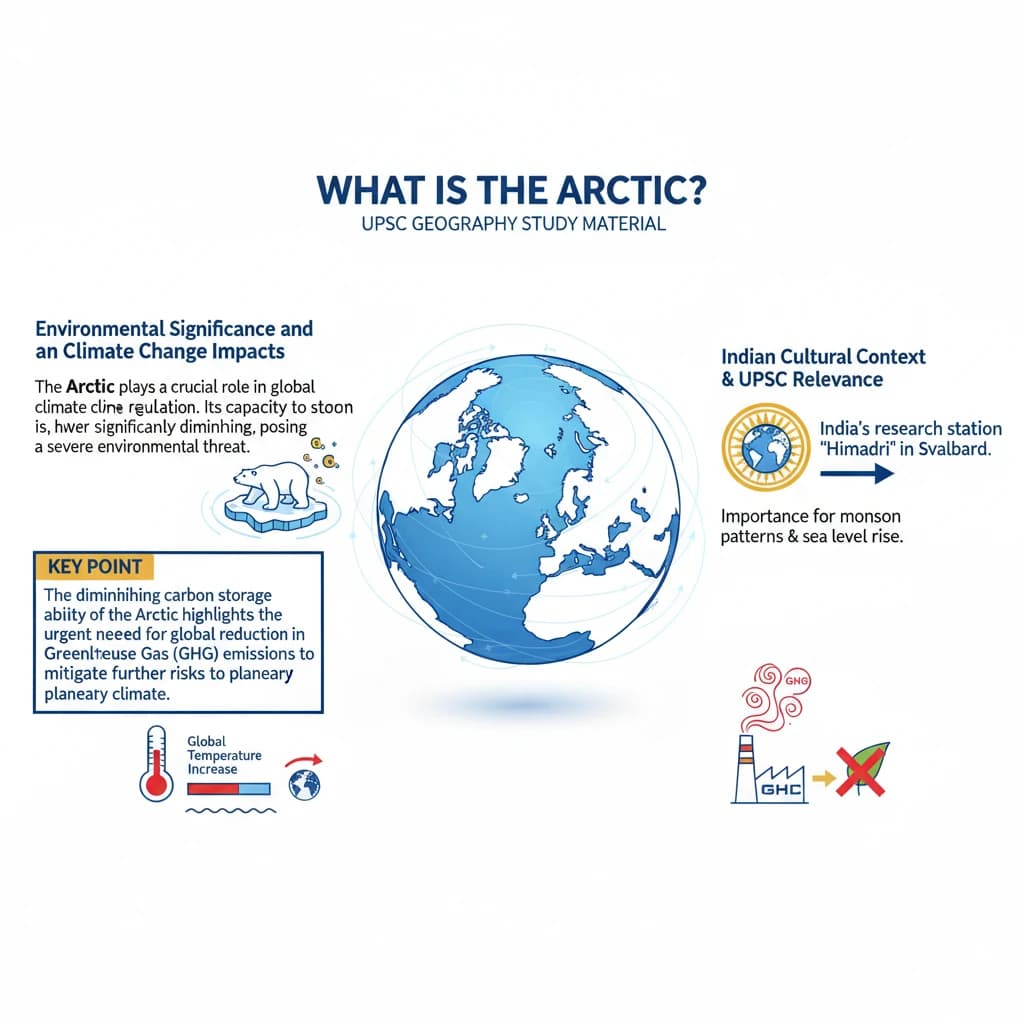
<h4>Environmental Significance and Climate Change Impacts</h4><p>The <strong>Arctic</strong> plays a crucial role in global climate regulation. Its capacity to store carbon is, however, significantly diminishing, posing a severe environmental threat.</p><div class='key-point-box'><p>The <strong>diminishing carbon storage ability</strong> of the Arctic highlights the urgent need for global reduction in <strong>Greenhouse Gas (GHG) emissions</strong> to mitigate further risks to the planetary climate system.</p></div><p>Climate change in the Arctic has profound ecological and social consequences. The decline of species like the <strong>reindeer</strong> or <strong>caribou</strong> is a direct impact.</p><div class='info-box'><p><strong>Impact on Indigenous Communities:</strong> Indigenous populations in the Arctic rely heavily on species like <strong>reindeer</strong> for their food security and deeply ingrained cultural practices. Their decline directly threatens these communities.</p></div><h4>Geopolitical Importance and Resource Scramble</h4><p>Beyond its environmental role, the Arctic holds immense <strong>geopolitical importance</strong> due to its vast natural resources. This attracts considerable international attention and competition.</p><div class='info-box'><p><strong>Rich Natural Resources:</strong> The Arctic region is estimated to contain significant reserves of <strong>oil</strong>, <strong>natural gas</strong>, and various valuable <strong>minerals</strong>. These resources are becoming more accessible as ice melts.</p></div><p>The potential for new shipping routes, particularly the <strong>Northern Sea Route</strong>, also adds to its strategic value, influencing global trade and security dynamics.</p><div class='exam-tip-box'><p>For UPSC, understand the dual nature of the Arctic: a critical environmental buffer and a zone of increasing geopolitical contestation. Link this to <strong>GS-I Geography</strong> and <strong>GS-II International Relations</strong>.</p></div>
Concept Diagram

💡 Key Takeaways

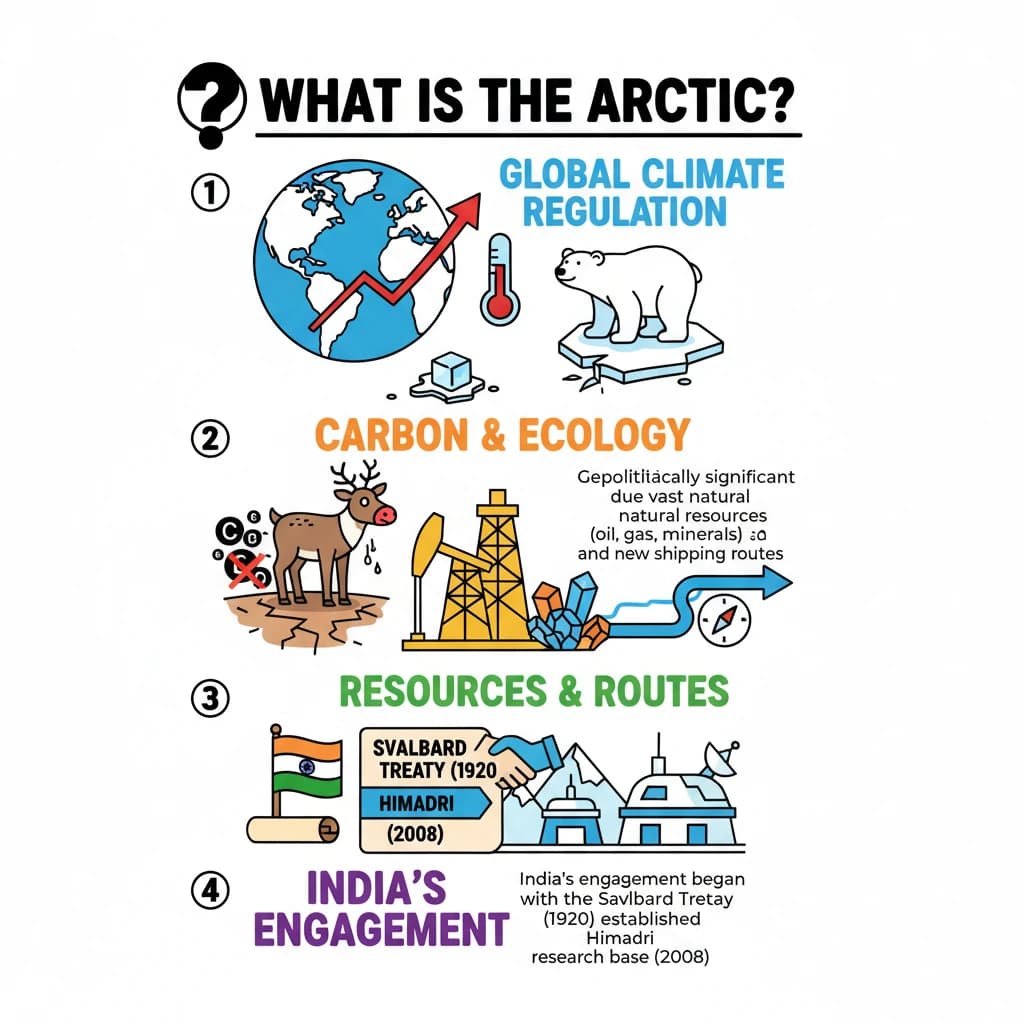
  • •The Arctic is the northernmost polar region, critical for global climate regulation.
  • •Its diminishing carbon storage and ecological impacts (e.g., reindeer decline) highlight urgent climate action.
  • •Geopolitically significant due to vast natural resources (oil, gas, minerals) and new shipping routes.
  • •India's engagement began with the Svalbard Treaty (1920) and established Himadri research base (2008).
  • •India holds observer status in the Arctic Council (2013) and launched a comprehensive Arctic Policy in 2022.
  • •NCPOR is the nodal agency for India's Arctic Policy, focusing on climate research.

🧠 Memory Techniques
Memory Aid
95% Verified Content

Related Topics

Loading related topics...
Explore:Geography Topics·All Subjects·Daily Current Affairs·Editorial Analysis·Previous Year Questions·UPSC GPT
What is the Arctic? - UPSC Geography