📖 Introduction
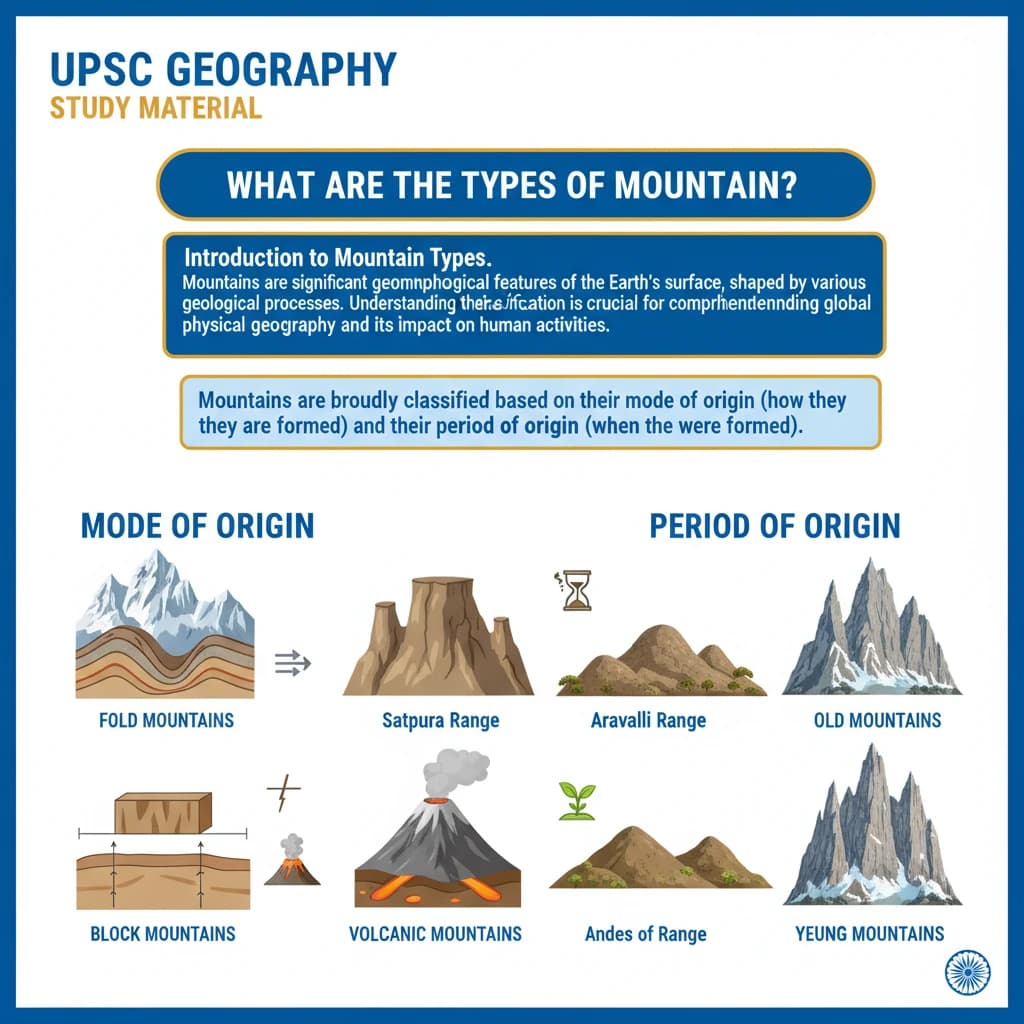
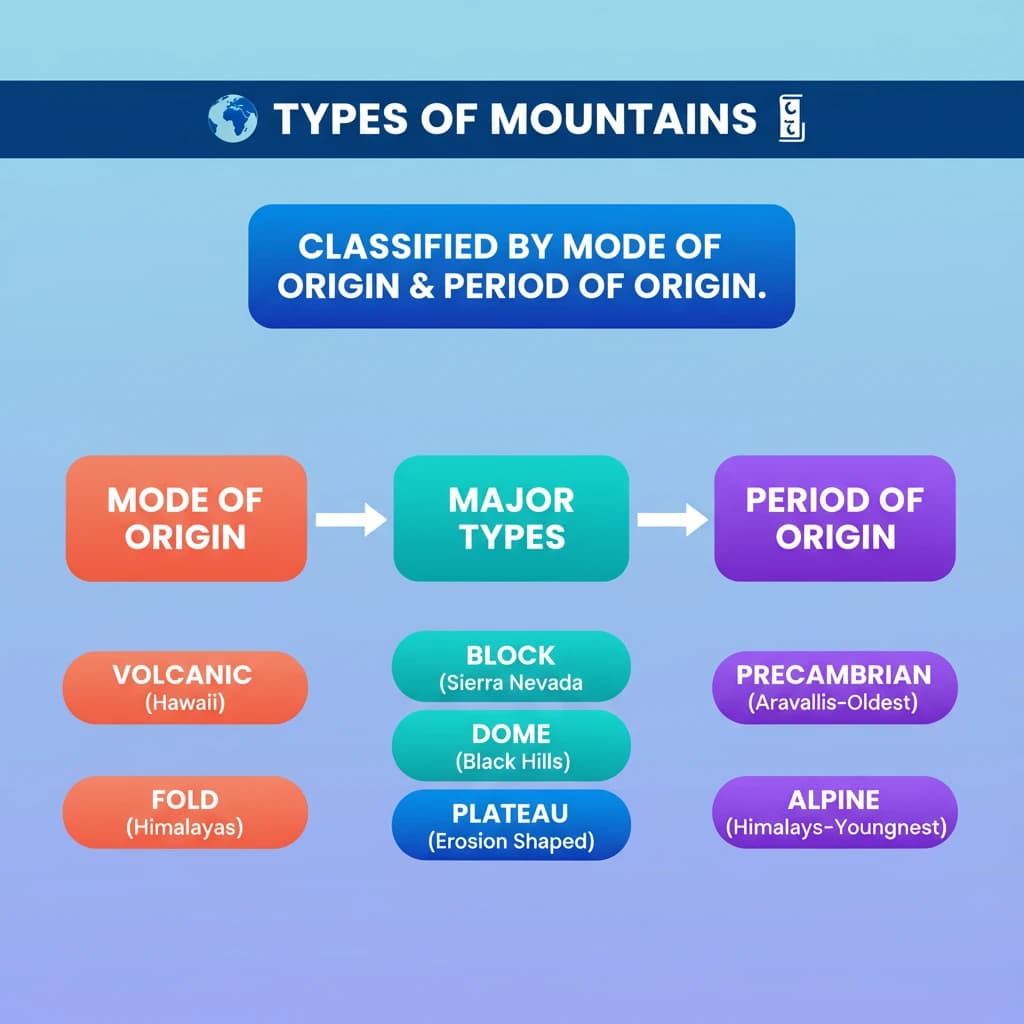
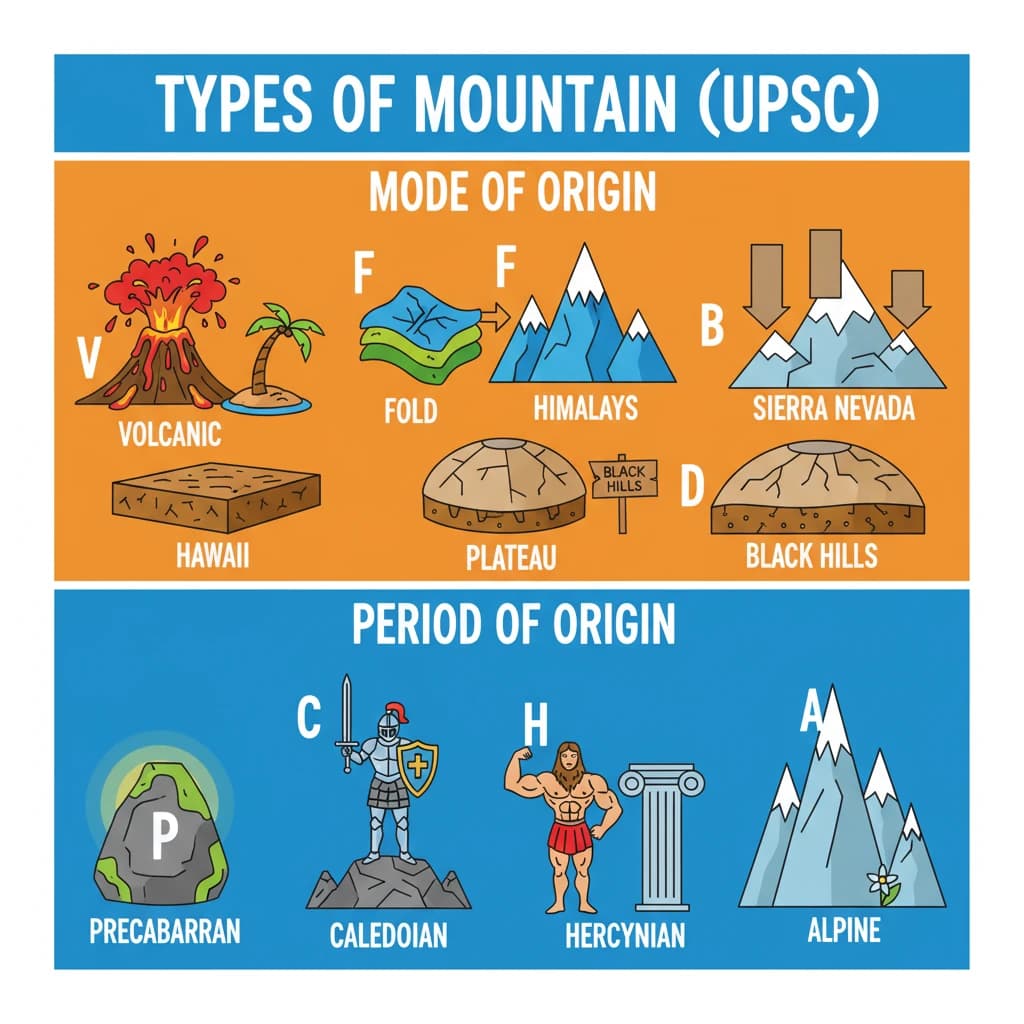
<h4>Introduction to Mountain Types</h4><p>Mountains are significant geomorphological features of the Earth's surface, shaped by various geological processes. Understanding their classification is crucial for comprehending global physical geography and its impact on human activities.</p><div class='key-point-box'><p>Mountains are broadly classified based on their <strong>mode of origin</strong> (how they are formed) and their <strong>period of origin</strong> (when they were formed).</p></div><h4>Classification Based on Mode of Origin</h4><p>This classification categorizes mountains based on the specific geological forces and processes that led to their creation.</p><h4>Volcanic Mountains: Formation and Examples</h4><p><strong>Volcanic mountains</strong> are formed directly by the eruption of <strong>magma</strong> from the Earth’s interior. As magma, ash, and rocks accumulate around a vent, they build up conical or shield-like structures.</p><div class='info-box'><p><strong>Formation Process:</strong> Repeated eruptions of <strong>lava</strong> and ash lead to the gradual accumulation of material, forming a mountain over time.</p><p><strong>Key Examples:</strong> Prominent examples include the mountains in <strong>Hawaii</strong> and <strong>Fiji</strong>, known for their distinct volcanic origins.</p></div><h4>Fold Mountains: Tectonic Collisions</h4><p><strong>Fold mountains</strong> are the most common type of mountain, created when two or more of Earth's <strong>tectonic plates</strong> collide. This immense pressure causes the Earth's crust to buckle and fold.</p><div class='info-box'><p><strong>Formation Process:</strong> The compression forces cause layers of rock to crumple into folds, known as <strong>anticlines</strong> (upfolds) and <strong>synclines</strong> (downfolds).</p><p><strong>Key Examples:</strong> The majestic <strong>Himalayas</strong> in Asia and the extensive <strong>Andes</strong> in South America are prime examples of young fold mountains.</p></div><h4>Block Mountains: Faulting and Uplift</h4><p><strong>Block mountains</strong> are formed due to <strong>faulting</strong> and the vertical movement of large blocks of the Earth’s crust. These movements occur along faults, which are fractures in the Earth's crust.</p><div class='info-box'><p><strong>Formation Process:</strong> Tensional or compressional forces cause sections of the crust to be uplifted (<strong>horsts</strong>) or dropped down (<strong>grabens</strong>), creating distinct block-like mountain ranges.</p><p><strong>Key Example:</strong> The <strong>Sierra Nevada</strong> mountain range in the United States is a classic illustration of a block mountain.</p></div><h4>Dome Mountains: Magmatic Uplift</h4><p><strong>Dome mountains</strong> are created when a large amount of <strong>magma</strong> pushes the Earth’s crust upward from beneath, but without erupting. This upward pressure creates a dome-like bulge on the surface.</p><div class='info-box'><p><strong>Formation Process:</strong> The overlying sedimentary layers are uplifted into a rounded, dome-shaped structure. Subsequent <strong>erosion</strong> often exposes the underlying igneous core.</p><p><strong>Key Example:</strong> The <strong>Black Hills</strong> in the United States are a well-known example of dome mountains, where erosion has revealed the core.</p></div><h4>Plateau Mountains: Erosion of Uplifted Land</h4><p><strong>Plateau mountains</strong>, while resembling dome mountains in some aspects, are formed primarily by the uplift of large landmasses due to colliding <strong>tectonic plates</strong>, followed by significant <strong>weathering and erosion</strong>.</p><div class='info-box'><p><strong>Formation Process:</strong> Large areas of land are uplifted, forming plateaus. Over geological time, rivers and other erosional agents carve out valleys and canyons, leaving behind mountain-like structures.</p><p><strong>Distinction:</strong> Unlike dome mountains formed by localized magma push, plateau mountains involve broader tectonic uplift and extensive erosional sculpting.</p></div><h4>Classification Based on Period of Origin</h4><p>This classification categorizes mountains based on the geological era or period during which their primary formation occurred. It reflects their age and the extent of subsequent erosion and modification.</p><h4>Precambrian Mountains: Ancient Relics</h4><p><strong>Precambrian mountains</strong> are the oldest mountain ranges on Earth, formed during the vast <strong>Precambrian era</strong>, which spans from <strong>4.6 billion to 541 million years ago</strong>. These ranges have undergone extensive geological changes.</p><div class='info-box'><p><strong>Characteristics:</strong> They have experienced billions of years of <strong>erosion</strong> and <strong>metamorphism</strong>, leading to highly weathered and often low-lying <strong>residual formations</strong>.</p><p><strong>Key Example:</strong> The <strong>Aravallis</strong> in India are a prime example of ancient Precambrian mountains, now existing as highly eroded remnants.</p></div><h4>Caledonian Mountains: Paleozoic Formation</h4><p>The <strong>Caledonian mountains</strong> were formed during the <strong>Paleozoic Era</strong>, approximately <strong>430 million years ago</strong>. This period saw significant tectonic activity contributing to their uplift.</p><div class='info-box'><p><strong>Geological Period:</strong> Their formation is associated with the <strong>Caledonian Orogeny</strong>, a mountain-building event that affected parts of Europe and North America.</p><p><strong>Key Example:</strong> The <strong>Appalachian Mountains</strong> in North America are often cited as an example of Caledonian mountain ranges, though they also experienced later Hercynian activity.</p></div><h4>Hercynian Mountains: Carboniferous to Permian Era</h4><p><strong>Hercynian mountains</strong> originated during the late <strong>Paleozoic Era</strong>, specifically from the <strong>Carboniferous to Permian Periods</strong>, approximately <strong>340 million to 225 million years ago</strong>.</p><div class='info-box'><p><strong>Geological Period:</strong> Also known as the <strong>Variscan Orogeny</strong>, this event created mountain ranges across Europe and parts of North Africa.</p><p><strong>Key Example:</strong> The <strong>Ural Mountains</strong>, which form a natural boundary between Europe and Asia, are a classic example of Hercynian mountain systems.</p></div><h4>Alpine Mountains: The Youngest Systems</h4><p><strong>Alpine mountains</strong> represent the youngest major mountain systems on Earth, formed during the relatively recent <strong>Tertiary period</strong>, which began approximately <strong>66 million years ago</strong>.</p><div class='info-box'><p><strong>Characteristics:</strong> These mountains are typically high, rugged, and still undergoing active geological processes, indicating their youth.</p><p><strong>Key Examples:</strong> The magnificent <strong>Himalayas</strong> and the majestic <strong>Alps</strong> are prominent examples of Alpine mountain ranges, characterized by their towering peaks and ongoing uplift.</p></div><div class='exam-tip-box'><p><strong>UPSC Insight:</strong> Distinguishing between <strong>Fold Mountains</strong> (mode of origin) and <strong>Alpine Mountains</strong> (period of origin) is important. While the <strong>Himalayas</strong> are both <strong>Fold</strong> and <strong>Alpine</strong>, not all fold mountains are Alpine, and vice-versa (e.g., older fold mountains exist). Focus on the classification criteria.</p></div>