Loading page, please wait…
Arctic Sea Ice Impact on Indian Monsoon - UPSC Geography
What is Arctic Sea Ice Impact on Indian Monsoon in UPSC Geography?
Arctic Sea Ice Impact on Indian Monsoon is a key topic under Geography for UPSC Civil Services Examination. Key points include: Arctic sea ice decline increases Indian Monsoon variability and unpredictability.. Central Arctic melt affects western/peninsular (reduced rain) and central/northern India (increased rain) via strengthened Rossby waves.. Barents-Kara Sea melt leads to high pressure over SW China and a positive Arctic Oscillation, impacting NE India (high rain) and central/NW India (less rain).. Understanding this topic is essential for both UPSC Prelims and Mains preparation.
Why is Arctic Sea Ice Impact on Indian Monsoon important for UPSC exam?
Arctic Sea Ice Impact on Indian Monsoon is a Medium-level topic in UPSC Geography. It is tested in both Prelims (factual MCQs) and Mains (analytical answer writing). Previous year UPSC questions have frequently covered aspects of Arctic Sea Ice Impact on Indian Monsoon, making it essential for comprehensive IAS preparation.
How to prepare Arctic Sea Ice Impact on Indian Monsoon for UPSC?
To prepare Arctic Sea Ice Impact on Indian Monsoon for UPSC: (1) Study the comprehensive notes covering all key concepts on Vaidra. (2) Practice previous year questions on this topic. (3) Connect it with current affairs using daily updates. (4) Revise using key takeaways and mind maps available for Geography. (5) Write practice answers linking Arctic Sea Ice Impact on Indian Monsoon to related GS Paper topics.
Key takeaways of Arctic Sea Ice Impact on Indian Monsoon for UPSC
- Arctic sea ice decline increases Indian Monsoon variability and unpredictability.
- Central Arctic melt affects western/peninsular (reduced rain) and central/northern India (increased rain) via strengthened Rossby waves.
- Barents-Kara Sea melt leads to high pressure over SW China and a positive Arctic Oscillation, impacting NE India (high rain) and central/NW India (less rain).
- Climate change, including a warming Arabian Sea, further exacerbates monsoon destabilization.
- Research by India's NCPOR and South Korea's KPRI confirms this critical Arctic-monsoon teleconnection.
Arctic Sea Ice Impact on Indian Monsoon
Medium⏱️ 7 min read
geography
📖 Introduction
Introduction to Arctic Sea Ice and Monsoon Link
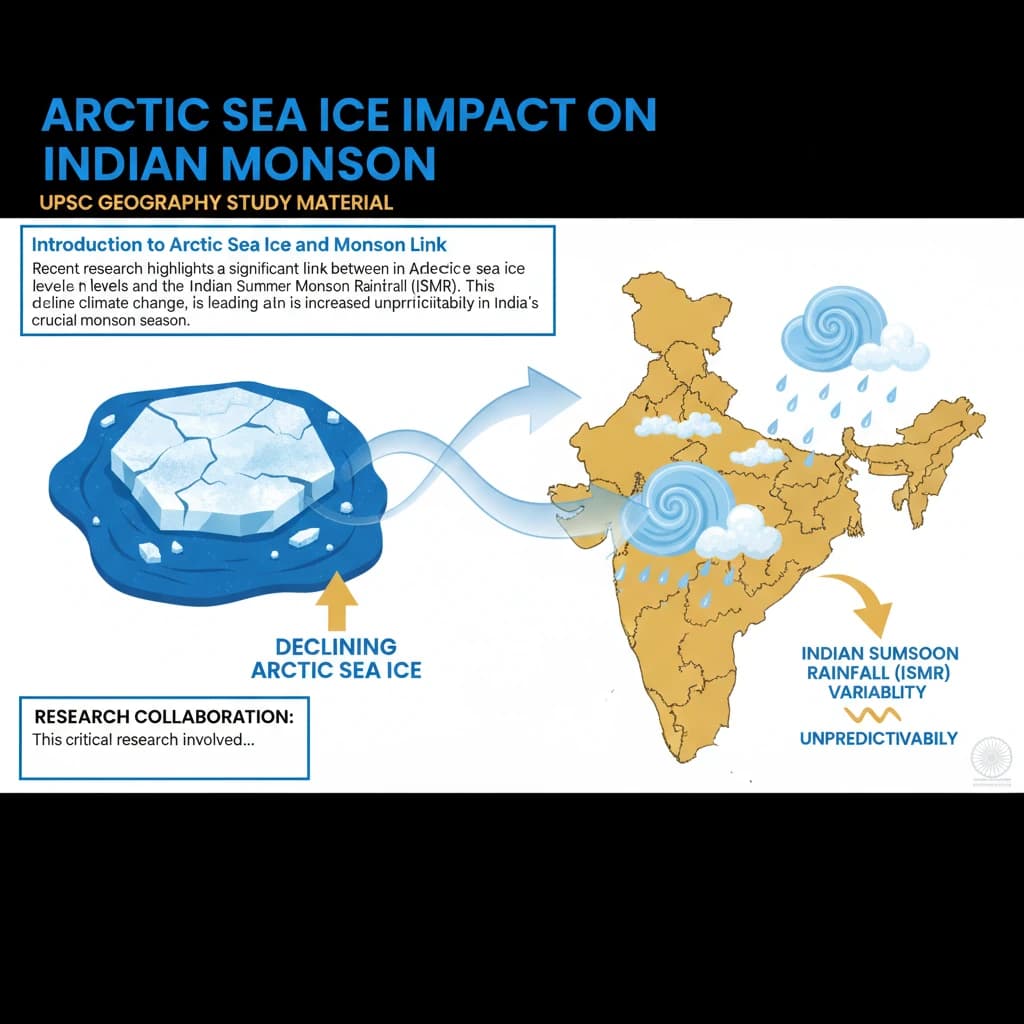
Recent research highlights a significant link between the decline in Arctic sea ice levels and the variability of the Indian Summer Monsoon Rainfall (ISMR).
This decline, primarily driven by climate change, is leading to increased unpredictability in India's crucial monsoon season.
Research Collaboration: This critical research involved scientists from India’s National Centre for Polar and Ocean Research (NCPOR), under the Ministry of Earth Sciences, and South Korea’s Korea Polar Research Institute.
Impact of Central Arctic Sea Ice Decline
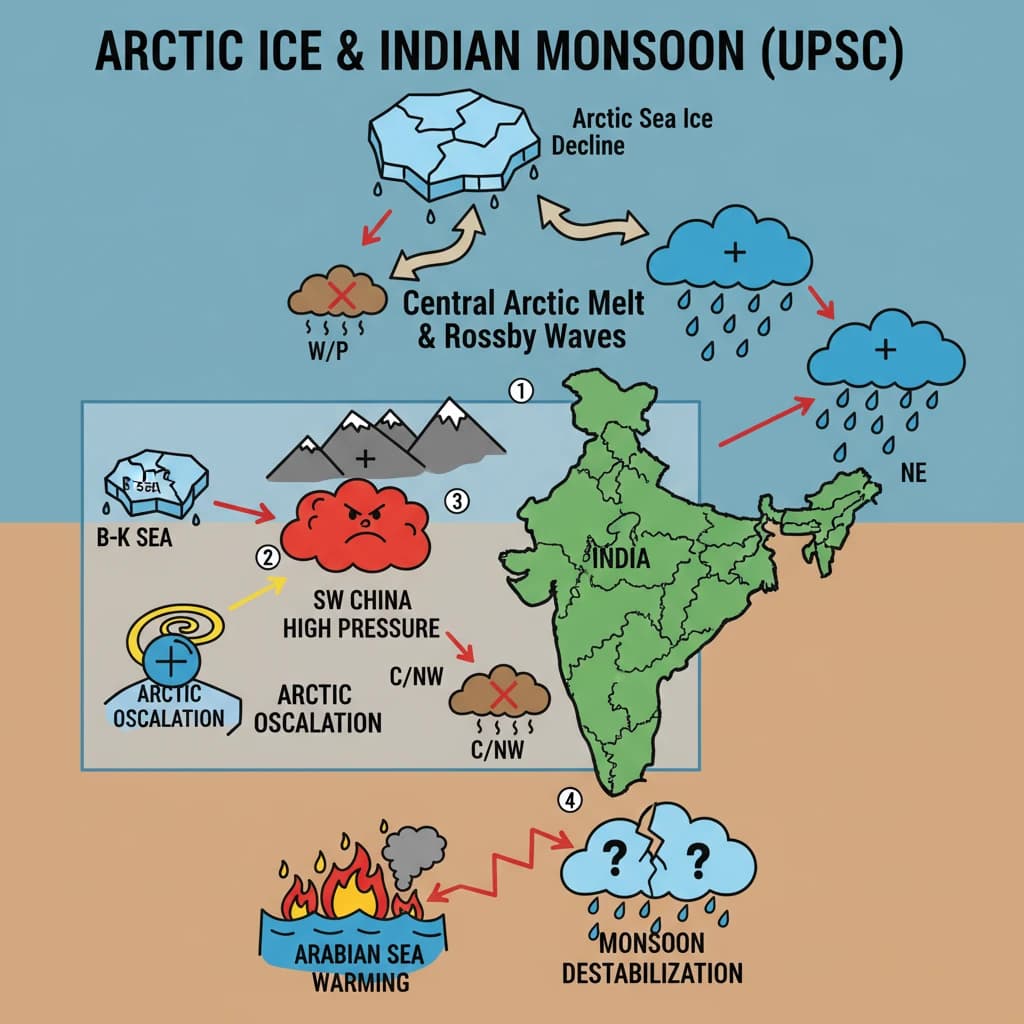
A decline in Central Arctic Sea Ice generally leads to reduced rainfall in western and peninsular India, but increased rainfall in central and northern India.
Underlying Mechanism: The reduced ice cover facilitates greater heat transfer from the ocean to the atmosphere. This intensification strengthens Rossby waves, which are large-scale atmospheric waves influencing global weather patterns.
These strengthened Rossby waves contribute to a high-pressure zone over northwest India and a low-pressure zone over the Mediterranean.
This atmospheric configuration shifts the subtropical easterly jet northward, which can result in more rain over western and peninsular India under specific conditions.
Influence of Low Sea Ice in Barents-Kara Sea Region
Low sea ice levels in the Barents-Kara Sea region also significantly affect monsoon patterns.
This condition results in higher atmospheric pressure over southwest China and contributes to a positive phase of the Arctic Oscillation, impacting global weather.
Arctic Oscillation (AO): A climate pattern characterized by opposing atmospheric pressure anomalies in the Arctic and mid-latitudes, influencing Northern Hemisphere weather.
The heat released from the ice-free Barents-Kara Sea creates calm, clear atmospheric conditions over northwest Europe.
This disruption in turn affects the upper atmospheric conditions in subtropical Asia and India.
The outcome is typically high rainfall over northeastern India, while central and northwest regions experience less rain.
Climate Change's Exacerbating Role
The overall impact is further complicated by climate change, which leads to a warming Arabian Sea.
Increased moisture from surrounding water bodies, combined with these factors, further destabilizes weather patterns.
This exacerbates the variability and unpredictability of the Indian monsoon rainfall.
Understanding the intricate links between Arctic climate change and the Indian monsoon is crucial for UPSC Mains GS Paper 1 (Geography) and GS Paper 3 (Environment). Focus on mechanisms and regional impacts.
💡 Key Takeaways
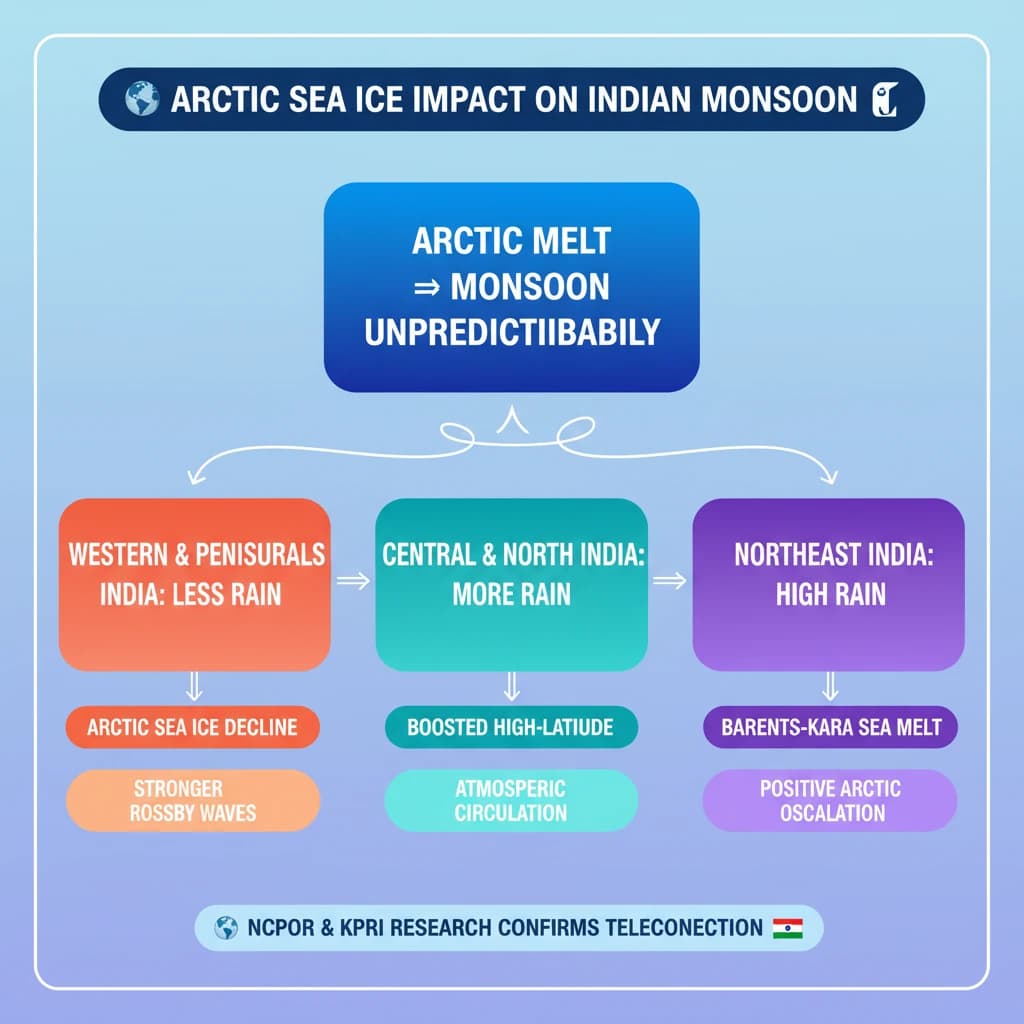
- •Arctic sea ice decline increases Indian Monsoon variability and unpredictability.
- •Central Arctic melt affects western/peninsular (reduced rain) and central/northern India (increased rain) via strengthened Rossby waves.
- •Barents-Kara Sea melt leads to high pressure over SW China and a positive Arctic Oscillation, impacting NE India (high rain) and central/NW India (less rain).
- •Climate change, including a warming Arabian Sea, further exacerbates monsoon destabilization.
- •Research by India's NCPOR and South Korea's KPRI confirms this critical Arctic-monsoon teleconnection.
🧠 Memory Techniques
90% Verified Content