Loading page, please wait…
Atmospheric River (Category 5 Exceptional) - UPSC Geography
What is Atmospheric River (Category 5 Exceptional) in UPSC Geography?
Atmospheric River (Category 5 Exceptional) is a key topic under Geography for UPSC Civil Services Examination. Key points include: Atmospheric Rivers (ARs) are concentrated corridors of water vapor, acting as 'rivers in the sky'.. Category 5 (Exceptional) ARs are highly hazardous, capable of causing widespread, severe flooding and economic damage (e.g., 1996-97 California: >USD 100 billion).. ARs have distinct seasonal occurrences: Dec-Feb in Northern Hemisphere, Jun-Aug in Southern Hemisphere.. Understanding this topic is essential for both UPSC Prelims and Mains preparation.
Why is Atmospheric River (Category 5 Exceptional) important for UPSC exam?
Atmospheric River (Category 5 Exceptional) is a Medium-level topic in UPSC Geography. It is tested in both Prelims (factual MCQs) and Mains (analytical answer writing). Previous year UPSC questions have frequently covered aspects of Atmospheric River (Category 5 Exceptional), making it essential for comprehensive IAS preparation.
How to prepare Atmospheric River (Category 5 Exceptional) for UPSC?
To prepare Atmospheric River (Category 5 Exceptional) for UPSC: (1) Study the comprehensive notes covering all key concepts on Vaidra. (2) Practice previous year questions on this topic. (3) Connect it with current affairs using daily updates. (4) Revise using key takeaways and mind maps available for Geography. (5) Write practice answers linking Atmospheric River (Category 5 Exceptional) to related GS Paper topics.
Key takeaways of Atmospheric River (Category 5 Exceptional) for UPSC
- Atmospheric Rivers (ARs) are concentrated corridors of water vapor, acting as 'rivers in the sky'.
- Category 5 (Exceptional) ARs are highly hazardous, capable of causing widespread, severe flooding and economic damage (e.g., 1996-97 California: >USD 100 billion).
- ARs have distinct seasonal occurrences: Dec-Feb in Northern Hemisphere, Jun-Aug in Southern Hemisphere.
- Upon landfall, ARs cause heavy precipitation (rain/snow) and can lead to rapid snowpack melting, runoff, and destructive flooding.
- They present a dual impact: crucial for water supply replenishment but also a major source of flood risk and disaster.
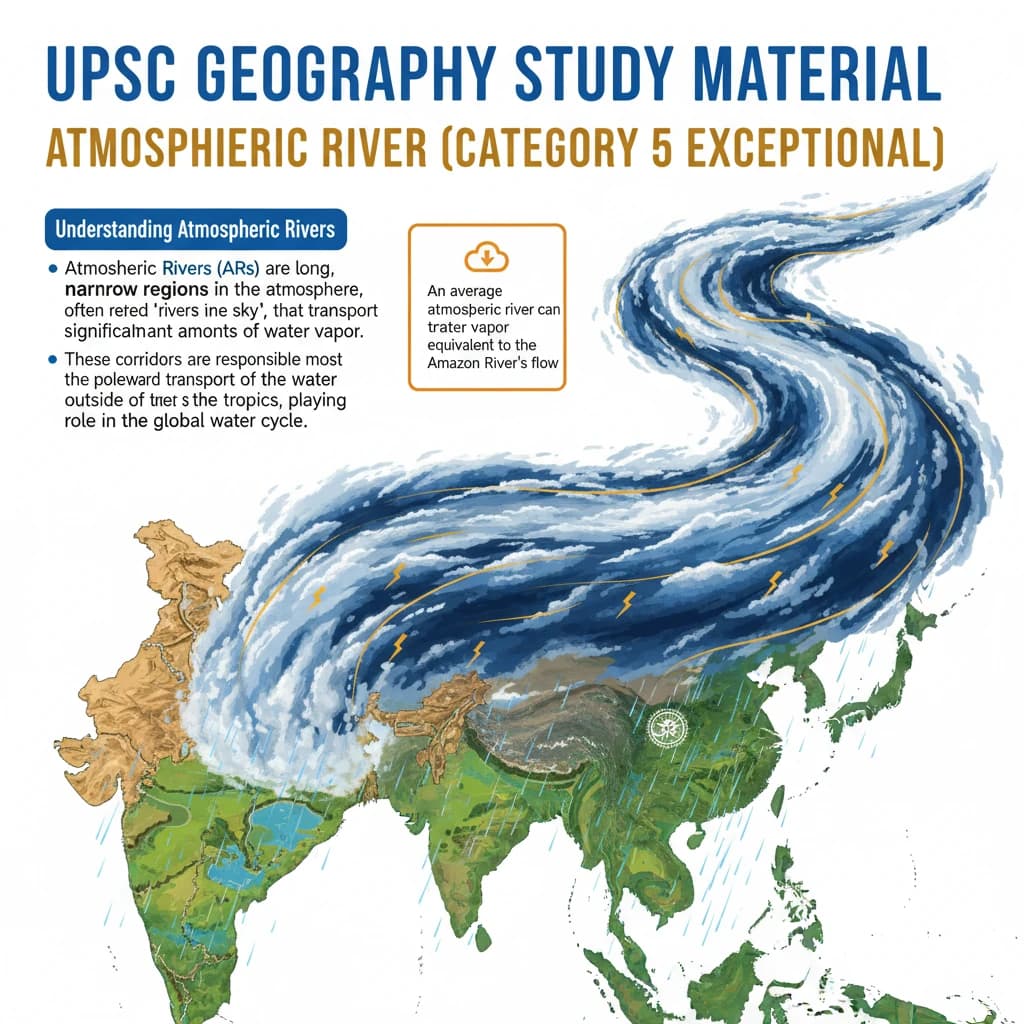
Atmospheric River (Category 5 Exceptional)
Medium⏱️ 5 min read
geography
📖 Introduction
Understanding Atmospheric Rivers
Atmospheric Rivers (ARs) are long, narrow regions in the atmosphere, often referred to as “rivers in the sky,” that transport significant amounts of water vapor.
These corridors are responsible for most of the poleward transport of water vapor outside of the tropics, playing a crucial role in the global water cycle.
An average atmospheric river can transport water vapor equivalent to the flow in the mouth of the Mississippi River. Exceptionally strong ones can carry up to 15 times that volume.
Key Characteristics of Atmospheric Rivers
- Length: These atmospheric phenomena can extend for thousands of kilometres and vary significantly in size and strength, much like terrestrial rivers.
- Seasonal Occurrence:
- In the Northern Hemisphere, they typically occur between December and February.
- In the Southern Hemisphere, they are most common from June to August.
- Water Vapour Capacity: They transport immense volumes of water vapor, which is vital for regional hydrology and precipitation.
- Variability: No two atmospheric rivers are exactly alike; their characteristics differ based on factors like atmospheric instability and prevailing jet stream patterns.
- Dual Impact: They can produce both highly beneficial rainfall, replenishing water supplies, and extremely destructive flooding, highlighting their complex influence on weather patterns.
Category 5 (Exceptional) Atmospheric Rivers
A Category 5 (Exceptional) Atmospheric River represents the highest classification on the AR scale, indicating a largely hazardous event.
Such an event is characterized by its extreme strength and potential to cause widespread and severe impacts over several days.
These are the strongest classification, signifying an extreme event likely to push many rivers to flood levels, leading to significant damage and disruption.
A historic example includes an atmospheric river over Central California during 1996-97, which caused damages exceeding USD 100 billion.
Atmospheric River on Reaching Land
When an atmospheric river reaches land, the moisture-laden air is forced to rise and cool, particularly as it encounters mountain ranges.
This cooling process leads to condensation and results in heavy precipitation, which can fall as either rain or snow.
Unlike typical cold winter storms, atmospheric rivers are known for contributing to slow-loading to rapid snowpack melting, leading to increased runoff and a higher risk of flooding. This significantly impacts a region’s water supply.
Understanding the dual role of atmospheric rivers – providing essential water but also causing devastating floods – is critical for questions on geographical phenomena, climate change impacts, and disaster management in UPSC Mains GS Paper 1 & 3.
💡 Key Takeaways
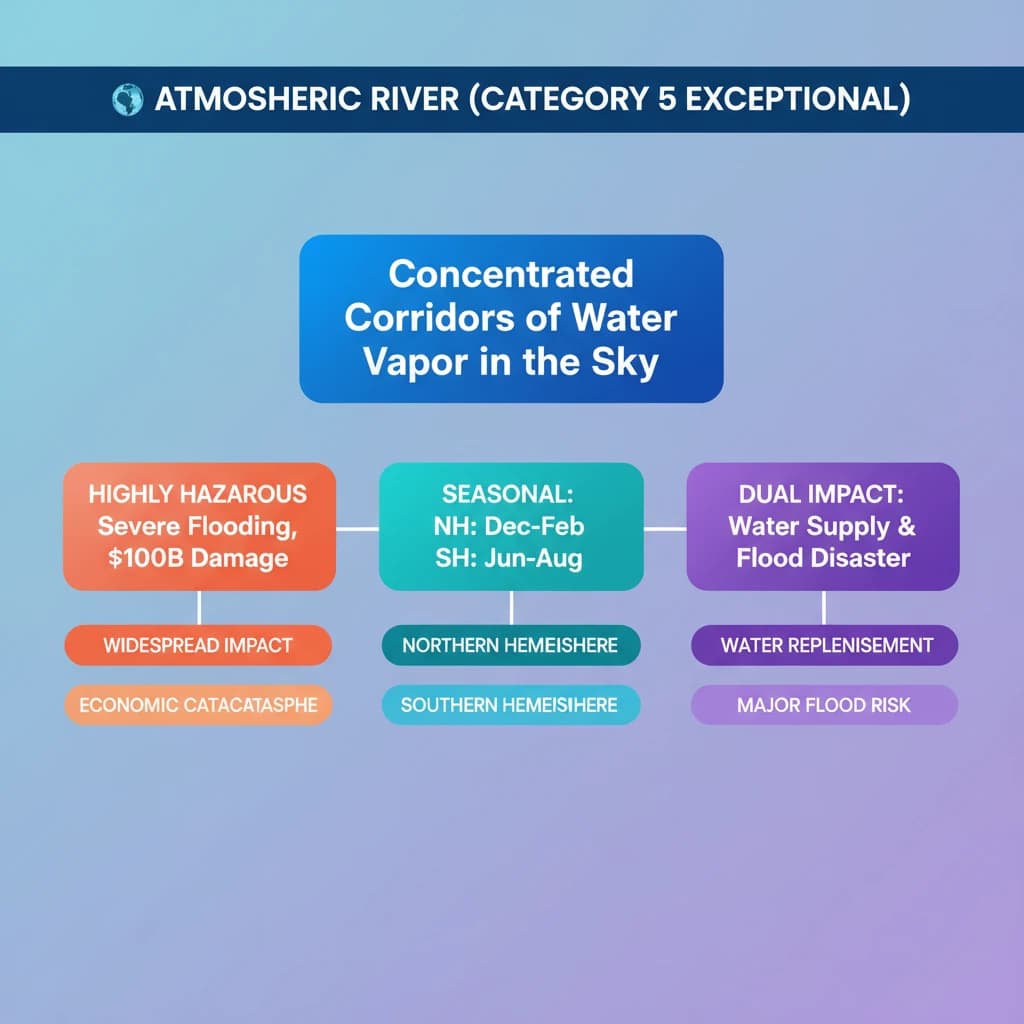
- •Atmospheric Rivers (ARs) are concentrated corridors of water vapor, acting as 'rivers in the sky'.
- •Category 5 (Exceptional) ARs are highly hazardous, capable of causing widespread, severe flooding and economic damage (e.g., 1996-97 California: >USD 100 billion).
- •ARs have distinct seasonal occurrences: Dec-Feb in Northern Hemisphere, Jun-Aug in Southern Hemisphere.
- •Upon landfall, ARs cause heavy precipitation (rain/snow) and can lead to rapid snowpack melting, runoff, and destructive flooding.
- •They present a dual impact: crucial for water supply replenishment but also a major source of flood risk and disaster.
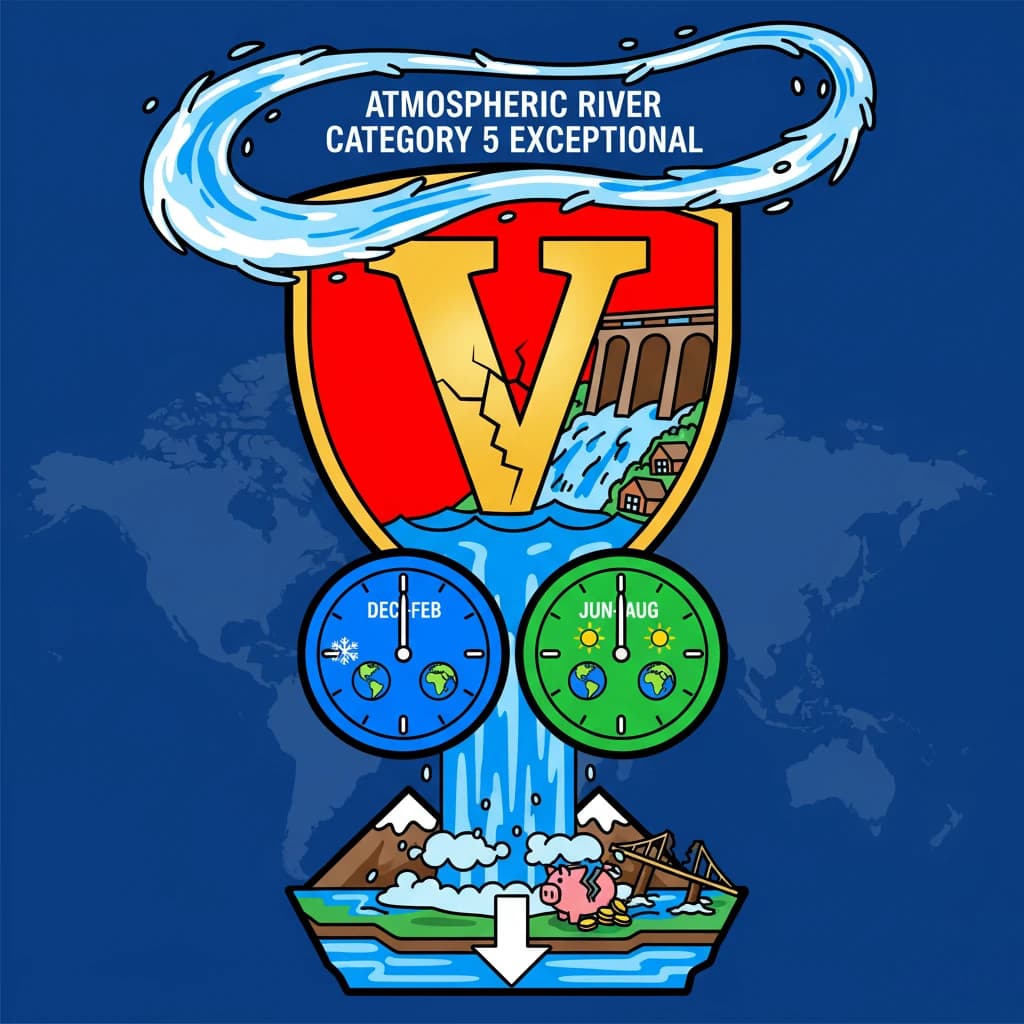
🧠 Memory Techniques
95% Verified Content
📚 Reference Sources
•NOAA Earth System Research Laboratories (ESRL) Physical Sciences Laboratory - Atmospheric River Portal
•NASA Jet Propulsion Laboratory (JPL) - Earth Science