Loading page, please wait…
Vaidra Logo
Vaidra

Top 4 items + smart groups

UPSC GPT
New
Current Affairs
Daily Solutions
Daily Puzzle
Mains Evaluator

Version 2.0.0 • Built with ❤️ for UPSC aspirants

Loading...
Loading...
Loading...
Loading...
Loading...
Loading...
Loading...
Loading...
Loading...
Loading...
Loading...
Loading...
Loading...
Back
All Subjects

Topics

0 topics • 0 completed

Loading topics...
Loading...
Loading...
Loading...
Loading...
Loading...
Overall Progress0%

Waterspouts: Formation, Types, and Recent Occurrence in Sicily - UPSC Geography

What is Waterspouts: Formation, Types, and Recent Occurrence in Sicily in UPSC Geography?

Waterspouts: Formation, Types, and Recent Occurrence in Sicily is a key topic under Geography for UPSC Civil Services Examination. Key points include: A waterspout is a rotating column of air and mist forming over water, less intense than a tornado.. They typically last 5-10 minutes, with a diameter of ~165 feet and winds up to 100 km/h.. Two main types: Tornadic (tornadoes over water, linked to severe thunderstorms) and Fair-Weather (form exclusively over water, calmer conditions).. Understanding this topic is essential for both UPSC Prelims and Mains preparation.

Why is Waterspouts: Formation, Types, and Recent Occurrence in Sicily important for UPSC exam?

Waterspouts: Formation, Types, and Recent Occurrence in Sicily is a Medium-level topic in UPSC Geography. It is tested in both Prelims (factual MCQs) and Mains (analytical answer writing). Previous year UPSC questions have frequently covered aspects of Waterspouts: Formation, Types, and Recent Occurrence in Sicily, making it essential for comprehensive IAS preparation.

How to prepare Waterspouts: Formation, Types, and Recent Occurrence in Sicily for UPSC?

To prepare Waterspouts: Formation, Types, and Recent Occurrence in Sicily for UPSC: (1) Study the comprehensive notes covering all key concepts on Vaidra. (2) Practice previous year questions on this topic. (3) Connect it with current affairs using daily updates. (4) Revise using key takeaways and mind maps available for Geography. (5) Write practice answers linking Waterspouts: Formation, Types, and Recent Occurrence in Sicily to related GS Paper topics.

Key takeaways of Waterspouts: Formation, Types, and Recent Occurrence in Sicily for UPSC

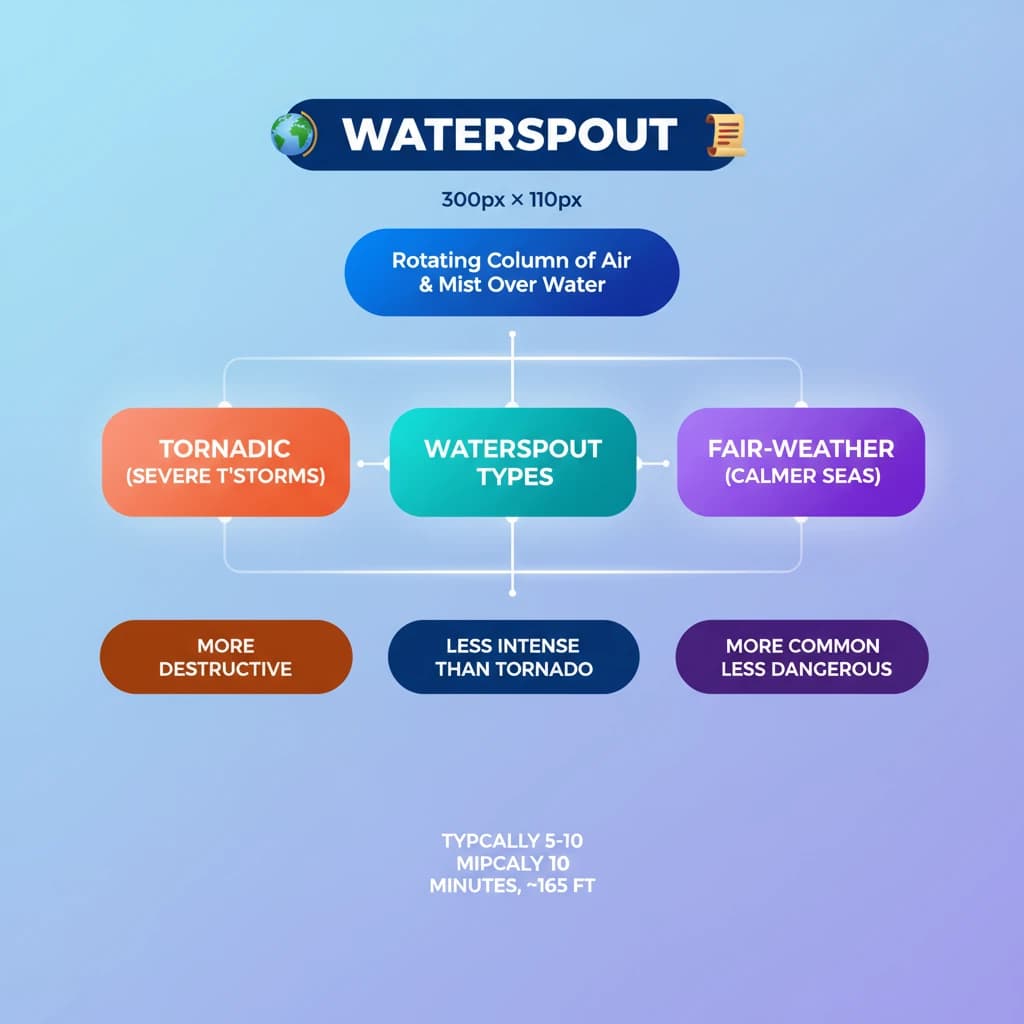
  • A waterspout is a rotating column of air and mist forming over water, less intense than a tornado.
  • They typically last 5-10 minutes, with a diameter of ~165 feet and winds up to 100 km/h.
  • Two main types: Tornadic (tornadoes over water, linked to severe thunderstorms) and Fair-Weather (form exclusively over water, calmer conditions).
  • Tornadic waterspouts are more destructive, associated with strong winds, hail, and lightning.
  • Fair-weather waterspouts are more common, smaller, and less dangerous.
  • The Sicily yacht incident highlights their potential danger to maritime activities.
  • Atmospheric rivers are distinct; they are invisible channels of water vapor, influencing precipitation, not localized vortices like waterspouts.
Waterspouts: Formation, Types, and Recent Occurrence in Sicily

Waterspouts: Formation, Types, and Recent Occurrence in Sicily

Medium⏱️ 8 min read✓ 95% Verified
geography

📖 Introduction

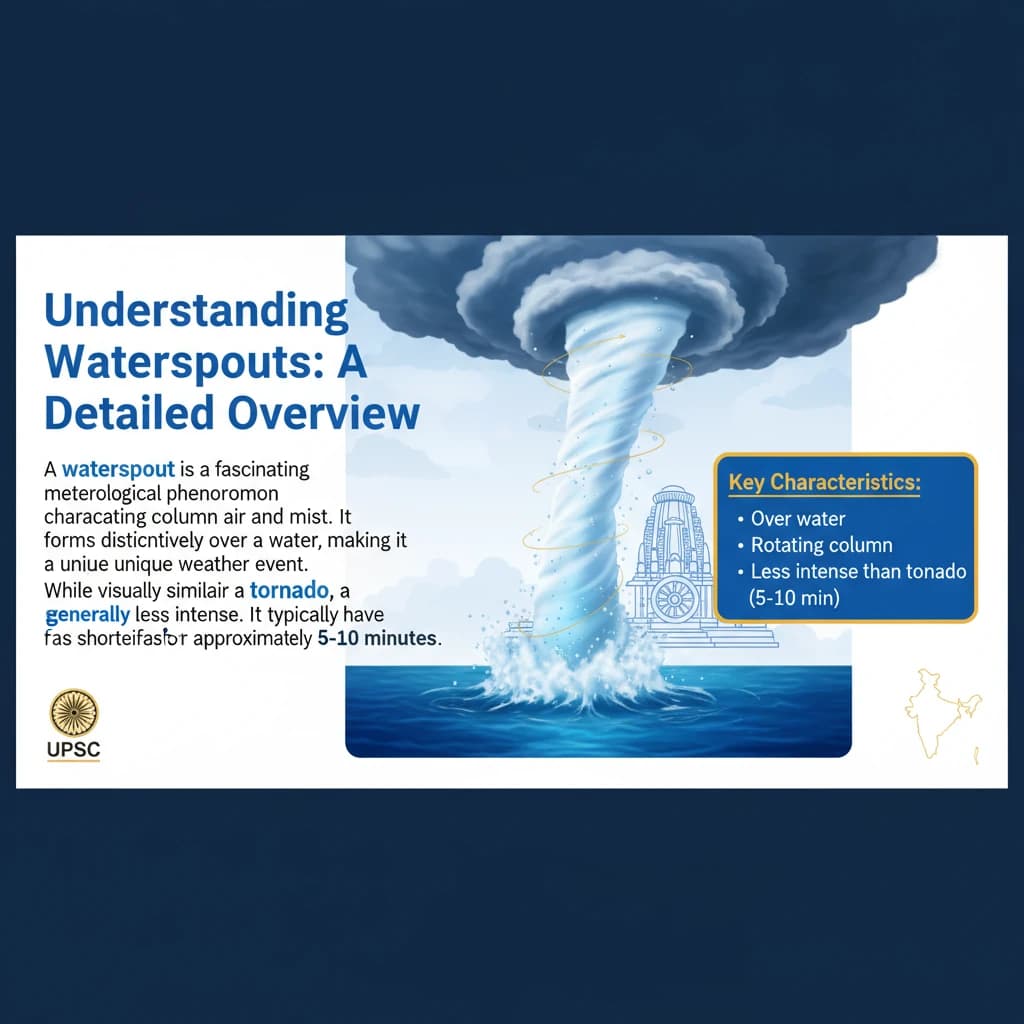
<h4>Understanding Waterspouts: A Detailed Overview</h4><p>A <strong>waterspout</strong> is a fascinating meteorological phenomenon characterized by a rotating column of air and mist. It forms distinctively over a body of water, making it a unique weather event.</p><p>While visually similar to a <strong>tornado</strong>, a waterspout is generally less intense. It typically has a shorter lifespan, persisting for approximately <strong>5-10 minutes</strong>.</p><div class='info-box'><p><strong>Key Characteristics of a Waterspout:</strong></p><ul><li><strong>Diameter:</strong> Approximately <strong>165 feet</strong> on average.</li><li><strong>Wind Speeds:</strong> Can reach up to <strong>100 kilometers per hour</strong>.</li><li><strong>Formation:</strong> Occurs over water bodies.</li></ul></div><h4>Types of Waterspouts</h4><p>Waterspouts are primarily categorized into two main types, each with distinct formation mechanisms and characteristics.</p><h5>Tornadic Waterspouts</h5><p><strong>Tornadic waterspouts</strong> are essentially <strong>tornadoes</strong> that either originate over water or move from land onto a water body. These are the more severe and potentially destructive type.</p><div class='info-box'><p>According to the <strong>National Oceanic and Atmospheric Administration (NOAA)</strong>, tornadic waterspouts are strongly associated with <strong>severe thunderstorms</strong>. They often bring a suite of hazardous weather conditions.</p></div><p>These conditions can include <strong>strong winds</strong>, <strong>rough seas</strong>, the possibility of <strong>large hail</strong>, and frequent, dangerous <strong>lightning</strong>. Due to their nature, tornadic waterspouts can be significant in size and are capable of causing substantial destruction.</p><h5>Fair-Weather Waterspouts</h5><p>In contrast, <strong>fair-weather waterspouts</strong> are much more common and develop exclusively over water. They are typically observed during periods of calm weather, rather than severe storms.</p><p>These waterspouts are generally smaller and pose less danger compared to their tornadic counterparts. Their formation is often linked to localized atmospheric instability over warm water.</p><div class='exam-tip-box'><p><strong>UPSC Insight:</strong> Differentiating between <strong>tornadic</strong> and <strong>fair-weather waterspouts</strong> is crucial. Focus on their formation conditions (severe thunderstorms vs. calm weather) and their destructive potential for both Prelims and Mains questions on extreme weather phenomena.</p></div>
Concept Diagram

💡 Key Takeaways

  • •A waterspout is a rotating column of air and mist forming over water, less intense than a tornado.
  • •They typically last 5-10 minutes, with a diameter of ~165 feet and winds up to 100 km/h.
  • •Two main types: Tornadic (tornadoes over water, linked to severe thunderstorms) and Fair-Weather (form exclusively over water, calmer conditions).
  • •Tornadic waterspouts are more destructive, associated with strong winds, hail, and lightning.
  • •Fair-weather waterspouts are more common, smaller, and less dangerous.
  • •The Sicily yacht incident highlights their potential danger to maritime activities.
  • •Atmospheric rivers are distinct; they are invisible channels of water vapor, influencing precipitation, not localized vortices like waterspouts.

🧠 Memory Techniques

Memory Aid
95% Verified Content

📚 Reference Sources

•National Oceanic and Atmospheric Administration (NOAA) official information on waterspouts

Related Topics

Loading related topics...
Explore:Geography Topics·All Subjects·Daily Current Affairs·Editorial Analysis·Previous Year Questions·UPSC GPT
Waterspouts: Formation, Types, and Recent Occurrence in Sicily - UPSC Geography