Loading page, please wait…
Vaidra Logo
Vaidra

Top 4 items + smart groups

UPSC GPT
New
Current Affairs
Daily Solutions
Daily Puzzle
Mains Evaluator

Version 2.0.0 • Built with ❤️ for UPSC aspirants

Loading...
Loading...
Loading...
Loading...
Loading...
Loading...
Loading...
Loading...
Loading...
Loading...
Loading...
Loading...
Loading...
Anoxic Marine Basins - UPSC Geography
Back
All Subjects

Topics

0 topics • 0 completed

Loading topics...
Loading...
Loading...
Loading...
Loading...
Loading...
Overall Progress0%

Anoxic Marine Basins - UPSC Geography

What is Anoxic Marine Basins in UPSC Geography?

Anoxic Marine Basins is a key topic under Geography for UPSC Civil Services Examination. Key points include: Anoxic basins are deep-water regions with extremely low or no dissolved oxygen, preventing aerobic life.. They are naturally occurring, often due to geological isolation or strong water stratification.. Anoxic basins are significant sites for long-term carbon sequestration due to slowed organic matter decay.. Understanding this topic is essential for both UPSC Prelims and Mains preparation.

Why is Anoxic Marine Basins important for UPSC exam?

Anoxic Marine Basins is a Medium-level topic in UPSC Geography. It is tested in both Prelims (factual MCQs) and Mains (analytical answer writing). Previous year UPSC questions have frequently covered aspects of Anoxic Marine Basins, making it essential for comprehensive IAS preparation.

How to prepare Anoxic Marine Basins for UPSC?

To prepare Anoxic Marine Basins for UPSC: (1) Study the comprehensive notes covering all key concepts on Vaidra. (2) Practice previous year questions on this topic. (3) Connect it with current affairs using daily updates. (4) Revise using key takeaways and mind maps available for Geography. (5) Write practice answers linking Anoxic Marine Basins to related GS Paper topics.

Key takeaways of Anoxic Marine Basins for UPSC

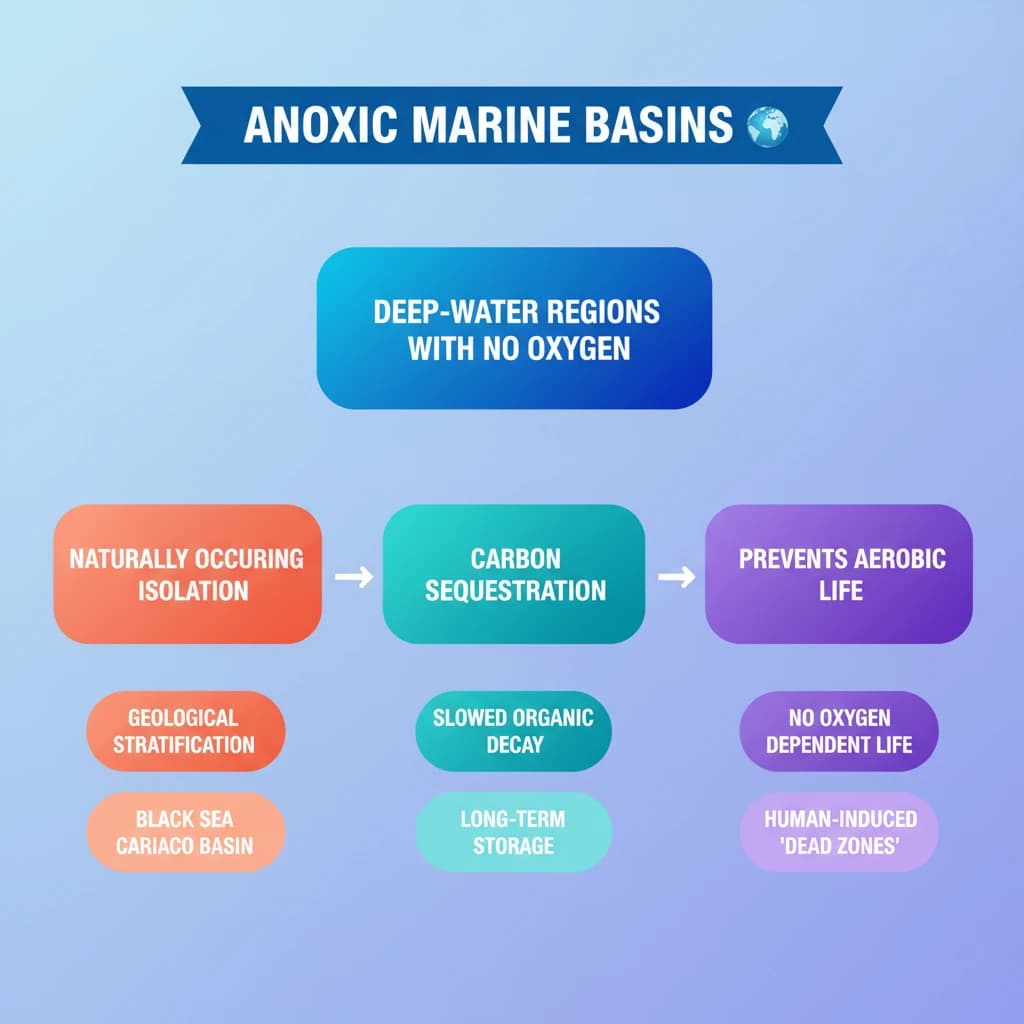
  • Anoxic basins are deep-water regions with extremely low or no dissolved oxygen, preventing aerobic life.
  • They are naturally occurring, often due to geological isolation or strong water stratification.
  • Anoxic basins are significant sites for long-term carbon sequestration due to slowed organic matter decay.
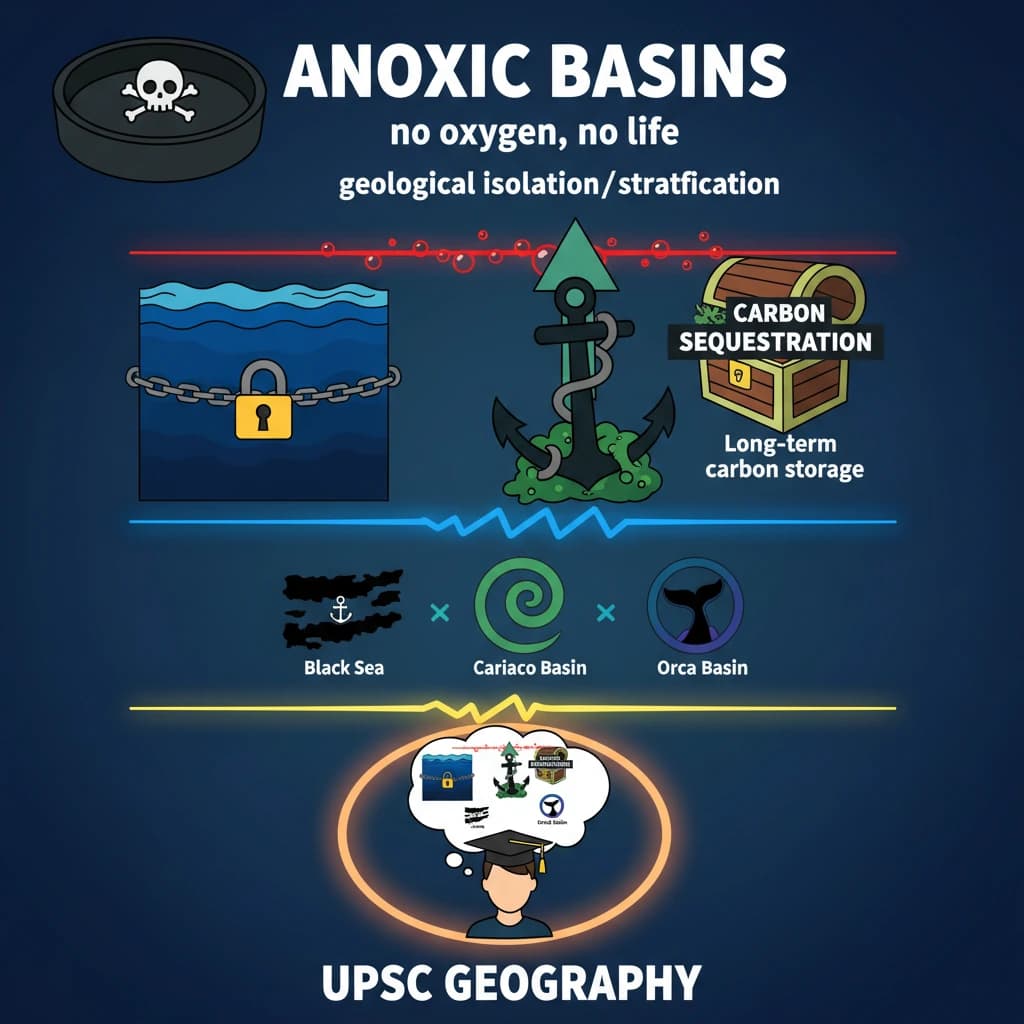
  • Examples include the Black Sea, Cariaco Basin, and Orca Basin.
  • Dead zones are human-induced hypoxic (low oxygen) areas, primarily caused by eutrophication.
  • Historical anoxic events (OAEs) indicate past climate-driven ocean deoxygenation.
  • Current relevance includes their role in climate regulation and the increasing threat of human-caused dead zones.
Anoxic Marine Basins

Anoxic Marine Basins

Medium⏱️ 7 min read✓ 98% Verified
geography

📖 Introduction

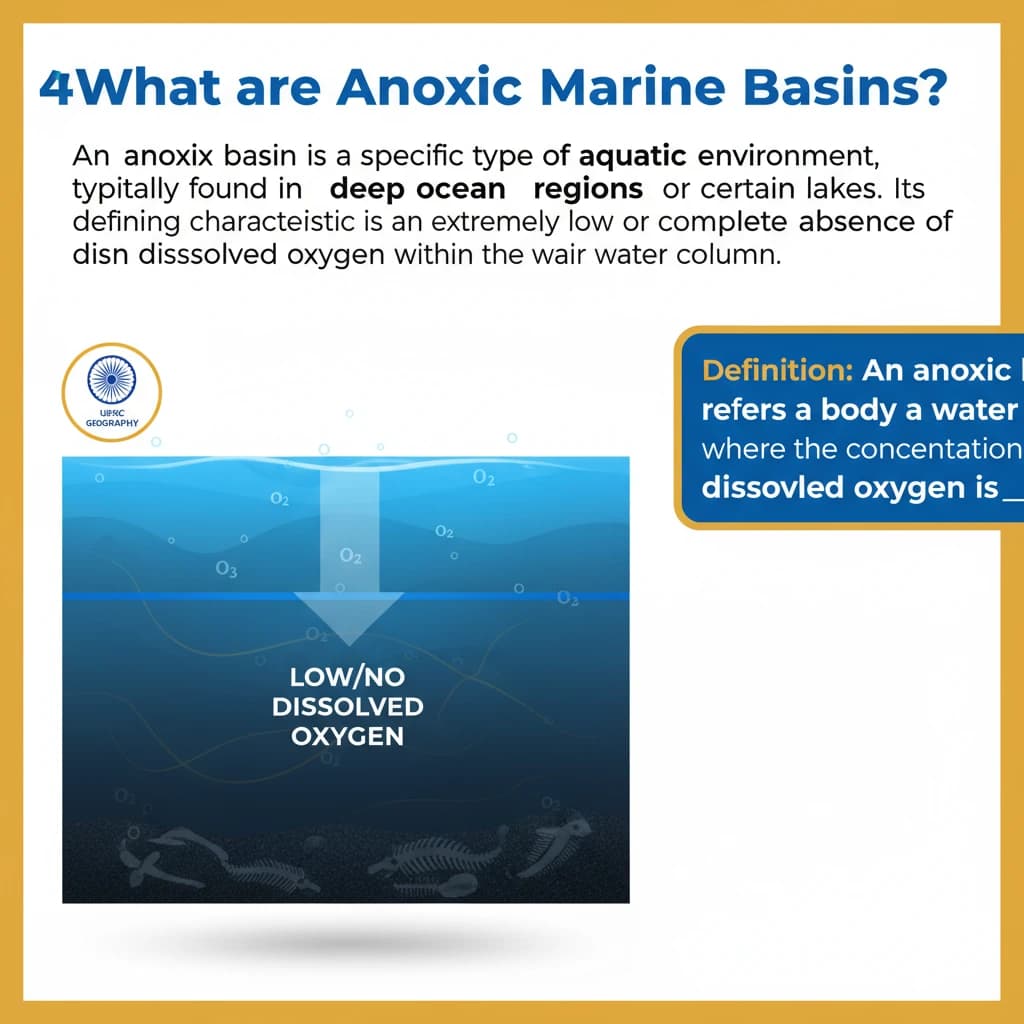
<h4>What are Anoxic Marine Basins?</h4><p>An <strong>anoxic basin</strong> is a specific type of aquatic environment, typically found in <strong>deep ocean regions</strong> or certain lakes. Its defining characteristic is an extremely low or complete absence of <strong>dissolved oxygen</strong> within the water column.</p><div class='info-box'><p><strong>Definition:</strong> An <strong>anoxic basin</strong> refers to a body of water where the concentration of <strong>dissolved oxygen</strong> is near zero (anoxia), making it inhospitable for most aerobic life forms.</p></div><h4>Conditions for Formation</h4><p>The lack of oxygen in these basins often results from their isolation from <strong>oxygen-rich surface waters</strong>. This isolation can be due to geological features, strong stratification, or limited water circulation.</p><p>Such conditions prevent the survival of most <strong>aerobic organisms</strong>, which require oxygen for respiration. However, specialized <strong>anaerobic microbes</strong> and certain fungi are adapted to thrive in these oxygen-depleted environments.</p><h4>Ecological Impact</h4><p>The unique chemistry of anoxic basins supports a distinct ecosystem. While most complex marine life cannot survive, a specialized microbial community plays crucial roles in nutrient cycling.</p><p>These environments are often considered extreme, yet they are vital for understanding ancient Earth conditions and the limits of life.</p><h4>Role in Carbon Sequestration</h4><div class='key-point-box'><p><strong>Carbon Sequestration:</strong> Anoxic basins are significant sites for <strong>long-term carbon sequestration</strong>. The extremely low oxygen levels drastically slow down the decay of <strong>organic material</strong>.</p></div><p>This reduced decomposition leads to the preservation of carbon-rich sediments. By trapping carbon in the deep sea, these basins contribute to reducing atmospheric <strong>carbon dioxide (CO2)</strong> levels over geological timescales.</p><h4>Examples of Anoxic Marine Basins</h4><div class='info-box'><ul><li><strong>Black Sea:</strong> One of the most prominent examples, with a vast anoxic zone below 150-200 meters.</li><li><strong>Cariaco Basin:</strong> Located in the <strong>Caribbean Sea</strong>, it is a deep-water anoxic basin with significant scientific importance.</li><li><strong>Orca Basin:</strong> Found in the <strong>northwest Gulf of Mexico</strong>, known for its hypersaline and anoxic conditions.</li></ul></div><h4>Distinction: Anoxic Basins vs. Dead Zones</h4><p>While related, it's important to differentiate between <strong>anoxic basins</strong> and <strong>dead zones</strong>. Anoxic basins are naturally occurring, often deep-sea features with persistent oxygen depletion.</p><p><strong>Dead zones</strong>, on the other hand, are typically <strong>hypoxic areas</strong> (low oxygen, but not entirely absent) in oceans and large lakes. They are often seasonal and primarily caused by human activities, such as nutrient runoff leading to eutrophication.</p><div class='info-box'><p><strong>Hypoxic Areas (Dead Zones):</strong> Regions where <strong>oxygen levels</strong> are too low to support most marine life, often occurring closer to coasts and linked to anthropogenic factors.</p></div>
Concept Diagram

💡 Key Takeaways

  • •Anoxic basins are deep-water regions with extremely low or no dissolved oxygen, preventing aerobic life.
  • •They are naturally occurring, often due to geological isolation or strong water stratification.
  • •Anoxic basins are significant sites for long-term carbon sequestration due to slowed organic matter decay.
  • •Examples include the Black Sea, Cariaco Basin, and Orca Basin.
  • •Dead zones are human-induced hypoxic (low oxygen) areas, primarily caused by eutrophication.
  • •Historical anoxic events (OAEs) indicate past climate-driven ocean deoxygenation.
  • •Current relevance includes their role in climate regulation and the increasing threat of human-caused dead zones.

🧠 Memory Techniques
Memory Aid
98% Verified Content

📚 Reference Sources

•National Oceanic and Atmospheric Administration (NOAA) resources on dead zones
•Oceanography textbooks (e.g., Tomczak & Godfrey, Open University)
•Scientific articles on anoxic basins (e.g., Black Sea, Cariaco Basin studies)

Related Topics

Loading related topics...
Explore:Geography Topics·All Subjects·Daily Current Affairs·Editorial Analysis·Previous Year Questions·UPSC GPT