Loading page, please wait…
Vaidra Logo
Vaidra

Top 4 items + smart groups

UPSC GPT
New
Current Affairs
Daily Solutions
Daily Puzzle
Mains Evaluator

Version 2.0.0 • Built with ❤️ for UPSC aspirants

Loading...
Loading...
Loading...
Loading...
Loading...
Loading...
Loading...
Loading...
Loading...
Loading...
Loading...
Loading...
Loading...
Back
All Subjects

Topics

0 topics • 0 completed

Loading topics...
Loading...
Loading...
Loading...
Loading...
Loading...
Overall Progress0%

Other Geophysical Phenomenon Similar to Polar Vortex - UPSC Geography

What is Other Geophysical Phenomenon Similar to Polar Vortex in UPSC Geography?

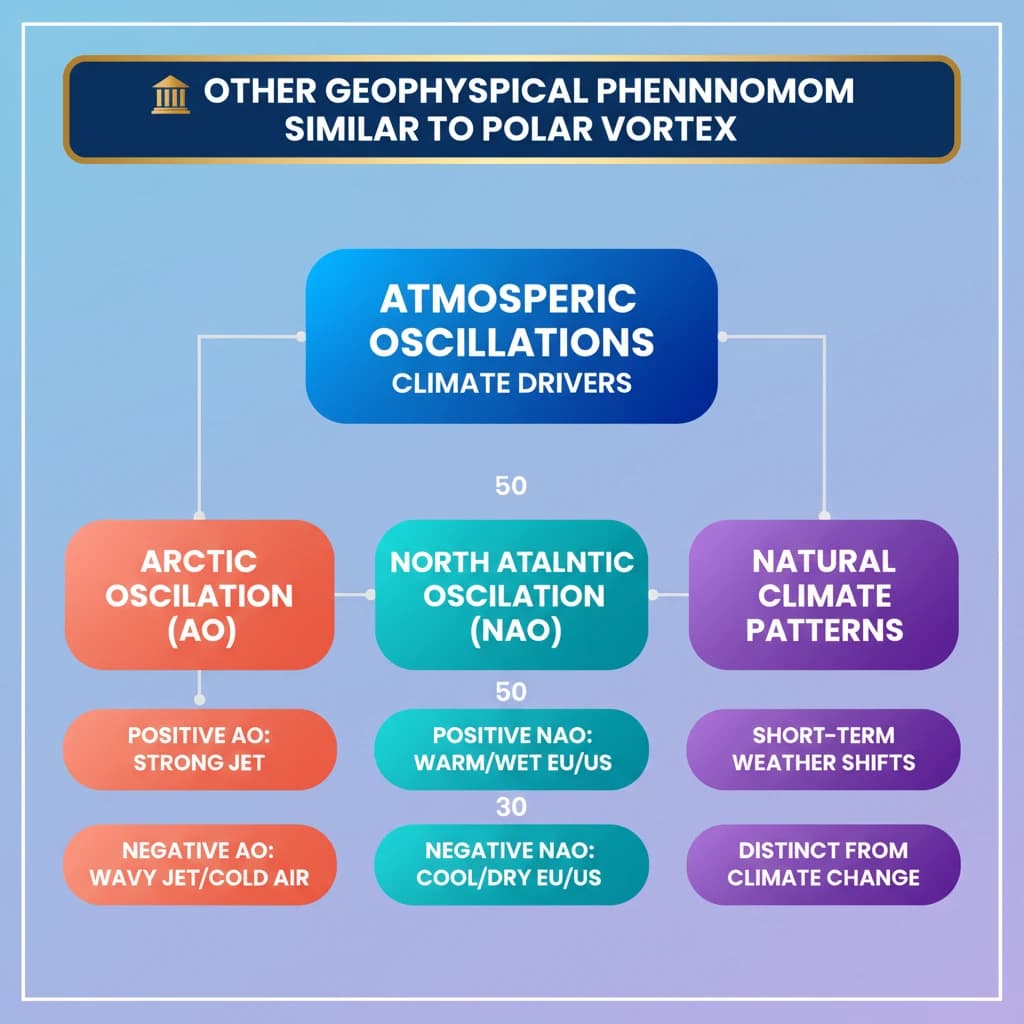
Other Geophysical Phenomenon Similar to Polar Vortex is a key topic under Geography for UPSC Civil Services Examination. Key points include: <strong>Arctic Oscillation (AO)</strong> affects Northern Hemisphere winter weather by influencing the jet stream and polar vortex.. <strong>Positive AO</strong> means a strong jet stream, trapping cold air in the Arctic; <strong>Negative AO</strong> means a weak, wavy jet stream, allowing cold air to spill south.. <strong>North Atlantic Oscillation (NAO)</strong> measures pressure differences between the Azores High and Subpolar Low, impacting North American and European weather.. Understanding this topic is essential for both UPSC Prelims and Mains preparation.

Why is Other Geophysical Phenomenon Similar to Polar Vortex important for UPSC exam?

Other Geophysical Phenomenon Similar to Polar Vortex is a Medium-level topic in UPSC Geography. It is tested in both Prelims (factual MCQs) and Mains (analytical answer writing). Previous year UPSC questions have frequently covered aspects of Other Geophysical Phenomenon Similar to Polar Vortex, making it essential for comprehensive IAS preparation.

How to prepare Other Geophysical Phenomenon Similar to Polar Vortex for UPSC?

To prepare Other Geophysical Phenomenon Similar to Polar Vortex for UPSC: (1) Study the comprehensive notes covering all key concepts on Vaidra. (2) Practice previous year questions on this topic. (3) Connect it with current affairs using daily updates. (4) Revise using key takeaways and mind maps available for Geography. (5) Write practice answers linking Other Geophysical Phenomenon Similar to Polar Vortex to related GS Paper topics.

Key takeaways of Other Geophysical Phenomenon Similar to Polar Vortex for UPSC

  • <strong>Arctic Oscillation (AO)</strong> affects Northern Hemisphere winter weather by influencing the jet stream and polar vortex.
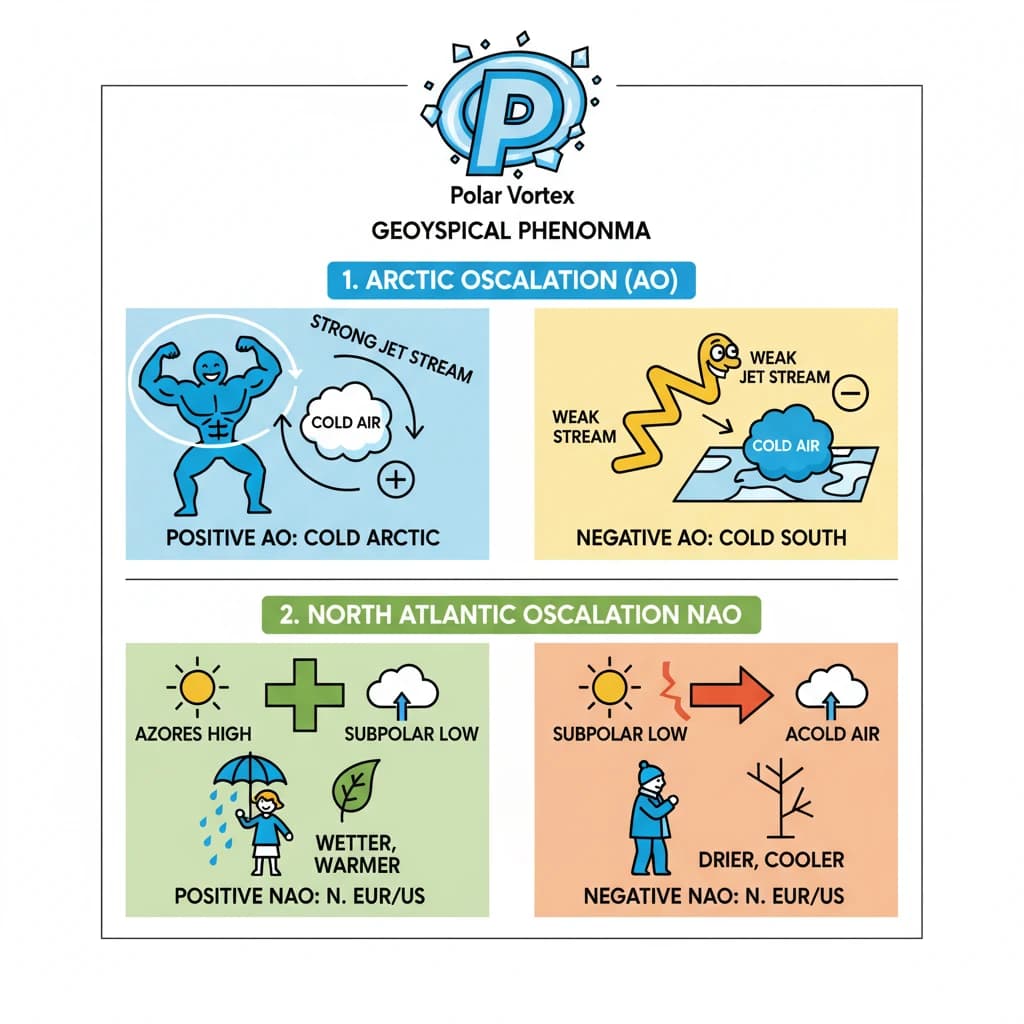
  • <strong>Positive AO</strong> means a strong jet stream, trapping cold air in the Arctic; <strong>Negative AO</strong> means a weak, wavy jet stream, allowing cold air to spill south.
  • <strong>North Atlantic Oscillation (NAO)</strong> measures pressure differences between the Azores High and Subpolar Low, impacting North American and European weather.
  • <strong>Positive NAO</strong> brings warmer, wetter conditions to northern Europe/US; <strong>Negative NAO</strong> brings cooler, drier conditions.
  • These oscillations are natural climate patterns, crucial for understanding short-term climate variability and extreme weather events, distinct from long-term climate change trends.
Other Geophysical Phenomenon Similar to Polar Vortex

Other Geophysical Phenomenon Similar to Polar Vortex

Medium⏱️ 8 min read✓ 95% Verified
geography

📖 Introduction

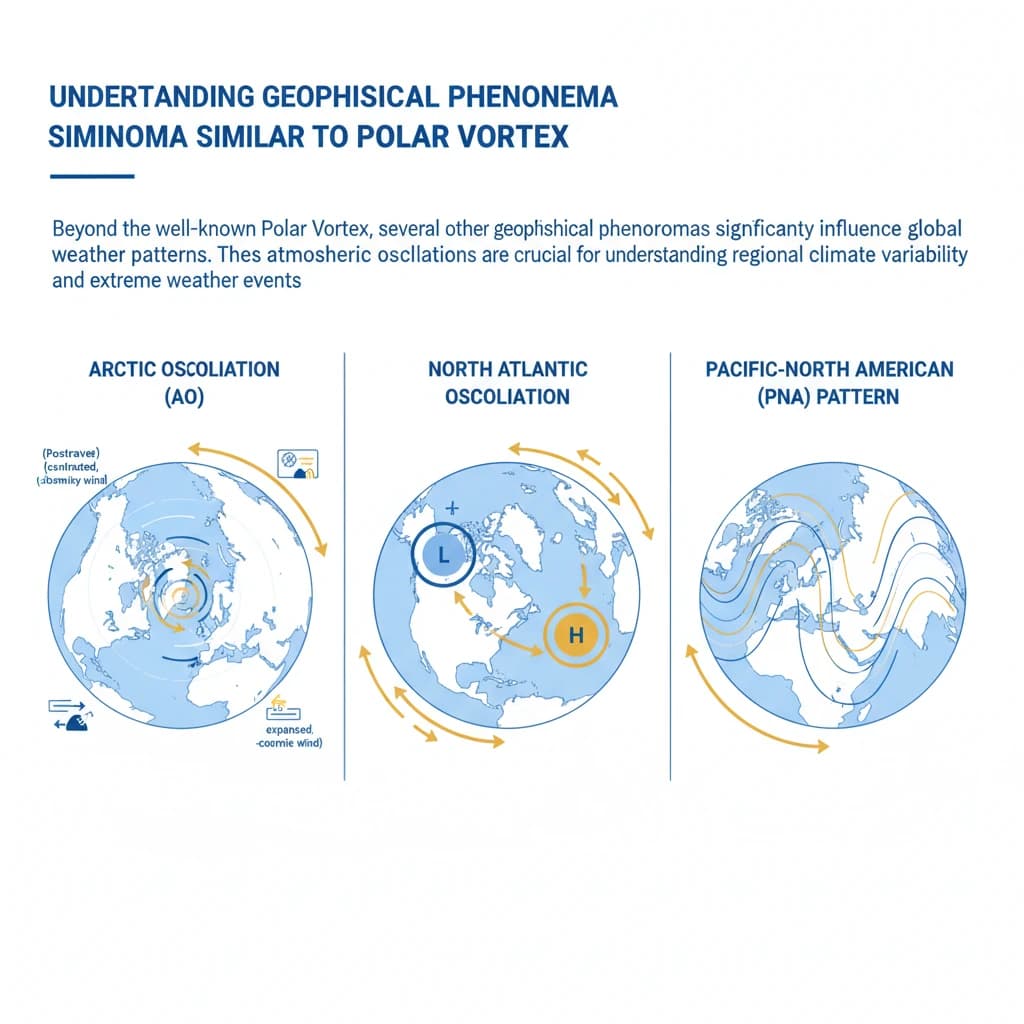
<h4>Understanding Geophysical Phenomena Similar to Polar Vortex</h4><p>Beyond the well-known <strong>Polar Vortex</strong>, several other <strong>geophysical phenomena</strong> significantly influence global weather patterns. These atmospheric oscillations are crucial for understanding regional climate variability and extreme weather events.</p><div class='exam-tip-box'><p>Understanding these oscillations is vital for <strong>UPSC Geography (GS Paper 1)</strong> and <strong>Environment (GS Paper 3)</strong>, especially for questions related to climate change and atmospheric dynamics.</p></div><h4>Arctic Oscillation (AO)</h4><p>The <strong>Arctic Oscillation (AO)</strong> is a prominent <strong>climate pattern</strong> primarily impacting <strong>winter weather</strong> across the <strong>Northern Hemisphere</strong>. It describes the opposing atmospheric pressure patterns between the Arctic and the mid-latitudes.</p><div class='info-box'><p>The <strong>Arctic Oscillation</strong> is characterized by fluctuations in the strength of the <strong>polar vortex</strong> and the position of the <strong>jet stream</strong> around the Arctic.</p></div><h4>Positive Phase of AO</h4><p>During the <strong>positive phase</strong> of the <strong>Arctic Oscillation</strong>, atmospheric pressure is lower over the <strong>Arctic</strong> and higher over the <strong>mid-latitudes</strong>. This pressure difference strengthens the <strong>jet stream</strong>.</p><div class='key-point-box'><p>A strong <strong>jet stream</strong> effectively traps cold air over the <strong>Arctic region</strong>, directing storms northward. This limits significant <strong>cold air outbreaks</strong> in the <strong>mid-latitudes</strong>, leading to milder winters there.</p></div><h4>Negative Phase of AO</h4><p>Conversely, the <strong>negative phase</strong> of the <strong>Arctic Oscillation</strong> involves higher pressure over the <strong>Arctic</strong> and lower pressure in the <strong>mid-latitudes</strong>. This weakens and often displaces the <strong>jet stream</strong>.</p><div class='key-point-box'><p>A weakened and southward-shifted <strong>jet stream</strong> allows frigid <strong>Arctic air</strong> to spill into the <strong>mid-latitudes</strong>. This results in severe <strong>cold outbreaks</strong> and increased storm activity in regions like <strong>North America</strong> and <strong>Europe</strong>.</p></div><h4>North Atlantic Oscillation (NAO)</h4><p>The <strong>North Atlantic Oscillation (NAO)</strong> is another critical <strong>climate pattern</strong> influencing weather across the <strong>North Atlantic basin</strong>. It specifically measures the difference in <strong>sea-level pressure</strong>.</p><div class='info-box'><p>The <strong>NAO</strong> is defined by the pressure anomaly between the <strong>Azores High</strong> (a persistent subtropical high-pressure system) and the <strong>Subpolar Low</strong> (a persistent low-pressure system near Iceland).</p></div><h4>Positive Phase of NAO</h4><p>In the <strong>positive phase</strong> of the <strong>North Atlantic Oscillation</strong>, both the <strong>Azores High</strong> and the <strong>Subpolar Low</strong> are stronger than average. This creates a steeper pressure gradient across the North Atlantic.</p><div class='key-point-box'><p>This stronger gradient enhances the <strong>westerly winds</strong>, leading to <strong>warmer</strong> and <strong>wetter conditions</strong> across the eastern <strong>United States</strong> and northern <strong>Europe</strong>. Conversely, southern Europe experiences drier conditions.</p></div><h4>Negative Phase of NAO</h4><p>The <strong>negative phase</strong> of the <strong>North Atlantic Oscillation</strong> is characterized by weaker than average <strong>Azores High</strong> and <strong>Subpolar Low</strong>. This reduces the pressure difference across the North Atlantic.</p><div class='key-point-box'><p>A weaker pressure gradient results in a southward shift of the <strong>storm track</strong>. This typically brings <strong>cooler</strong> and <strong>drier conditions</strong> to the eastern <strong>United States</strong> and northern <strong>Europe</strong>, while southern Europe may experience increased rainfall.</p></div>
Concept Diagram

💡 Key Takeaways

  • •<strong>Arctic Oscillation (AO)</strong> affects Northern Hemisphere winter weather by influencing the jet stream and polar vortex.
  • •<strong>Positive AO</strong> means a strong jet stream, trapping cold air in the Arctic; <strong>Negative AO</strong> means a weak, wavy jet stream, allowing cold air to spill south.
  • •<strong>North Atlantic Oscillation (NAO)</strong> measures pressure differences between the Azores High and Subpolar Low, impacting North American and European weather.
  • •<strong>Positive NAO</strong> brings warmer, wetter conditions to northern Europe/US; <strong>Negative NAO</strong> brings cooler, drier conditions.
  • •These oscillations are natural climate patterns, crucial for understanding short-term climate variability and extreme weather events, distinct from long-term climate change trends.

🧠 Memory Techniques
Memory Aid
95% Verified Content

📚 Reference Sources

•National Oceanic and Atmospheric Administration (NOAA) Climate Prediction Center (for AO/NAO details)
•NASA Earth Observatory (for general climate pattern information)

Related Topics

Loading related topics...
Explore:Geography Topics·All Subjects·Daily Current Affairs·Editorial Analysis·Previous Year Questions·UPSC GPT
Other Geophysical Phenomenon Similar to Polar Vortex - UPSC Geography