Loading page, please wait…
Vaidra Logo
Vaidra

Top 4 items + smart groups

UPSC GPT
New
Current Affairs
Daily Solutions
Daily Puzzle
Mains Evaluator

Version 2.0.0 • Built with ❤️ for UPSC aspirants

Loading...
Loading...
Loading...
Loading...
Loading...
Loading...
Loading...
Loading...
Loading...
Loading...
Loading...
Loading...
Loading...
Back
All Subjects

Topics

0 topics • 0 completed

Loading topics...
Loading...
Loading...
Loading...
Loading...
Loading...
Overall Progress0%
What are the Other Ways to Study the Interior of the Earth? - UPSC Geography

What are the Other Ways to Study the Interior of the Earth? - UPSC Geography

What is What are the Other Ways to Study the Interior of the Earth? in UPSC Geography?

What are the Other Ways to Study the Interior of the Earth? is a key topic under Geography for UPSC Civil Services Examination. Key points include: Earth's interior is studied via direct (drilling, sampling) and indirect (seismic, gravity, magnetic, heat flow) methods.. Direct methods like rotary, percussion, Soyo drilling, and hydraulic fracturing provide physical samples but are depth-limited.. Indirect methods, especially seismic wave analysis, are primary for understanding deep Earth structure (crust, mantle, core).. Understanding this topic is essential for both UPSC Prelims and Mains preparation.

Why is What are the Other Ways to Study the Interior of the Earth? important for UPSC exam?

What are the Other Ways to Study the Interior of the Earth? is a Medium-level topic in UPSC Geography. It is tested in both Prelims (factual MCQs) and Mains (analytical answer writing). Previous year UPSC questions have frequently covered aspects of What are the Other Ways to Study the Interior of the Earth?, making it essential for comprehensive IAS preparation.

How to prepare What are the Other Ways to Study the Interior of the Earth? for UPSC?

To prepare What are the Other Ways to Study the Interior of the Earth? for UPSC: (1) Study the comprehensive notes covering all key concepts on Vaidra. (2) Practice previous year questions on this topic. (3) Connect it with current affairs using daily updates. (4) Revise using key takeaways and mind maps available for Geography. (5) Write practice answers linking What are the Other Ways to Study the Interior of the Earth? to related GS Paper topics.

Key takeaways of What are the Other Ways to Study the Interior of the Earth? for UPSC

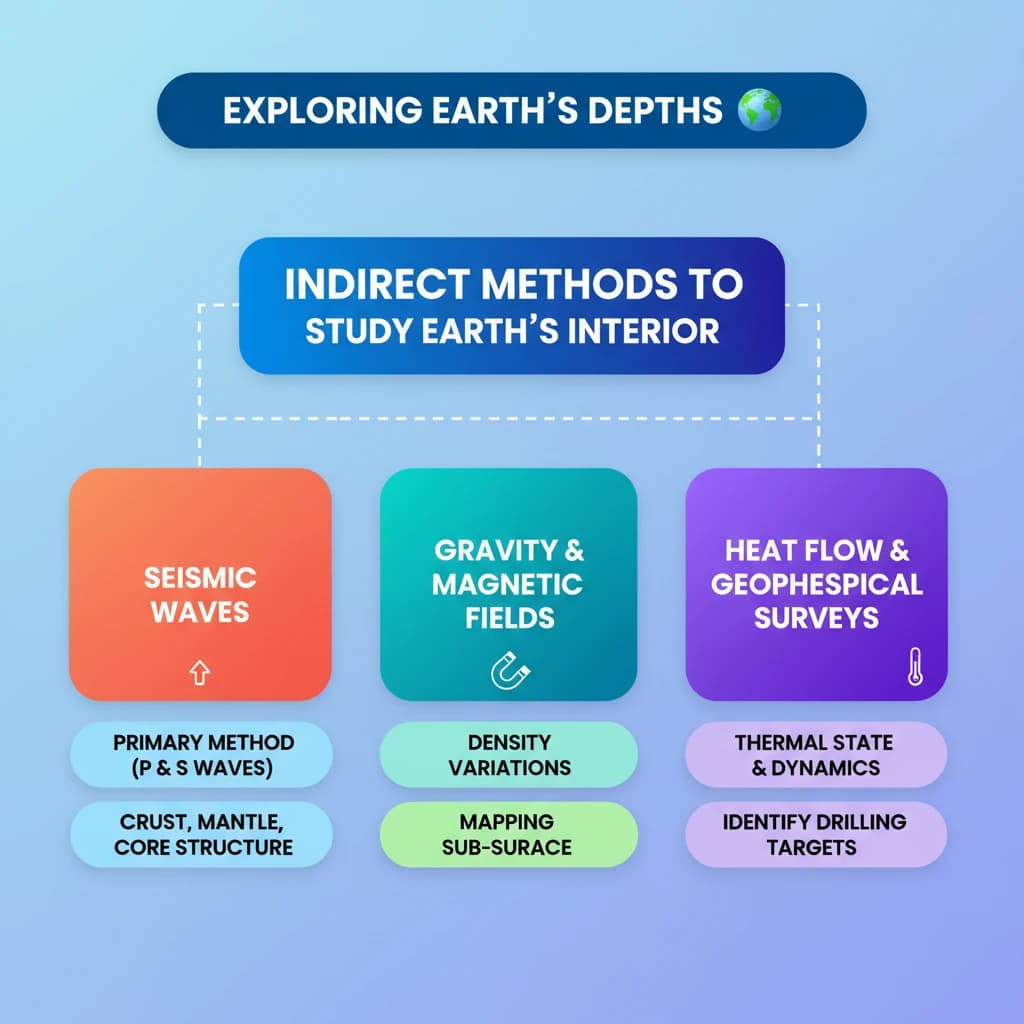
  • Earth's interior is studied via direct (drilling, sampling) and indirect (seismic, gravity, magnetic, heat flow) methods.
  • Direct methods like rotary, percussion, Soyo drilling, and hydraulic fracturing provide physical samples but are depth-limited.
  • Indirect methods, especially seismic wave analysis, are primary for understanding deep Earth structure (crust, mantle, core).
  • Geophysical surveys (seismic, magnetic, gravity) map subsurface structures and identify drilling targets.
  • Heat flow measurements provide insights into Earth's thermal state and internal dynamics.
  • These methods are critical for resource exploration, disaster management, and renewable energy development.
What are the Other Ways to Study the Interior of the Earth?

What are the Other Ways to Study the Interior of the Earth?

Medium⏱️ 8 min read✓ 95% Verified
geography

📖 Introduction

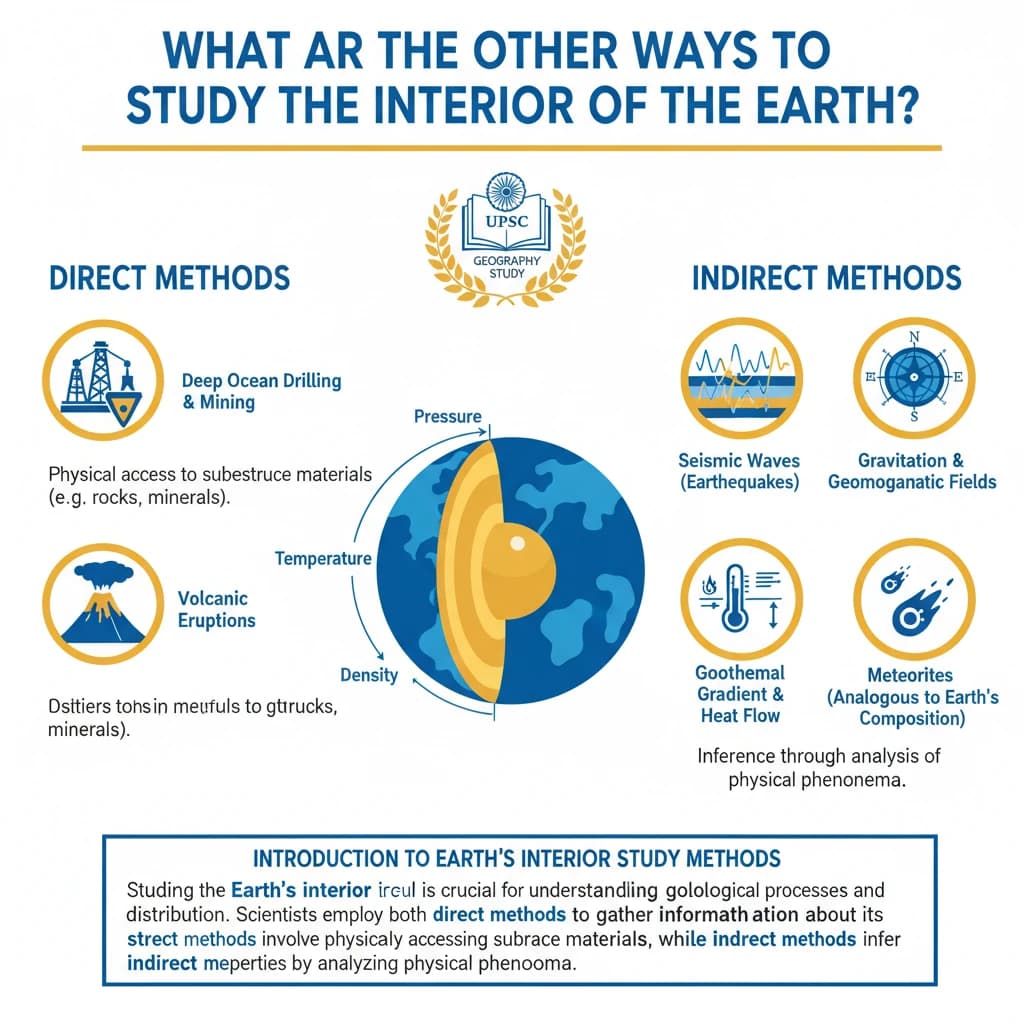
<h4>Introduction to Earth's Interior Study Methods</h4><p>Studying the <strong>Earth's interior</strong> is crucial for understanding geological processes and resource distribution. Scientists employ both <strong>direct</strong> and <strong>indirect methods</strong> to gather information about its structure and composition.</p><p><strong>Direct methods</strong> involve physically accessing subsurface materials, while <strong>indirect methods</strong> infer properties by analyzing physical phenomena.</p><h4>Direct Methods: Drilling Techniques</h4><p><strong>Direct methods</strong> primarily involve drilling into the Earth's crust to obtain samples and data. These techniques provide tangible evidence of subsurface geology.</p><h5>Rotary Drilling</h5><p><strong>Rotary drilling</strong> is a fundamental direct method used to penetrate deep into the Earth.</p><p>It employs a <strong>rotating drill bit</strong> designed to cut through various <strong>rock formations</strong>.</p><div class='info-box'><p>The <strong>drill bit</strong> is attached to a <strong>drill string</strong>, which is rotated by a specialized <strong>drilling rig</strong> on the surface.</p></div><p>During the process, <strong>drilling mud</strong> is continuously circulated. This mud serves to cool the bit and efficiently carry <strong>rock cuttings</strong> back to the surface for geological analysis.</p><h5>Percussion Drilling (Air Hammering)</h5><p><strong>Percussion drilling</strong>, also known as <strong>Air Hammering</strong>, offers a distinct approach to rock penetration.</p><p>This method uses <strong>high-pressure air</strong> to power a hammer, which rapidly impacts a <strong>drill bit</strong>.</p><div class='info-box'><p>The rapid impacts efficiently break rock, and the high-pressure air flushes out the resulting <strong>cuttings</strong>.</p></div><p>It is valued for its <strong>speed</strong>, <strong>cost-effectiveness</strong>, and <strong>versatility</strong>, especially in drilling through <strong>hard rock applications</strong>.</p><p>Common uses include <strong>mineral exploration</strong>, establishing <strong>water wells</strong>, and developing <strong>geothermal energy</strong> projects.</p><div class='key-point-box'><p>While highly efficient, percussion drilling can be quite <strong>noisy</strong> and is generally best suited for <strong>shallower depths</strong> compared to some other methods.</p></div><h5>Soyo Drilling Technique</h5><p>The <strong>Soyo drilling technique</strong> represents an advanced, hybrid approach to subsurface exploration.</p><div class='info-box'><p>It uniquely combines the strengths of both <strong>mud rotary drilling</strong> and <strong>percussion drilling (air hammering)</strong>.</p></div><p>This integration allows for enhanced efficiency and adaptability, making it suitable for a wider range of challenging geological conditions.</p><h5>Hydraulic Fracturing (Fracking)</h5><p><strong>Hydraulic Fracturing</strong>, commonly referred to as <strong>Fracking</strong>, is a specialized technique used to create or enlarge fractures within rock formations.</p><p>It involves injecting fluid at extremely <strong>high pressure</strong> into targeted subterranean rock layers.</p><div class='info-box'><p>The primary purpose is to enhance the flow of fluids, which is critical for <strong>sampling subsurface materials</strong> or stimulating <strong>resource production</strong> in various extraction operations.</p></div><p>This method is particularly significant in the recovery of unconventional oil and gas resources.</p><h4>Indirect Methods: Geophysical Surveys</h4><p><strong>Indirect methods</strong> infer the properties of the Earth's interior by analyzing physical measurements taken at the surface or from boreholes. These methods are non-invasive and cover vast areas.</p><h5>Geophysical Surveys Overview</h5><p><strong>Geophysical surveys</strong> are crucial indirect methods that map <strong>subsurface structures</strong> without direct physical penetration.</p><p>They employ a range of techniques, including <strong>seismic</strong>, <strong>magnetic</strong>, and <strong>gravitational methods</strong>.</p><div class='info-box'><p>These surveys are vital for identifying potential <strong>drilling targets</strong> and providing continuous data both before and during drilling operations.</p></div><p>They optimize exploration efforts and reduce the risks associated with drilling.</p><h5>Seismic Waves Analysis</h5><p>The study of <strong>seismic waves</strong> is arguably the most informative indirect method for understanding Earth's interior.</p><p>These waves are primarily generated by natural events like <strong>earthquakes</strong> or artificial sources, and they travel through the Earth's interior.</p><div class='key-point-box'><p>The behavior of seismic waves, specifically their <strong>refraction</strong> (bending) and <strong>reflection</strong> (bouncing back), provides critical insights.</p></div><p>By analyzing these behaviors, scientists can infer the <strong>composition</strong>, <strong>density</strong>, and <strong>physical properties</strong> of the Earth's different layers, including the <strong>crust</strong>, <strong>mantle</strong>, and <strong>core</strong> boundaries.</p><h5>Gravitational and Magnetic Field Measurements</h5><p>Variations in the Earth's natural <strong>gravitational field</strong> and <strong>magnetic field</strong> offer additional valuable information about its interior.</p><p>These measurements can indicate changes in the <strong>density</strong> and <strong>composition</strong> of the Earth's crust and deeper layers.</p><div class='info-box'><p>They are instrumental in identifying the boundaries between the Earth’s major concentric layers: the <strong>core</strong>, <strong>mantle</strong>, and <strong>crust</strong>.</p></div><p>Anomalies in these fields often point to geological structures or mineral deposits.</p><h5>Heat Flow Measurements</h5><p>Measuring the <strong>heat flow</strong> emanating from the Earth's interior provides crucial clues about its thermal state.</p><p>This outward flow of heat helps scientists understand the <strong>temperature distribution</strong> and <strong>thermal properties</strong> of the Earth's deep structure.</p><div class='key-point-box'><p>It contributes significantly to models of <strong>mantle convection</strong>, the driving force behind plate tectonics, and the overall dynamics of the Earth's internal heat engine.</p></div>
Concept Diagram

💡 Key Takeaways

  • •Earth's interior is studied via direct (drilling, sampling) and indirect (seismic, gravity, magnetic, heat flow) methods.
  • •Direct methods like rotary, percussion, Soyo drilling, and hydraulic fracturing provide physical samples but are depth-limited.
  • •Indirect methods, especially seismic wave analysis, are primary for understanding deep Earth structure (crust, mantle, core).
  • •Geophysical surveys (seismic, magnetic, gravity) map subsurface structures and identify drilling targets.
  • •Heat flow measurements provide insights into Earth's thermal state and internal dynamics.
  • •These methods are critical for resource exploration, disaster management, and renewable energy development.

🧠 Memory Techniques
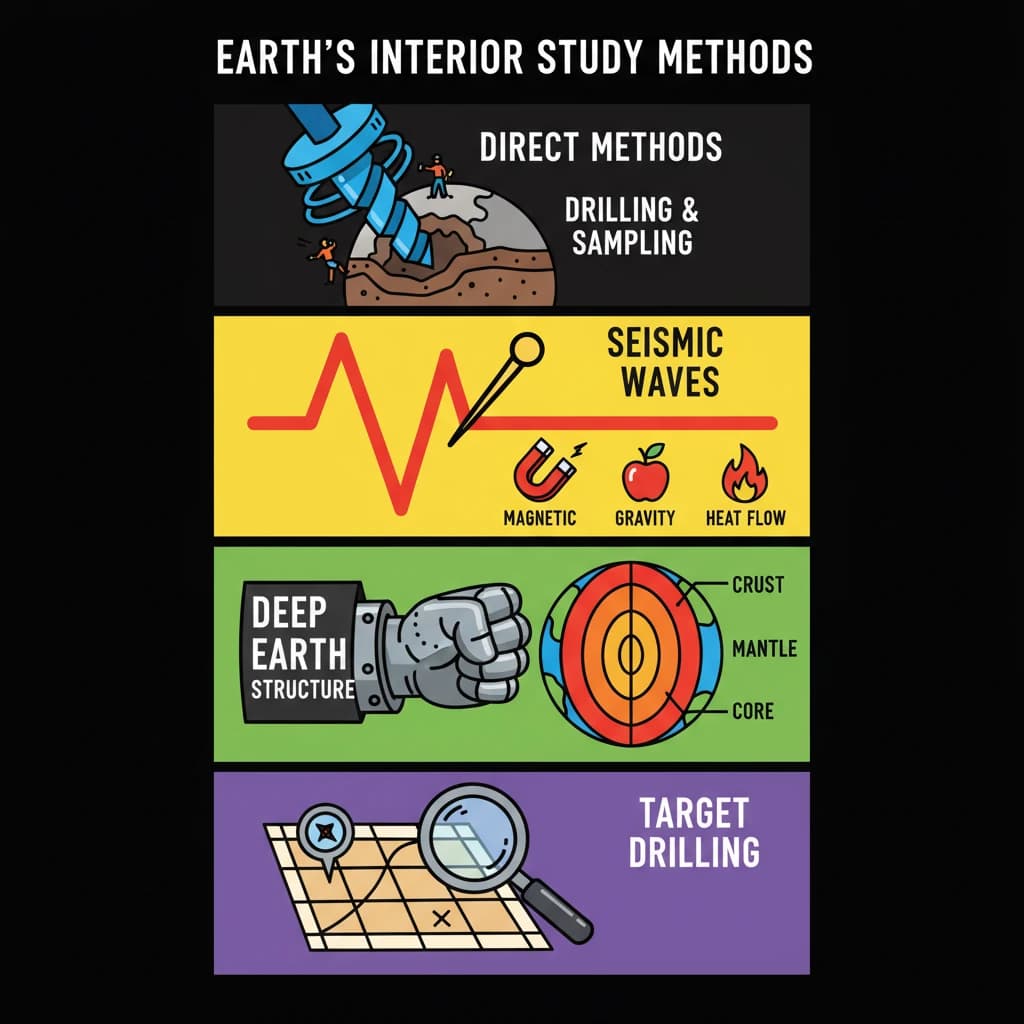
Memory Aid
95% Verified Content

Related Topics

Loading related topics...
Explore:Geography Topics·All Subjects·Daily Current Affairs·Editorial Analysis·Previous Year Questions·UPSC GPT