Loading page, please wait…
Vaidra Logo
Vaidra

Top 4 items + smart groups

UPSC GPT
New
Current Affairs
Daily Solutions
Daily Puzzle
Mains Evaluator

Version 2.0.0 • Built with ❤️ for UPSC aspirants

Loading...
Loading...
Loading...
Loading...
Loading...
Loading...
Loading...
Loading...
Loading...
Loading...
Loading...
Loading...
Loading...
What are Coral Reefs? - UPSC Geography

What are Coral Reefs? - UPSC Geography

What is What are Coral Reefs? in UPSC Geography?

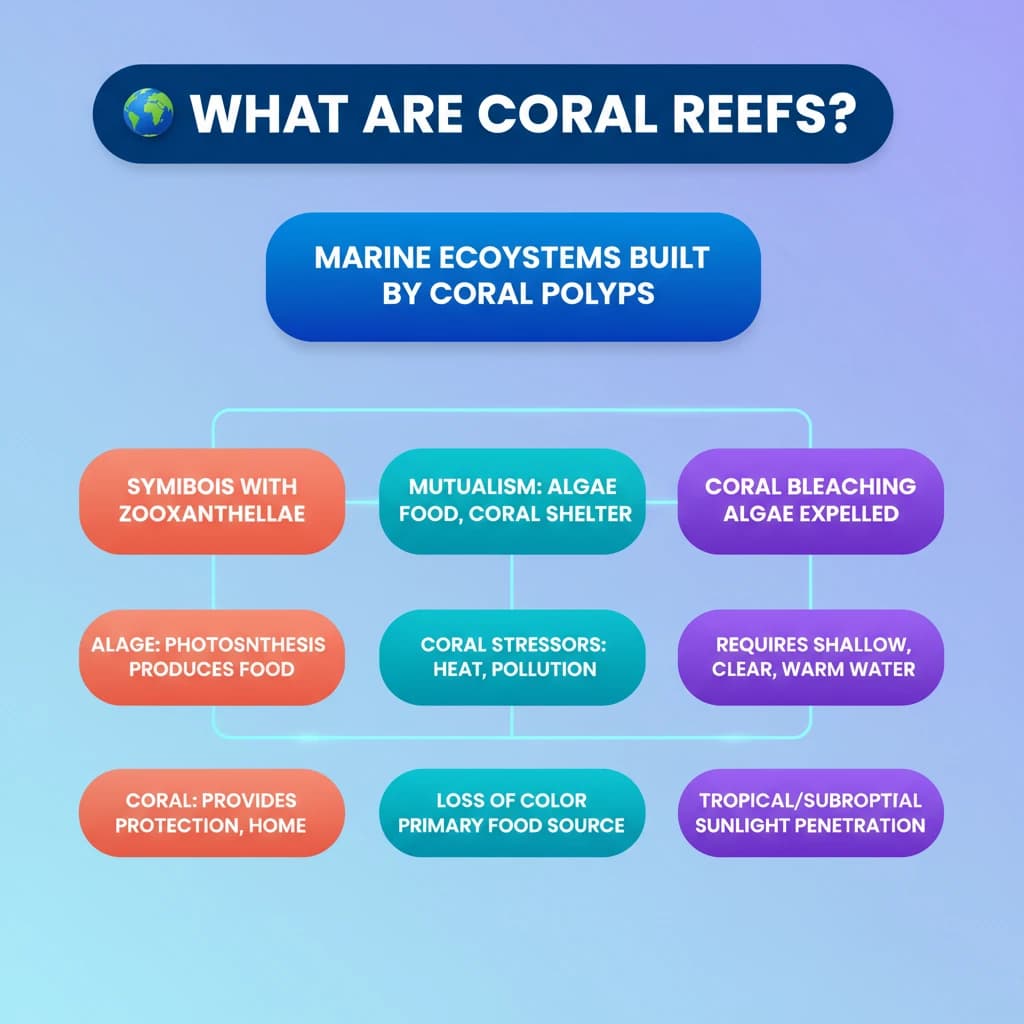
What are Coral Reefs? is a key topic under Geography for UPSC Civil Services Examination. Key points include: Coral reefs are marine ecosystems built by coral polyps in symbiosis with zooxanthellae algae.. Zooxanthellae provide food via photosynthesis; corals offer shelter, a mutualistic relationship.. Coral bleaching occurs when stressed corals expel zooxanthellae, losing color and primary food source.. Understanding this topic is essential for both UPSC Prelims and Mains preparation.

Why is What are Coral Reefs? important for UPSC exam?

What are Coral Reefs? is a Medium-level topic in UPSC Geography. It is tested in both Prelims (factual MCQs) and Mains (analytical answer writing). Previous year UPSC questions have frequently covered aspects of What are Coral Reefs?, making it essential for comprehensive IAS preparation.

How to prepare What are Coral Reefs? for UPSC?

To prepare What are Coral Reefs? for UPSC: (1) Study the comprehensive notes covering all key concepts on Vaidra. (2) Practice previous year questions on this topic. (3) Connect it with current affairs using daily updates. (4) Revise using key takeaways and mind maps available for Geography. (5) Write practice answers linking What are Coral Reefs? to related GS Paper topics.

Key takeaways of What are Coral Reefs? for UPSC

  • Coral reefs are marine ecosystems built by coral polyps in symbiosis with zooxanthellae algae.
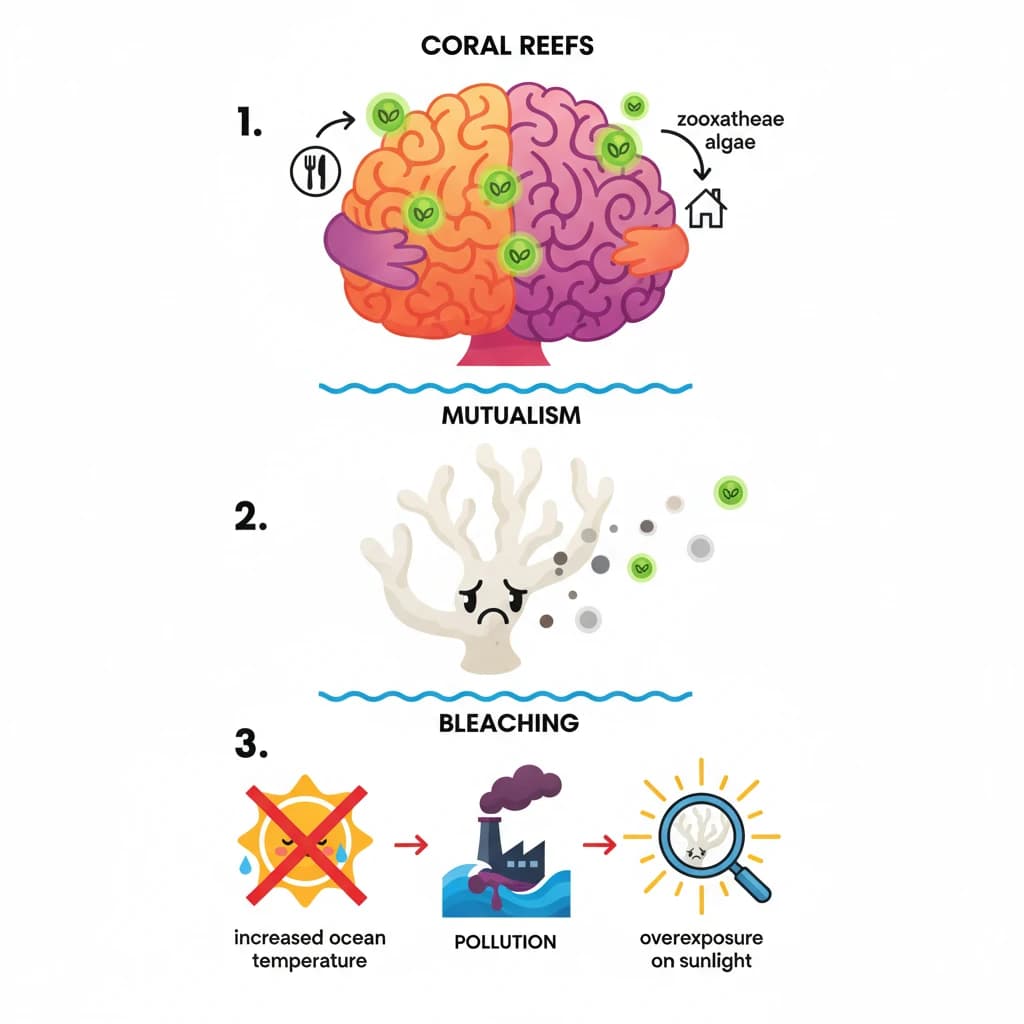
  • Zooxanthellae provide food via photosynthesis; corals offer shelter, a mutualistic relationship.
  • Coral bleaching occurs when stressed corals expel zooxanthellae, losing color and primary food source.
  • Primary causes of bleaching include increased ocean temperature, pollution, and overexposure to sunlight.
  • Reef-building corals require shallow, clear, tropical/subtropical waters for light penetration.
  • Types include Hydrocorals (Fire Corals), Octocorals (Soft Corals), and Antipatharians (Black Corals).
What are Coral Reefs?

What are Coral Reefs?

Medium⏱️ 8 min read✓ 95% Verified
geography

📖 Introduction

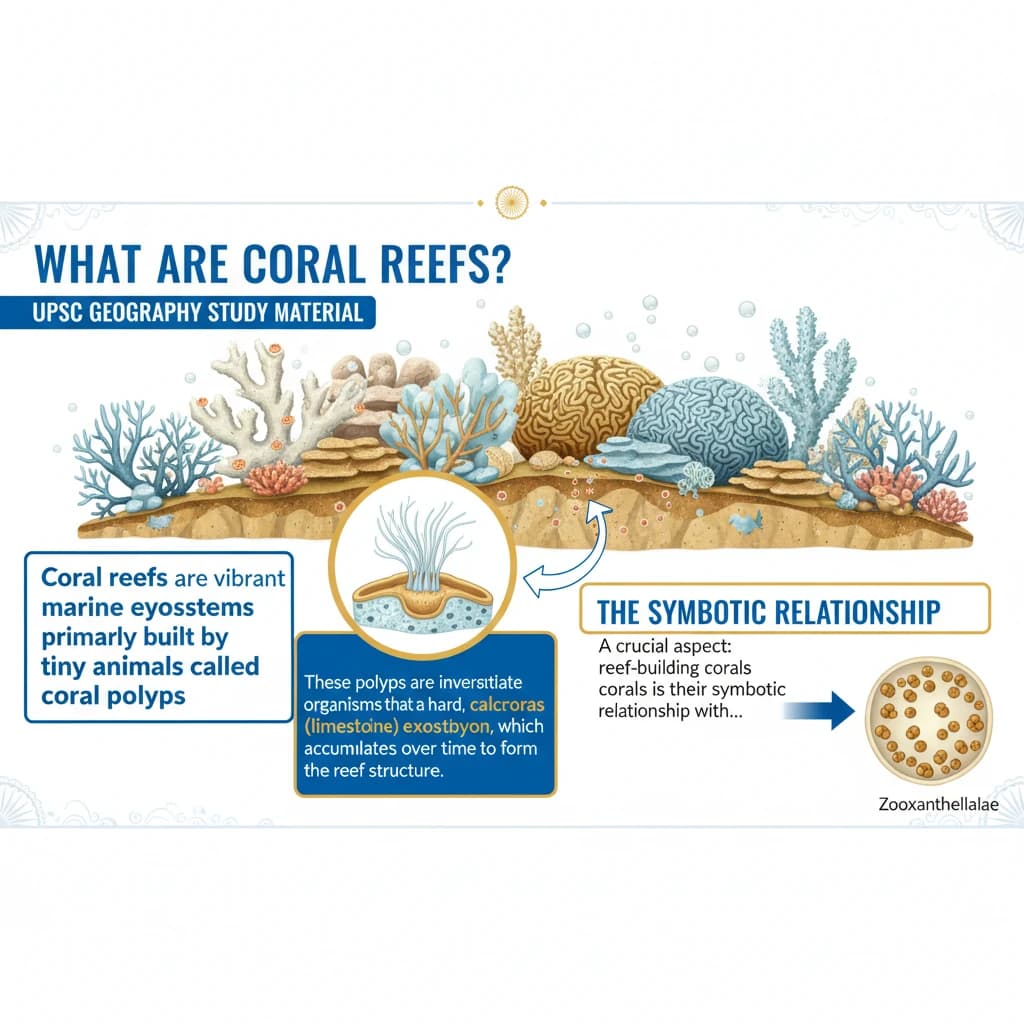
<h4>What are Coral Reefs?</h4><p><strong>Coral reefs</strong> are vibrant <strong>marine ecosystems</strong> primarily built by tiny animals called <strong>coral polyps</strong>.</p><div class='info-box'><p>These polyps are invertebrate organisms that secrete a hard, calcareous (limestone) exoskeleton, which accumulates over time to form the reef structure.</p></div><h4>The Symbiotic Relationship</h4><p>A crucial aspect of reef-building corals is their <strong>symbiotic relationship</strong> with microscopic algae known as <strong>zooxanthellae</strong>.</p><div class='key-point-box'><p>The <strong>zooxanthellae</strong> live within the coral polyps' tissues. They perform <strong>photosynthesis</strong>, providing the corals with vital <strong>nutrients</strong> and <strong>oxygen</strong>.</p></div><p>In return, the corals offer a protected habitat and compounds necessary for the algae's photosynthesis. This <strong>mutualism</strong> is indispensable for the health and survival of the entire coral reef ecosystem.</p><h4>Understanding Coral Bleaching</h4><p><strong>Coral bleaching</strong> is a severe threat where corals lose their vibrant color and become white, indicating stress and potential death.</p><p>It occurs when the <strong>symbiotic relationship</strong> between the coral polyp and its <strong>zooxanthellae</strong> breaks down.</p><p>Without their primary food source, the algae leave the coral tissue. The coral then turns pale or white and becomes highly susceptible to disease.</p><div class='exam-tip-box'><p>Understanding <strong>coral bleaching</strong> is critical for <strong>UPSC GS-III Environment</strong> as it highlights the fragility of marine ecosystems to climate change.</p></div><h4>Causes of Coral Bleaching</h4><ul><li><strong>Changes in Ocean Temperature</strong>: The leading cause is increased water temperature, which stresses the symbiotic algae.</li><li><strong>Runoff and Pollution</strong>: Storms can cause freshwater runoff, rapidly diluting ocean water. Pollutants like <strong>sunscreen</strong> and <strong>industrial waste</strong> can also poison corals.</li><li><strong>Overexposure to Sunlight</strong>: High solar irradiance, especially when temperatures are already elevated, can cause bleaching in shallow-water corals.</li><li><strong>Extreme Low Tides</strong>: Prolonged exposure to air during very low tides can bleach shallow corals.</li></ul><h4>Types of Corals</h4><p>Corals are broadly classified based on their structure and composition:</p><h5>Hydrocorals (Fire Corals)</h5><p>These are <strong>reef-building hydroids</strong> known for their hard, <strong>calcareous exoskeleton</strong>.</p><div class='info-box'><p>They possess <strong>stinging cells</strong> (nematocysts) that can cause a burning sensation upon contact, hence the name <strong>"Fire Corals"</strong>.</p></div><h5>Octocorals (Soft Corals)</h5><p>This group includes organisms like <strong>sea fans</strong> and <strong>sea whips</strong>.</p><div class='info-box'><p>Unlike stony corals, <strong>Octocorals</strong> grow more like fleshy plants and generally <strong>do not form calcium carbonate skeletal structures</strong> that contribute to reef building.</p></div><h5>Antipatharians (Black Corals)</h5><p>Often referred to as a type of 'soft' coral, <strong>Black Corals</strong> are distinguished by their distinctive <strong>jet-black</strong> or <strong>dark brown chitin skeletons</strong>.</p><div class='info-box'><p>They are typically found in deeper waters and are known for their long lifespans.</p></div><h4>Geographical Extent of Reef-Building Corals</h4><p>Corals can be found in oceans worldwide, inhabiting both shallow and deep waters.</p><p>However, the <strong>reef-building corals</strong>, which depend on their symbiotic relationship with algae, have specific environmental requirements.</p><div class='key-point-box'><p>They require <strong>shallow, clear water</strong> to allow sufficient light penetration for the <strong>photosynthesis</strong> carried out by their <strong>zooxanthellae</strong>.</p></div><p>These <strong>stony corals</strong> also thrive in <strong>tropical or subtropical temperatures</strong>, typically found within a band between <strong>30° North and 30° South latitudes</strong>.</p>
Concept Diagram

💡 Key Takeaways

  • •Coral reefs are marine ecosystems built by coral polyps in symbiosis with zooxanthellae algae.
  • •Zooxanthellae provide food via photosynthesis; corals offer shelter, a mutualistic relationship.
  • •Coral bleaching occurs when stressed corals expel zooxanthellae, losing color and primary food source.
  • •Primary causes of bleaching include increased ocean temperature, pollution, and overexposure to sunlight.
  • •Reef-building corals require shallow, clear, tropical/subtropical waters for light penetration.
  • •Types include Hydrocorals (Fire Corals), Octocorals (Soft Corals), and Antipatharians (Black Corals).

🧠 Memory Techniques
Memory Aid
95% Verified Content

📚 Reference Sources

•NOAA Coral Reef Conservation Program (https://coralreef.noaa.gov)

Related Topics

Loading related topics...
Explore:Geography Topics·All Subjects·Daily Current Affairs·Editorial Analysis·Previous Year Questions·UPSC GPT
Back
All Subjects

Topics

0 topics • 0 completed

Loading topics...
Loading...
Loading...
Loading...
Loading...
Loading...
Overall Progress0%