Loading page, please wait…
Vaidra Logo
Vaidra

Top 4 items + smart groups

UPSC GPT
New
Current Affairs
Daily Solutions
Daily Puzzle
Mains Evaluator

Version 2.0.0 • Built with ❤️ for UPSC aspirants

Loading...
Loading...
Loading...
Loading...
Loading...
Loading...
Loading...
Loading...
Loading...
Loading...
Loading...
Loading...
Loading...
Back
All Subjects

Topics

0 topics • 0 completed

Loading topics...
Loading...
Loading...
Loading...
Loading...
Loading...
Overall Progress0%

Aurorae in Ladakh - UPSC Geography

What is Aurorae in Ladakh in UPSC Geography?

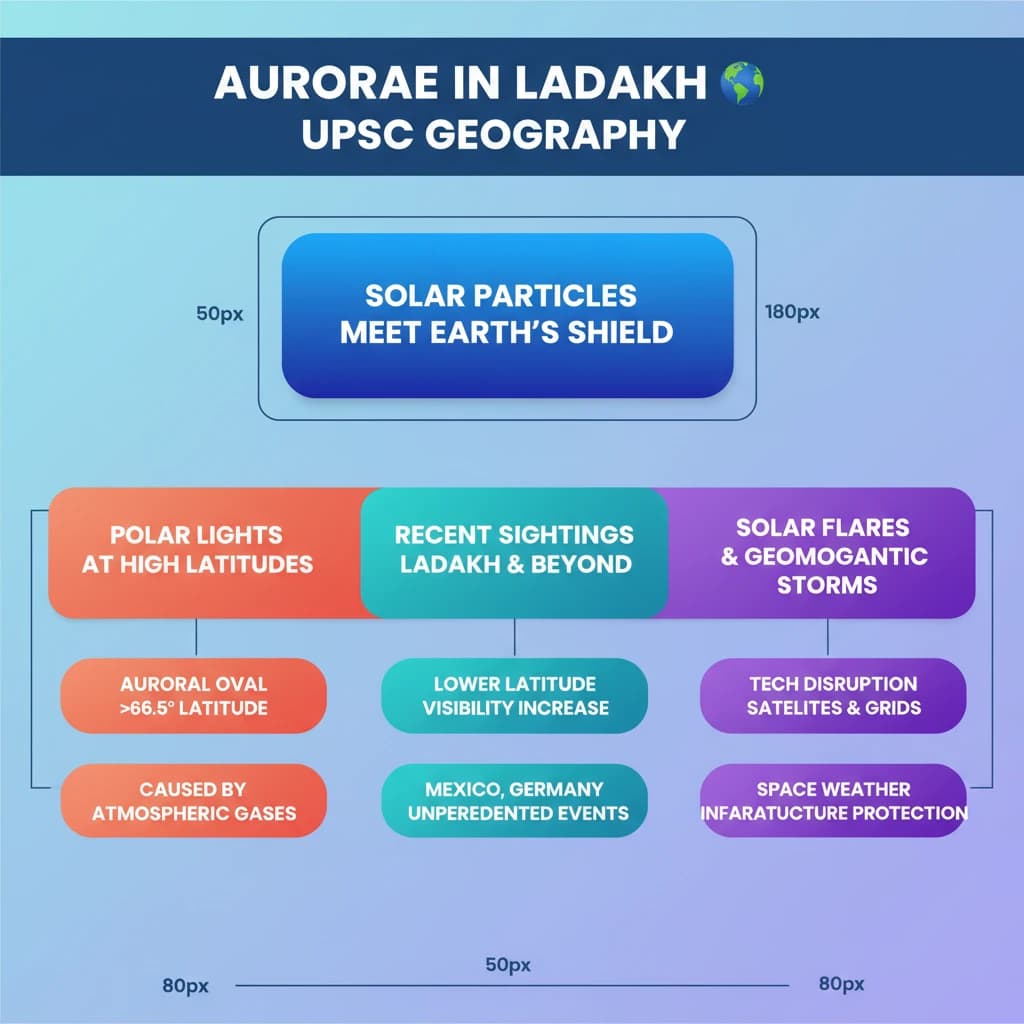
Aurorae in Ladakh is a key topic under Geography for UPSC Civil Services Examination. Key points include: Aurorae are natural light displays caused by solar particles interacting with Earth's magnetic field and atmosphere.. They typically occur in polar regions (above 66.5 degrees latitude).. Recent sightings in lower latitudes (Ladakh, Mexico, Germany) indicate heightened solar activity.. Understanding this topic is essential for both UPSC Prelims and Mains preparation.

Why is Aurorae in Ladakh important for UPSC exam?

Aurorae in Ladakh is a Medium-level topic in UPSC Geography. It is tested in both Prelims (factual MCQs) and Mains (analytical answer writing). Previous year UPSC questions have frequently covered aspects of Aurorae in Ladakh, making it essential for comprehensive IAS preparation.

How to prepare Aurorae in Ladakh for UPSC?

To prepare Aurorae in Ladakh for UPSC: (1) Study the comprehensive notes covering all key concepts on Vaidra. (2) Practice previous year questions on this topic. (3) Connect it with current affairs using daily updates. (4) Revise using key takeaways and mind maps available for Geography. (5) Write practice answers linking Aurorae in Ladakh to related GS Paper topics.

Key takeaways of Aurorae in Ladakh for UPSC

  • Aurorae are natural light displays caused by solar particles interacting with Earth's magnetic field and atmosphere.
  • They typically occur in polar regions (above 66.5 degrees latitude).
  • Recent sightings in lower latitudes (Ladakh, Mexico, Germany) indicate heightened solar activity.
  • Heightened solar activity can disrupt technology like satellites and power grids.
  • Understanding space weather is crucial for protecting modern infrastructure.
Aurorae in Ladakh

Aurorae in Ladakh

Medium⏱️ 8 min read✓ 95% Verified
geography

📖 Introduction

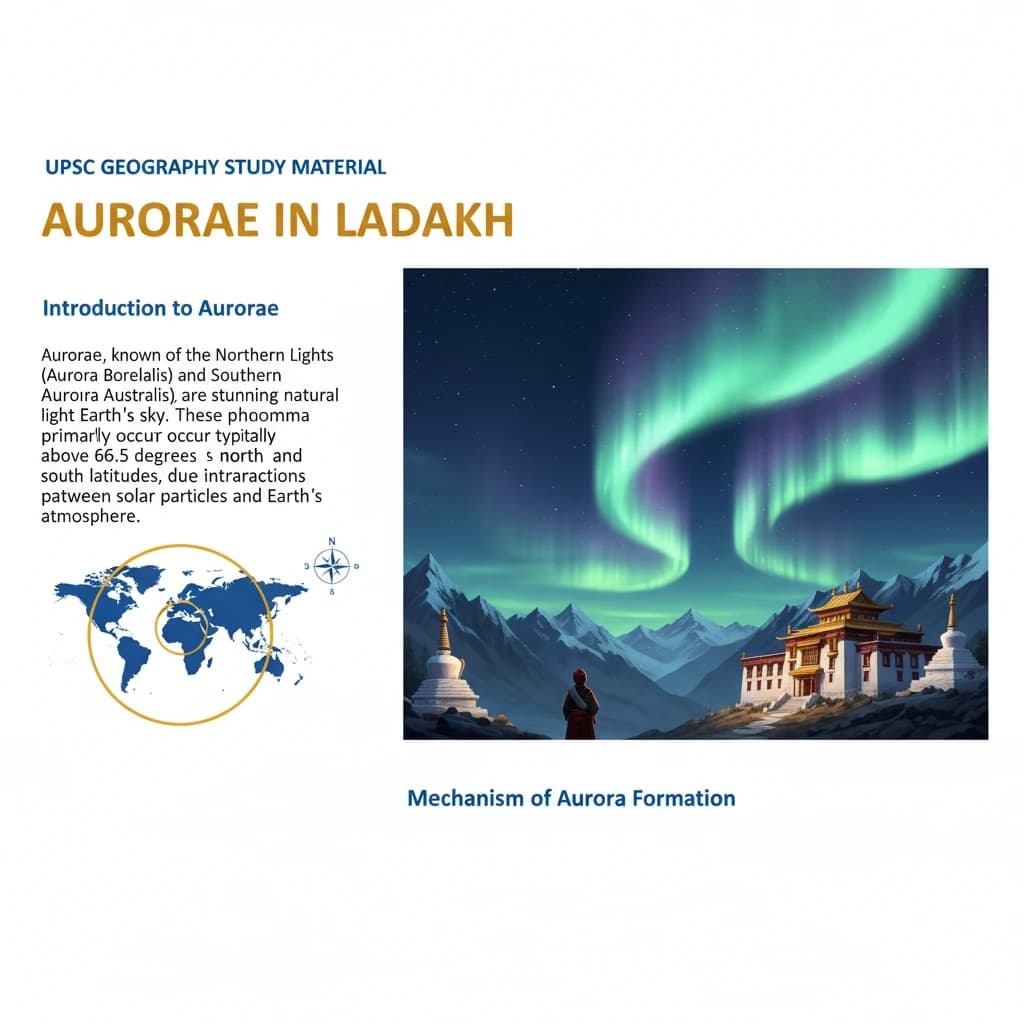
<h4>Introduction to Aurorae</h4><p><strong>Aurorae</strong>, also known as the <strong>Northern Lights (Aurora Borealis)</strong> and <strong>Southern Lights (Aurora Australis)</strong>, are stunning natural light displays in the Earth's sky.</p><p>These phenomena primarily occur in the <strong>polar regions</strong>, typically above <strong>66.5 degrees north and south latitudes</strong>, due to interactions between solar particles and Earth's atmosphere.</p><h4>Mechanism of Aurora Formation</h4><p>The formation of aurorae begins with the <strong>Sun's activity</strong>, specifically <strong>solar flares</strong> and <strong>coronal mass ejections (CMEs)</strong>, which release charged particles into space.</p><p>These particles, primarily <strong>electrons</strong> and <strong>protons</strong>, travel towards Earth as part of the <strong>solar wind</strong>.</p><div class="info-box"><p>Upon reaching Earth, these <strong>charged particles</strong> are guided by the planet's <strong>magnetic field lines</strong> towards the <strong>magnetic poles</strong>. As they enter the upper atmosphere (<strong>ionosphere</strong>), they collide with atmospheric gases.</p></div><p>The collisions excite atoms and molecules of gases like <strong>oxygen</strong> and <strong>nitrogen</strong>. When these excited particles return to their lower energy states, they emit light, creating the vibrant auroral displays.</p><div class="key-point-box"><p>The color of the aurora depends on the type of gas involved and the altitude of the collision. <strong>Oxygen</strong> typically produces <strong>green</strong> and <strong>red</strong> light, while <strong>nitrogen</strong> contributes to <strong>blue</strong> and <strong>purple</strong> hues.</p></div><h4>Significance of Lower-Latitude Sightings</h4><p>Recently, aurorae have been sighted in <strong>lower-latitude regions</strong>, significantly below the typical polar zones. This includes locations like <strong>Hanle</strong> and <strong>Merak</strong> in <strong>Ladakh, India</strong>, as well as parts of <strong>Mexico</strong> and <strong>Germany</strong>.</p><div class="info-box"><p>The standard range for aurora sightings is within the <strong>auroral ovals</strong>, which are concentrated around the magnetic poles. Sightings outside these ovals are less common.</p></div><p>The occurrence of aurorae in these lower-latitude areas is a direct indication of <strong>heightened solar activity</strong>. When solar storms are exceptionally strong, they can cause the <strong>Earth's magnetosphere</strong> to be significantly disturbed.</p><p>This disturbance allows charged particles to penetrate the atmosphere at lower latitudes than usual, expanding the auroral oval and making the displays visible further from the poles.</p><div class="exam-tip-box"><p>UPSC often asks about the implications of scientific phenomena. The sighting of aurorae at lower latitudes is a key indicator of intense <strong>space weather events</strong>, which have implications for satellites and communication systems. This links to <strong>GS Paper III: Science and Technology</strong>.</p></div><h4>Aurorae in Ladakh: A Recent Event</h4><p>The sighting of aurorae in <strong>Hanle</strong> and <strong>Merak</strong> in <strong>Ladakh</strong> marks a rare and significant event for India. These regions are located in the <strong>Himalayan range</strong> and are not typically associated with auroral displays.</p><p>This specific event underscores the powerful nature of the recent <strong>solar storm</strong> and its extensive reach across Earth's magnetic field.</p><div class="highlight-box"><p>The observation in <strong>Ladakh</strong> highlights the global impact of solar activity and the dynamic nature of our planet's interaction with the Sun's emissions.</p></div>
Concept Diagram

💡 Key Takeaways

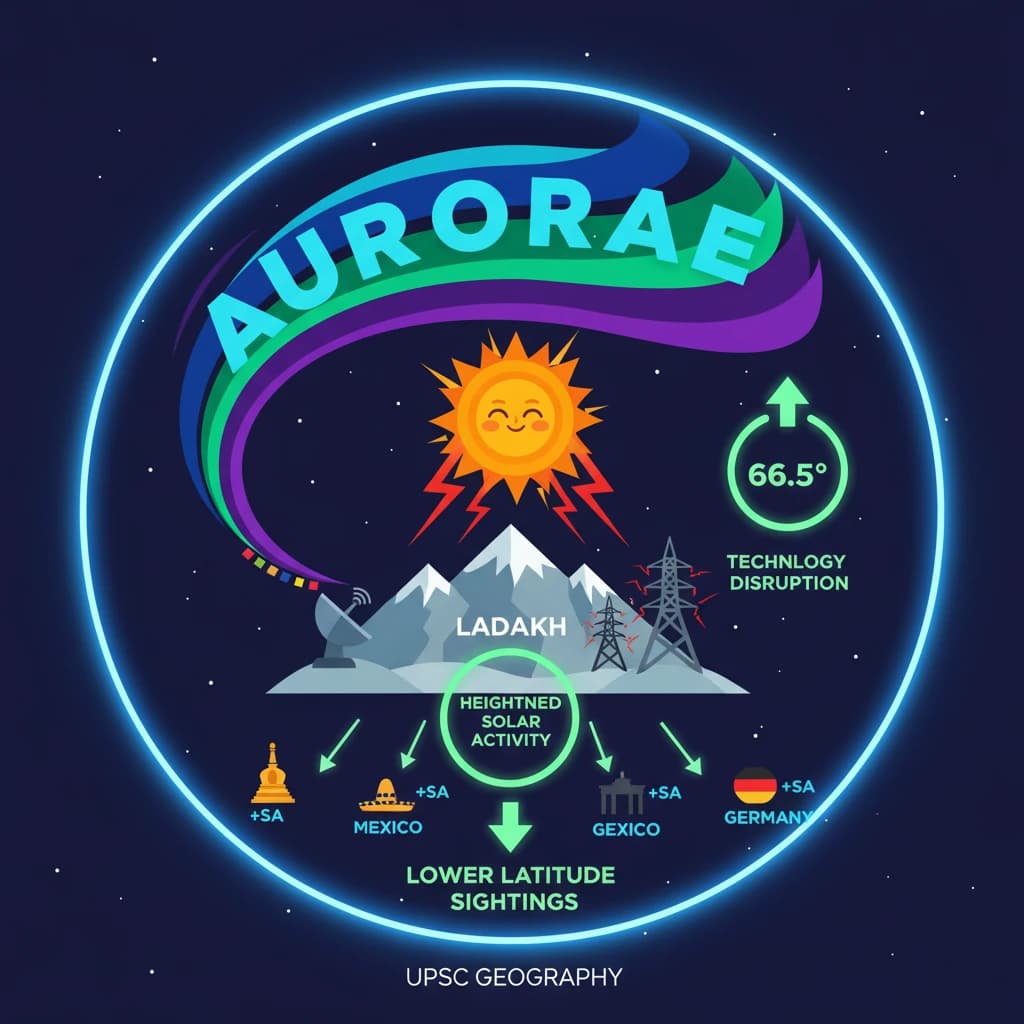
  • •Aurorae are natural light displays caused by solar particles interacting with Earth's magnetic field and atmosphere.
  • •They typically occur in polar regions (above 66.5 degrees latitude).
  • •Recent sightings in lower latitudes (Ladakh, Mexico, Germany) indicate heightened solar activity.
  • •Heightened solar activity can disrupt technology like satellites and power grids.
  • •Understanding space weather is crucial for protecting modern infrastructure.

🧠 Memory Techniques
Memory Aid
95% Verified Content

📚 Reference Sources

•NASA Space Weather Research
•European Space Agency (ESA) Aurora Information
•National Oceanic and Atmospheric Administration (NOAA) Space Weather Prediction Center

Related Topics

Loading related topics...
Explore:Geography Topics·All Subjects·Daily Current Affairs·Editorial Analysis·Previous Year Questions·UPSC GPT
Aurorae in Ladakh - UPSC Geography