Loading page, please wait…
Copper in India: Demand, Imports, and Supply Security Efforts - UPSC Geography
What is Copper in India: Demand, Imports, and Supply Security Efforts in UPSC Geography?
Copper in India: Demand, Imports, and Supply Security Efforts is a key topic under Geography for UPSC Civil Services Examination. Key points include: India has minor copper deposits but soaring demand due to infrastructure, renewable energy, and urbanization.. The country heavily relies on copper imports despite domestic efforts.. Government promotes smelters, refineries, and Indian companies acquire overseas mines to secure supply.. Understanding this topic is essential for both UPSC Prelims and Mains preparation.
Why is Copper in India: Demand, Imports, and Supply Security Efforts important for UPSC exam?
Copper in India: Demand, Imports, and Supply Security Efforts is a Medium-level topic in UPSC Geography. It is tested in both Prelims (factual MCQs) and Mains (analytical answer writing). Previous year UPSC questions have frequently covered aspects of Copper in India: Demand, Imports, and Supply Security Efforts, making it essential for comprehensive IAS preparation.
How to prepare Copper in India: Demand, Imports, and Supply Security Efforts for UPSC?
To prepare Copper in India: Demand, Imports, and Supply Security Efforts for UPSC: (1) Study the comprehensive notes covering all key concepts on Vaidra. (2) Practice previous year questions on this topic. (3) Connect it with current affairs using daily updates. (4) Revise using key takeaways and mind maps available for Geography. (5) Write practice answers linking Copper in India: Demand, Imports, and Supply Security Efforts to related GS Paper topics.
Key takeaways of Copper in India: Demand, Imports, and Supply Security Efforts for UPSC
- India has minor copper deposits but soaring demand due to infrastructure, renewable energy, and urbanization.
- The country heavily relies on copper imports despite domestic efforts.
- Government promotes smelters, refineries, and Indian companies acquire overseas mines to secure supply.
- Copper is listed as a critical mineral, highlighting the need to reduce import dependence.
- It acts as a global economic indicator, reflecting demand/supply and market dynamics.
- Copper is vital for energy efficiency in buildings due to its excellent conductivity.
- Chile is the world's largest copper producer, home to Escondido and Collahuasi mines.
Copper in India: Demand, Imports, and Supply Security Efforts
Medium⏱️ 8 min read
geography
📖 Introduction
Indian Copper Reserves and Demand
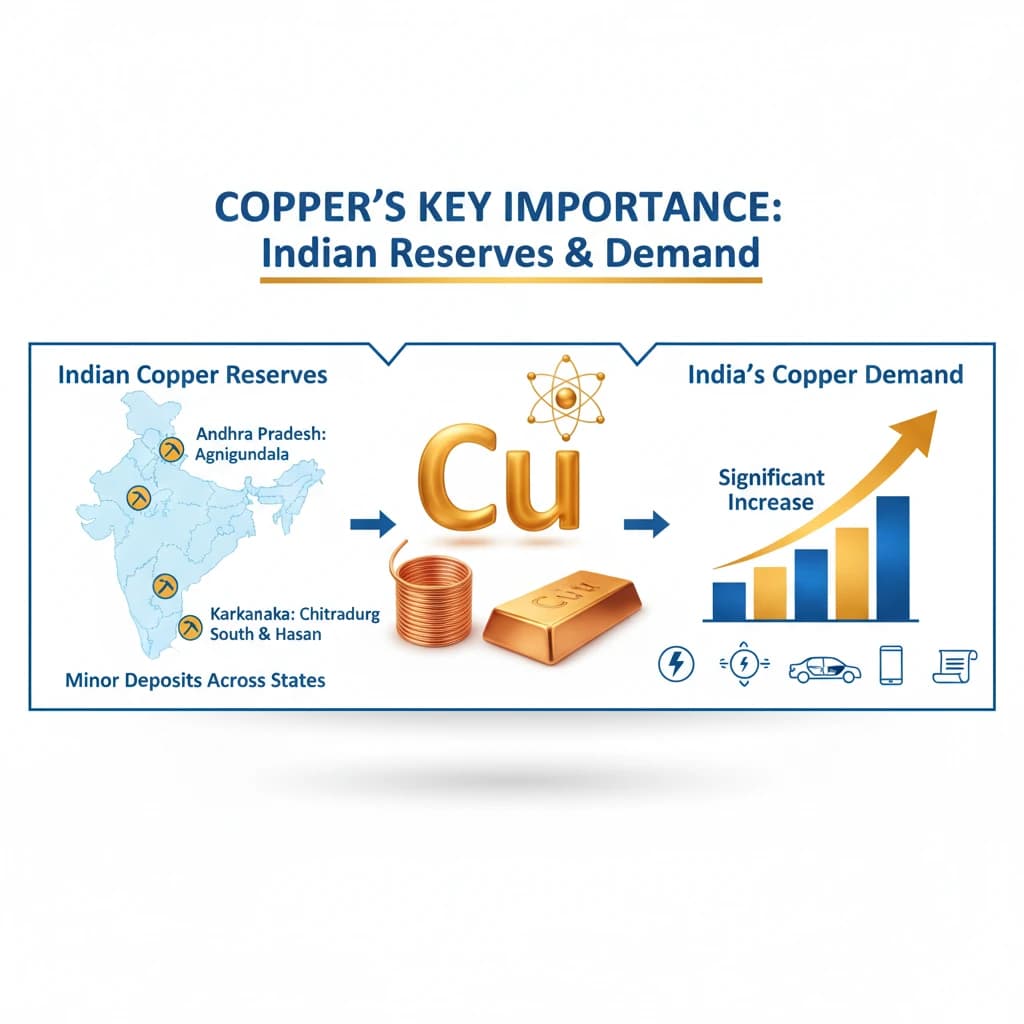
India possesses relatively minor deposits of copper across various states.
- Andhra Pradesh: Agnigundala
- Karnataka: Chitradurg and Hasan
- Tamil Nadu: South Arcot districts
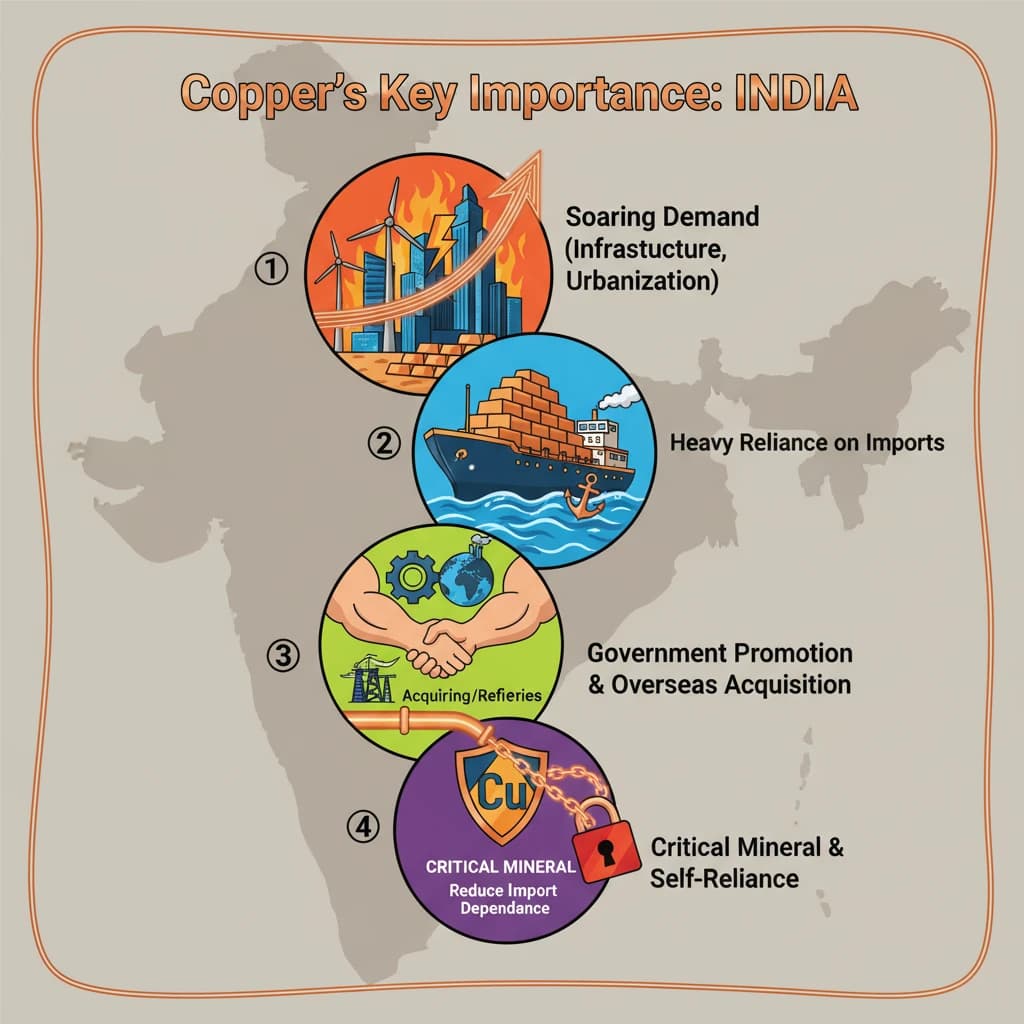
Despite these deposits, India's demand for copper is experiencing a significant surge.
This rising demand is primarily driven by rapid infrastructure projects, ambitious renewable energy initiatives, and accelerating urbanisation across the country.
Consequently, India maintains a heavy reliance on copper imports due to its limited domestic reserves.
Addressing Import Dependence and Strategic Initiatives
To mitigate the substantial dependence on imports, the Indian government is actively implementing several strategic measures.
These include promoting significant investments in domestic smelters and refineries to enhance processing capabilities within the country.
Concurrently, Indian companies are pursuing the acquisition of copper mines abroad.
This global acquisition strategy aims to secure a stable supply of copper and reduce India's vulnerability to fluctuations in international markets.
Recently, the Ministry of Mines has proposed dispatching an Indian Industry delegation to Zambia.
The objective is to discuss potential copper exploration and mining projects in the copper-rich southern African nation.
Recognizing its strategic importance, the government has officially included copper in its list of critical minerals, underscoring the urgent need to reduce import reliance.
Copper as a Global Economic Barometer
Copper prices are widely regarded as a significant indicator of global economic health, often earning it the nickname "Dr. Copper."
Its price movements reflect complex interactions between demand/supply dynamics, global monetary markets, and speculative trading.
Unlike commodities specific to a single sector, copper is integral and extensively used across virtually all economic sectors, from construction to electronics.
Copper's Vital Role in Energy Efficiency
Copper plays a crucial and often underestimated role in promoting energy efficiency, particularly within buildings.
Its outstanding thermal and electrical conductivity make it an ideal material for various applications.
- Wiring: Ensures minimal energy loss during electricity transmission.
- Heat Exchangers: Facilitates efficient heat transfer in HVAC systems.
- Roofing: Contributes to better thermal regulation.
These applications lead to a significant reduction in energy consumption for heating, cooling, and lighting.
By minimizing energy losses throughout a building's lifespan, copper directly contributes to a more sustainable future and lower carbon footprint.
Global Copper Production: Chile's Dominance
On the global stage, Chile stands as the undisputed top copper producer in the world.
Chile accounts for an impressive 27% of the total global copper production.
Furthermore, the country is home to two of the largest and most significant copper mines globally: Escondido and Collahuasi.
💡 Key Takeaways
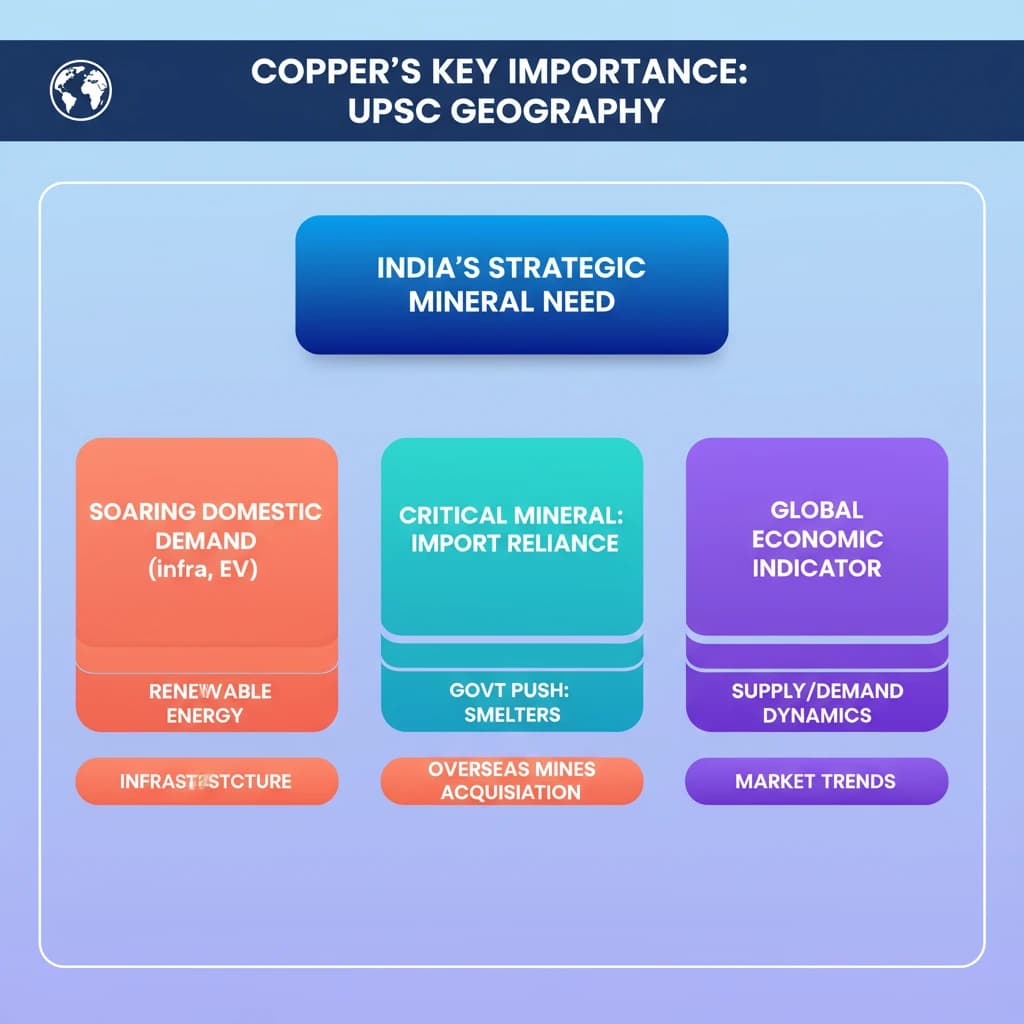
- •India has minor copper deposits but soaring demand due to infrastructure, renewable energy, and urbanization.
- •The country heavily relies on copper imports despite domestic efforts.
- •Government promotes smelters, refineries, and Indian companies acquire overseas mines to secure supply.
- •Copper is listed as a critical mineral, highlighting the need to reduce import dependence.
- •It acts as a global economic indicator, reflecting demand/supply and market dynamics.
- •Copper is vital for energy efficiency in buildings due to its excellent conductivity.
- •Chile is the world's largest copper producer, home to Escondido and Collahuasi mines.
🧠 Memory Techniques
95% Verified Content
📚 Reference Sources
•General knowledge on global copper production and uses