Loading page, please wait…
Deccan Volcanism and Movement of Indian Plate - UPSC Geography
What is Deccan Volcanism and Movement of Indian Plate in UPSC Geography?
Deccan Volcanism and Movement of Indian Plate is a key topic under Geography for UPSC Civil Services Examination. Key points include: Deccan Volcanism caused mass extinction of fauna (dinosaurs, gymnosperms) but supported tropical flora (angiosperms).. It contributed to the global Cretaceous-Paleogene (K-Pg) mass extinction 66 million years ago.. Deccan Traps formed from fissure eruptions as the Indian Plate moved over the Réunion hotspot.. Understanding this topic is essential for both UPSC Prelims and Mains preparation.
Why is Deccan Volcanism and Movement of Indian Plate important for UPSC exam?
Deccan Volcanism and Movement of Indian Plate is a Medium-level topic in UPSC Geography. It is tested in both Prelims (factual MCQs) and Mains (analytical answer writing). Previous year UPSC questions have frequently covered aspects of Deccan Volcanism and Movement of Indian Plate, making it essential for comprehensive IAS preparation.
How to prepare Deccan Volcanism and Movement of Indian Plate for UPSC?
To prepare Deccan Volcanism and Movement of Indian Plate for UPSC: (1) Study the comprehensive notes covering all key concepts on Vaidra. (2) Practice previous year questions on this topic. (3) Connect it with current affairs using daily updates. (4) Revise using key takeaways and mind maps available for Geography. (5) Write practice answers linking Deccan Volcanism and Movement of Indian Plate to related GS Paper topics.
Key takeaways of Deccan Volcanism and Movement of Indian Plate for UPSC
- Deccan Volcanism caused mass extinction of fauna (dinosaurs, gymnosperms) but supported tropical flora (angiosperms).
- It contributed to the global Cretaceous-Paleogene (K-Pg) mass extinction 66 million years ago.
- Deccan Traps formed from fissure eruptions as the Indian Plate moved over the Réunion hotspot.
- Black soil, rich in minerals, formed from basaltic lava, supporting cotton and tobacco agriculture.
- The event highlights the complex interplay between geological forces, climate, and biodiversity.
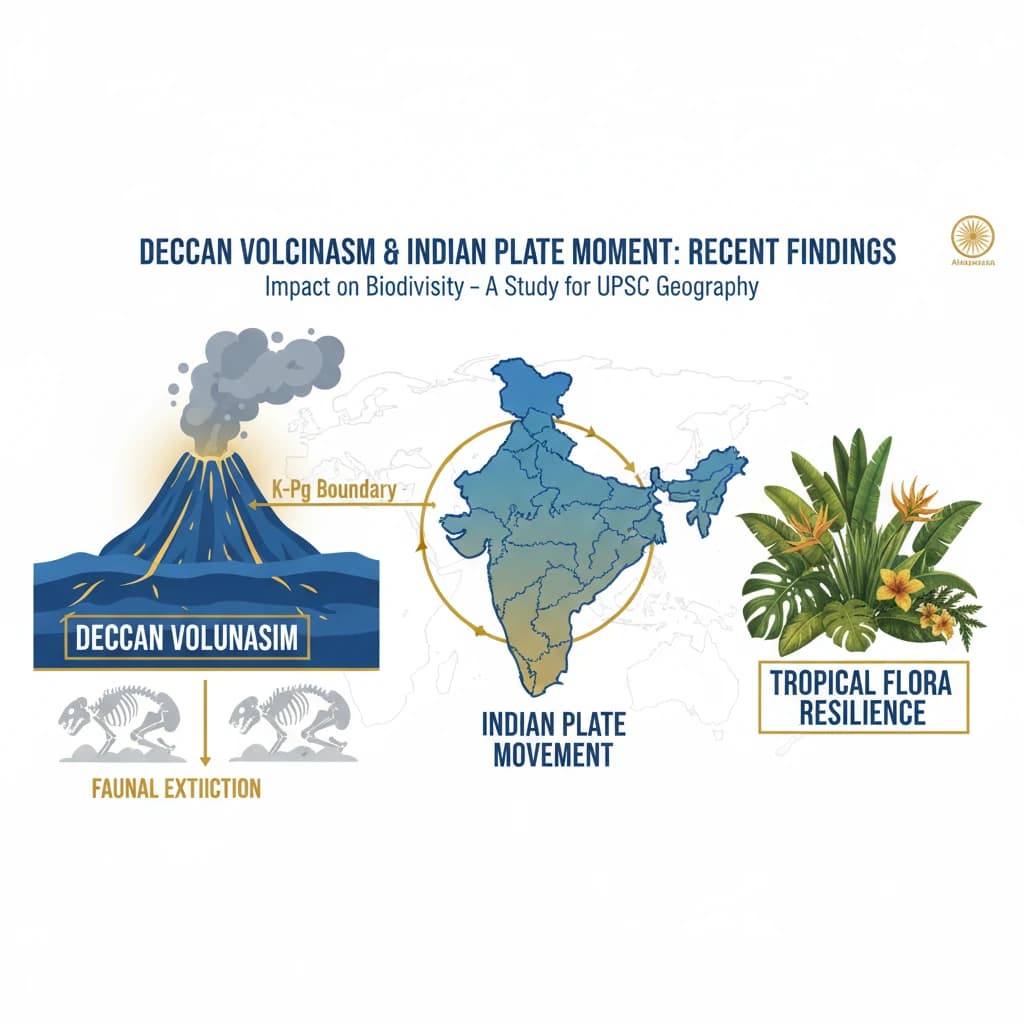
Deccan Volcanism and Movement of Indian Plate
Medium⏱️ 7 min read
geography
📖 Introduction
Context and Recent Study Findings
A recent study has shed new light on the impact of Deccan Volcanism on the Indian Plate. The research indicates that while this massive volcanic activity led to widespread extinction of fauna, tropical flora demonstrated significant resilience.
Mass extinctions are catastrophic events causing rapid loss of biodiversity. They are often triggered by factors like severe climate changes, asteroid impacts, or large-scale volcanic eruptions.
UPSC Relevance: Understanding past mass extinction events like the K-Pg extinction provides crucial context for current biodiversity challenges and environmental studies (GS Paper 1 & 3).
Impact on Fauna and Flora
The Deccan Volcanism played a significant role in the mass extinction of dinosaurs and other associated fauna. It also negatively impacted gymnosperms, a group of primitive plants.
However, surprisingly, the volcanic activity supported a hyper-diverse tropical flora. It achieved this by creating fertile and relatively undisturbed habitats, which allowed angiosperms to thrive rather than face extinction.
A combination of a warm, humid climate during the volcanic period and the Indian Plate's movement through the equator significantly contributed to this flourishing floral diversity.
Global and Regional Implications
Globally, Deccan volcanism is recognized as a contributing factor to the Cretaceous-Paleogene (K-Pg) mass extinction event, which occurred approximately 66 million years ago. This event famously led to the demise of ammonoids (invertebrate cephalopods) and dinosaurs.
Despite this global catastrophe, tropical rainforests on the Indian Plate adapted and flourished. This resilience highlights the inherent robustness of tropical flora when faced with severe climatic stresses.
Tropical Flora: These are plant species that thrive in tropical regions, located between 23.5° North and 23.5° South latitudes. These areas, found near the equator between the Tropic of Cancer and the Tropic of Capricorn, are characterized by consistently warm temperatures and high humidity year-round. Examples include Mahogany trees, Orchids, and Coconut palms.
Gymnosperms: These plants produce 'naked seeds', meaning their seeds are not enclosed within an ovary. They are often found on cone-like structures and represent some of the oldest and most primitive plant forms.
Angiosperms: Also known as flowering plants, angiosperms produce seeds that are enclosed within a fruit. After fertilization, the flower's ovary develops into a fruit containing the seeds.
Deccan Volcanism Theory
The Deccan Volcanism Theory posits that the massive volcanic eruptions responsible for forming the Deccan Traps played a crucial role in the mass extinction event around 66 million years ago.
The Deccan Traps constitute a vast volcanic plateau situated in peninsular India. They were formed by extensive fissure volcanic eruptions.
Fissure Volcanic Eruptions: This type of eruption occurs when magma emerges through long cracks or fissures in the Earth's crust, rather than through a single, central volcanic vent.
Formation of Deccan Traps
The formation of the Deccan Traps is attributed to intense volcanic activity driven by the Deccan mantle plume. This volcanic activity persisted for several hundred thousand years, depositing immense layers of lava.
Mantle Plume: A mantle plume is a cylindrical upwelling of hot, molten rock originating from the Earth's mantle. These plumes are responsible for creating volcanic hotspots that are not directly linked to plate boundaries.
Today, the Deccan Traps are characterized by extensive layers of basaltic lava flows, which are the remnants of these colossal volcanic eruptions.
Connection with Indian Plate Movement
Historically, India was a large island positioned off the coast of Australia. It is believed that the Indian Plate commenced its northward journey approximately 200 million years ago.
Beneath the Indian Plate lies the Réunion hotspot, which is a mantle plume of hot, molten rock originating from the Earth's interior. As the Indian Plate traversed over this Réunion hotspot, the resulting fissure volcanic eruptions led to the formation of the Deccan Traps.
Réunion Hotspot: This is a significant volcanic hotspot located in the Indian Ocean, situated near the island of Réunion (a French overseas region). Its interaction with the moving Indian Plate is key to the Deccan Traps' origin.
Economic Significance of Deccan Volcanism
The geological legacy of Deccan Volcanism has several economic implications for India:
- Major Rocks: The Deccan Traps are predominantly composed of basalt. In contrast, granite and gneiss are common in southern India, particularly in Karnataka and Tamil Nadu.
- Mineral Resources: The region is rich in mineral deposits. Iron ore is found in abundance in Karnataka, while bauxite deposits are significant in the Eastern Ghats.
- Agriculture: The weathering of volcanic rocks, especially basalt, gives rise to Black soil (Regur soil). This soil is rich in minerals like iron, magnesium, calcium, and potassium, making it highly fertile and ideal for cultivating crops such as cotton and tobacco.
💡 Key Takeaways
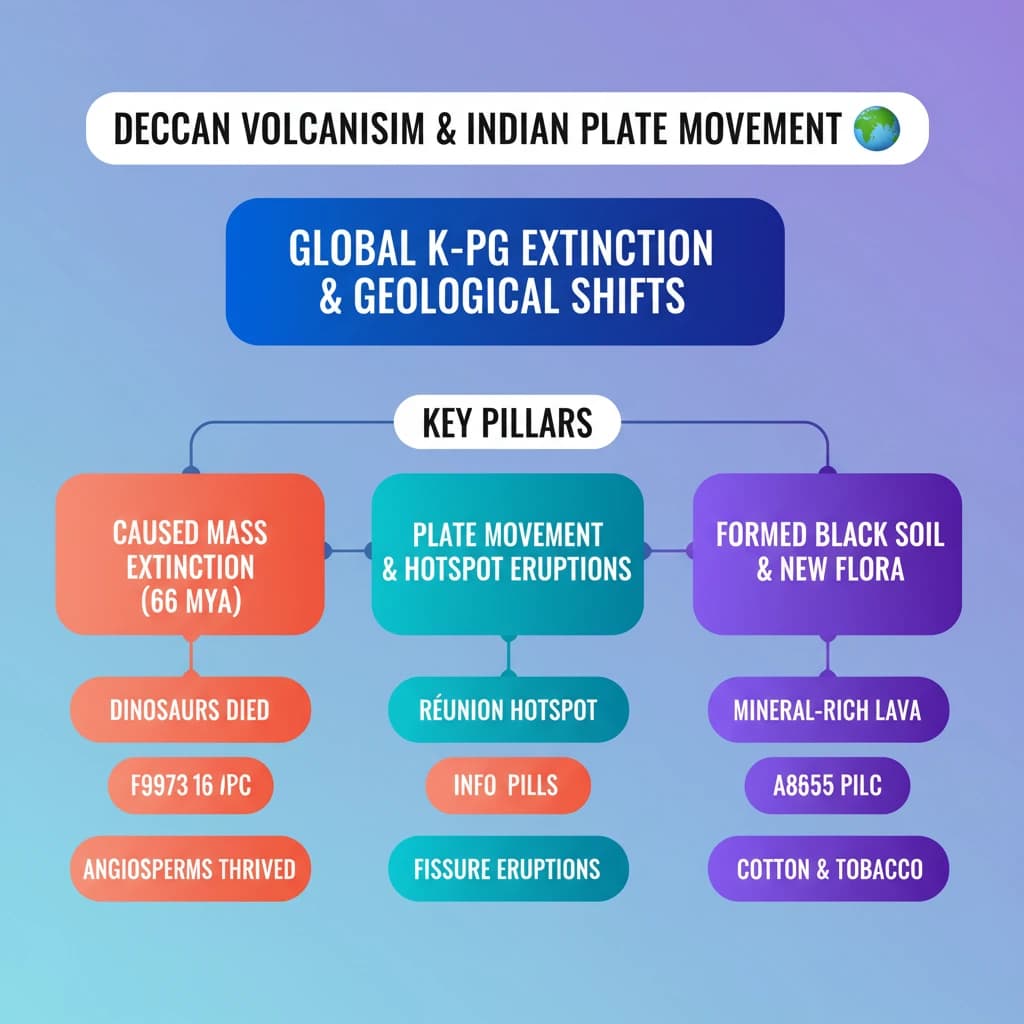
- •Deccan Volcanism caused mass extinction of fauna (dinosaurs, gymnosperms) but supported tropical flora (angiosperms).
- •It contributed to the global Cretaceous-Paleogene (K-Pg) mass extinction 66 million years ago.
- •Deccan Traps formed from fissure eruptions as the Indian Plate moved over the Réunion hotspot.
- •Black soil, rich in minerals, formed from basaltic lava, supporting cotton and tobacco agriculture.
- •The event highlights the complex interplay between geological forces, climate, and biodiversity.
🧠 Memory Techniques
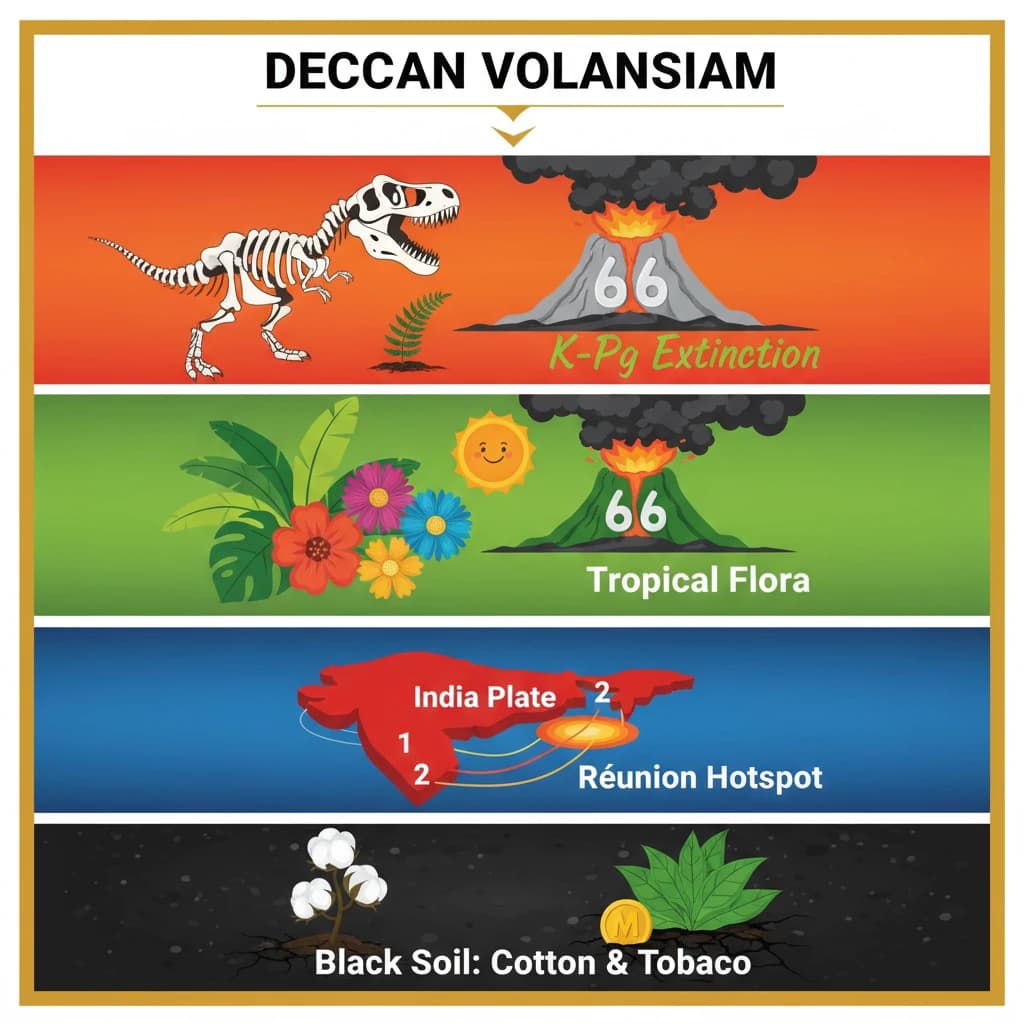
95% Verified Content