Loading page, please wait…
Vaidra Logo
Vaidra

Top 4 items + smart groups

UPSC GPT
New
Current Affairs
Daily Solutions
Daily Puzzle
Mains Evaluator

Version 2.0.0 • Built with ❤️ for UPSC aspirants

Loading...
Loading...
Loading...
Loading...
Loading...
Loading...
Loading...
Loading...
Loading...
Loading...
Loading...
Loading...
Loading...
Back
All Subjects

Topics

0 topics • 0 completed

Loading topics...
Loading...
Loading...
Loading...
Loading...
Loading...
Overall Progress0%

World’s Deepest Blue Hole - UPSC Geography

What is World’s Deepest Blue Hole in UPSC Geography?

World’s Deepest Blue Hole is a key topic under Geography for UPSC Civil Services Examination. Key points include: Taam Ja’ Blue Hole (TJBH) in Mexico is the world's deepest known blue hole, exceeding 420 mbsl.. TJBH's depth reaches the mesopelagic zone, a unique environment for marine life.. Blue holes are vital biological hotspots, hosting diverse species like corals, sharks, and sea turtles.. Understanding this topic is essential for both UPSC Prelims and Mains preparation.

Why is World’s Deepest Blue Hole important for UPSC exam?

World’s Deepest Blue Hole is a Medium-level topic in UPSC Geography. It is tested in both Prelims (factual MCQs) and Mains (analytical answer writing). Previous year UPSC questions have frequently covered aspects of World’s Deepest Blue Hole, making it essential for comprehensive IAS preparation.

How to prepare World’s Deepest Blue Hole for UPSC?

To prepare World’s Deepest Blue Hole for UPSC: (1) Study the comprehensive notes covering all key concepts on Vaidra. (2) Practice previous year questions on this topic. (3) Connect it with current affairs using daily updates. (4) Revise using key takeaways and mind maps available for Geography. (5) Write practice answers linking World’s Deepest Blue Hole to related GS Paper topics.

Key takeaways of World’s Deepest Blue Hole for UPSC

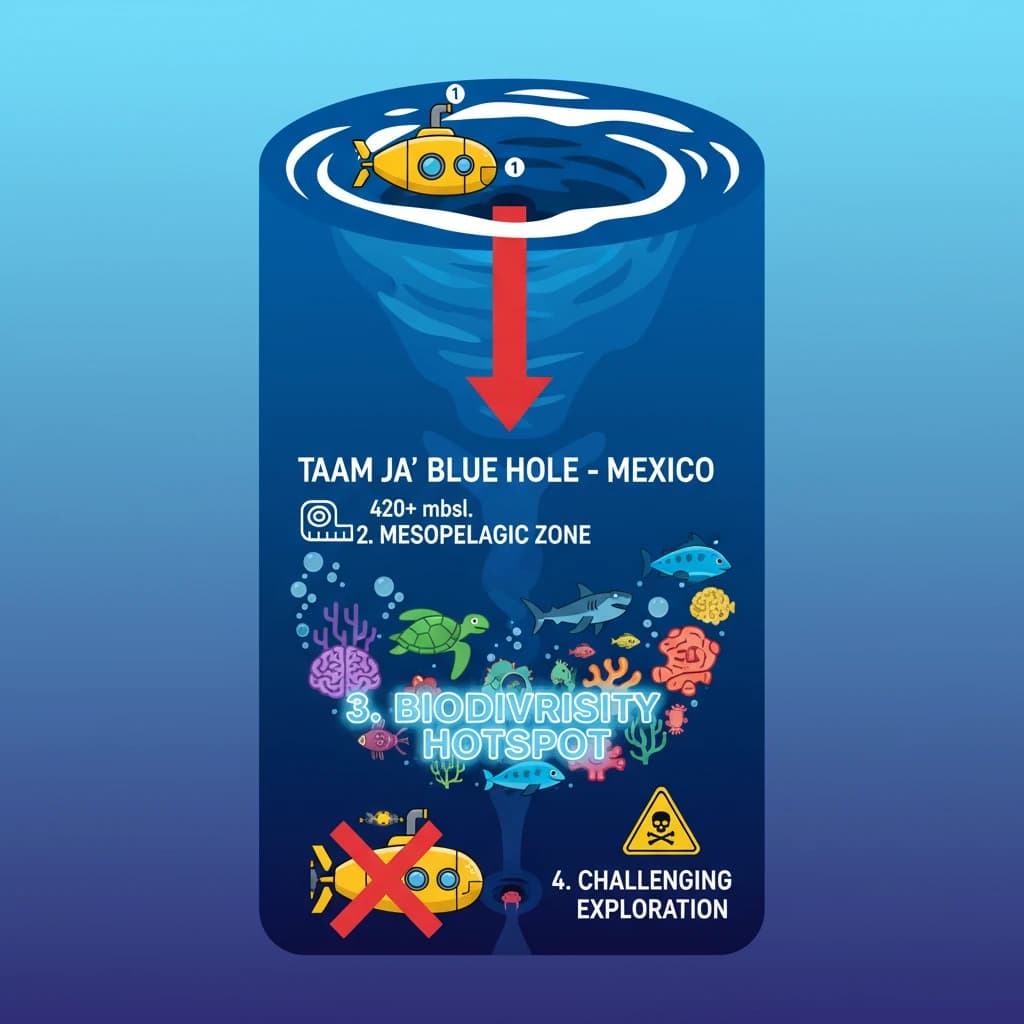
  • Taam Ja’ Blue Hole (TJBH) in Mexico is the world's deepest known blue hole, exceeding 420 mbsl.
  • TJBH's depth reaches the mesopelagic zone, a unique environment for marine life.
  • Blue holes are vital biological hotspots, hosting diverse species like corals, sharks, and sea turtles.
  • Exploration of blue holes is challenging due to small, deep openings inaccessible to many submersibles.
  • Blue holes form from cave collapse in carbonate rock, fundamentally differing from deep ocean trenches formed by tectonic subduction.
World’s Deepest Blue Hole

World’s Deepest Blue Hole

Medium⏱️ 8 min read✓ 95% Verified
geography

📖 Introduction

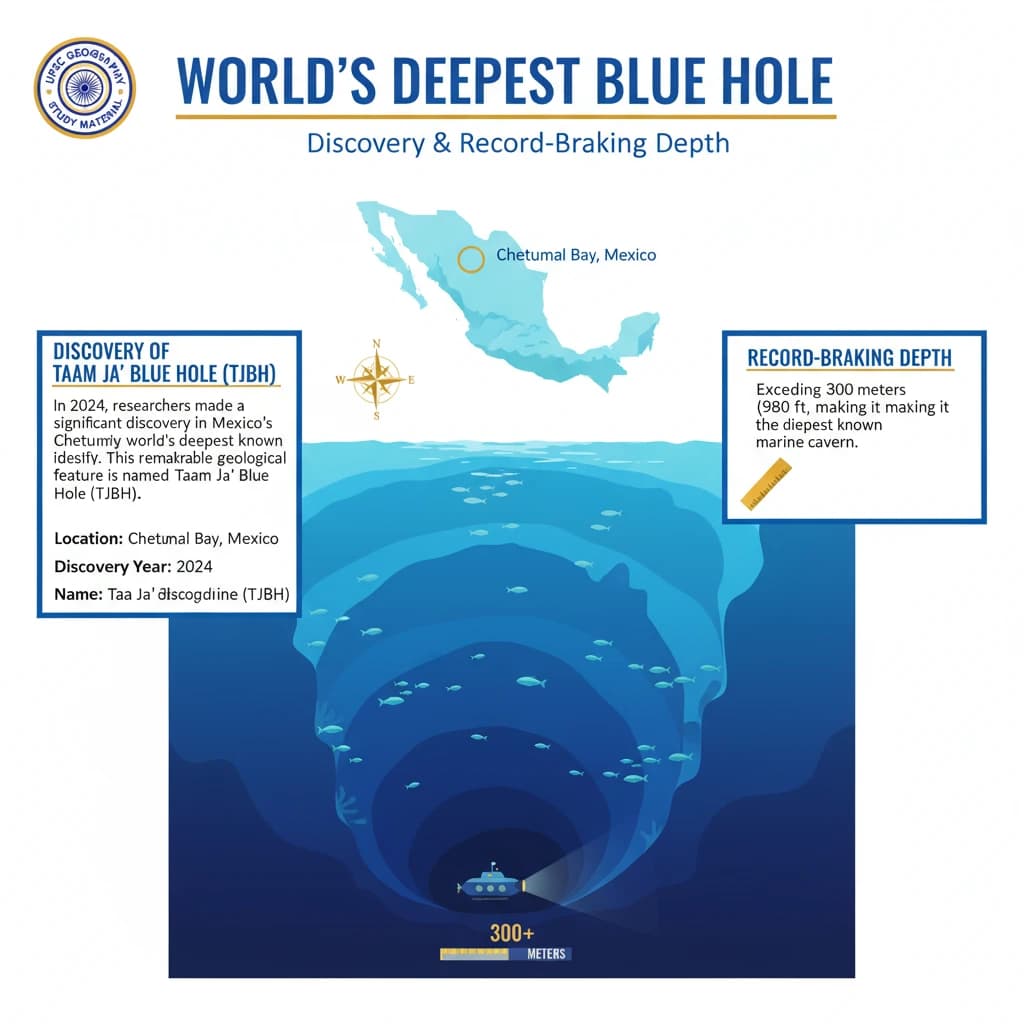
<h4>Discovery of the World's Deepest Blue Hole</h4><p>In <strong>2024</strong>, researchers made a significant discovery in <strong>Mexico's Chetumal Bay</strong>, identifying the world's deepest known blue hole. This remarkable geological feature is named <strong>Taam Ja’ Blue Hole (TJBH)</strong>.</p><div class='info-box'><p><strong>Location:</strong> Chetumal Bay, Mexico</p><p><strong>Discovery Year:</strong> 2024</p><p><strong>Name:</strong> Taam Ja’ Blue Hole (TJBH)</p></div><h4>Record-Breaking Depth and Mesopelagic Zone</h4><p>Initially, <strong>TJBH</strong> was thought to be the second deepest blue hole. However, recent and more precise measurements have revealed its true extent, confirming its status as the deepest.</p><p>The new measurements indicate that <strong>TJBH</strong> exceeds <strong>420 meters below sea level (mbsl)</strong>. This depth surpasses all previously known blue holes globally.</p><div class='key-point-box'><p>The depth of <strong>TJBH</strong> reaches into the <strong>mesopelagic zone</strong>, also known as the "twilight zone." In this zone, sunlight is significantly reduced, yet it supports a high concentration of unique marine life.</p></div><p>This makes <strong>TJBH</strong> considerably deeper than other prominent blue holes such as the <strong>Sansha Yongle Blue Hole</strong> in the <strong>South China Sea</strong> (301 mbsl) and the <strong>Dean’s Blue Hole</strong> in the <strong>Bahamas</strong> (202 mbsl).</p><h4>Ecological Significance: Biological Hotspots</h4><p>Blue holes are recognized as crucial <strong>biological hotspots</strong>. They host an incredibly diverse array of marine life, thriving in their unique environments.</p><ul><li><strong>Corals</strong></li><li><strong>Sponges</strong></li><li><strong>Molluscs</strong></li><li><strong>Sea turtles</strong></li><li><strong>Sharks</strong></li></ul><div class='key-point-box'><p>These diverse ecosystems make blue holes vital areas for <strong>marine biodiversity</strong> and scientific study, offering insights into adaptation in extreme conditions.</p></div><h4>Challenges in Exploration</h4><p>Despite their ecological importance, the exploration of blue holes remains significantly limited. This is primarily due to challenging access conditions.</p><p>Most blue holes feature relatively <strong>small openings</strong> that are located several hundred feet underwater. This structural characteristic makes them largely inaccessible for conventional automated submersibles.</p><div class='exam-tip-box'><p>Understanding the challenges of exploration can be relevant for questions on <strong>oceanography</strong> and <strong>technological limitations</strong> in deep-sea research. It highlights the vast unknown within our oceans.</p></div><h4>Blue Holes vs. Deep Trenches: A Comparison</h4><p>It is important to distinguish blue holes from deep oceanic trenches, as they differ fundamentally in their formation, location, and characteristics.</p><table class="info-table"><tr><th>Feature</th><th>Blue Holes</th><th>Deep Trenches</th></tr><tr><td><strong>Formation</strong></td><td><strong>Cave collapse</strong></td><td><strong>Subduction of tectonic plates</strong></td></tr><tr><td><strong>Location</strong></td><td><strong>Continental shelves</strong>, reefs, etc.</td><td><strong>Convergent plate boundaries</strong></td></tr><tr><td><strong>Depth</strong></td><td>Variable, from shallow to very deep (e.g., <strong>TJBH</strong> &gt;420 mbsl)</td><td>Deepest parts of the ocean (e.g., <strong>Mariana Trench</strong> &asymp; 36,000 ft / 11,000 m)</td></tr></table>
Concept Diagram

💡 Key Takeaways

  • •Taam Ja’ Blue Hole (TJBH) in Mexico is the world's deepest known blue hole, exceeding 420 mbsl.
  • •TJBH's depth reaches the mesopelagic zone, a unique environment for marine life.
  • •Blue holes are vital biological hotspots, hosting diverse species like corals, sharks, and sea turtles.
  • •Exploration of blue holes is challenging due to small, deep openings inaccessible to many submersibles.
  • •Blue holes form from cave collapse in carbonate rock, fundamentally differing from deep ocean trenches formed by tectonic subduction.

🧠 Memory Techniques
Memory Aid
95% Verified Content

Related Topics

Loading related topics...
Explore:Geography Topics·All Subjects·Daily Current Affairs·Editorial Analysis·Previous Year Questions·UPSC GPT
World’s Deepest Blue Hole - UPSC Geography